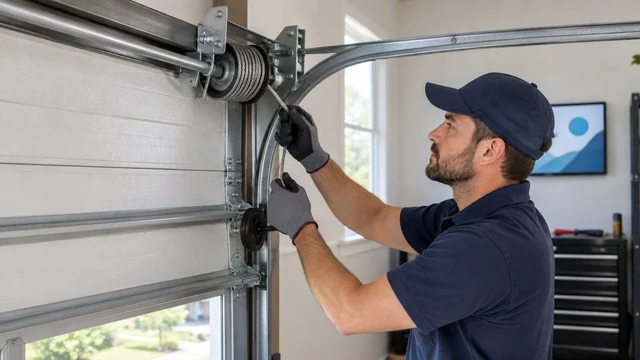
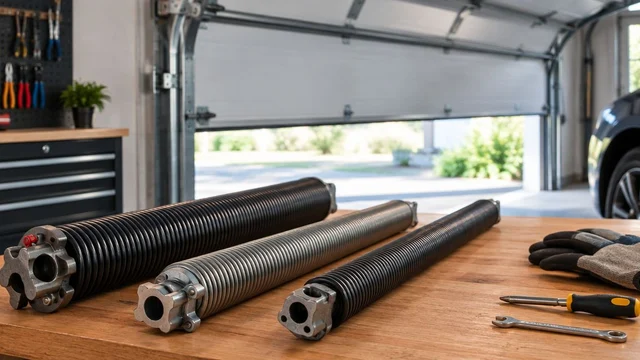
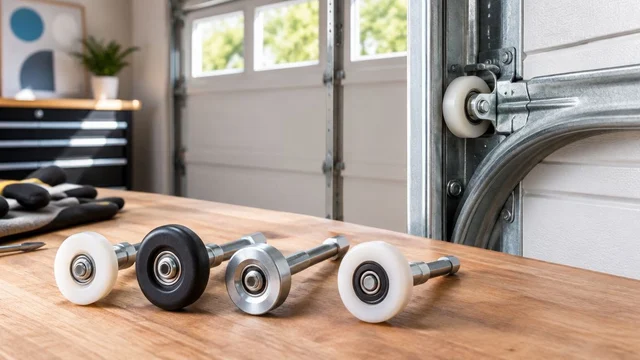
You can reuse tracks when replacing a garage door in Lexington only if the new door’s installation requirements allow it and a professional confirms the existing tracks are compatible, undamaged and correctly supported. Matching the opening size is not enough: roller fit, track geometry, clearance and the complete lifting system must also work with the new door.
TL;DR
- To reuse tracks when replacing garage door sections, verify compatibility with the new door’s installation requirements first.
- Lexington homeowners should not treat straight-looking tracks as proof that garage door replacement hardware will fit.
- Derby Strong provides garage door repair and installation for Lexington homeowners needing a professional assessment.
- Leave track, bracket, spring and cable adjustments to a garage door professional.
Can you reuse tracks with a new garage door in Lexington?
Reuse is a compatibility decision, not a visual judgment. The installer must check the existing track assembly against the requirements for the specific replacement door. If the match cannot be established, do not approve reuse simply because the old door traveled through those tracks.
Start with the opening and surrounding space. This guide to measuring a garage door opening in Lexington explains the measurements to gather before discussing replacement, but measurements alone do not establish track compatibility.
| Replacement approach | Best for | Main benefit | Main limitation |
|---|---|---|---|
| Reuse verified compatible tracks | A replacement whose installation requirements permit the existing assembly | Retains suitable components rather than replacing them automatically | Requires confirmation of fit, condition, mounting and clearance |
| Install the specified replacement tracks | A door requiring different geometry or an existing assembly that cannot be verified | Matches the track arrangement to the replacement door’s requirements | Requires removal and installation work around the opening and ceiling |
| Repair the existing door instead | A serviceable door with an isolated repairable problem | Addresses the actual fault without committing to a new door | Does not resolve unrelated deterioration or an unsuitable door design |
Ask the installer to identify the proposed approach in writing. A description that says only “new garage door” leaves an important question unanswered: which parts of the old system remain?
Why This Matters for Your Door
Tracks guide the rollers as the door moves from the opening into its overhead position. Their shape, placement and supports affect that path. A replacement door must move through the intended path without binding, interfering with surrounding surfaces or relying on the opener to overcome a mechanical fault.
The visible metal channels are only part of the decision. The curved transition, mounting brackets and overhead supports also need evaluation. Replacing the door sections does not automatically make the surrounding assembly suitable.
For a Lexington replacement planned in 2026, ask for the installation requirements for the actual door being ordered. A general assurance that “these usually fit” is not the same as checking the selected door against the existing assembly.
When keeping the existing tracks is reasonable
Keeping tracks is reasonable only when the replacement door’s requirements permit the arrangement and the inspection supports reuse. The installer needs to establish both points. Good condition cannot compensate for an incompatible track configuration.
Ask for clear answers to these questions:
- Does the replacement door’s installation documentation permit this track arrangement?
- Do the track profile and roller arrangement match the replacement door’s requirements?
- Is the curved transition appropriate for the door and available headroom?
- Are the mounting points and overhead supports suitable and secure?
- Is there damage, wear or corrosion that makes retaining the assembly inappropriate?
- Will the completed door have the required clearance throughout its travel?
Keep verified compatible tracks—not merely familiar ones. The fact that an assembly worked with the old door establishes its past use, not its suitability for a different door.
An installer should also distinguish what stays from what changes. Keeping track channels does not establish that the existing rollers, hinges, springs, cables or other hardware should remain. Each component has its own compatibility and condition questions.
When replacement tracks are the right choice
Replacement tracks are the right choice when the new door requires a different arrangement, the existing tracks are damaged, or compatibility cannot be established. Do not ask an installer to make an unsupported combination work to preserve old hardware.
Visible warning signs include a kinked channel, a distorted curve, damaged mounting points or a roller sitting outside its intended path. These observations call for professional assessment; they are not instructions to straighten, loosen or reposition anything yourself.
A change in door construction also deserves attention. Different section thicknesses, hardware arrangements or lifting configurations can change the installation requirements even when the opening remains the same size.
Replacement tracks still need correct installation. New metal alone does not establish proper alignment, adequate support or suitable clearance. Ask how the proposed assembly meets the selected door’s requirements rather than treating “all new hardware” as the entire explanation.
Why track compatibility varies
The answer changes with the door and the garage, not simply with the age of the tracks. These factors determine whether retaining the assembly makes sense:
- Door construction: Section dimensions and hardware placement affect how the door travels through the track assembly.
- Roller fit: The rollers must suit the track profile and the door’s specified hardware arrangement.
- Track geometry: The vertical run, curved transition and horizontal run must provide the intended path.
- Available clearance: Space above and beside the opening, plus room behind it, constrains the installation.
- Physical condition: Distortion, wear, corrosion and damaged connections require assessment before reuse.
- Supporting structure: Brackets and overhead supports need suitable attachment points for the proposed installation.
A change in any of these factors can alter the recommendation. That is why a door’s advertised width and height cannot answer the track question by themselves.
What should an installer check before approving reuse?
A useful assessment follows the installation requirements outward: from the selected door, to the track assembly, to the structure supporting it. It should produce a specific explanation, not just a general statement that the old parts look usable.
- Door requirements: Identify the replacement door and review its specified hardware and track arrangement.
- Track condition: Inspect the channels, curves, connections and mounting points for damage or deterioration.
- Clearance: Check the required movement path against the ceiling, opening, opener and nearby obstructions.
- Support: Assess the mounting brackets, overhead supports and their attachment points.
- Final testing: After installation, check balance, travel and the opener’s safety functions according to the applicable instructions.
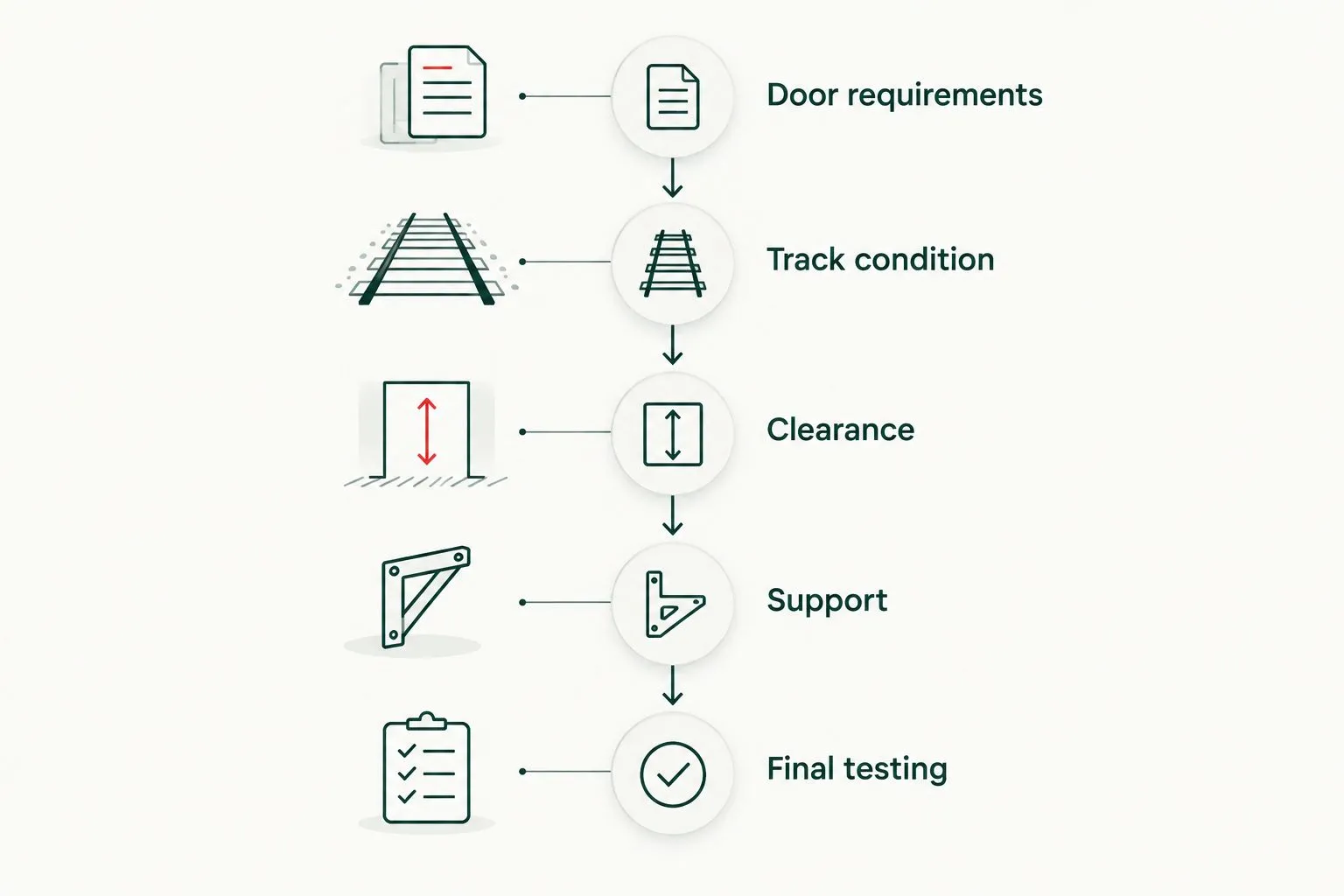
Track reuse needs a compatibility check before installation and operational checks afterward.
These are professional assessment stages, not a homeowner repair sequence. Do not loosen track fasteners, disconnect cables or adjust spring hardware to help gather information. Tell the installer what you can observe safely and leave the system assembled.
Does the same door size mean the old tracks will fit?
The same door size does not prove the tracks will fit. Opening dimensions describe the space the door closes; they do not fully describe the replacement door’s roller placement, section construction or required travel path.
Two doors serving the same opening can have different installation requirements. Even an unchanged opening needs a fresh compatibility check when the door assembly changes.
Avoid approving a replacement based solely on a description such as “same-size swap.” Ask which existing components were checked and what documentation supports retaining them. The answer should connect the proposed hardware to the specific door, not to the opening dimensions alone.
Can you reuse tracks if you keep the garage door opener?
Keeping the opener does not establish that the tracks are reusable. The opener moves a properly installed and balanced door; it does not make incompatible tracks suitable.
An opener that still runs also needs its own assessment for the replacement door. Mounting, connection to the door, travel settings and safety functions belong in that review. Track reuse and opener reuse are separate decisions that must work together in the finished installation.
Never increase opener force to push a replacement door through a binding track. Stop operation and have the underlying problem assessed. More force is not a correction for poor fit, damaged hardware or an unbalanced door.
Should you replace the door if only the track is damaged?
Track damage alone does not establish that the whole door needs replacement. A professional should assess the door sections, hardware, supporting structure and cause of the damage before recommending the scope of work.
A repairable track problem on an otherwise serviceable door deserves a repair discussion. A damaged door with incompatible or deteriorated surrounding hardware calls for a broader assessment. Neither decision should rest on a photograph of one component alone.
Describe what happened before the problem appeared. An impact, recurring rubbing or a door that suddenly hangs unevenly gives the installer useful context. Do not operate the door again to recreate the symptom for a video.
What Lexington homeowners should put in the replacement scope
A useful replacement scope explains what remains, what changes and why. This lets you compare proposed work without assuming that every installer means the same thing by “installation.”
Ask for these details before approving the job:
- The replacement door being supplied and its installation requirements.
- Whether the vertical tracks, curved sections and horizontal tracks stay or change.
- Which mounting brackets and overhead supports remain.
- Which rollers, hinges and lifting components are included in the work.
- Whether the existing opener will be evaluated for continued use.
- What final balance, movement and safety checks are included.
Ask how the installer will handle an existing component found unsuitable during the work. Agreeing on that process beforehand is clearer than making assumptions once the old door is removed.
Derby Strong garage door service is best suited to Lexington homeowners seeking professional repair or installation. For this decision, request an assessment of both the door and the existing track assembly. A service description alone cannot establish whether your particular tracks can stay.
How can you prepare without touching the hardware?
You can make the assessment easier without testing or adjusting a questionable door. Gather information from a safe position and keep the work area accessible.
Write down the symptoms you have already noticed: rubbing near a curve, uneven movement, scraping or a visible gap between a roller and its intended path. Note whether the problem appeared suddenly or developed gradually. Do not repeatedly cycle the door to confirm it.
If an identification label is readable without a ladder or reaching near moving parts, record it. Share existing paperwork or installation records if you have them. Do not assume that a label on the opener identifies the door or its tracks.
Move stored items away from the work area only when you can do so without passing beneath an unstable door. If the door is crooked, partly suspended or visibly off track, keep people and vehicles clear and arrange professional service.
Frequently Asked Questions
Can I reuse tracks when replacing a garage door in Lexington?
You can reuse tracks only when the replacement door’s installation requirements permit the existing arrangement and a professional confirms compatibility and condition. Matching the opening dimensions is not enough.
Do new garage doors always need new tracks?
New garage doors do not all have the same track requirements. The selected door’s installation instructions and the existing assembly’s condition determine whether reuse is appropriate.
Can I keep the tracks if I buy the same size garage door?
The same door size does not prove track compatibility. The installer must also check the roller arrangement, track geometry, mounting and clearance.
Can a garage door installer reuse only part of the track assembly?
Partial reuse requires the same compatibility and condition checks as full reuse. Do not assume an old vertical track and a different curved or horizontal section form an acceptable assembly.
Should I straighten a bent garage door track before an installation visit?
Do not straighten or loosen a damaged track yourself. Keep clear of an unstable door and leave track, bracket, cable and spring work to a professional.
Can I keep my opener if the replacement door needs new tracks?
Keeping the opener is a separate compatibility decision from keeping the tracks. The installer needs to assess the opener connection, operation and safety functions with the replacement door.
Will reusing garage door tracks affect my warranty?
Warranty terms depend on the specific written coverage and installation requirements. Ask for those documents and clarification about retained components before approving the work.
One Last Thing Before You Decide
The most useful question is not “Can you leave the old tracks?” Ask: “What confirms that these tracks are right for this replacement door?” That wording puts the decision where it belongs—on documented compatibility and physical condition, not on a preference for keeping or discarding parts.
Keep the written scope with the replacement door’s paperwork. A record of retained components gives a future technician better context than a receipt that says only “new door installed.”