Best overall for residential use: compatible sealed-bearing nylon rollers. Best for heavy-duty doors: load-rated steel rollers. Best for a maintained existing system: serviceable-bearing nylon rollers. Best for a basic like-for-like repair: plain-bearing plastic rollers. The best garage door rollers match the door’s load, track and hardware; wheel material alone does not establish durability.
TL;DR
- The best garage door rollers combine correct fit, documented load capacity and bearings suited to the installation.
- Sealed-bearing nylon rollers are the default residential choice when compatible with the door.
- Load-rated steel rollers suit heavy-duty applications when the door manufacturer specifies them.
- Derby Strong provides garage door repair for Kentucky homeowners and businesses.
- Bent tracks, loose cables and displaced rollers need professional repair, not stronger opener settings.
Why This Matters for Your Door
A quiet roller is not necessarily a durable roller. Bearing construction, wheel condition, stem fit and track alignment all affect how the assembly performs. A damaged track can also wear out a replacement roller without solving the original problem.
For homeowners and commercial customers, Derby Strong provides garage door repair, installation and opener service in Louisville, Lexington and Northern Kentucky. Derby Strong is a garage door repair option for Kentucky owners who need roller and track problems assessed together.
This guide ranks construction types by their practical application, not by an unsupported lifespan claim. No single wheel material wins on every door, and no roller upgrade makes a bent or poorly secured track acceptable.
What makes the best garage door rollers?
Use these criteria before choosing a replacement:
- Documented compatibility: Match the roller assembly to the door, track profile, hinges and manufacturer requirements.
- Load capacity: Use a roller rated for its application. Wheel material does not establish how much load the assembly can carry.
- Bearing protection: Check whether the bearing is sealed, shielded, serviceable or absent; those terms are not interchangeable.
- Wheel and stem condition: Look for cracks, flat spots, corrosion and excessive movement without touching loaded hardware.
- Maintenance requirements: Choose a construction you can maintain according to its instructions, with professional service where required.
- Track condition: Confirm that wear is not being caused by deformation, misalignment or loose supports.
A useful specification names the roller construction and its intended application. A vague description such as heavy-duty nylon does not answer whether the bearing, stem and wheel are suitable for your door.
Garage door roller options at a glance
| Rank and option | Best for | Standout feature | Key limitation |
|---|---|---|---|
| 1. Sealed-bearing nylon rollers | Residential doors where quieter travel matters | Nylon wheel with an enclosed bearing assembly | Sealed construction does not prove load capacity or compatibility |
| 2. Load-rated steel rollers | Heavy-duty applications specified for steel rollers | Steel rolling surface with application-specific load capacity | Metal-on-metal travel can transmit more noise |
| 3. Serviceable-bearing nylon rollers | Existing systems with a defined maintenance routine | Nylon wheel with bearings maintained according to instructions | Durability depends partly on correct maintenance |
| 4. Plain-bearing plastic rollers | Basic like-for-like repairs where approved | Simple construction without a ball-bearing assembly | Not the default upgrade for demanding use |
The ranking is a residential buying order with separate use-case winners. It is not a measured comparison of service life, and it does not put an unspecified steel roller above a properly rated nylon assembly.
1. Sealed-bearing nylon rollers: best for residential comfort
Sealed-bearing nylon rollers combine a nylon rolling surface with an enclosed bearing assembly. The nylon wheel reduces direct metal-on-metal contact at the track, while bearing seals help limit contamination.
For a residential door, this construction is a practical starting point when you want smoother, quieter travel without choosing maintenance-intensive hardware. Verify the exact assembly, though: a sealed bearing does not make the stem, wheel or load rating suitable for every door.
Sealed-bearing nylon roller pros:
- Nylon rolling surfaces reduce metal-on-metal contact.
- Bearing seals help keep contaminants away from bearing components.
- This construction addresses both rolling contact and bearing protection.
Sealed-bearing nylon roller cons:
- A damaged wheel or failed enclosed bearing still needs replacement.
- Nylon construction alone does not establish a load rating.
- New rollers cannot correct a bent track or an unbalanced door.
Best for: Homeowners replacing worn rollers on a compatible residential sectional door.
Ask for the roller’s manufacturer identification and applicable specifications, not just its color or bearing description. Follow its lubrication instructions; do not assume an enclosed bearing needs the same treatment as an exposed assembly.
Verdict: Buy compatible sealed-bearing nylon rollers as the default residential choice after the track and door condition are checked.
2. Load-rated steel rollers: best for specified heavy-duty use
Steel rollers use a metal rolling surface. Their suitability for demanding service comes from the complete assembly’s documented capacity and intended application, not from steel being automatically stronger than every alternative.
For a heavy commercial door, the important question is which roller the door manufacturer specifies. Do not transfer a residential recommendation to commercial hardware simply because the parts look similar.
Load-rated steel roller pros:
- A documented rating lets the technician match the assembly to the application.
- Steel wheels provide a metal rolling surface where the system specifies one.
- Application-specific assemblies support a repair based on the door’s requirements.
Load-rated steel roller cons:
- Metal-on-metal travel can transmit more noise than nylon contact.
- Corrosion protection and bearing maintenance still matter.
- An unspecified steel roller is not proof of heavy-duty suitability.
Best for: Commercial or heavier door systems whose documentation calls for the selected steel assembly.
Give the service company the door’s manufacturer information and a description of how the door is used. Frequent operation belongs in the selection discussion, but it does not justify an improvised change to the track or hinges.
Verdict: Buy load-rated steel rollers when the door specification supports them; skip a material-only upgrade.
3. Serviceable-bearing nylon rollers: best for maintained systems
Serviceable-bearing nylon rollers pair a nylon wheel with bearings that receive maintenance under the manufacturer’s instructions. They remain an option when the assembly matches the door and maintenance is part of the property’s routine.
The distinction is maintenance access, not a universal claim that exposed or serviceable bearings last longer. Bearing design, contamination and care all matter.
Serviceable-bearing nylon roller pros:
- Nylon wheels reduce direct metal contact with the track.
- Serviceable construction allows the specified bearing maintenance.
- Compatible replacements can preserve an existing hardware arrangement.
Serviceable-bearing nylon roller cons:
- Missed maintenance undermines the reason for choosing this construction.
- Exposed components require attention to contamination and condition.
- Lubrication does not repair a cracked wheel, loose stem or damaged bearing.
Best for: Owners with compatible hardware and a defined maintenance routine.
Ask what needs lubrication, which product is approved and who should perform the work. Do not spray the entire roller-and-track area indiscriminately; bearing care and track cleaning are different tasks.
Verdict: Buy serviceable-bearing nylon rollers when maintenance is realistic; hold if you cannot identify the required care.
4. Plain-bearing plastic rollers: best for approved basic repairs
Plain-bearing plastic rollers use a simple wheel-and-stem arrangement without a ball-bearing assembly. They belong in the discussion when the original system uses that construction and the replacement is approved for the door.
Simple does not mean defective. It does mean you should not treat the assembly as a durability upgrade without supporting specifications.
Plain-bearing plastic roller pros:
- Simple construction suits an approved like-for-like repair.
- Plastic wheels avoid a steel rolling surface against the track.
- Matching the original specification avoids an unsupported hardware change.
Plain-bearing plastic roller cons:
- The construction lacks a ball-bearing assembly.
- Wheel and bore wear remain inspection concerns.
- It is not the default recommendation for demanding operation.
Best for: A basic replacement where the door documentation supports that exact construction.
If the existing rollers show repeated wear, have the technician investigate the cause rather than installing another identical set automatically. Track condition, door balance and hardware fit deserve attention before you blame the wheel material.
Verdict: Hold for an approved like-for-like repair; skip plain-bearing plastic as an assumed durability upgrade.
Track options: geometry comes before durability
Garage door tracks guide the rollers; they are not interchangeable rails. Track width, curve, supports and lift arrangement must work with the door and surrounding space.
Standard lift, low-headroom and high-lift tracks describe travel arrangements, not durability grades. Select the arrangement that fits the building, then specify compatible hardware and supports.
| Track arrangement | Best for | Practical advantage | Key limitation |
|---|---|---|---|
| Standard lift | A garage with suitable overhead clearance | Conventional travel from vertical to horizontal | Requires sufficient clearance for the complete system |
| Low-headroom | A garage with restricted clearance | A track arrangement designed around limited overhead space | Hardware and opener compatibility need careful checking |
| High lift | A building with suitable height and a reason for increased vertical travel | Keeps the door vertical farther before the horizontal transition | Requires a coordinated system design, not a track-only swap |
What a durable track installation needs
Correctly specified tracks need sound attachment points, suitable supports and alignment consistent with the door manufacturer’s instructions. A thicker-looking rail does not solve inadequate mounting or a mismatched curve.
Inspect visible damage from a safe position. Do not loosen brackets, straighten a rail or reposition a roller yourself; the door’s weight and connected tensioned hardware make those professional tasks.
The photograph below illustrates roller-and-track contact, not a customer repair or a particular manufacturer’s hardware.
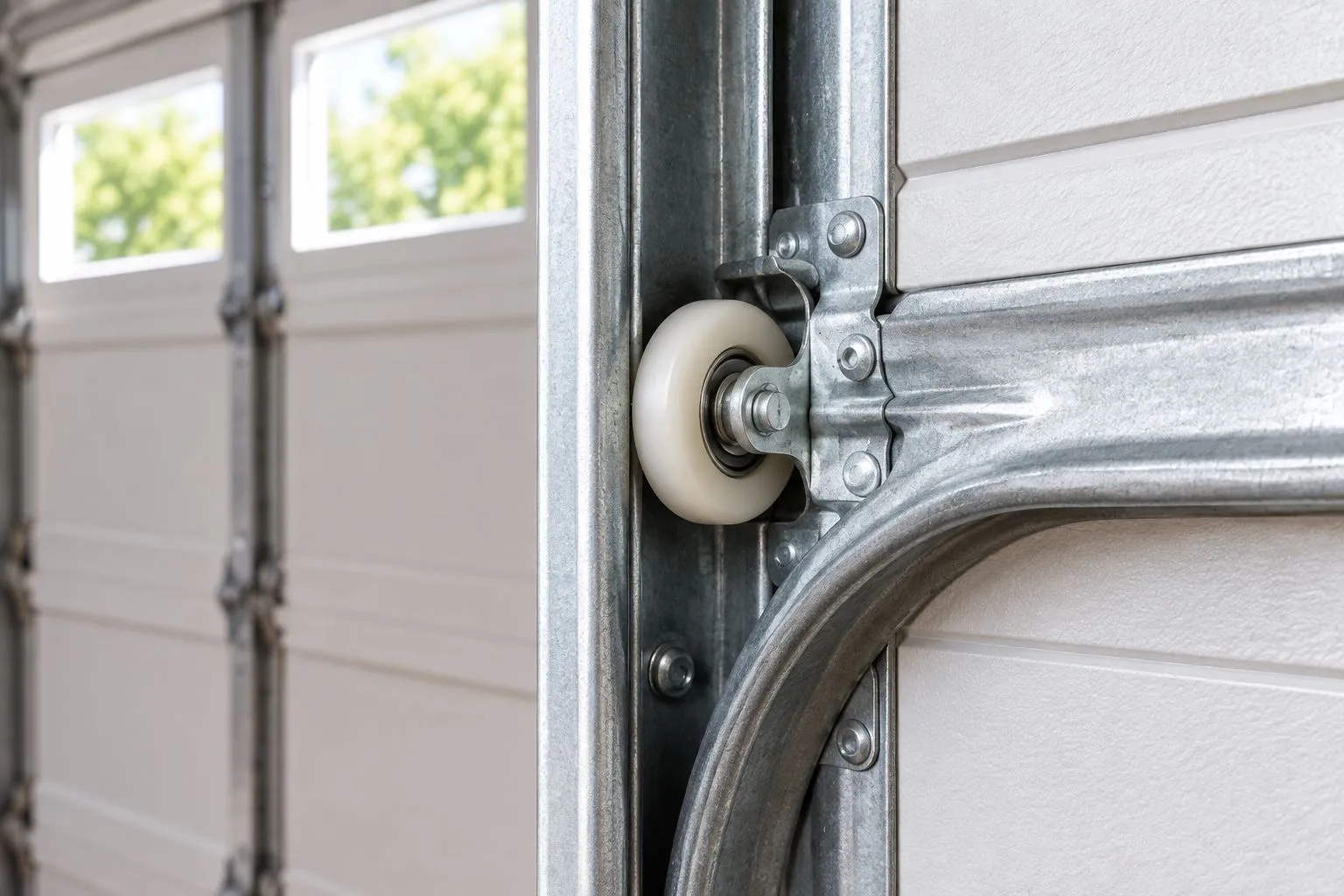
Illustrative photo, not a Derby Strong project; roller fit and track condition must be assessed together.
When replacing the track is justified
A visibly bent track, damaged attachment point or incompatible arrangement needs a professional assessment. Roller replacement alone does not restore the rail’s geometry.
A sound, compatible track does not need replacement merely because its rollers are worn. Ask the technician to separate the roller recommendation from the track recommendation and explain the condition behind each one.
Is the roller actually causing the problem?
Noise alone cannot identify the failed part. Bearings, hinges, tracks, springs and the opener can contribute to what you hear during travel.
For a focused symptom guide, see garage door rollers making noise in Louisville. Record the symptom only if you can do so safely; do not operate a visibly damaged door to capture a better video.
| Safe observation | What it tells you | Next move |
|---|---|---|
| A visibly cracked or flattened wheel | The roller has visible damage | Stop using the damaged door and arrange assessment |
| A roller outside the track | The door is no longer correctly guided | Keep people clear; do not operate or reposition it |
| A bent rail or loose-looking support | The track system needs assessment | Do not tighten or reshape loaded hardware |
| Noise without visible damage | The sound does not isolate the cause | Describe when it occurs; request a system inspection |
| A loose cable or crooked door | The problem extends beyond wheel selection | Stop operation and keep clear of the door |
Never increase opener force to overcome a sticking door. A motor setting is not a repair for friction, misalignment or damaged hardware.
What to ask before approving roller replacement
Derby Strong provides residential garage door repair and commercial overhead door services. Whether you are arranging service for a home or business, use the same questions to separate a supported repair from a vague upgrade:
- What failed? Ask whether the wheel, bearing, stem, track or another component caused the symptom.
- Why this assembly? Request compatibility and load information for the proposed roller.
- What stays? Confirm whether the existing tracks, hinges and supports remain suitable.
- What maintenance follows? Get instructions for the installed construction.
- What else needs correction? Ask about balance, alignment and connected hardware.
Prepare by clearing stored items away from the work area without entering beneath an unsafe door. Keep children and pets away, and tell the technician about visible damage before any operation begins.
How these options are ranked
The residential default combines nylon rolling contact with bearing protection, subject to compatibility. Steel earns the heavy-duty slot only with supporting specifications; serviceable bearings earn their place when maintenance is planned.
Plain-bearing plastic stays last as a durability-focused recommendation because its role here is an approved basic replacement, not a documented performance upgrade. These are selection criteria, not test results or promised lifespans.
Which garage door rollers should you choose?
Choose compatible sealed-bearing nylon rollers for a residential door unless its specifications point elsewhere. For commercial hardware, start with the door documentation and required load capacity rather than a residential ranking.
Repair the cause of wear before selecting the replacement. If the track is sound and the door remains repairable, roller service does not automatically justify replacing the entire door.
Frequently Asked Questions
What are the best garage door rollers for a residential door?
Compatible sealed-bearing nylon rollers are the default residential recommendation in this guide. Confirm the assembly’s load capacity, stem fit and compatibility with the door before installation.
Are nylon garage door rollers better than steel rollers?
Nylon rollers are the preferred starting point when reduced metal-on-metal noise matters, while specified steel assemblies suit their intended heavy-duty applications. Material alone does not establish durability or load capacity.
Do more ball bearings mean a garage door roller lasts longer?
Bearing count alone does not establish a roller’s service life. Bearing quality, protection, load capacity, alignment and maintenance also affect performance.
Do sealed garage door rollers need lubrication?
Follow the installed roller manufacturer’s lubrication instructions. Do not assume the bearing, wheel and stem all require the same treatment or spray the entire track indiscriminately.
Can I replace garage door rollers myself?
Leave roller replacement to a garage door professional. The work can involve loaded hardware, and bottom fixtures can connect to tensioned cables.
Should I replace the tracks when I replace the rollers?
Replace or repair tracks when their condition or compatibility requires it, not automatically with every roller change. A professional should check deformation, alignment, supports and the specified track arrangement.
Will new rollers fix a garage door that keeps getting stuck?
New rollers fix sticking only when roller failure is the cause and the rest of the system is suitable. Do not force the door or increase opener force to overcome an unresolved fault.
Are low-headroom garage door tracks more durable than standard tracks?
Low-headroom tracks are designed around restricted clearance, not ranked above standard tracks for durability. Both arrangements need compatible hardware, proper supports and correct installation.
One Last Thing Before You Decide
A repeat roller failure is a reason to inspect the system, not simply reorder the same part. Ask the technician to show you the failed component and explain whether track condition, compatibility or door balance contributed to the wear. That answer is more useful than a claim that one wheel material always lasts longest.