Movement and alignment
Track, rollers, wheels, hinges, guides, posts, stops, frames, and operator attachments are checked under movement.
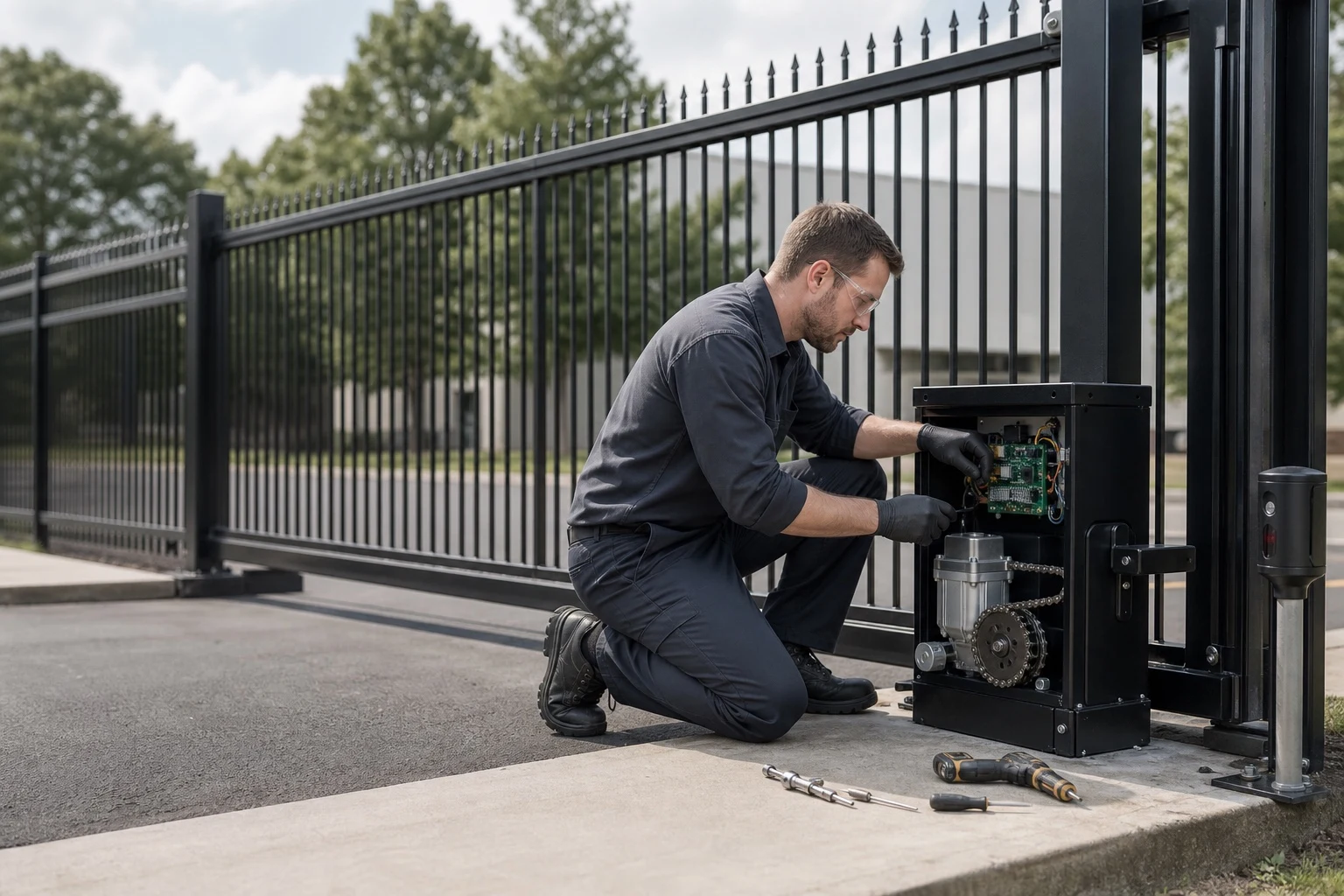
Gate repair across Louisville, Lexington and Northern Kentucky for automatic, electric, driveway and commercial gates. We trace the whole entrance, from track, hinges and alignment to operators, access controls and safety devices, before replacing parts.
Gate repair across Louisville, Lexington and Northern Kentucky for automatic, driveway and commercial gates, operators and access controls.




Diagnosis before parts
A gate that will not open may have a failed operator. It may also be binding on its track, sitting on a damaged hinge, holding a safety fault, missing an access command, or running on weak batteries. Replacing controls without correcting resistance or alignment often creates the same failure again.
Derby Strong gate repair follows the command from the remote, keypad, reader, or loop through the controls and operator to the moving gate. Mechanical condition, power, safety devices, and access behavior are checked before the repair path is explained.
Track, rollers, wheels, hinges, guides, posts, stops, frames, and operator attachments are checked under movement.
Control boards, limits, drive components, batteries, charging, wiring, and output are tested against the symptom.
Remotes, keypads, readers, loops, photo eyes, sensing edges, timers, and emergency inputs are verified separately.
Symptoms we fix
Do not force a heavy or damaged gate. Note the position, sounds, control-board message, recent impact or outage, and what happened immediately before movement stopped.

Power loss, manual release, access commands, limits, binding, safety faults, and operator output are separated during testing.
Operator and control systems
Track, rollers, cantilever hardware, hinges, guides, frame alignment, stops, posts, and drive connections are checked before powered operation resumes.
Compare gate installation
Bent frames, shifted posts, fence transitions, operator mounts, loops, photo eyes, and opening geometry are documented together.
Commercial gate supportCommonly failed parts
Parts are replaced only after the failed function and the condition that caused it are understood.
Rollers, wheels, track, guides, hinges, pivots, stops, posts, latches, and frame connections.
Chain, belts, racks, sprockets, arms, couplers, gearboxes, hydraulic lines, cylinders, and mounts.
Control boards, relays, limit switches, encoders, timers, receivers, programming, and field wiring.
Disconnects, transformers, supplies, batteries, chargers, grounding, surge-damaged parts, and solar equipment.
Monitored photo eyes, sensing edges, loop detectors, vehicle probes, warning devices, guards, and inputs.
Remotes, keypads, card or fob readers, intercom relays, vehicle tags, exit inputs, locks, and schedules.
Eight common failure patterns
The inspection reproduces the problem safely and checks the relevant mechanical, electrical, control, and protection systems.
Power, access commands, limits, seized hardware, a disconnected drive, or active protection can create a no-movement fault.
Photo eyes, edges, loops, binding, limits, or intermittent wiring may interrupt the close cycle.
Track, rollers, wheels, trolleys, hinges, guides, posts, stops, and frame alignment are checked together.
Impact can shift foundations and geometry while damaging operator mounts, loops, devices, and adjacent fencing.
The fault may be supply power, a disconnect, transformer, wiring, surge damage, charging, or batteries.
Credentials, receivers, relays, schedules, field wiring, and access-device power are tested separately.
Worn drive parts, poor alignment, binding, low power, hydraulics, or incorrect operator sizing may be involved.
Loops, monitored photo eyes, sensing edges, wiring, alignment, and operator inputs are verified without bypassing protection.
Repair or replace
The recommendation compares safe movement, frame and post condition, operator age, parts support, recurring faults, duty-cycle fit, and related damage.
A localized failure is often repairable when the gate is straight, supported, aligned, and compatible parts remain available.
Often repairable if the gate is straight and parts exist.
Impact work may replace track, frame sections, posts, operator mounts, loops, or fence transitions without replacing the entrance.
Replace damaged track, frame or posts, not the whole entrance.
Usable gate construction may receive a supported operator, monitored protection, backup power, or updated access equipment.
Keep the gate; update the operator, protection or access.
Severe structural damage, poor geometry, unsupported equipment, repeated failures, or inadequate capacity may justify replacement.
Severe damage or repeated failures may justify replacement.
Commercial gates can follow a written schedule for movement, hardware, operator, battery, access, and safety-device inspection.
Commercial gates can follow a written inspection schedule.
Gate repair visit
Gate position, access impact, fault history, recent weather or impact, equipment, and whether the entrance can be secured are recorded.
Record gate position, access impact and fault history.
When safe, the frame, posts, track, rollers, hinges, guides, drive attachment, stops, and resistance are checked.
Check frame, posts, track, rollers and hinges when safe.
Supply, batteries, limits, board status, safety devices, loops, commands, wiring, and operator output are tested.
Test power, batteries, limits, safety devices and wiring.
Approved work is completed, protection and access commands are tested, repeated cycles are observed, and condition notes are explained.
Finish approved work, test protection and cycle the gate.
Kentucky gate repair coverage
Use the local page for the direct market phone, service-area context, and the best starting point for a blocked or unreliable entrance.
Driveway, multifamily, parking, warehouse, service-yard, and commercial entrance support.
Alignment, operator, access control, impact, and safety-device diagnosis across Lexington.
Residential and commercial gate repair throughout Northern Kentucky.
Customer reviews
Before you request service
Confirm the property has power, check whether a breaker or disconnect is visibly off, look for an obvious obstruction, and note any operator display code. Try another authorized remote or credential if available. Do not reach into the operator, bypass protection, force the gate, or use manual release unless you know the correct safe procedure.
Response depends on location, schedule, system type, access, and condition. If a commercial request involves a blocked lane, unsecured perimeter, trapped vehicles, or a safety concern, say so clearly. The team can then evaluate the available emergency or after-hours path.
Many common slide, swing, barrier, and specialty operators can be diagnosed. Repair depends on safe access, equipment condition, parts support, wiring documentation, and compatibility. Unsupported or severely damaged equipment may require modernization.
That depends on the frame, posts, foundations, track or hinges, operator mount, drive connection, safety devices, and fence transitions. Localized impact can often be rebuilt in sections; distorted geometry or widespread structural damage may make replacement safer.
The close cycle is commonly held by a photo eye, sensing edge, vehicle loop, timer, access input, limit, control fault, or binding detected under load. Do not bypass the device. Record indicator lights or fault messages and request diagnosis.
Frequency depends on cycles, gate weight and length, environment, vehicle traffic, security importance, and manufacturer guidance. High-cycle or access-critical properties benefit from a written maintenance schedule with movement, hardware, operator, battery, control, and safety-device testing.
Request gate repair
Share whether the gate is stuck open or closed, the operator brand, any fault message, and any recent outage or impact. Note access-device behavior and unusual sounds, and send photos of the opening, hardware, and controls.