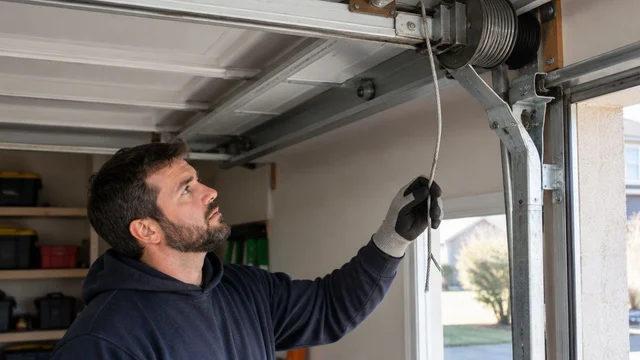
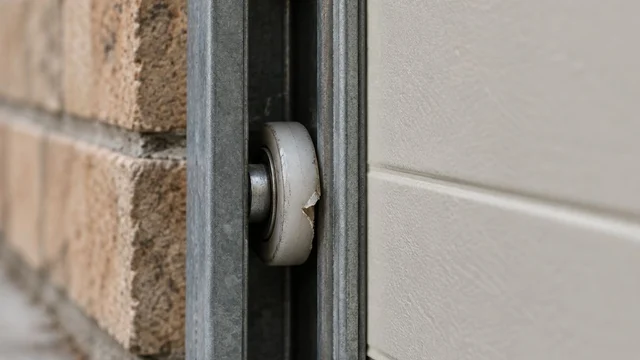
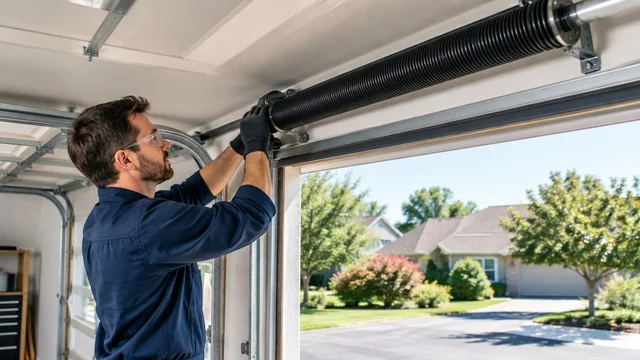
No—an off-track garage door in Northern Kentucky is not safe to move with the opener or by hand. Stop using it, keep people and vehicles away, and arrange professional garage door repair. A crooked door, displaced roller or loose cable needs inspection before anyone attempts to lower, lift or straighten it.
TL;DR
- Off track garage door safety in Northern Kentucky starts with stopping all movement, not testing the opener again.
- A crooked panel, displaced roller or loose cable requires professional inspection; do not push the door back into place.
- Leave the emergency release alone when the door is off-track, hanging unevenly or partly open.
- Derby Strong provides garage door repair for Northern Kentucky homeowners and businesses.
Is an off-track garage door safe to move in Northern Kentucky?
Do not move an off-track garage door, even if it still responds to the opener. Movement does not prove that the rollers, tracks, cables and supports can carry the door correctly. Another opener cycle can worsen the damage or move an already unstable section.
For Northern Kentucky homeowners and businesses, Derby Strong provides professional garage door repair. The immediate job is to secure the area and have the mechanical fault assessed—not to get one more opening or closing cycle out of the door.
| What you can see without approaching the door | What it means for safety | Your next move |
|---|---|---|
| A roller visibly outside its track | The door is not guided correctly at that point | Stop using the door and request repair |
| One side hanging lower than the other | The door is uneven; the cause needs inspection | Keep clear and leave the door where it is |
| A cable hanging loose or visibly displaced | The lifting system needs professional assessment | Do not touch the cable or release the opener |
| A bent track beside a damaged section | Both the guide and door section need inspection | Do not straighten the track yourself |
| Scraping or jerking without a visible derailment | The symptom does not establish the cause | Stop operation rather than cycling it to diagnose it |
These observations help describe the problem. They do not establish that the door is stable, and they are not instructions for getting close enough to inspect its hardware.
Why this matters: the opener is not a safety test
A garage door opener moves a door that should already travel correctly through its tracks. It does not correct a derailed roller, restore a displaced cable or support every damaged section independently. Increasing opener force to overcome a fault is not a repair.
A partially open door creates a particular access problem: the opening looks usable while the door remains overhead. Do not walk, drive or crawl beneath an off-track door. Use a different entrance and keep the garage opening out of use.
Northern Kentucky commercial customers also need to stop routine traffic through the affected opening. Tell employees, delivery drivers and anyone using the building that the door is out of service. Do not let someone operate it because they did not hear the initial warning.
What can you safely do before a technician arrives?
Your role is to stop further use, protect access to the area and report what happened. You do not need to identify the failed part before requesting service. Follow these steps without touching the door or entering its possible fall path.
- Stop operation. Do not press the wall button, remote or keypad again. Do not use an app to test whether the door still moves.
- Keep the opening clear. Move people and pets away. Leave a vehicle where it is if retrieving it would require passing beneath or beside the unstable door.
- Prevent accidental use. Tell everyone with access to the controls that the door must stay out of service. Keep portable remotes away from anyone who might try them.
- Observe from a safe position. Describe the door’s position and anything already visible, such as a crooked bottom edge or a roller outside the track. Do not approach hidden hardware to complete your description.
- Arrange professional repair. Explain whether the door is closed, partly open or overhead, and whether it blocks the property’s usual entrance.
If you can take a photograph without approaching the door, use a wide view that shows its position. Do not stand under the opening, climb a ladder or reach around a panel to get a better picture.
A useful service report is plain: the door stopped crooked, a roller appears outside the track, and no one has moved it since. Report an impact or unusual noise if it happened. Avoid calling it a broken spring or failed cable unless that fault has been professionally confirmed.
What does an off-track door look like?
A roller outside the metal channel is a clear sign that the door is no longer following its intended path. A tilted bottom edge, uneven panel joints or a section pulling away from one side can also indicate a mechanical problem. These signs justify stopping use, even when the exact cause remains unknown.
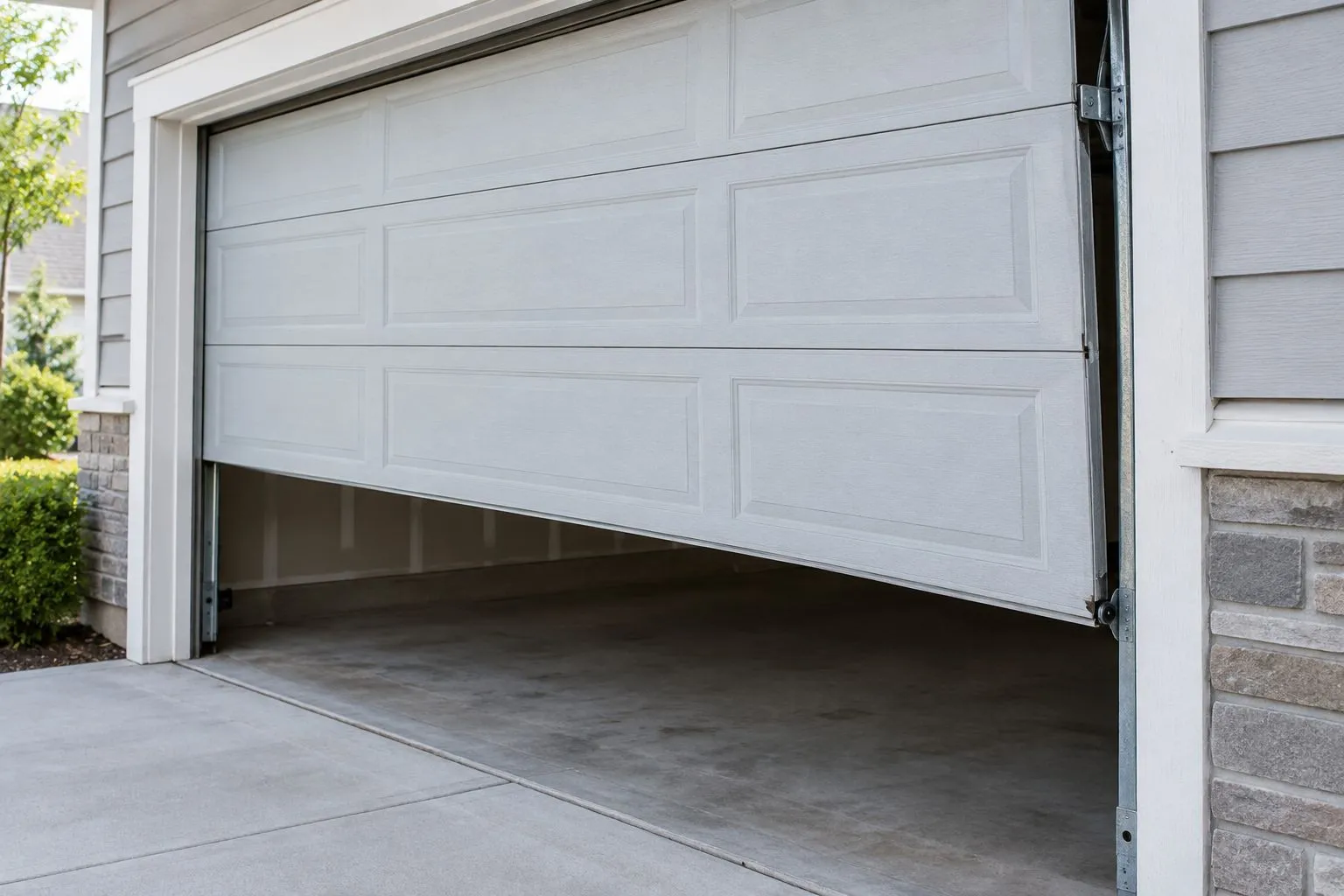
Illustrative photo—not a Derby Strong project. A crooked door needs inspection before anyone attempts movement.
Noise alone is less specific. Scraping, banging or jerking can accompany several faults, so do not repeatedly cycle the door to distinguish them. A technician needs to assess the door’s alignment, lifting components and supporting hardware together.
A door that looks straight from the driveway is not automatically safe, either. If it has just struck an object, dropped unevenly or stopped after a loud mechanical noise, leave it unused until the problem is assessed. Appearance is one observation, not clearance to operate.
Why the safe response depends on the door’s position
The instruction stays the same—do not move the door—but its position changes how you manage access. Keep the following distinctions in mind when describing the job and protecting the area.
- Fully closed: Leave it closed. Do not lift it manually to see whether the opener is the problem.
- Partly open: Keep the entire opening out of use. Do not lower the door by hand or pass beneath it.
- Overhead: Keep people, vehicles and stored equipment away from the opening and the area beneath the door.
- Hanging unevenly: Do not push the low side upward, pull the high side down or try to equalize the panels.
- After an impact: Report what was struck and what changed. Do not assume the visible dent is the only damage.
A closed door can still have damaged lifting components. An open door can have a displaced roller that is not obvious from your position. Neither situation calls for a homeowner balance test, emergency-release test or trial movement.
Should you pull the emergency release?
Do not pull the emergency release on an off-track or unevenly supported garage door. Disconnecting the opener does not repair the lifting system or put rollers back into their tracks. With a mechanical fault present, releasing the opener can allow unexpected movement.
This boundary applies whether you want to free a trapped car, close the garage for the night or determine whether the motor is working. The release is not a diagnostic shortcut for a damaged door.
If someone is injured or trapped, contact emergency services and keep other people away. Do not enter beneath the door or improvise a rescue by releasing, lifting or pulling its components. Describe the unstable door when requesting help.
Can you close an off-track garage door for security?
Do not force an off-track garage door closed for security. A damaged door needs controlled professional handling, not an improvised push, pull or opener adjustment. The security problem does not make the mechanical hazard smaller.
Use another entrance and secure accessible interior doors without approaching the damaged opening. Do not attach a tarp, board or temporary barrier to the door, tracks or lifting hardware. Do not stack objects beneath the door as supports.
When requesting service, explain that the garage is open and identify any access concern, such as an interior doorway into the home or an active commercial entrance. That information helps communicate the problem without promising an arrival time or assuming the door can immediately be closed.
Which repairs belong to a professional?
Repositioning rollers, adjusting tracks, handling cables and working on springs or supporting brackets are professional-only tasks. These components affect how the door is guided, supported and lifted. Loosening the wrong fastener or moving a loaded component can change the door’s position unexpectedly.
Do not bend a track with pliers, hammer a roller back into its channel or loosen a bracket to create clearance. Do not cut, unwind or reattach a cable. Keep hands away from panel joints and any gap that can close if the door shifts.
The opener also needs a clear boundary: do not increase its force setting to move a binding door. Do not bypass a safety device or hold a control to force movement. Mechanical resistance requires investigation rather than a stronger push from the motor.
Safe preparation means clearing access from outside the hazard area, not preparing the hardware for repair. Leave tools, ladders and improvised supports out of the job. The technician needs to assess the existing condition before deciding how to stabilize and correct it.
Does an off-track door need repair or replacement?
An off-track garage door does not automatically need replacement. The decision depends on the condition of the door sections, tracks, rollers, lifting system and supporting structure. A professional inspection should explain both the fault and the reason for the proposed work.
| Approach | Best for | Benefit | Limitation |
|---|---|---|---|
| Repair | A correctable fault with otherwise serviceable components | Addresses the problem without replacing sound parts unnecessarily | Repositioning alone is insufficient if damaged components remain |
| Replacement | Damage that makes the existing door unsuitable for continued service | Replaces the affected door rather than retaining compromised sections | A new door does not remove the need to assess tracks, supports and opener suitability |
Ask what caused the derailment and what needs correction before normal operation resumes. The answer should distinguish the immediate symptom from underlying damage. A roller returned to its track is not a complete explanation if the track, cable or door section remains faulty.
For an impact-damaged door, ask which components can remain in service and which cannot. For a door that became crooked without an obvious impact, ask how the lifting and guiding systems were assessed. Choose the scope of work based on the findings, not the assumption that every derailment means a new door.
What should Northern Kentucky customers tell the repair provider?
Start with the door’s current position and whether anyone has tried to move it since the fault appeared. State whether the property is a home or business and give the actual service address. Do not rely on a nearby city name alone to communicate the location.
Explain any access constraints: a vehicle behind the door, a blocked entrance or business traffic that normally uses the opening. Report visible damage from a safe distance. Mention an impact, sudden drop or loud noise without guessing which part failed.
Derby Strong provides garage door repair for Northern Kentucky homeowners and businesses. Request a mechanical assessment before asking to resume operation. For a commercial opening, also describe how the door is used so the repair discussion addresses the actual access problem.
Request off-track door repair
Describe the door’s position, visible damage and access problem before any further operation.
Frequently Asked Questions
Is an off-track garage door safe to move in Northern Kentucky?
No—do not move an off-track garage door with the opener or by hand. Keep the opening out of use and arrange professional inspection before attempting movement.
Can I push a garage door roller back into its track?
No—repositioning a roller on an off-track door is professional-only work. The door also needs assessment for track, cable, section and support damage before operation resumes.
Should I pull the emergency release if my garage door is crooked?
No—leave the emergency release alone when the door is crooked, off-track or unevenly supported. Disconnecting the opener does not correct the fault and can allow unexpected movement.
Can I drive under an off-track garage door to get my car out?
No—do not drive, walk or crawl beneath an off-track garage door. Leave the vehicle in place if retrieving it requires entering the unstable opening.
Does an off-track garage door always need replacement?
No—an off-track door does not automatically need replacement. The condition of the sections, tracks, lifting components and supports determines whether repair is appropriate.
What should I do if my off-track garage door is stuck open?
Leave the door where it is and keep the opening clear. Use another entrance, secure accessible interior doors without approaching the damaged door, and explain the open-garage concern when requesting repair.
Does Derby Strong provide garage door repair in Northern Kentucky?
Yes—Derby Strong provides garage door repair for Northern Kentucky homeowners and businesses. Describe the door’s position, visible damage and access constraints when requesting service.
One Last Thing Before You Decide
A door that returns to a straight position has not necessarily had its fault corrected. Before using it again, ask what caused the derailment, what was repaired and whether normal operation has been checked. The useful outcome is a door cleared for operation—not simply a door that looks straight.