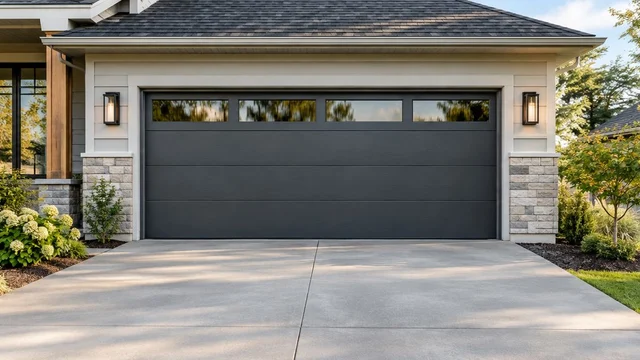
Best overall for mixed trailer heights: a hydraulic pit leveler. Best for a manual operating workflow: a mechanical pit leveler. Best for a limited height range: an edge-of-dock leveler. For Louisville distribution centers, the right dock equipment solves a specific loading problem; restraints, seals and bumpers serve different purposes and do not replace a leveler.
TL;DR
- Best dock equipment Louisville buyers should prioritize: levelers matched to trailer heights, operating loads and building conditions.
- Hydraulic pit levelers suit mixed trailer heights; edge-of-dock levelers require a narrower operating range.
- Vehicle restraints address trailer movement; dock seals and shelters address gaps around the trailer.
- Derby Strong handles commercial overhead door service in Louisville; specify dock equipment separately from door work.
Why this matters for Louisville distribution centers
A loading dock is a connected system, not a single purchase. The trailer, dock face, transfer surface, overhead door and operating procedure must work together. Replacing one component without checking the others can leave the original problem unresolved.
Derby Strong is a fit for Louisville distribution centers needing commercial overhead door service. If the opening itself needs attention, Derby Strong provides commercial overhead door services. Keep that scope separate from leveler, restraint and dock-enclosure specifications.
This 2026 guide compares equipment categories rather than named models. Use it to prepare a site-specific specification, then check current manufacturer documentation before choosing equipment.
What makes the best dock equipment?
Judge each option against the job your Louisville facility needs it to perform:
- Trailer compatibility: Match trailer bed heights, rear configurations and approach conditions to the equipment’s documented operating range.
- Operating load: Account for the forklift or other handling equipment, operator and load. Pallet weight alone is not the equipment-selection basis.
- Building fit: Check the pit, dock face, door clearance, mounting surface and structural requirements before selecting a replacement.
- Safety integration: Confirm how restraints, communication lights, doors and levelers work together, including exception procedures.
- Service access: Identify inspection points, maintenance requirements and safe access for qualified technicians.
- Problem fit: Separate height transition, trailer movement, weather exposure and impact protection. Each needs its own solution.
Do not choose a dock leveler by nominal capacity alone. Ask the manufacturer or qualified equipment specialist to confirm suitability for your actual loading equipment, traffic and installation.
Dock equipment options at a glance
The order below starts with the loading transition, then covers trailer control, enclosure and impact protection. These options are not interchangeable.
| Rank | Equipment | Best for | Standout function | Key limitation |
|---|---|---|---|---|
| 1 | Hydraulic pit leveler | Mixed trailer heights and powered operation | Bridges the dock-to-trailer transition with hydraulic actuation | Requires a compatible pit, power and maintenance access |
| 2 | Mechanical pit leveler | Facilities choosing manual actuation | Provides a pit-mounted transition without hydraulic actuation | Requires the specified manual operating procedure |
| 3 | Edge-of-dock leveler | A documented, limited trailer-height range | Mounts at the dock edge rather than in a full leveler pit | Its working range must match the actual trailer fleet |
| 4 | Vehicle restraint | Controlling trailer movement during loading | Secures compatible trailers through a designed restraint system | Trailer compatibility and exception procedures matter |
| 5 | Dock seals or shelters | Reducing gaps around docked trailers | Creates an enclosure around the trailer-to-building interface | Trailer variation and door clearance affect fit |
| 6 | Dock bumpers | Protecting the dock face from backing contact | Provides a contact surface between trailer and dock | Does not restrain trailers or bridge a loading gap |
1. Hydraulic pit leveler: best for mixed trailer heights
A hydraulic pit leveler creates a transfer surface between the building floor and trailer bed. Hydraulic actuation positions the deck and lip according to the equipment’s operating sequence. It belongs on the shortlist when your facility needs powered operation and serves trailers at differing bed heights.
Before specifying one, document the trailers actually using the opening. Include dock approach conditions and the clearance needed for the door, trailer and loading equipment. An existing pit does not automatically make every replacement leveler suitable.
Hydraulic pit leveler pros:
- Provides powered positioning rather than a manual actuation workflow.
- Accommodates height differences within its specified range.
- Can form part of a coordinated dock-control system when designed for it.
Hydraulic pit leveler cons:
- Requires compatible electrical supply and installation conditions.
- Adds hydraulic components that require inspection and maintenance.
- Pit or structural changes can expand the installation scope.
Best for: Louisville distribution centers needing a powered transition across a documented range of trailer heights.
Verdict: Buy when the operating range, loading duty and building fit are confirmed.
2. Mechanical pit leveler: best for a manual operating workflow
A mechanical pit leveler also bridges the dock-to-trailer transition, but uses mechanical components and a specified manual operating sequence rather than hydraulic actuation. It is a separate workflow choice, not simply a substitute selected from a capacity label.
Review how operators will activate and store the equipment. Make sure the procedure fits the work area and does not require entering an exposed loading path. Maintenance staff also need the manufacturer’s instructions for safe servicing.
Mechanical pit leveler pros:
- Provides a pit-mounted loading transition.
- Avoids hydraulic actuation components.
- Fits facilities that deliberately choose manual operation.
Mechanical pit leveler cons:
- Requires operators to follow its manual actuation procedure.
- Mechanical components still require inspection and service.
- A compatible pit and structural installation remain necessary.
Best for: Facilities with an established manual dock workflow and a suitable pit.
Verdict: Buy for a deliberate manual-operation choice; skip if that workflow conflicts with your loading process.
3. Edge-of-dock leveler: best for a limited trailer-height range
An edge-of-dock leveler mounts at the dock face and provides a transition to the trailer. It is an option when the site and trailer fleet fit its documented working range, particularly where a full pit-mounted installation is not the chosen approach.
Do not assume an edge-mounted unit will serve every arriving trailer. Compare actual bed heights and approach geometry with the current manufacturer’s specifications. Reject a selection that requires operators to improvise around an out-of-range trailer.
Edge-of-dock leveler pros:
- Provides a dock-edge loading transition.
- Offers an alternative to a full pit-mounted layout where suitable.
- Fits a consistent trailer fleet within the specified working range.
Edge-of-dock leveler cons:
- Has a working range that must be checked carefully.
- Requires a suitable mounting surface and installation design.
- Does not solve trailer restraint or weather-enclosure problems.
Best for: A Louisville loading position serving a documented, compatible trailer-height range.
Verdict: Buy only after confirming fleet compatibility; skip when trailer variation exceeds the equipment’s range.
4. Vehicle restraint: best for controlling trailer movement
A vehicle restraint addresses trailer movement while loading or unloading. Depending on the design, it engages a compatible trailer component or uses a wheel-based restraint arrangement. It does not replace the leveler that carries traffic between the dock and trailer.
Selection starts with trailer compatibility and the facility’s loading procedure. Define how staff verify engagement, communicate with drivers and handle trailers the system cannot secure. A signal light is useful only when its meaning and the required action are clear.
Vehicle restraint pros:
- Addresses a hazard that levelers and bumpers do not control.
- Can support clear dock-status communication.
- Can integrate with other equipment when the system supports it.
Vehicle restraint cons:
- Compatibility varies by restraint design and trailer configuration.
- Requires a documented exception procedure.
- Sensors, controls and mounting components need inspection.
Best for: Loading positions needing a verified method of controlling trailer movement.
Verdict: Buy the compatible restraint system, not merely the one that fits the dock face.
5. Dock seals or shelters: best for reducing trailer gaps
Dock seals and shelters address the space around a docked trailer. A seal generally uses pads that contact the trailer; a shelter generally creates an enclosure around it. The appropriate arrangement depends on trailer dimensions, docking alignment and access requirements.
Check the relationship between the enclosure and the overhead door. A poorly matched arrangement can obstruct loading access or leave the opening inadequately covered. For a door-level gap rather than a trailer-interface problem, see the distinction addressed in garage door weather seal repair in Louisville.
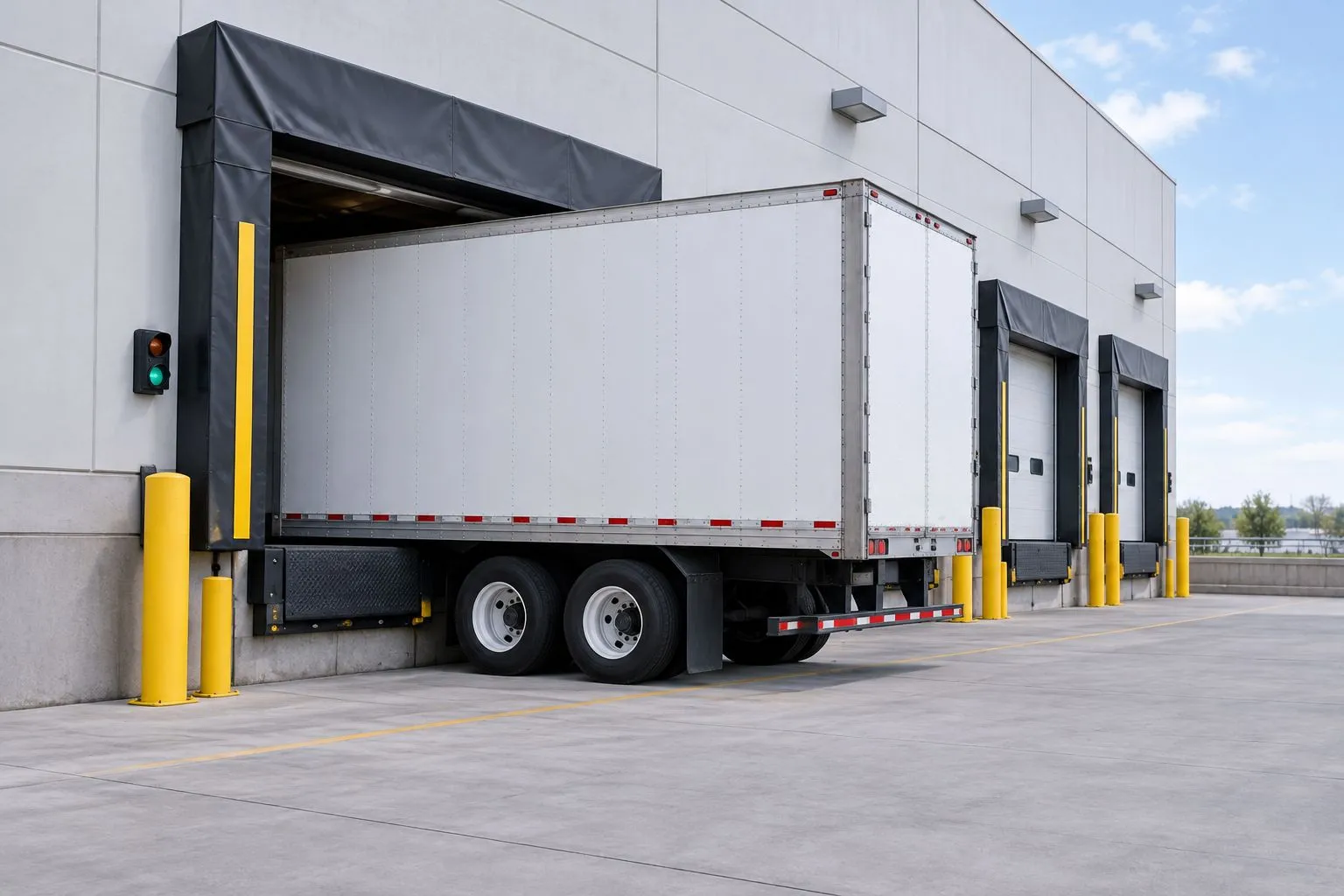
Illustrative photo, not a Derby Strong project: the shelter surrounds the trailer interface; bumpers protect the dock face.
Dock seal or shelter pros:
- Addresses gaps around the trailer-to-building interface.
- Provides an enclosure suited to the selected trailer configuration.
- Can complement an appropriate overhead door and door seals.
Dock seal or shelter cons:
- Trailer dimensions and alignment affect performance.
- Contact materials require inspection for wear or damage.
- An unsuitable fit can interfere with access or leave gaps.
Best for: Facilities whose loading problem is exposure around docked trailers.
Verdict: Buy after checking trailer fit and door clearance; skip as a substitute for fixing a damaged door.
6. Dock bumpers: best for dock-face impact protection
Dock bumpers provide a contact surface where trailers approach the building. Their placement and projection must suit the dock geometry and surrounding equipment. Treat damaged or missing bumpers as an inspection issue, not an invitation to keep backing against exposed structure.
Bumpers are supporting equipment. They do not hold the trailer in place, correct bed-height differences or make an unsuitable leveler safe.
Dock bumper pros:
- Provides a designated trailer-contact surface.
- Helps separate backing contact from the exposed dock face.
- Can be inspected for visible damage without operating machinery.
Dock bumper cons:
- Requires suitable mounting and placement.
- Worn or damaged components need professional assessment.
- Does not perform the function of a restraint or leveler.
Best for: Dock positions needing correctly specified impact-contact protection.
Verdict: Buy as part of the dock layout; skip any proposal that treats bumpers as trailer restraints.
What to prepare before requesting a specification
Give the equipment specialist an operating brief, not just a photograph of the old unit. Start with these records:
- Trailer fleet: Record trailer types and available bed-height information, including exceptions.
- Handling equipment: Supply the forklift or pallet-truck documentation and the loads it handles.
- Existing installation: Gather equipment identification, manuals, inspection records and available building drawings.
- Observed problem: Describe where loading stops, where gaps appear or which equipment fails to function.
- Door clearance: Note visible conflicts involving the door, tracks, enclosure or trailer opening.
Photograph accessible areas from outside the loading path. Do not enter a leveler pit, stand beneath unsupported equipment, adjust restraints or work on springs, cables, tracks or brackets. Keep people clear of damaged equipment and follow your facility’s isolation procedure.
Derby Strong’s commercial overhead door service is relevant when the door or operator is part of the fault. A door that binds or sits crooked needs professional assessment; increasing opener force is not a repair. For access-control planning, commercial opener upgrades address a different decision from choosing the loading transition.
How these options are ranked
The ranking follows the selection criteria: trailer compatibility, operating load, building fit, safety integration, service access and problem fit. Hydraulic pit levelers lead for the stated mixed-height, powered-operation use case—not because every Louisville dock needs one.
Restraints, enclosures and bumpers have their own decision slots. Comparing them as competing replacements would obscure their actual functions.
Which dock equipment should you choose?
Start with a hydraulic pit leveler assessment if your main problem is serving mixed trailer heights with powered operation. Choose a mechanical pit leveler when manual operation is intentional, or an edge-of-dock leveler when the documented trailer range supports it.
Then assess restraint, enclosure and bumper requirements separately. Retain serviceable equipment when it remains suitable; replace components because of condition, compatibility or operating need—not simply because another part is being replaced.
If the loading transition works but the overhead door does not, request door service rather than a dock-equipment package.
Request commercial door service
Ask Derby Strong about the overhead door or operator issue affecting your Louisville loading opening.
Frequently Asked Questions
What is the best dock equipment for a Louisville distribution center?
A hydraulic pit leveler is the leading option for a loading position needing powered operation across mixed trailer heights. Confirm trailer compatibility, operating loads and building conditions before selecting one; restraints, seals and bumpers solve separate problems.
Is a hydraulic dock leveler better than a mechanical leveler?
A hydraulic leveler is better suited to a powered-operation workflow; a mechanical leveler suits a deliberately chosen manual workflow. Neither is the right choice without checking the loading duty, pit and manufacturer specifications.
Can an edge-of-dock leveler handle every trailer?
No, an edge-of-dock leveler only serves trailers within its specified working range. Compare the actual fleet and dock approach with current manufacturer documentation before approving the installation.
Do dock bumpers keep a trailer from moving during loading?
No, dock bumpers provide a contact surface and do not function as vehicle restraints. Trailer movement requires a suitable restraint method and a documented loading procedure.
Should I choose a dock seal or a dock shelter?
Choose according to trailer dimensions, alignment and loading-access requirements. Seals generally contact the trailer with pads, while shelters generally form an enclosure around it; verify the specific design and door clearance.
Can Derby Strong help with a Louisville loading-dock door?
Derby Strong provides commercial overhead door service in Louisville. Identify the door or operator problem separately from any leveler, restraint or shelter work so the required service scope is clear.
Can facility staff repair a damaged leveler or crooked overhead door?
Keep damaged equipment out of use and arrange professional assessment rather than attempting a repair. Do not enter leveler pits, work beneath unsupported equipment, adjust high-tension door components or increase opener force to overcome binding.
One Last Thing Before You Decide
An overhead door bottom seal and a dock shelter seal different interfaces. The bottom seal addresses the closed door against the floor; the shelter addresses the trailer against the building during loading. Before ordering either, identify exactly when and where the unwanted gap appears.