Best overall for backyard privacy: wood. Best for privacy without repainting: vinyl. Best for a visible, enclosed boundary: chain link. The best fence options for Kentucky properties depend on what you need to block, contain or leave visible—not just which material looks best from the road.
TL;DR
- Best fence options Kentucky: wood wins for adaptable backyard privacy; vinyl suits owners who want no repainting.
- Aluminum suits decorative boundaries; chain link suits visible enclosures; steel suits rigid perimeter designs.
- Split rail marks an open boundary but needs additional infill when containment matters.
- Derby Strong provides fence and gate services for Kentucky homeowners and businesses.
Why This Matters for Your Door
A privacy fence, a dog enclosure and a business perimeter solve different problems. Choose the wrong layout and you can end up with blocked sightlines, an inconvenient gate or openings that do not contain your pet.
Choose the fence’s job before its material. Start with privacy, containment, appearance or controlled access, then check the property constraints that affect installation.
Derby Strong provides fence and gate services for homeowners and businesses in Louisville, Lexington and Northern Kentucky. Derby Strong is a fit for Kentucky homeowners and businesses seeking fence and gate services.
What makes the best fence for your property?
Use these five criteria to compare designs, not just material samples:
- Privacy: Decide whether you need a solid screen, partial screening or an open view. Material alone does not determine visibility.
- Containment: Match openings, ground clearance and gate latches to the children or animals using the space. A decorative boundary is not automatically a containment fence.
- Upkeep: Compare cleaning, finish care and repair access. No fence is maintenance-free.
- Site fit: Account for slopes, drainage, property boundaries, buried utilities and access for equipment.
- Gate access: Plan pedestrian entry, mower access and vehicle access before choosing the fence layout.
For a Kentucky property, verify requirements with the authority responsible for that address. Louisville, Lexington and Northern Kentucky are distinct markets; do not treat approval in one location as permission in another.
Best fence options at a glance
The six options below occupy different use-case slots. Wood leads for adaptable privacy, not because every property needs a wood fence.
| Fence option | Best for | Standout feature | Key limitation |
|---|---|---|---|
| Wood privacy | Adaptable backyard screening | Board layouts can control sightlines | Wood needs condition checks and finish care |
| Vinyl privacy | Privacy without repainting | Solid panels without a painted finish | Damaged sections need compatible replacement parts |
| Aluminum ornamental | Decorative boundaries with open views | Open pickets and corrosion-resistant material | Does not provide solid privacy |
| Chain link | Visible pet and utility enclosures | Mesh maintains visibility through the boundary | Does not provide visual screening on its own |
| Steel ornamental | Rigid residential or commercial perimeters | Strong, open metal construction | Exposed steel needs corrosion protection |
| Split rail | Open, informal property boundaries | Rails mark space without a solid screen | Wide openings do not provide reliable containment |
1. Wood privacy: best fence for adaptable backyard screening
A wood privacy fence uses boards to screen a yard, patio or neighboring activity. Board spacing and layout determine how much you can see through it; the word “privacy” does not guarantee a completely closed view from every angle.
Best for: Homeowners who want adaptable screening and accept ongoing wood care.
Wood works well when appearance and sightlines need careful control. Ask to see the proposed board arrangement, particularly where a sloped yard changes the relationship between the fence and the ground.
Wood privacy pros:
- Board arrangements offer different levels of screening.
- Individual boards can be replaceable when the supporting structure remains sound.
- The material supports a natural appearance alongside planting and outdoor living areas.
Wood privacy cons:
- Moisture exposure can contribute to decay, movement and splitting.
- Finish care and condition checks remain part of ownership.
Do not judge the fence by boards alone. Posts, connections and gate construction matter because a straight-looking panel can still have a weak support system.
Verdict: Buy wood privacy fencing when adaptable screening matters more than avoiding finish upkeep.
2. Vinyl privacy: best fence for privacy without repainting
Vinyl privacy fencing uses manufactured panels or interlocking components to form a screen. It suits owners who want a solid boundary without maintaining a painted wood finish.
Best for: Homeowners who prioritize screening and do not want repainting as a routine task.
Ask how the proposed system handles the slope and how damaged components are replaced. A clean appearance is useful, but replacement compatibility matters after installation.
Vinyl privacy pros:
- Does not require repainting to maintain the vinyl surface.
- Solid-panel designs provide visual screening.
- The material does not develop wood rot.
Vinyl privacy cons:
- Impacts can crack or damage components.
- Replacement sections must match the installed system.
Vinyl still needs cleaning and inspection. Check gates, connections and posts rather than assuming that a material without wood rot cannot develop other problems.
Verdict: Buy vinyl privacy fencing when you want a solid screen without a painted finish; skip it if easy custom alterations are essential.
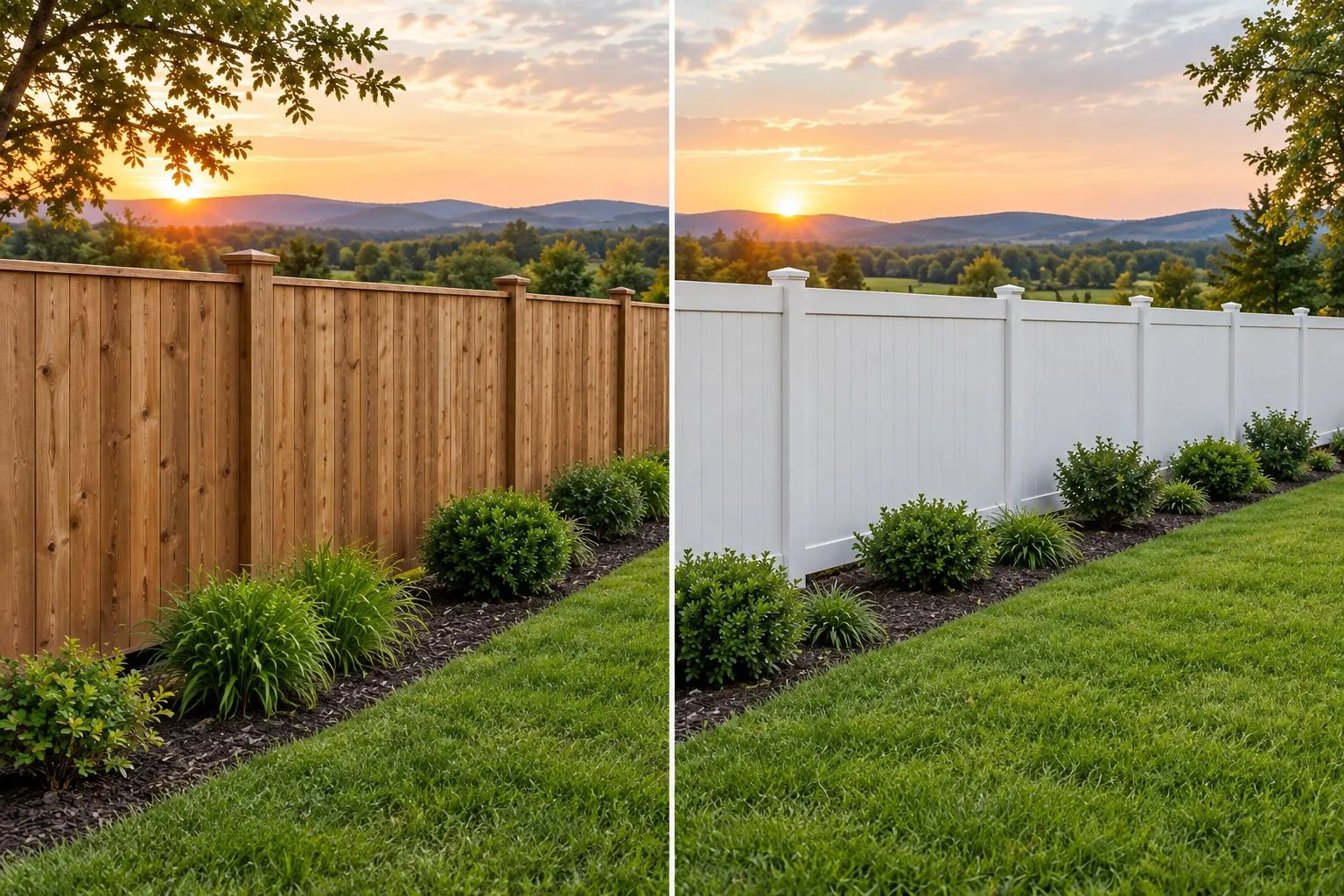
Illustrative photo: wood and vinyl both provide screening, but their upkeep and repair needs differ.
3. Aluminum ornamental: best fence for decorative boundaries
Aluminum ornamental fencing uses open pickets rather than a solid screen. It defines a yard while keeping landscaping and views visible.
Best for: Homeowners who want a decorative boundary without closing off the view.
Aluminum resists rust, but that does not make every fence design equally strong or suitable for containment. Review picket spacing, bottom clearance and gate operation for the actual household using the yard.
Aluminum ornamental pros:
- Open pickets preserve visibility.
- Aluminum does not rust like exposed steel.
- Decorative layouts define a boundary without a solid wall of material.
Aluminum ornamental cons:
- Open designs do not provide backyard privacy.
- Members can bend under impact.
If you have a small dog, check the proposed openings rather than relying on the material name. For a pool enclosure, require a design that meets the applicable barrier requirements; an ornamental appearance is not proof of compliance.
Verdict: Buy aluminum ornamental fencing for an open decorative boundary; skip it when screening is the main goal.
4. Chain link: best fence for visible pet and utility enclosures
Chain link uses woven wire mesh to enclose an area without creating a solid visual barrier. It fits yards and work areas where seeing through the fence is useful.
Best for: Pet owners and property managers who need containment with clear visibility.
Containment depends on more than the mesh. The bottom edge, gate gaps, latch and any digging behavior need attention in the design.
Chain link pros:
- Mesh keeps the enclosed area visible.
- It separates spaces without a solid screen.
- Damaged mesh can be repairable when posts and framework remain sound.
Chain link cons:
- Standard mesh does not provide visual privacy.
- Climbing or digging animals need additional design consideration.
Privacy inserts change the fence’s exposure to wind. Have the supporting design reviewed before adding screening to an existing open fence rather than treating inserts as a purely decorative upgrade.
Verdict: Buy chain link for visible containment; skip it if your main problem is an exposed patio or overlooked backyard.
5. Steel ornamental: best fence for a rigid perimeter
Steel ornamental fencing provides an open boundary using steel posts, rails and pickets. It suits residential and business properties where a rigid perimeter and controlled entry are priorities.
Best for: Owners who want a rigid open fence paired with deliberately planned access.
The material is not a complete security system. Gate hardware, openings, connections and the surrounding site determine how the perimeter functions.
Steel ornamental pros:
- Steel supports rigid fence construction.
- Open designs preserve sightlines around entrances.
- Fence and gate layouts can be coordinated around access needs.
Steel ornamental cons:
- Damaged protective finishes can expose steel to corrosion.
- Open pickets do not provide solid privacy.
Ask how coating damage and replacement components will be handled. For powered gates, leave installation, adjustment and safety-system work to professionals; never defeat a safety device to keep an entrance operating.
Verdict: Buy steel ornamental fencing for a rigid perimeter when you accept protective-finish inspection and care.
6. Split rail: best fence for an open property boundary
Split rail fencing uses horizontal rails and widely spaced posts to mark space without creating a solid enclosure. It suits an informal boundary where openness matters more than screening.
Best for: Owners who want to define a landscaped or open area without a continuous visual barrier.
Do not mistake a visible boundary for pet containment. If containment matters, discuss suitable infill and gate details before choosing this style.
Split rail pros:
- Open rails retain views across the property.
- The style defines space without a solid screen.
- Individual damaged rails can be replaceable when posts remain sound.
Split rail cons:
- Wide openings do not reliably contain children or pets.
- Wood components remain vulnerable to decay and movement.
Adding mesh changes the appearance and function of the fence. Compare the complete rail-and-infill design with chain link rather than comparing bare rails with a finished enclosure.
Verdict: Buy split rail for an open boundary; skip bare split rail when containment is the primary requirement.
Check the property before choosing the material
A fence selection is incomplete until the layout works on the ground. Before discussing installation with Derby Strong, gather observations—not excavation measurements or assumptions about where the legal boundary sits.
- Confirm boundaries: Locate relevant property records and determine whether a survey is needed. An existing fence is not proof of the legal boundary.
- Check approvals: Ask about applicable permits, association restrictions and any easements affecting the proposed route.
- Plan access: Identify who uses each entrance and what equipment must pass through it.
- Review drainage: Note low areas and existing water paths so the proposed fence does not ignore them.
- Arrange utility marking: Contact 811 before digging and clarify how private buried lines will be identified.
Do not dig posts to investigate utilities yourself. Keep observations above ground and leave excavation, structural assessment and installation decisions to qualified professionals.
Plan the gate before closing the boundary
The gate is where a suitable fence can become inconvenient. Check the opening needed for lawn equipment, delivery access and routine pedestrian use, then review the gate’s movement and latch position.
For vehicle entry, compare garage gate options for Kentucky properties alongside the fence layout. A pedestrian fence gate and a powered vehicle gate solve different access problems.
How we ranked these fence options
The ranking follows privacy, containment, upkeep, site fit and gate access. Wood takes the default privacy slot because board layouts offer adaptable screening; the remaining options win different jobs rather than competing for one universal title.
No material receives a blanket durability or security promise. The installed design, support system, condition and use matter alongside the material.
Which fence should you choose?
Choose wood privacy fencing if you need backyard screening and accept finish care. Choose vinyl instead when avoiding repainting is the deciding factor.
For an open boundary, choose aluminum for decorative definition, chain link for visible containment, steel for a rigid perimeter or split rail for informal space marking. Keep a sound existing fence when a targeted repair resolves the problem; replacement is not the default answer to a damaged board, rail or gate component.
Frequently Asked Questions
What’s the best fence option for a Kentucky backyard?
Wood privacy fencing is the default choice for adaptable backyard screening. Vinyl privacy fencing suits owners who want a solid screen without repainting; the final layout still needs to fit the slope, boundaries and access needs.
Is vinyl fencing better than wood fencing?
Vinyl is better for avoiding repainting, while wood offers adaptable board layouts. Both need inspection, and damaged vinyl components require replacements compatible with the installed system.
What’s the best fence for keeping a dog in the yard?
A dog fence needs openings, ground clearance and gate details matched to the animal. Chain link provides visible containment, but digging or climbing behavior requires additional design consideration.
Does an aluminum fence provide privacy?
An open aluminum ornamental fence does not provide solid privacy. Choose a solid wood or vinyl layout when blocking sightlines is the main requirement.
Do I need permission to install a fence in Kentucky?
Check the requirements for your property address before installation. Applicable permits, association rules, easements and boundary questions must be resolved for the proposed layout.
Can I add privacy screening to an existing chain-link fence?
Have the support system reviewed before adding privacy screening to chain link. Screening changes wind exposure, so the existing posts and framework need assessment rather than an assumption that they are suitable.
Should I repair or replace an existing fence?
Repair a localized problem when the surrounding fence and supports remain sound. Widespread decay, unstable posts or a layout that no longer serves the property justify a replacement assessment.
One Last Thing Before You Decide
Check the gate path with the equipment you actually use before approving the fence layout. A fence that contains the yard but blocks mower access has missed a basic requirement. Derby Strong fence and gate services can be discussed together so the boundary and entrance serve the same purpose.