Repair your Louisville garage door when the problem is confined to a serviceable component and the door sections, tracks and mounting points remain suitable for continued use. Consider replacement when damage affects much of the door, compatible repair parts cannot be obtained, or the existing door no longer meets your property’s needs. An opener fault alone does not justify replacing the door; have the door’s condition and operation checked before choosing either option.
TL;DR
- Garage door repair or replace Louisville: repair isolated faults; consider replacement for extensive damage or an unsuitable door.
- Derby Strong provides garage door repair and installation in Louisville, so either path belongs in the service discussion.
- Keep spring, cable, track and bracket repairs professional-only; never increase opener force to overcome a fault.
- Compare the complete repair scope with replacement, including the existing opener, mounting conditions and the reason for the failure.
Should you repair or replace your garage door in Louisville?
Repair the fault, not automatically the entire door. Replacement becomes the stronger choice when the door itself is the limiting problem, rather than a component attached to it. For Louisville homeowners, the useful distinction is between a door that needs service and a door that needs a different physical condition, fit or function.
Derby Strong provides garage door repair, installation and opener service in Louisville. That service scope matters because a stuck door, a failed opener and damaged sections require different decisions.
| Path | Best for | Main advantage | Main limitation |
|---|---|---|---|
| Repair the existing door | An isolated fault with otherwise serviceable sections and supporting hardware | Keeps suitable parts of the existing door in use | Does not resolve unrelated damage or an unsuitable door design |
| Replace the door | Extensive section damage, unavailable compatible parts or a needed change in door function | Addresses the condition and requirements of the door assembly | Requires planning for fit, mounting conditions and opener compatibility |
| Service or replace the opener | An opener fault after the door’s mechanical condition is checked | Targets the powered operating system | Does not correct damaged sections, broken springs or cable problems |
These are decision paths, not diagnoses. A visible symptom tells you what to report; an inspection determines which components are responsible and whether repair is appropriate.
Why this matters: the opener and door are different systems
A garage door that will not open does not automatically need replacement. The motorized opener moves the door, while the door’s counterbalance system supports its weight. A problem in either system can interrupt normal operation.
An opener struggling against a mechanical fault is not a reason to increase its force setting. Stop using the door and have the underlying problem assessed. Repeated attempts can turn a limited fault into additional damage.
The same distinction applies to buying decisions. A new door does not automatically require a new opener, and a new opener does not make a damaged door safe. Compatibility and condition need separate checks, even when both items appear on the same proposal.
When repairing the existing door makes sense
Best for: a specific, repairable fault in an otherwise suitable door. Repair is the right starting point when the technician can identify a defined problem without finding broader damage that makes continued use inappropriate.
Examples include worn weather seals, an opener or access-control fault, or a component failure that can be corrected with compatible parts. Spring and cable problems also belong in a repair assessment, but their presence alone does not establish that the entire door needs replacement.
Look beyond the failed part. If a roller problem has also damaged a track or section, the repair scope must address that damage. Replacing only the most obvious component leaves the original concern unresolved.
What supports a repair decision?
A sound repair recommendation explains:
- Which component failed and what evidence supports that diagnosis.
- Whether the sections and supporting hardware remain serviceable.
- Whether compatible replacement parts are obtainable.
- What caused the failure and what the repair will address.
- Which existing problems will remain after the work.
Repair preserves a door that still suits your garage. Its limitation is equally important: a targeted repair cannot change an unsuitable opening arrangement, remove extensive corrosion or provide features the existing door does not have.
Do not choose repair solely because the door still moves. A door can move while exhibiting damage or unreliable operation. The decision depends on its condition, not a successful opening attempt.
When replacing the garage door makes sense
Best for: a door whose condition or function cannot be adequately addressed by a defined repair. Replacement deserves serious consideration when damage extends across the assembly, compatible sections are unavailable, or your requirements have changed.
A damaged section is not an automatic replacement verdict. Ask whether a compatible section can be installed and whether the impact also affected hinges, tracks, mounting points or the opener connection. A cosmetic dent and a distorted section that interferes with travel are different problems.
Replacement also becomes a relevant discussion when you want a different door construction, window arrangement or thermal specification. Keep those improvements separate from the repair diagnosis. Wanting an upgrade does not prove that the current door is beyond repair.
What a replacement proposal should resolve
A replacement proposal should address the opening dimensions, available clearance, mounting conditions and the intended use of the garage. It should also state whether the existing opener remains suitable for the proposed door.
For an attached garage, explain how you use the space and whether temperature separation matters to you. For a detached garage used primarily for storage, different features can take priority. These are property-specific requirements, not reasons to prescribe the same door for every Louisville home.
Replacement addresses the door assembly, but it does not automatically fix the surrounding building. Damaged framing, an uneven threshold or other opening defects need their own assessment. Ask what is included before treating replacement as a complete solution.
Why the repair-versus-replacement decision varies
The correct choice depends on what failed and what you need the door to do. A recommendation based only on age or appearance leaves out the conditions that determine whether a repair will solve the problem.
- Damage extent: A localized fault calls for a different scope than distorted sections and damaged supporting hardware.
- Parts compatibility: A repair needs suitable parts, not components that merely look similar.
- Failure cause: The work must address the underlying fault rather than only its visible symptom.
- Opening condition: Mounting surfaces, clearances and the threshold affect both repair and installation planning.
- Required function: Access, appearance, temperature separation and garage use influence whether the existing door remains suitable.
Compare solutions to the same problem. A limited component repair and a replacement with different features are not equivalent proposals. Ask each provider to separate necessary work from optional improvements so you can understand the actual decision.
What can you safely check before scheduling service?
Observe the door without touching its mechanical components or deliberately cycling it to reproduce a fault. If the door is crooked, partly open, visibly displaced or showing loose cables, keep people clear and leave it alone.
Safe observations
- Stop use. Keep vehicles, children and pets away from a damaged door. Do not stand or walk beneath it.
- Record symptoms. Note whether the problem appeared during opening, closing or while the door was stationary. Describe what happened before it stopped.
- Photograph damage. Take photographs from a safe distance of visible section damage, the door’s position and the opener label if accessible without climbing.
- Share details. Tell the service provider whether the garage is attached, whether it is your only practical access and whether the opening serves vehicles or other equipment.
Do not pull the emergency release on a door with suspected spring, cable or balance problems. Do not loosen brackets, reposition tracks or attempt to push a damaged section back into place. Those actions belong to professional assessment and repair.
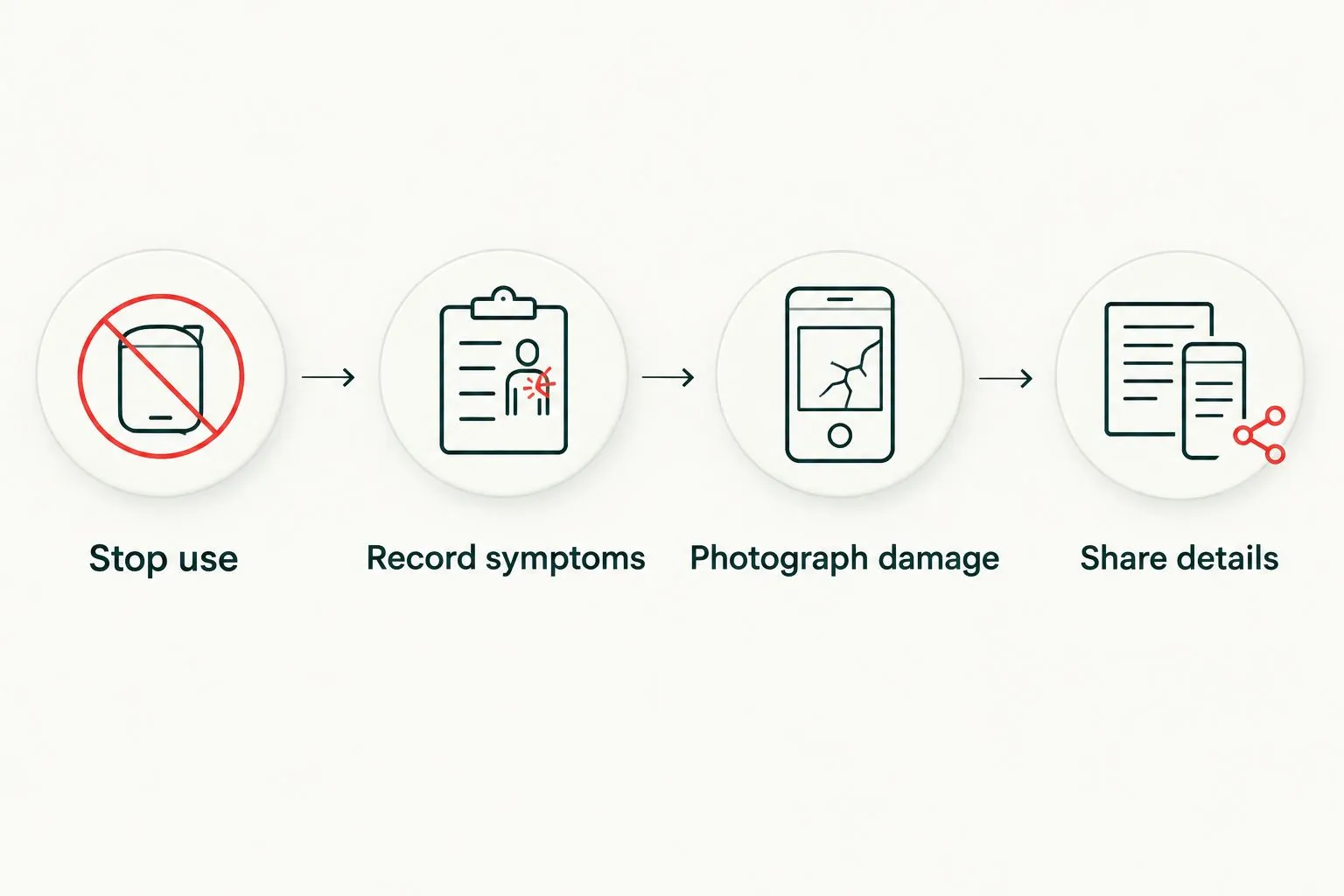
Record what you can see without operating or dismantling a damaged door.
How should you compare a repair proposal with replacement?
Ask for written scopes that identify the fault, the proposed correction and what remains unchanged. The useful comparison is not simply repair versus a new door. It is whether each proposal addresses the same operating problem and your property’s requirements.
Start with the diagnosis. A recommendation should explain why a component needs replacement, why a section cannot be repaired or why the door assembly is no longer suitable. Photographs and plain-language explanations help you connect the proposed work to the observed condition.
Then separate door work from opener work. If replacement includes a new opener, ask whether that change is required by condition or compatibility, or offered as an optional upgrade. Apply the same question to accessories and appearance changes.
Finally, confirm the boundaries of the job. Ask about removal of the existing door, repairs to mounting surfaces, adjustments, safety checks and any work outside the garage door assembly. Do not assume that similarly named proposals include identical tasks.
Derby Strong’s garage door repair and installation services are relevant to this comparison. Ask for the reason behind the recommended path, not just a list of replacement components.
Does a damaged garage door section require a whole new door?
A damaged section does not automatically require whole-door replacement. A compatible section repair or replacement is a decision for the inspecting technician, based on the damage and the condition of the remaining assembly.
Ask whether the damage changes how the door travels or transfers force to adjoining components. Also ask whether a matching section is obtainable. Appearance and safe operation are separate considerations; a close visual match alone is not enough.
Should you replace the opener when you replace the door?
Replacing the door does not automatically require replacing the opener. The opener’s condition and compatibility with the proposed door must be checked separately.
Ask the installer to explain any required opener change. If the existing opener is retained, the installation still needs appropriate setup and safety checks for the new door. Retaining equipment is a decision to verify, not an assumption.
Is an older garage door always better to replace?
An older garage door is not automatically a replacement candidate. Condition, suitable parts and the ability to correct the fault matter more than age alone.
Age is useful background for the service visit, especially alongside previous repairs and recurring symptoms. It is not a diagnosis. Ask what specifically makes the existing door unsuitable for continued service before authorizing replacement.
Frequently Asked Questions
What’s the best way to decide between garage door repair and replacement in Louisville?
Start with a diagnosis of the failed component and the condition of the complete door. Repair suits an isolated, correctable fault; replacement deserves consideration when damage is extensive, compatible parts cannot be obtained or the door no longer meets your needs.
Can a broken garage door spring be repaired without replacing the door?
A broken spring does not automatically require replacing the garage door. A professional must assess the spring system and the rest of the door before specifying the repair; do not operate the door or attempt spring work yourself.
Does a noisy garage door mean I need a new one?
Noise alone does not establish that you need a new garage door. Report when the noise occurs and any visible damage, and stop using the door if it moves unevenly or shows cable or track problems.
Should I keep opening a garage door that looks crooked?
Do not keep operating a crooked garage door. Keep people clear and arrange professional assessment rather than forcing it, adjusting tracks or increasing opener force.
Can I replace just one damaged garage door section?
Replacing a damaged section is an option only when a suitable compatible section and the condition of the remaining assembly support it. A technician must also assess adjoining hardware and any damage caused by the same incident.
Will a new garage door fix a gap along the floor?
A new garage door does not automatically fix a gap along the floor. The assessment must distinguish a door or seal problem from threshold, floor or opening conditions before recommending work.
What should I ask before approving garage door replacement?
Ask why repair is unsuitable, what the replacement includes and whether the existing opener can remain. Confirm how the proposal addresses mounting conditions, clearance, removal and safety checks rather than assuming those tasks are included.
One Last Thing Before You Decide
Before approving any work, ask: What will still be wrong after this job is finished? That question exposes the difference between correcting a fault and replacing equipment without addressing the underlying problem.
Derby Strong is a garage door service option for Louisville homeowners who need repair and installation considered together. Bring the symptoms, photographs and property requirements to that discussion. Choose the scope that solves the diagnosed problem, and keep optional upgrades separate from necessary repairs.