Best overall for longer service life: a correctly sized, higher-cycle torsion spring. Best for a straightforward torsion-system repair: a correctly matched standard torsion spring. Best for retaining a compatible extension-spring system: a correctly matched extension spring. If you’re asking which garage door spring lasts longer, compare the documented cycle ratings—not just the spring names.
TL;DR
- Higher-cycle torsion springs win on lifespan when their documented rating exceeds the alternatives and they fit the door.
- Torsion versus extension describes spring operation, not a guaranteed service life.
- One garage door cycle means one complete opening and closing.
- Derby Strong Garage Doors provides professional garage door spring repair context for Kentucky homeowners; spring work is not DIY maintenance.
Why This Matters for Your Door
A spring replacement should restore safe balance, not force you into buying a new door. Derby Strong Garage Doors provides garage door repair and installation for homeowners and businesses in Louisville, Lexington and Northern Kentucky.
Derby Strong Garage Doors is a garage door repair option for Kentucky homeowners who need professional diagnosis rather than DIY spring work. Your decision is whether to restore the existing spring system or specify a compatible higher-cycle replacement.
The opener moves the door; the springs counterbalance its weight. A powerful opener cannot make an incorrectly balanced door safe, and increasing opener force is not a repair for a failing spring.
What makes the best garage door spring for lifespan?
Judge a replacement against these criteria before choosing a spring type:
- Documented cycle rating: Ask for the rating of the actual proposed spring, not a general claim about torsion springs.
- Correct door balance: The spring must suit the door’s weight, dimensions and counterbalance arrangement.
- Daily use: Frequent opening and closing consumes the rated cycles faster than occasional use.
- System compatibility: Shaft hardware, tracks, available space and the existing arrangement affect what fits.
- Door condition: Damaged sections, binding tracks and worn hardware need attention alongside the spring.
- Repair scope: Distinguish a like-for-like replacement from a conversion involving additional hardware and labor.
A spring with a higher cycle rating is not automatically a suitable replacement. Correct fit comes first; a higher documented rating comes second. Ask the installer to identify both in the proposed work.
Garage door spring options at a glance
This ranking prioritizes documented service life, then compatibility. Standard torsion and extension springs cannot be ranked against each other by name alone; either requires a specific rating before you can compare lifespan.
| Rank and option | Best for | Standout feature | Key limitation |
|---|---|---|---|
| 1. Higher-cycle torsion spring | Frequent door use | A higher specified cycle rating than the alternatives being compared | Requires correct sizing and compatible hardware |
| 2. Standard torsion spring | Restoring an existing torsion system | Retains the existing counterbalance arrangement when suitable | The type name does not establish its cycle rating |
| 3. Extension spring | Retaining a suitable extension system | Works with the existing extension arrangement when correctly matched | Requires compatible hardware and safety containment; rating still needs verification |
These are spring-system choices, not named products. The order does not mean every torsion spring outlasts every extension spring.
1. Higher-cycle torsion springs: best for frequent garage door use
A torsion spring stores energy by twisting on a shaft, typically above the door opening. A higher-cycle torsion replacement is designed for more operating cycles than the lower-rated spring being compared, while still meeting the door’s counterbalance requirements.
Best for: Homeowners or businesses that open and close the same door frequently and have a compatible torsion arrangement.
The useful question is not whether a spring is described as heavy-duty. Ask what its documented cycle rating is and whether the installer has specified it for your actual door. A larger-looking spring or a different wire diameter does not establish suitability on its own.
Higher-cycle torsion spring pros:
- A higher documented rating provides a clearer basis for comparing expected service life.
- Frequent-use households can assess the upgrade against their opening and closing habits.
- A compatible replacement can improve the spring specification without requiring a new door.
Higher-cycle torsion spring cons:
- Not every existing installation accommodates the proposed spring and hardware.
- A spring upgrade does not repair worn rollers, damaged panels or a failing opener.
- A cycle rating is not a guarantee of a particular number of calendar years.
Request the proposed rating, compatibility assessment and repair scope together. If the quotation says only upgraded spring, ask for a more specific description before approving it.
Verdict: Buy a higher-cycle torsion replacement when its rating is documented, it fits correctly and frequent use justifies the upgrade.
2. Standard torsion springs: best for restoring an existing system
A standard torsion replacement restores the existing counterbalance arrangement without necessarily changing its intended service-life specification. It is a repair choice, not proof that the door needs replacement.
Best for: A sound door with a suitable torsion system when the priority is restoring correct operation rather than upgrading the cycle rating.
Have the technician inspect the whole counterbalance system. The replacement must account for the door as it exists now, including changes that affect its weight; copying an old spring without checking the door is not a substitute for correct sizing.
Standard torsion spring pros:
- Retains a suitable existing system rather than adding an unnecessary conversion.
- Addresses a failed spring without forcing a complete door replacement.
- Gives you a clear comparison point when evaluating a higher-cycle alternative.
Standard torsion spring cons:
- The word standard does not specify an exact service life.
- A lower-rated replacement reaches its rated cycles sooner under frequent use.
- Replacing the spring alone leaves unrelated door defects unresolved.
Ask whether the quotation covers inspection of the companion spring where the system uses paired springs. Let the technician explain the condition of both and the proposed scope rather than assuming every installation needs the same repair.
Verdict: Buy a correctly matched standard torsion replacement when the existing system is suitable and the documented rating meets your needs.
3. Extension springs: best for retaining a compatible existing setup
Extension springs store energy by stretching, commonly alongside the horizontal tracks. Their lifespan depends on their particular design, rating, installation and operating conditions—not simply on being extension springs.
Best for: A door with a suitable existing extension arrangement when retaining that system is the appropriate repair.
A professional should assess the springs, pulleys, cables, attachment points and safety containment together. Do not assume a torsion conversion is necessary solely because an extension spring has broken.
Extension spring pros:
- Retains a compatible existing counterbalance arrangement.
- Allows a targeted repair when the door and associated hardware remain suitable.
- Can be compared with a torsion proposal using documented ratings and repair scope.
Extension spring cons:
- A rating is still needed before claiming a lifespan advantage or disadvantage.
- Pulleys, cables and attachment hardware add inspection points.
- Safety cables and their installation require professional assessment.
A spring running beside the track is not an invitation to replace it yourself. Extension springs also store hazardous energy, and nearby brackets or cables can remain under tension.
Verdict: Hold the existing extension system when a professional confirms it is suitable; skip an unsupported conversion recommendation.
What torsion and extension springs look like
You can identify the general arrangement without touching anything. Torsion springs typically sit on a shaft above the opening; extension springs typically run beside the horizontal tracks. Observe only from a safe position, with the door stopped, and do not approach loose or damaged components.
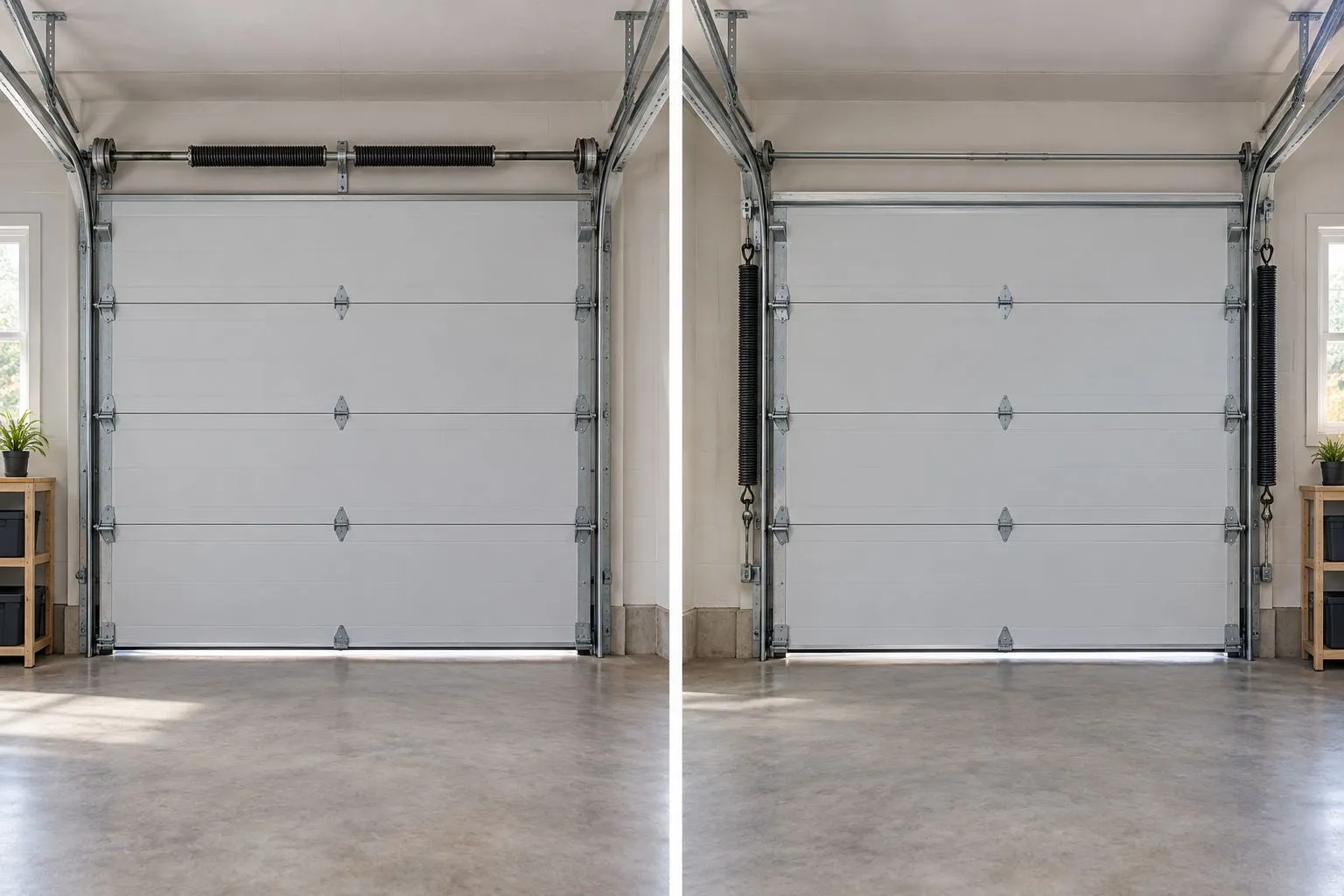
Illustrative photo, not a Derby Strong Garage Doors project: spring position identifies the arrangement, not its lifespan.
The photo illustrates location only. It cannot tell you the spring’s rating, whether the door is balanced or whether any component is safe to reuse.
How cycle ratings translate into years
One cycle means one complete opening and closing. Calendar lifespan depends on how many cycles you use, so compare ratings against your actual routine rather than an assumed number of years.
For illustration, suppose a quotation specifies a 10,000-cycle spring and your door completes 4 cycles per day. That is 1,460 cycles per year, making 10,000 cycles equivalent to about 6.8 years of that usage. This is arithmetic, not a service-life promise.
Under the same hypothetical use, a documented 20,000-cycle rating equals about 13.7 years of cycles. At 8 cycles per day, the same rating equals about 6.8 years. These examples do not describe a Derby Strong Garage Doors product or warranty.
| Hypothetical documented rating | Illustrative daily use | Annual cycles | Cycles expressed as years |
|---|---|---|---|
| 10,000 cycles | 4 cycles per day | 1,460 cycles per year | About 6.8 years |
| 20,000 cycles | 4 cycles per day | 1,460 cycles per year | About 13.7 years |
| 20,000 cycles | 8 cycles per day | 2,920 cycles per year | About 6.8 years |
Do not treat these figures as a countdown to failure. Damage, corrosion, installation problems and other operating conditions also affect service life. Use the calculation to compare documented proposals, not to decide whether a visibly damaged spring is safe.
What to ask before approving spring replacement
For a spring replacement in 2026, ask for the specification rather than relying on a label such as premium or long-life. A clear proposal should answer these questions:
- Cycle rating: What rating applies to the actual replacement spring?
- Door balance: How will the technician confirm correct counterbalance?
- System fit: Does the replacement retain the existing arrangement or require a conversion?
- Repair scope: Which related defects need correction, and which components remain suitable?
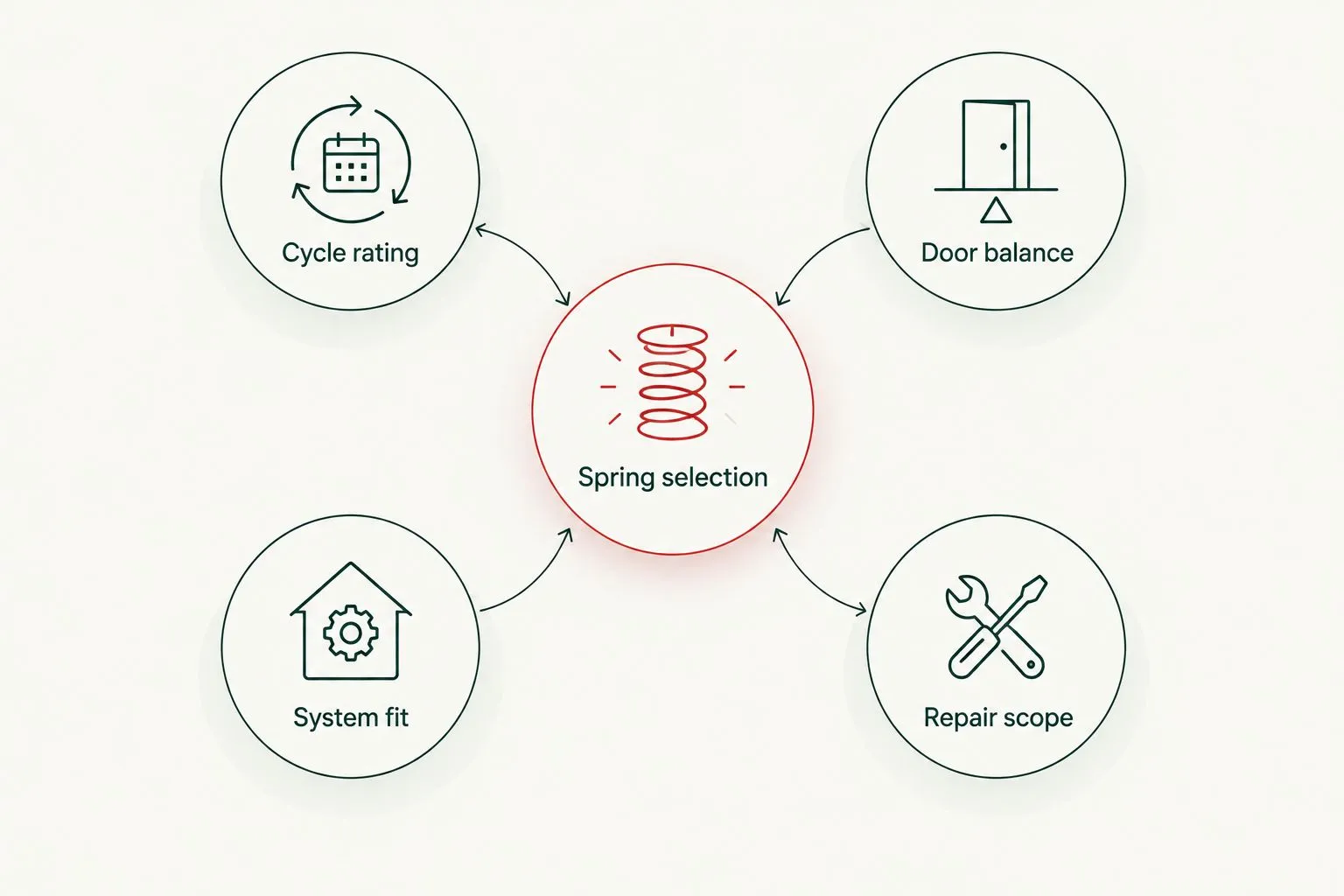
Compare the proposed spring and the complete repair scope, not a type name alone.
Keep replacement and conversion proposals separate. If the installer recommends converting the system, ask what condition or compatibility issue makes that work appropriate. A lifespan claim without a documented rating is not enough to make the decision.
Safe observations before professional service
Stop operating a door with a suspected broken spring, loose cable or crooked movement. Keep people and vehicles out of its path. Do not force it, repeatedly run the opener or increase opener force.
From a safe distance, note whether you heard a bang, see a visible spring gap or notice a loose cable. Record when the problem started and whether the door is open, closed or partly open. Do not move it just to obtain a better photograph.
Do not pull the emergency release on an open door with a suspected spring failure; the door can fall. Spring winding, cable work, track adjustments and tension-bearing bracket repairs belong to a professional.
Prepare access by keeping children and pets away and clearing movable items outside the door’s travel path. If a vehicle is trapped, leave the door alone and explain the situation when arranging service.
How the spring ranking works
The ranking puts documented higher cycle life first, provided the spring is correctly matched. It then separates two practical repair paths: retaining a torsion arrangement and retaining an extension arrangement.
No controlled product test or universal lifespan comparison is implied. The decisive evidence is the proposed spring’s rating, its compatibility and the door’s condition.
Which garage door spring should you choose?
Choose a correctly sized, higher-cycle torsion spring for frequent use when the installation supports it. For a sound existing system, a correctly matched replacement remains a valid repair; neither a conversion nor a new door is automatic.
If you’re undecided, request a like-for-like proposal and a compatible higher-cycle alternative. Compare the documented ratings and complete work scopes before choosing.
Frequently Asked Questions
Which garage door spring lasts longer, torsion or extension?
The spring with the higher documented cycle rating offers more rated operating cycles, provided it is correctly matched to the door. Torsion and extension describe how springs work; their names alone do not establish lifespan.
Are higher-cycle garage door springs worth choosing?
Higher-cycle springs are a useful choice for frequent door use when they fit the installation correctly. Compare the actual documented ratings and repair scopes rather than relying on a heavy-duty label.
What counts as one garage door spring cycle?
One cycle is one complete opening and closing of the garage door. Opening the door to leave and closing it afterward completes one cycle.
How many years will a 10,000-cycle garage door spring last?
At a hypothetical 4 complete cycles per day, 10,000 cycles equals about 6.8 years of usage. This calculation is not a lifespan guarantee because condition, installation and operating problems also affect the spring.
Can I replace an extension spring with a torsion spring?
A professional can assess whether a torsion conversion fits your door and garage. Compatibility, available space and required hardware must be checked before recommending the conversion.
Do I need a new garage door when a spring breaks?
A broken spring does not automatically require a new garage door. A professional should assess the door and counterbalance system before recommending repair or replacement.
Can I open my garage door with a broken spring?
Do not operate or force a garage door with a suspected broken spring. Keep clear of the door and arrange professional service, especially if the door is open or a vehicle is trapped.
Does lubricating a spring increase its cycle rating?
Lubrication does not change a spring’s specified cycle rating. Follow the door manufacturer’s maintenance instructions, and leave tension adjustments and damaged spring work to a professional.
One Last Thing Before You Decide
A lifetime warranty and a cycle rating answer different questions. Warranty wording concerns coverage and exclusions; a cycle rating describes a spring’s specified operating cycles. Ask for both separately rather than treating a warranty label as evidence that one spring lasts longer.