Best overall for a fenced business entrance with enough side clearance: a cantilever slide gate. Best for an entrance with clear swing space: a swing gate. Best for vehicle admission rather than perimeter closure: a barrier arm. This guide compares commercial gate options for Florence, KY, businesses by usable space, traffic, safety and maintenance—not appearance alone.
TL;DR
- Commercial gate options in Florence, KY: choose a cantilever slide gate when side clearance supports a fenced entrance.
- Swing gates suit entrances with clear sweep space; tracked slide gates need an unobstructed ground track.
- Barrier arms control vehicle admission but do not close a fenced perimeter.
- Derby Strong provides commercial gate and fence services in Northern Kentucky; confirm the scope for your business address.
Why this matters for a Florence business
A gate that fits the opening can still obstruct a delivery truck, trap a vehicle in its travel path or leave pedestrians without a safe entrance. Choose the gate movement before choosing the gate finish. The operator and access controls come after the physical layout works.
For a Florence address using ZIP code 41042, include the complete street address when requesting a site assessment. A postal code does not establish property boundaries, approval requirements or service coverage. Your driveway, fence line and operating needs determine the recommendation.
Derby Strong provides commercial gate and fence services in Northern Kentucky. For a Florence business, the useful starting point is a site-specific discussion—not an assumption that every gate type suits the property.
What makes the best commercial gate
Use these criteria to compare proposals for your 2026 gate project:
- Movement clearance: Identify the entire slide path, swing arc or raised position, not just the driveway opening.
- Vehicle movement: Account for the largest expected vehicle, its turning path and where drivers wait while requesting entry.
- Pedestrian separation: Provide an appropriate pedestrian route rather than directing people through an automated vehicular gate.
- Perimeter purpose: Decide whether you need a physical perimeter closure or only a checkpoint for authorized vehicles.
- Operating demand: Describe actual traffic patterns so the installer can select an operator using current manufacturer documentation.
- Service access: Keep rollers, hinges, tracks, controls and safety devices accessible for professional inspection and maintenance.
A wider opening does not automatically solve a difficult approach. Trucks need turning space on both sides, and an access reader placed badly can put the driver beside a moving gate. Review the approach and departure as part of the entrance—not as separate problems.
Commercial gate options at a glance
The order below reflects distinct site needs, not a claim that one design wins everywhere. No gate type receives a security or operating-performance rating without a specified product and installation.
| Gate option | Best for | Standout feature | Key limitation |
|---|---|---|---|
| Cantilever slide gate | Fenced entrances with sufficient side clearance | Slides without a track across the driveway | Needs room for the gate leaf and supporting tail |
| Swing gate | Entrances with unobstructed sweep space | Opens on hinges beside the entrance | The swing arc must stay clear of vehicles and people |
| Tracked slide gate | Sites suited to a maintained ground track | Travels sideways on a driveway-level track | Debris and track condition affect movement |
| Barrier arm | Controlled vehicle admission | Raises an arm rather than moving a fence panel | Does not provide full perimeter closure |
| Vertical pivot gate | Sites constrained by lateral movement space | Rotates upward instead of sliding along the fence | Needs a clear raised envelope and specialized assessment |
For a broader property-level comparison, see the guide to garage gate options for Kentucky properties. The commercial decision here is narrower: how to control a working business entrance without creating a traffic or safety problem.
1. Cantilever slide gate: best for fenced business entrances
A cantilever slide gate moves sideways while its support system holds the gate clear of a driveway-level track. The gate includes a supporting section beyond the portion that closes the entrance. That extra length is part of the required installation space.
This is the default shortlist choice when you need a fenced closure and have adequate room alongside the entrance. It keeps the gate’s sweep out of the driveway, but the sliding area still needs protection against access to moving components and pinch points.
Cantilever slide gate pros:
- No ground track runs across the vehicle opening.
- Sideways movement avoids a swing arc across the approach.
- The gate can form part of a continuous fence enclosure.
Cantilever slide gate cons:
- The supporting tail increases the necessary side clearance.
- Support posts, rollers and foundations need a suitable design.
- The travel area must remain clear and appropriately guarded.
Best for: A Florence business needing perimeter closure with usable space along the fence.
Ask the installer to mark the complete gate envelope on the site plan. A fence run that looks long enough is not proof that the support arrangement, setbacks and safety clearances fit.
Verdict: Buy when the full gate and support layout fits; skip when lateral clearance is insufficient.
2. Swing gate: best for entrances with clear sweep space
A swing gate rotates on hinges rather than traveling along the fence. Depending on the design, a single leaf or paired leaves close the entrance. The choice changes the sweep area, posts and operator arrangement.
Swing gates belong on the shortlist when the driveway gives the leaves room to move without crossing a waiting position or obstructing an exit. Ground slope also matters: a leaf must clear the surface throughout its movement, not only when closed.
Swing gate pros:
- No sliding track crosses the driveway.
- No long sliding pocket is required beside the opening.
- Single-leaf and paired-leaf layouts offer different planning options.
Swing gate cons:
- The sweep area consumes usable approach or yard space.
- Sloping ground can conflict with leaf movement.
- Hinges, posts and operator geometry require coordinated design.
Best for: A business entrance with a clear, suitable sweep area and enough vehicle waiting space.
Do not let a proposed gate swing into a public walking route or a place where drivers must stop to use the entry control. Ask for a plan showing the leaves both open and closed, with vehicles positioned at the reader.
Verdict: Buy for a clear sweep area; skip if vehicles, pedestrians or rising ground occupy that space.
3. Tracked slide gate: best for a maintainable ground-track layout
A tracked slide gate runs on wheels along a track at ground level. Like a cantilever gate, it moves sideways and needs a clear receiving area beside the entrance. Unlike a cantilever gate, its movement depends on the condition of the track across the opening.
This option deserves consideration when the site supports the track and staff can keep it free of obstructions. A delivery entrance that collects gravel, packaging or other debris needs that problem addressed before the gate is selected.
Tracked slide gate pros:
- Sideways travel avoids a swing arc in the driveway.
- The gate provides a physical closure across the entrance.
- Its ground-supported movement offers an alternative to cantilever support.
Tracked slide gate cons:
- The track requires inspection and cleaning.
- Debris or track damage can interfere with travel.
- Drainage and the driveway surface affect the installation detail.
Best for: An entrance where the ground track can remain clear, supported and accessible for upkeep.
Compare the complete site work, not just the gate leaf. Ask who handles the track foundation, surface transitions and drainage detail. Those responsibilities should be clear before installation starts.
Verdict: Buy only with a practical track-maintenance plan; skip where recurring obstructions cannot be controlled.
4. Barrier arm: best for controlling vehicle admission
A barrier arm raises and lowers across a vehicle lane. It serves a different purpose from a full-height gate: managing who drives through an entrance rather than completing a fence enclosure.
Choose this category when the business needs a checkpoint for employees, visitors or authorized deliveries. Do not describe a barrier arm as equivalent to a perimeter gate. People can pass around or beneath an arm, and the surrounding layout determines how vehicles approach it.
Barrier arm pros:
- Makes a vehicle admission point easy to identify.
- Does not need a full gate leaf to slide along the fence.
- Can be planned around an access-control workflow.
Barrier arm cons:
- Does not close a perimeter against pedestrian access.
- Needs appropriate vehicle detection and safety planning.
- An arm can be struck if drivers misjudge the lane or operating sequence.
Best for: A controlled parking or vehicle-entry lane where full perimeter closure is not the objective.
Define the visitor process before selecting controls. If a driver needs help entering, staff need a clear way to handle that request without sending someone into the moving equipment’s path.
Verdict: Buy for vehicle admission; skip when your primary requirement is a fenced security closure.
5. Vertical pivot gate: best for constrained lateral space
A vertical pivot gate rotates upward instead of sliding along the fence line. It offers a different movement envelope for sites where sideways travel is difficult. The raised position, counterbalance arrangement and supporting structure still require space.
This is a specialist shortlist option, not a universal answer to a tight entrance. Overhead obstructions, vehicle clearance and service access need review against the exact manufacturer’s requirements.
Vertical pivot gate pros:
- Avoids a long horizontal sliding path.
- Provides a gate-panel closure rather than only a barrier arm.
- Offers another layout to assess when conventional movement conflicts with the site.
Vertical pivot gate cons:
- Requires a clear raised envelope.
- Specialized components need an appropriate service plan.
- Suitability depends on the specific gate and operator system.
Best for: A business entrance with restricted lateral space and a verified clear upward movement area.
Do not approve this option from a rendering alone. Require a layout showing the raised gate, nearby structures and the manufacturer’s specified clearances.
Verdict: Hold until a site assessment confirms the complete movement envelope.
Plan the entrance before selecting the operator
Draw the driveway, fence, pedestrian route and access-control position together. Include where a delivery vehicle waits and how it leaves after entry is denied. A gate should not force a driver to stop inside its movement area.
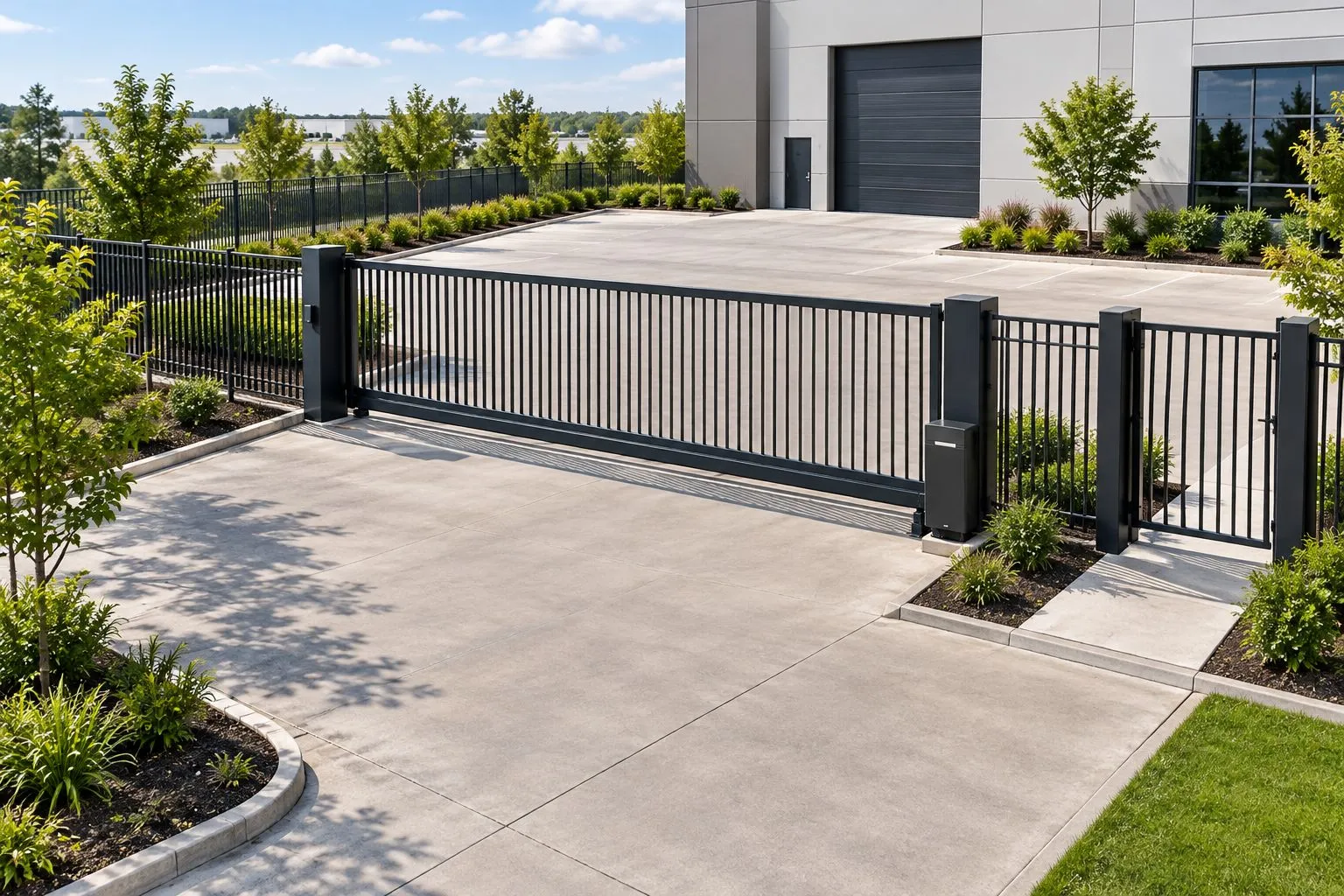
Illustrative photo, not a Derby Strong project: the vehicle entrance and pedestrian route need separate planning.
Bring the installer a practical operating brief:
- Traffic pattern: Explain employee arrivals, visitor access and delivery movements, including periods when arrivals cluster.
- Vehicle mix: Identify the largest vehicles expected and whether trailers enter.
- Access method: Describe who receives credentials and who handles visitors.
- Outage procedure: Ask how authorized staff manage access when power or communications fail.
- Property constraints: Supply available surveys, lease conditions and existing electrical information.
Ask Derby Strong which gate configurations and control systems it can assess for your address. Product suitability must come from current manufacturer documentation and the proposed site design, not a general claim about “commercial-grade” equipment.
Automated gate safety is not optional
In the United States, UL 325 addresses door and gate operator safety, while ASTM F2200 addresses automated vehicular gate construction. Ask the installer to explain how the proposed system addresses the applicable requirements and site conditions. Naming a standard does not establish that a particular installation complies.
Keep pedestrian access separate from automated vehicular gate travel. Safety planning also needs to address entrapment areas, exposed moving components and the locations of controls and detection devices.
Never increase operator force, bypass a safety device or force a damaged gate to move. If a gate drags, leans, stops unexpectedly or has damaged hardware, keep people away and arrange professional assessment. Do not enter the movement area to diagnose it.
For business staff, useful observations include the displayed fault message, when the problem occurs and whether an obstruction is visible from a safe position. Leave hinge adjustment, rollers, counterbalances, electrical work and operator troubleshooting to qualified professionals.
Repair or replace an existing commercial gate?
Repair is appropriate when the existing layout still serves the business and the fault can be corrected safely. A failed reader or worn component does not, by itself, justify replacing the entire gate.
Replacement deserves assessment when the entrance geometry no longer works, the gate has significant structural damage or the existing system cannot support the required safe operation. A new operator alone does not correct an unsuitable gate structure.
Ask the proposal to separate gate repair, operator work, access controls and site changes. That makes the decision clearer and prevents a controls problem from becoming an unexplained full-system replacement.
How these commercial gate options were ranked
The ranking starts with perimeter purpose, then movement clearance, vehicle routing, safety and upkeep. Cantilever gates receive the default recommendation only for fenced entrances with sufficient side space. Barrier arms rank separately because admission control is not the same job as perimeter closure.
No specific models were ranked. Before purchase, compare the selected gate and operator against current documentation and a measured site layout.
Which commercial gate should you choose?
Choose a cantilever slide gate first for a fenced Florence business entrance with adequate side clearance. Choose a swing gate when the sweep area works better than a sliding pocket. Consider a tracked gate only when the ground track is practical to maintain.
Use a barrier arm for vehicle admission, not as a substitute for a perimeter gate. Keep a vertical pivot gate on hold until its raised position and service requirements are verified. Derby Strong’s commercial gate and fence services provide a starting point for discussing the site—not a reason to skip that assessment.
Frequently Asked Questions
What’s the best commercial gate for a Florence business?
A cantilever slide gate is the default shortlist choice for a fenced Florence business entrance with enough side clearance. A site assessment must confirm the supporting tail, vehicle approach and safety layout before selection.
Is a swing gate better than a sliding gate for a business entrance?
A swing gate is the better fit when the entrance has clear sweep space but insufficient room for sideways travel. A sliding gate is the better fit when a swing arc would obstruct vehicles or pedestrians.
Does a barrier arm provide the same security as a full gate?
No. A barrier arm controls vehicle admission but does not complete a fenced perimeter against pedestrian access. Choose a full gate when perimeter closure is the requirement.
What should I send before a commercial gate site visit in Florence?
Send the full business address, entrance photos taken from safe positions, expected vehicle types and a description of access needs. Include available property plans and lease restrictions so the assessment addresses the actual site.
Can my business keep its existing gate and replace only the operator?
An operator-only replacement is an option when the gate structure, movement and safety arrangement remain suitable. The installer must verify compatibility and current requirements rather than assume the existing gate is acceptable.
What should staff do if an automated gate stops working?
Keep people away from the gate’s movement area and arrange professional assessment. Record visible fault messages from a safe position; do not force movement, raise operator force or bypass safety devices.
How do I compare commercial gate proposals without choosing on appearance?
Compare the proposed movement envelope, vehicle routing, pedestrian separation, operator suitability and maintenance responsibilities. Require each proposal to explain site work, safety provisions and the outage procedure.
One Last Thing Before You Decide
Before approving the gate, ask the installer to walk through a denied-entry delivery: where the truck stops, who responds and how the driver exits. That exercise exposes layout problems a picture of the closed gate will not show. Solve the route before committing to the equipment.