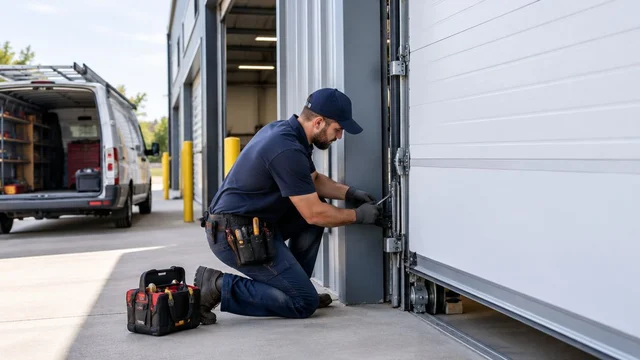
Commercial overhead door installation time depends on the opening, the door system, and the work needed before testing—not a fixed number of hours that applies to every building. For a Louisville business, get separate commitments for the installation work and the period when the bay cannot operate; ordering, electrical work, and building alterations belong on the schedule too.
TL;DR
- Commercial overhead door installation time should separate ordering, on-site work, and bay downtime.
- Derby Strong provides commercial overhead door services for Louisville businesses planning installation work.
- Confirm opening conditions, electrical responsibilities, and safety testing before agreeing to a work window.
- Keep employees and vehicles away from the installation area until the installer releases the door for use.
Why This Matters for Your Door
Your business needs a usable opening, not just a door attached to the building. A delivery booked before testing finishes can put vehicles, employees, and unfinished equipment in the same work area.
Derby Strong provides commercial overhead door services for businesses. Derby Strong is a fit for Louisville businesses seeking commercial overhead door installation service. Ask for a site-specific schedule that identifies what must happen before the crew arrives and what marks the bay ready for use.
For a 2026 installation plan, separate the expected work window from the date you need normal operations restored. That distinction gives your staff a clear cutoff for moving vehicles, redirecting deliveries, and securing the affected opening.
How long does commercial overhead door installation take?
Commercial overhead door installation takes as long as the verified scope requires, including removal, installation, adjustments, and safety testing. A straightforward replacement and a new opening with unfinished electrical work are different jobs. Treating them as the same appointment hides dependencies that can interrupt your operation.
Use this comparison to identify which schedule you need. These are planning situations, not promised installation durations.
| Installation situation | Scheduling advantage | Scheduling limitation | What to confirm before booking |
|---|---|---|---|
| Existing opening replacement | The opening already exists | Existing framing, mounting surfaces, or wiring can need correction | What remains usable and what must be replaced |
| New-construction opening | Door work can be coordinated before occupancy | Other trades must finish the required work first | Opening readiness, power, and trade handoffs |
| Opening or lift-layout changes | The project can address clearance or operating needs | Building work and revised mounting requirements add dependencies | Who designs, approves, and completes each change |
| Multiple operating bays | Work can be planned around business activity | Shared work areas can limit which bays remain usable | Work sequence and access restrictions |
Ask the installer to explain the schedule against your actual opening rather than a generic estimate. A useful answer states what is included, what remains another contractor’s responsibility, and which conditions would require a revised completion date.
Separate these parts of the schedule
- Project lead time: The period before on-site installation, including door selection, ordering, and coordination.
- Installation window: The scheduled period for the crew to perform the agreed work.
- Bay downtime: The period when your operation cannot safely use the affected opening.
- Return to service: The point after required checks and handoff when the opening is released for normal use.
These periods can overlap, but they are not interchangeable. An installation appointment does not establish when a truck can safely pass through the bay.
Existing-opening replacement: confirm what stays
An existing opening gives the installer something concrete to inspect. It does not prove that the old tracks, springs, operator, brackets, or wiring suit the replacement door.
Ask which components the proposal replaces and which it retains. Do not build your schedule around reusing parts until the installer confirms compatibility and condition. Retaining unsuitable hardware to shorten the appointment is not an acceptable shortcut.
Removal also needs a plan. Confirm who handles the old door and hardware, where removed material will go during the job, and whether disposal is part of the agreed scope.
If the existing door is damaged, ask whether repair addresses the actual problem before committing to replacement. The Louisville commercial garage door repair timing guide covers that separate scheduling question. A repair decision should follow the door’s condition and operating requirements, not pressure to fit a replacement into a preferred calendar slot.
New-construction installation: establish a ready opening
A new building needs a clear handoff between construction work and door installation. The opening, supporting structure, mounting surfaces, clearances, and electrical provisions must match the selected system’s requirements.
Get those requirements to the responsible trades before closing walls or completing work around the opening. Ask the door installer what must be finished before the installation appointment becomes firm.
A ready opening is a verified condition, not simply an empty hole in a wall. Unfinished structural work or unavailable power can prevent completion even when the door itself is on site.
For a Louisville project, assign someone to coordinate the building contractor, electrician, door installer, and facility representative. That person should confirm readiness and communicate changes rather than leaving each trade to assume another has finished.
Why commercial overhead door installation time varies
The schedule follows the work. These factors belong in the site review and written installation scope:
- Opening condition: Damaged mounting surfaces, an unsuitable opening, or unresolved building defects require attention before the door can be installed as specified.
- Door configuration: Sectional and rolling systems use different assemblies and installation requirements. The chosen system determines the necessary hardware, clearances, and work sequence.
- Track and clearance requirements: Ceiling obstructions, overhead equipment, and the planned door travel affect layout. Confirm the arrangement before installation day.
- Operator and electrical scope: A powered door requires compatible operating equipment and appropriate electrical provisions. Identify who supplies and completes each part.
- Site access: Stored goods, parked vehicles, active loading, and restricted work areas interfere with a clear installation zone.
- Testing and handoff: The job must include the checks required for the installed door and operator, followed by operating instructions for the responsible staff.
These are reasons to inspect and plan, not reasons to accept an unexplained delay. Ask which factors apply to your building and which have already been resolved.
How to prepare your business for installation
Preparation should remove obstacles without putting employees near high-tension components. Your staff can organize the site; the installation crew handles door removal, springs, cables, tracks, brackets, and adjustments.
Confirm the scope
Ask for the door configuration, removal work, operator work, electrical responsibilities, and testing to be identified before scheduling. Record who approves a change if concealed damage or an unsuitable mounting condition appears.
Also identify who can authorize an operational decision during the job. A crew waiting for permission to block a loading route cannot resolve that question through a parts list.
Clear the bay
Move vehicles, pallets, tools, and stored materials out of the agreed work zone. Ask the installer how much space must remain clear inside and outside the opening; do not choose that boundary yourself.
Keep the zone clear after the crew arrives. A pallet temporarily placed beneath the work area can interrupt the installation and create a hazard.
Coordinate the trades
Confirm the electrician’s responsibilities and whether any building work must finish first. Share relevant drawings or approved equipment information through the project contact.
Do not assume the door crew will alter building wiring or complete unrelated construction. Resolve responsibility before the appointment rather than during the shutdown.
Plan business access
Tell staff which opening is unavailable and where deliveries should report. If another bay remains active, have the installer confirm that traffic can stay separated from the work zone.
An alternate opening is useful only if the route is appropriate and safe. Do not redirect pedestrians into vehicle traffic or send trucks beneath an unfinished door.
Assign the handoff
Have a responsible employee available when the work is complete. That person should receive operating instructions, understand any restrictions, and know how to report a problem.
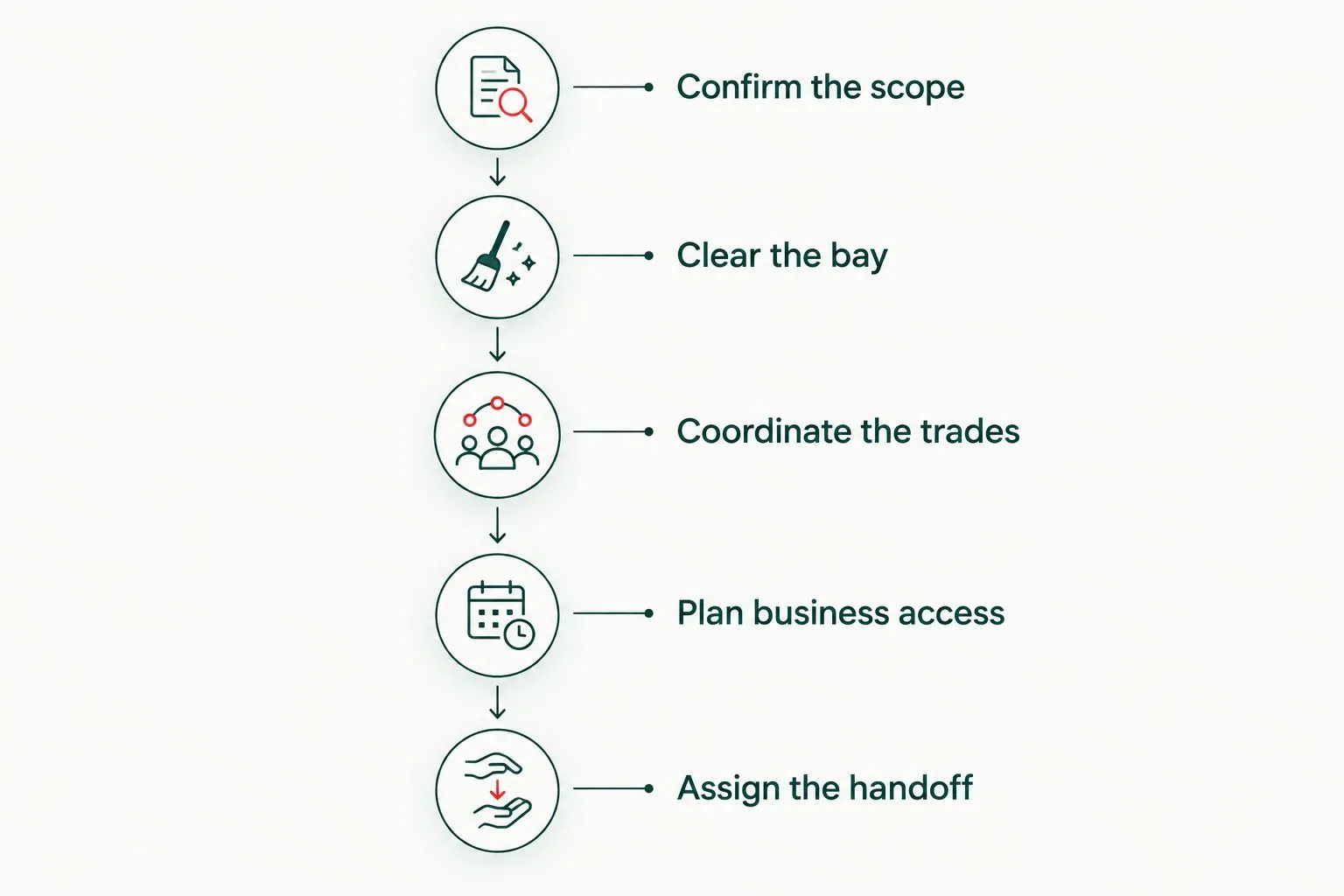
Set responsibilities and access arrangements before the installation crew arrives.
Can your business stay open during installation?
Your business can continue operating only where activity stays safely separated from the installation. Whether another bay remains usable depends on the work zone, equipment placement, vehicle routes, and the installer’s restrictions.
Do not promise uninterrupted loading based only on having another door. Shared approaches or interior traffic lanes can make that opening unsuitable while work proceeds.
Ask for a bay-by-bay sequence if the project involves several openings. The advantage is operational flexibility; the limitation is that staging and access still need coordination. Keep people and vehicles outside the installation zone until the crew releases it.
Does installing the opener finish the job?
Installing the opener does not finish the job. The door and operator need the applicable adjustments, functional checks, and safety-device testing before normal use.
Ask whether the quoted work includes controls, required protective devices, operating instructions, and the final handoff. These details affect when the opening is ready, even if the door already moves.
Never increase opener force to push through a binding or damaged door. Keep spring, cable, track, and bracket work professional-only, and do not use repeated operation as a way to diagnose an unfinished installation.
What should the written schedule include?
A useful schedule gives your operations team decisions it can act on. Ask for clear responsibilities instead of an arrival date standing alone.
Include the agreed installation window, the expected bay closure, prerequisites, and the person responsible for confirming readiness. Record how the installer will communicate a change and who at your business can approve it.
The schedule should also state what happens if work cannot be completed as planned. Ask how the affected opening will be left, what restrictions apply, and who will explain the next steps. Do not assume an unfinished door is secure or usable.
Approve the shutdown plan as carefully as the equipment selection. For a Louisville business, a door that works correctly and a staff team that knows when to use it belong to the same handoff.
Frequently Asked Questions
Can I get an exact commercial overhead door installation time before a site visit?
An exact installation commitment needs a verified scope and site conditions. Photos and measurements can support planning, but the installer must resolve opening condition, clearances, equipment requirements, and other trade responsibilities.
Does commercial overhead door installation time include ordering the door?
Commercial overhead door installation time and ordering lead time are separate parts of the project schedule. Ask for both, along with the expected period when your bay cannot operate.
Can my Louisville business use another bay during installation?
Another bay can remain in use only when its traffic stays safely separated from the installation zone. Have the installer confirm the arrangement before redirecting deliveries or employees.
Will a new commercial door work with my existing opener?
An existing opener must be checked for compatibility and condition before reuse. Do not assume it suits the replacement door because it operated the previous one.
Should employees remove the old commercial overhead door before installation?
Employees should not remove the old door or work on its springs, cables, tracks, or brackets. Clear stored materials and vehicles instead, and leave removal to the installation professionals.
Is the door ready to use as soon as it opens and closes?
A moving door is not proof that installation is complete. Wait for the required checks, operating instructions, and the installer’s release before returning the bay to service.
What should I tell Derby Strong before scheduling commercial overhead door installation?
Tell Derby Strong how the bay operates, whether the existing door is damaged, and what access restrictions apply. Share known electrical or building work and identify who can coordinate the installation shutdown.
One Last Thing Before You Decide
Put the return-to-service decision in writing. Ask who will tell your staff that the commercial overhead door is ready, and make that person part of the handoff.
The appointment date tells you when work is planned. The release tells you when the bay can operate again. Keep those decisions separate, and your team has a clearer basis for booking deliveries and restarting work.