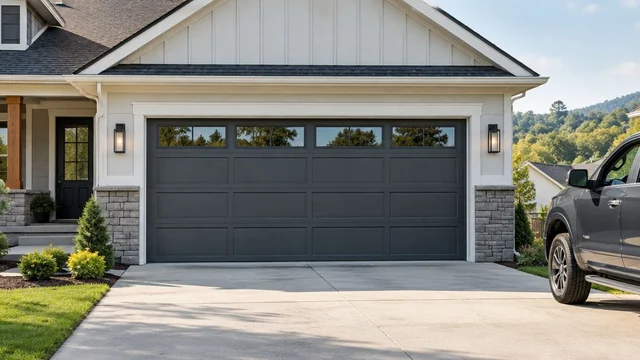
A garage door balance adjustment in Danville, KY has no fixed completion time: the technician must first determine whether the door needs an adjustment or a repair. Spring damage, uneven cables, or binding hardware changes the work involved, so ask for an on-site labor estimate that includes inspection and final testing—not just the adjustment itself.
TL;DR
- Garage door balance adjustment time in Danville, KY depends on diagnosis, required repairs, and final testing.
- Derby Strong Garage Doors provides garage door repair; confirm Danville service availability before booking.
- A heavy, crooked, or unstable door needs professional inspection, not repeated opener attempts.
- Ask whether the appointment estimate includes troubleshooting, parts replacement, and safety testing.
How long does a garage door balance adjustment take in Danville, KY?
The useful estimate is the time needed to leave the door balanced and operating safely—not the time spent changing spring tension. An adjustment-only appointment and a spring-replacement appointment involve different work, even when you initially report the same symptom.
For your Danville property, describe what the door is doing before requesting an appointment length. A door that feels heavy, one that hangs crooked, and one that reverses near the floor do not establish the same diagnosis.
Derby Strong Garage Doors provides residential garage door repair and opener service. Confirm service availability for your Danville address before arranging an inspection; a Kentucky service description does not establish coverage at every address.
| Possible finding | What the work involves | What it means for scheduling |
|---|---|---|
| Adjustment-only condition | Technician checks intact, compatible components and corrects balance | Ask for an estimate covering inspection, adjustment, and testing |
| Broken or unsuitable spring | Technician identifies and replaces the required spring components | Treat this as repair work, not a minor adjustment |
| Cable or drum problem | Technician diagnoses uneven lifting and repairs the affected system | Balance cannot be judged separately from the lifting fault |
| Binding rollers or tracks | Technician locates resistance and evaluates damaged hardware | Removing resistance is part of the diagnosis |
| Opener-related fault | Technician checks the operator after assessing the door itself | An opener repair does not automatically correct door balance |
These are diagnostic possibilities, not reasons to authorize every listed repair. Ask the technician to identify which finding applies to your door and explain the proposed work.
Why this matters: the opener is not a substitute for balance
A garage door’s springs counterbalance its weight. The opener moves the door through its travel; it should not compensate for a failed spring or a mechanical obstruction.
Repeatedly pressing the remote does not resolve a balance fault. Increasing opener force to push through resistance is not an appropriate repair, either.
For a homeowner planning a workday around a Danville appointment, the distinction matters: an arrival window, an inspection, and hands-on repair are separate parts of the schedule. Ask which part the stated time describes.
Choose a diagnosis-led garage door repair appointment, not a promise of a quick adjustment before anyone has inspected the door. The benefit is a repair scope tied to the actual fault. The limitation is that you cannot settle the completion estimate from the symptom alone.
What happens during a professional balance assessment?
The technician needs to separate a counterbalance problem from friction, damaged lifting hardware, and opener behavior. This is professional work; the sequence below explains the appointment rather than providing spring-adjustment instructions.
- Inspect the door. The technician assesses the panels, hinges, rollers, tracks, springs, cables, and lifting hardware before deciding how to test the system safely.
- Identify the fault. The technician distinguishes inadequate counterbalance from binding, uneven lifting, or an operator problem. More than one fault can exist.
- Explain the scope. You should receive an explanation of the required adjustment or repair before approving additional work.
- Complete the repair. Spring, cable, track, bracket, and other high-tension work stays with the professional. An apparent balance complaint can require component replacement instead of adjustment.
- Verify operation. The technician checks door movement and balance, then evaluates opener operation and the applicable safety functions according to manufacturer instructions.
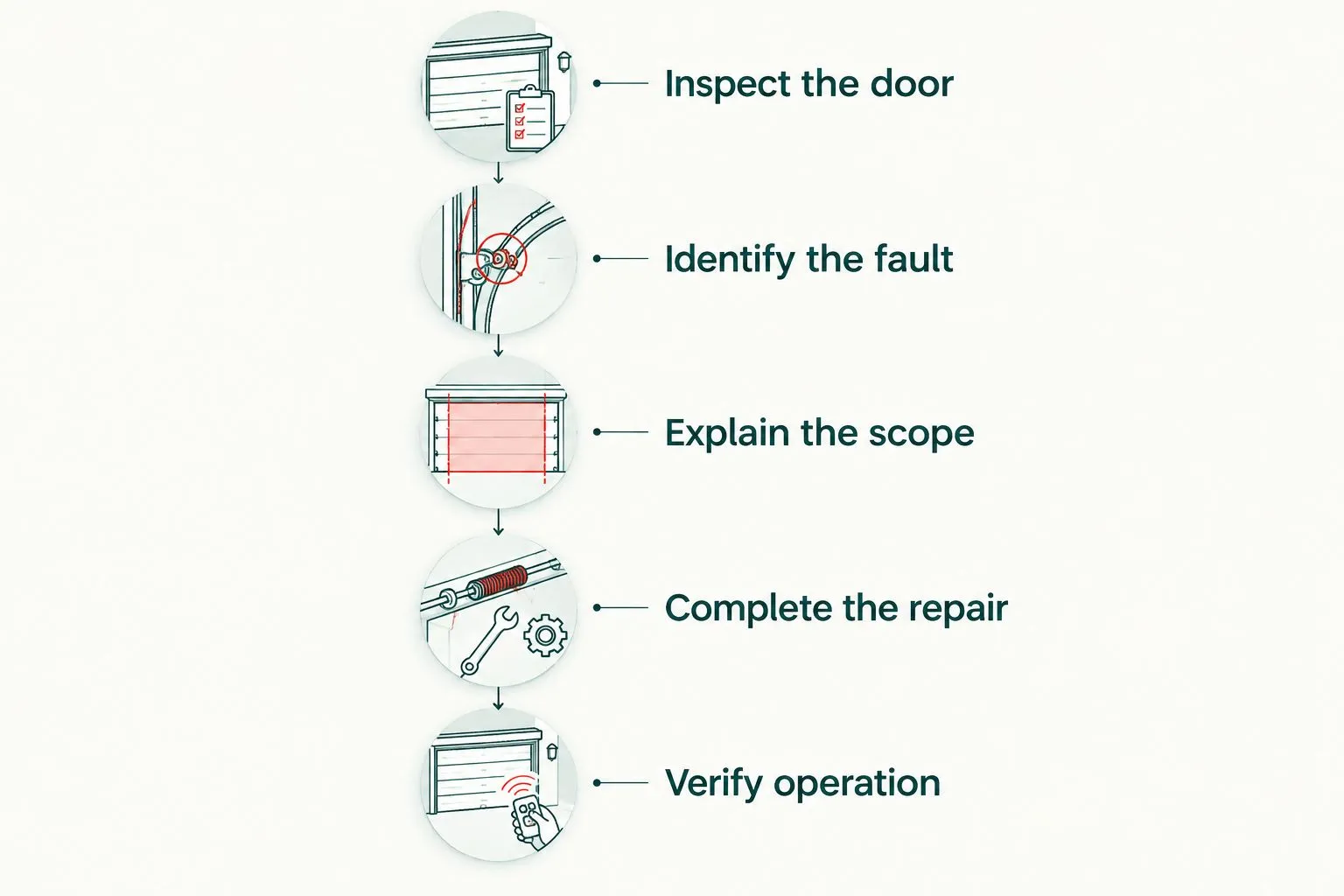
The appointment includes diagnosis and verification, not just the adjustment.
Ask what happens if inspection changes the initial scope. A clear approval process lets you decide whether to proceed without confusing the original appointment description with the final repair plan.
Why garage door balance adjustment time varies
The door’s condition determines the work. Your location identifies where service is needed, but it does not establish how much repair the mechanism requires.
- Spring condition and suitability. An intact spring that needs adjustment presents a different job from a broken spring or a spring unsuitable for the door.
- Cable condition and winding. Frayed, displaced, or uneven cables require investigation before a technician treats the problem as balance alone.
- Track and roller resistance. A door that catches during travel needs the source of resistance identified. Changing spring tension does not repair damaged track hardware.
- Door modifications. Tell the technician about added insulation, replaced panels, or other changes affecting door weight. The counterbalance system must suit the door as it exists now.
- Required replacement components. If inspection identifies failed hardware, ask whether the repair can be completed during the appointment or requires another visit.
- Opener and safety checks. The door’s mechanical condition and the opener’s operation both need attention before the system returns to normal use.
Report previous repairs without assuming they explain the current fault. A recently installed opener, for example, does not prove the door is balanced or that the opener caused the problem.
What can you safely check before the appointment?
Observe from a safe distance; do not create a new test to reproduce a dangerous symptom. You can describe what already happened without running the door again.
Useful information includes whether the door stopped partway, became crooked, made a sudden loud noise, or started straining during normal operation. Note whether the problem began after a panel repair, insulation change, impact, or other known event.
From a safe position, look for a visible gap in an overhead torsion spring, a cable hanging loose, or a roller outside its track. These observations help describe the problem, but they are not a complete diagnosis. Do not climb beside the mechanism or reach toward hardware to get a better view.
Leave an open or partially open damaged door alone and keep people away from the opening. Do not pull the emergency-release handle on a door that appears unstable, has damaged lifting hardware, or has suspected spring failure. Disconnecting the opener can remove support from an unsafe door.
If a cable is visibly displaced, the safety issue takes priority over the appointment length. The guidance on loose garage door cables addresses that related symptom; do not attempt to wind the cable back onto its drum.
How should you prepare your Danville garage for service?
Give the provider your actual service address when booking. Confirm coverage, the arrival window, and whether the appointment is for diagnosis or a previously identified repair. Do not treat an arrival window as a promised completion time.
Clear stored items from the work area only when you can reach them without approaching damaged hardware or passing beneath an unstable door. Keep children and pets away. Tell the provider if the garage is your only practical entry or if a vehicle is trapped inside.
Do not operate a damaged door just to move the vehicle before the appointment. Explain the situation instead so the technician understands the access problem before arrival.
Have any repair paperwork and the opener’s model information ready if they are already accessible. Photos taken from a safe position can help communicate visible conditions, but a photo cannot confirm spring suitability or establish that the door is safe to operate.
Does spring replacement change the appointment scope?
Spring replacement is a repair, not simply a longer balance adjustment. A broken spring needs an appropriate replacement; tightening another component is not a substitute.
Ask the technician to explain why replacement is necessary, which components are affected, and how the completed system will be checked. If additional work is proposed, ask whether it addresses visible damage, compatibility, or a separate operating fault.
The distinction also matters when comparing estimates. Discussions of garage door spring repair costs concern replacement and repair scope, which is different from adjusting intact hardware; a Denver estimate does not establish a Danville quote or appointment duration.
Do not assume that every balance complaint requires new springs. The technician should connect the recommendation to the inspected condition of your door. Likewise, do not insist on adjustment alone when inspection identifies a failed component.
Does an unbalanced door mean you need a new opener?
An unbalanced door does not automatically mean the opener needs replacement. The door’s mechanical condition must be assessed before an operator fault can be separated from excessive resistance or inadequate counterbalance.
Replacing the opener while leaving the underlying door fault unresolved does not correct that fault. Ask whether the door operates correctly independently of the opener under the technician’s controlled assessment.
Derby Strong Garage Doors handles both garage door repair and opener service. That service scope fits homeowners who need the door and operator assessed together; confirm Danville coverage and the specific appointment scope before booking.
The practical limitation remains the same: a service description cannot establish whether your existing opener is repairable or whether parts are needed. Those decisions require inspection and the relevant manufacturer instructions.
What should the technician explain before leaving?
Ask what caused the complaint and whether the completed work was an adjustment, a component repair, or both. You should understand the difference between the original symptom and the diagnosed fault.
Request an explanation of the final checks. These should address the door’s balance and movement, the lifting hardware, and the opener’s applicable safety functions. Follow the manufacturer’s instructions for any homeowner checks recommended after service.
Also ask whether any remaining condition limits use. If the repair is incomplete or the door must remain out of service, get clear instructions rather than assuming that a connected opener means normal operation is safe.
Record what was repaired for future maintenance. A useful service record describes the affected components and completed work, not merely that the door received a tune-up.
Frequently Asked Questions
Can someone tell me the exact balance adjustment time over the phone?
An exact completion time requires a confirmed repair scope. A phone description helps organize the appointment, but inspection determines whether the door needs adjustment, replacement parts, or another repair.
Can I use my garage door while waiting for a balance adjustment?
Do not use a door that is crooked, unstable, unusually heavy, or showing damaged lifting hardware. Keep people clear and ask the service provider how to leave the door secured until inspection.
Will turning up the opener force fix an unbalanced garage door?
Increasing opener force does not fix an unbalanced garage door. The spring system and mechanical components need assessment before opener settings are considered under manufacturer instructions.
Should I pull the emergency release to check the balance myself?
Do not release a door with suspected spring failure, damaged cables, or unstable movement. Have a professional establish that testing is safe before disconnecting the operator.
Does a crooked garage door just need a balance adjustment?
A crooked garage door needs inspection for cable, track, roller, and lifting-system faults. Do not assume spring adjustment alone will correct uneven movement.
Does Derby Strong Garage Doors provide garage door balance repairs in Danville?
Derby Strong Garage Doors provides garage door repair, but you should confirm service availability for your Danville address before booking. Also confirm whether the appointment covers diagnosis and any approved follow-up repair.
What should I ask when scheduling a balance adjustment?
Ask whether the estimate includes inspection, the required repair, and final operating checks. Confirm the arrival window separately from the expected hands-on work and ask how additional repairs receive approval.
One last thing: faster movement is not proof of balance
A door moving under opener power does not prove that its counterbalance system is correct. Before approving the job as complete, ask the technician to explain how balance was assessed separately from powered operation. Judge the result by the diagnosed fault and completed checks, not by how quickly the door opens.