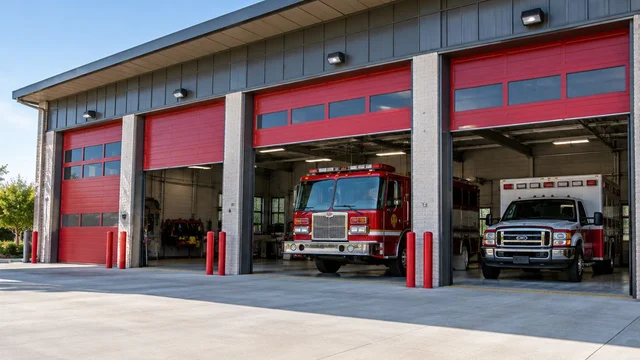
School facility overhead door selection is the process of matching commercial doors, operators, and safety provisions to each opening so staff can move equipment while keeping students away from moving doors. Choose overhead doors for school facilities by the opening’s actual use, available clearance, operating frequency, and exposure—not by appearance alone.
TL;DR
- Choose overhead doors for school facilities by opening use, student separation, clearance, and operating frequency.
- Insulated sectional doors suit conditioned work areas; rolling steel doors require room above the opening.
- Keep spring, cable, track, and operator adjustments professional-only.
- Derby Strong provides commercial overhead door service in Lexington; confirm the scope for your school’s opening.
Why overhead door selection matters for school facilities
A school maintenance bay has different demands from a residential garage. Staff need to move equipment, control deliveries, coordinate contractors, and keep students out of the operating area. A door that fits the opening still needs an operating plan that fits the school.
For a Lexington school facility team, separating pedestrian movement from overhead door operation comes before choosing panels or controls. Write down who uses the opening, what passes through it, and when students or visitors are nearby. Those facts should shape the specification.
Derby Strong provides commercial overhead door services in Lexington. The guide below explains what your staff can document safely, what requires professional assessment, and how to compare repair with replacement without treating every problem as a reason to buy a new door.
How to plan overhead doors for school facilities
Document each opening’s actual job
Start with a simple inventory rather than a product catalog. Create a suggested 1-page record for each opening, including its location within the campus, purpose, users, and known operating problems. Keep the record where both facilities staff and purchasing staff can find it.
Separate a grounds-equipment storage door from a delivery opening or vehicle maintenance bay. Their security, clearance, and operating needs are not interchangeable. A door used occasionally for storage needs a different assessment from one used repeatedly during equipment movements.
For an existing opening, log activity over 5 school days as an initial observation period. Record what actually happens; include seasonal activities separately so a quiet week does not become the entire specification.
- Identify the equipment, carts, or vehicles that pass through.
- Record opening and closing activity without operating a damaged door.
- Note nearby student routes and pedestrian entrances.
- List recurring faults, impacts, and weather-seal problems.
- Identify who authorizes operation and who reports defects.
Separate people from the operating area
Map pedestrian routes before deciding where controls belong. An overhead opening should not become the assumed walking route simply because it is convenient. Ask the school’s facilities and safety personnel to review pedestrian access and applicable egress requirements.
Keep students and visitors away from the door’s travel area. Staff should not walk beneath a moving door, stand under a partly open door, or treat a motionless door as safe when cables, tracks, or panels show damage.
Do not bypass a protective device to keep deliveries moving. If the door reverses unexpectedly, runs crooked, has a loose cable, or shows displaced rollers, stop using it and arrange professional assessment. Use a safe alternate route rather than forcing operation.
- Mark the door travel area on the opening record.
- Identify a separate pedestrian route where available.
- Keep stored materials clear of controls and protective devices.
- Define who can remove a faulty door from service.
- Give staff a clear process for reporting unsafe conditions.
Confirm clearance and mounting conditions
Collect existing drawings, installation records, and equipment information before requesting a site assessment. Staff can photograph the opening from floor level and document visible obstructions without climbing, removing covers, or touching tensioned components.
Record 3 dimensions in inches where they can be obtained safely: clear opening width, clear opening height, and available headroom. Also flag side obstructions and anything occupying the ceiling area. These observations help a contractor prepare; they do not replace installation measurements.
Derby Strong commercial overhead door service is an option for Lexington facility teams seeking professional assessment. Confirm that the proposed scope includes the opening, mounting conditions, door travel, operator arrangement, and any building work that requires separate responsibility.
- Supply existing drawings and the door’s identification information.
- Photograph lights, piping, ducts, and other visible obstructions.
- Identify the largest equipment that must clear the opening.
- Have the installer verify dimensions and mounting requirements.
- Resolve structural questions with the appropriate building professional.
Compare door construction against the opening
Start by listing performance requirements in plain language: retain conditioned air, accommodate equipment, tolerate the intended use, or preserve ceiling space. Then ask which door construction meets those requirements within the building’s constraints.
An insulated sectional door is a starting point for a conditioned work area, not an automatic answer for every school opening. Panel insulation does not correct a damaged perimeter seal, and a door’s published thermal information needs to be compared on a consistent basis.
Rolling steel construction uses a different storage arrangement from sectional construction. It still needs space for its assembly, mounting, operation, and service. The commercial overhead door options for Kentucky warehouses guide offers another commercial comparison, but school pedestrian patterns need their own review.
- Identify whether the space is conditioned or unconditioned.
- Compare the complete assembly, not insulation claims alone.
- Review overhead track space against coiling space.
- Ask how damaged components would be repaired or replaced.
- Keep appearance secondary to fit, safety, and operating needs.
Match the operator and controls to authorized staff
Write down the operating routine before selecting controls. Who opens the door? Can the operator see the opening? What happens when a delivery arrives while the usual staff member is absent? An operating plan should answer those questions without depending on shared personal devices.
Have a qualified installer match the operator, controls, and protective devices to the door and intended use. A residential opener should not be assumed suitable for a school’s commercial overhead door. Suitability depends on the specific equipment and application.
Power-loss operation also needs a documented procedure. Do not disconnect or manually move a damaged or unbalanced door. Have the installer explain the approved procedure for the installed equipment, including situations in which staff must leave the door alone.
- Define which staff roles can operate the door.
- Ask the installer to assess control placement and visibility.
- Include required protective devices in the written scope.
- Request the correct operating manuals and staff instruction.
- Document how authorization changes when staff leave or transfer.
Plan service around the school’s operating schedule
Keep an observation log before the service visit. Record whether a problem occurs during opening, closing, or both, and whether it follows an impact or power interruption. Do not recreate a dangerous fault to obtain a video.
For planned work, give the contractor the school’s delivery windows, equipment needs, and restrictions on work-area access. Confirm how the opening will be secured if work remains incomplete. A service appointment and a complete repair are not necessarily the same milestone.
During handover, review operating instructions, service findings, and unresolved building issues. A suggested 10-minute staff briefing can establish reporting responsibilities, but it does not replace equipment-specific training or the manufacturer’s instructions.
- Assign a school contact and an alternate contact.
- Agree on barriers and separation from school activity.
- Confirm who handles electrical or structural work if needed.
- Retain service records with the opening’s inventory sheet.
- Set inspection and maintenance tasks from the installed equipment’s instructions.
Compare overhead door options for school facilities
Choose construction by the work area, not by a campus-wide preference. Different school buildings—and different openings within one building—can justify different doors. The following options describe general construction choices, not interchangeable specifications.
| Option | Best for | Main advantage | Key limitation |
|---|---|---|---|
| Insulated sectional door | Conditioned maintenance shops or equipment work areas | Combines sectional operation with insulated panels | Tracks occupy interior space; seals and installation still affect thermal performance |
| Non-insulated sectional door | Unconditioned storage where thermal separation is not a priority | Provides a sectional door without making insulation part of the specification | Does not provide the thermal separation of an insulated assembly |
| Rolling steel door | Openings where a coiling arrangement suits the building | Stores the curtain above the opening rather than along horizontal tracks | Needs suitable space, support, and service access around the coil assembly |
A fire-rated requirement is a separate design decision, not an assumed feature of an ordinary steel door. Have the project’s design professional and applicable authority establish whether a rated assembly is required. Do not substitute a standard overhead door for a specified protective assembly.
Decide whether repair or replacement solves the problem
Repair is the right discussion when a specific fault can be corrected and the existing assembly remains suitable for its job. Replacement deserves consideration when the opening’s requirements have changed or the existing system cannot meet them after assessment.
Ask for a diagnosis tied to observed conditions. A noisy door does not establish that the entire assembly needs replacement; a new operator does not correct damaged tracks or an unsuitable opening. Keep the door’s mechanical condition separate from the operator’s condition.
Derby Strong provides commercial overhead door service, but the recommendation for your school should still identify the fault, proposed work, and any remaining limitations. Ask these questions before authorizing either approach:
- What condition is causing the reported problem?
- Which components need work, and why?
- Does the existing opening still suit the equipment using it?
- What building or electrical work falls outside the door scope?
- What limitation would remain after the proposed repair?
Common mistakes school facility teams make
Specifying every campus opening the same way
A grounds-storage building and a conditioned maintenance shop do not share every requirement. Standardize records and purchasing questions, but let each opening’s use determine its specification.
Keeping a faulty door running through a busy period
A delivery schedule does not make a crooked door or loose cable safe. Stop use, separate people from the opening, and arrange professional service instead of repeatedly trying the controls.
Treating insulation as the whole enclosure decision
Insulated panels do not seal a damaged bottom edge or correct a gap caused by another building condition. Assess the complete opening before choosing a thermal upgrade.
Buying an operator before checking the door
The operator is only part of the system. Have the door’s mechanical condition assessed first; never increase opener force to overcome binding, damage, or a balance problem.
Finishing installation without assigning responsibility
A handover package is not useful if nobody owns it. Name the staff member responsible for operating instructions, defect reports, service records, and changes in authorized users.
Frequently Asked Questions
What are the best overhead doors for school facilities?
The best overhead doors for school facilities match each opening’s use, clearance, operating frequency, and safety requirements. Insulated sectional doors suit conditioned work areas, while other constructions require a separate fit assessment.
Should a school choose sectional doors or rolling steel doors?
Choose between sectional and rolling steel doors by the available space and the opening’s requirements. Sectional doors use tracks, while rolling steel doors need space and support for the coiling assembly above the opening.
Can school maintenance staff repair an overhead door spring or cable?
School maintenance staff should leave spring, cable, track, bracket, and other high-tension repairs to qualified door professionals. Staff can document visible conditions from a safe position and keep people away from the affected opening.
What should a school do if an overhead door reverses or runs crooked?
Stop using a school overhead door that reverses unexpectedly or runs crooked and arrange professional assessment. Keep students and staff away, and do not bypass protective devices or increase operator force.
Does an insulated overhead door fix drafts in a school maintenance building?
An insulated overhead door does not by itself fix drafts around the opening. Perimeter seals, the bottom seal, installation conditions, and the surrounding building enclosure also need assessment.
Can a school keep its existing operator when replacing an overhead door?
A school can retain an existing operator only after its condition and compatibility with the replacement door and application are confirmed. Ask the installer to assess the complete system rather than assuming the old operator will suit the new door.
Does Derby Strong provide commercial overhead door service in Lexington?
Derby Strong provides commercial overhead door services in Lexington. School facility teams should confirm the scope for their particular opening, including any separate electrical, structural, or design responsibilities.
One Last Thing Before You Decide
Specify the handover, not just the hardware. Before authorizing work, require an opening-specific record of the installed equipment, operating instructions, service responsibilities, and unresolved issues. That record helps the next facilities employee understand the door without relying on someone else’s memory.
Related Garage Door Guides
- Commercial garage door repair timing in Louisville
- Garage door maintenance checklist
- Garage door insulation upgrades in Kentucky
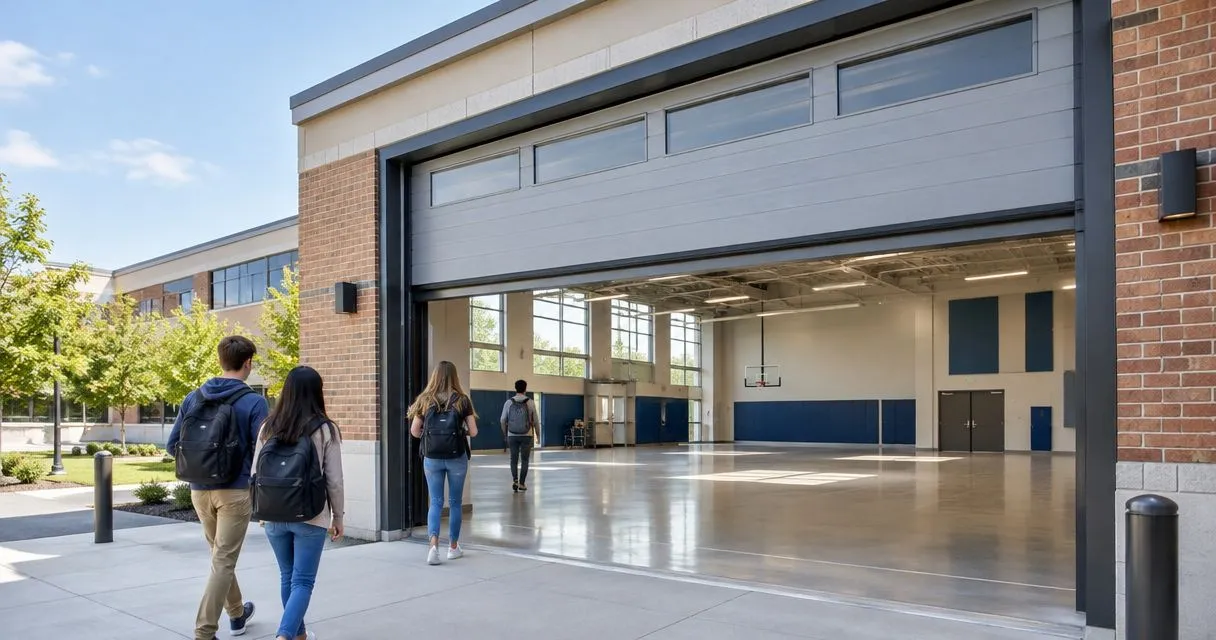
AI-generated illustration; not a Derby Strong customer project.