Commercial garage door repair in Louisville has no dependable fixed duration before the door is inspected: diagnosis, the required work, and final safety testing determine the repair time. Your business’s total interruption also includes getting the bay ready for service and resolving any replacement-component requirements—not just the technician’s hands-on work.
TL;DR
- Commercial garage door repair time Louisville businesses can plan around requires an inspection, a defined repair scope, and safety testing.
- Derby Strong provides commercial overhead door service in Louisville; describe the affected bay and operating problem when requesting service.
- Separate the service appointment, hands-on repair, and permission to resume door operation.
- Stop using a crooked, off-track, or visibly damaged door; do not force it open.
Why This Matters for Your Door
A disabled overhead door can interrupt vehicle movement, deliveries, or access to a work area. But a door that moves again is not automatically ready for normal business use. Plan around a safe return to operation, not the first successful opening.
Derby Strong provides commercial overhead door service in Louisville. When you request service, explain what the affected opening does for your business: vehicle entry, loading, storage access, or another function. That information helps define the operational problem without substituting for a mechanical inspection.
How long does commercial garage door repair take in Louisville?
The repair timeline becomes useful when it identifies the actual fault, the work required, and the conditions for reopening the bay. A symptom such as reversing, grinding, or refusing to open does not establish a completion time by itself.
Ask for the timeline in this order:
- Initial assessment: Identify the door, its symptoms, visible damage, and any immediate safety concerns.
- Repair scope: Establish whether the problem involves controls, the operator, moving hardware, the door structure, or several connected components.
- Work requirements: Confirm the matching components, equipment, access, and work-area isolation needed to complete the repair.
- Repair and testing: Complete the work and check the door’s operation and applicable safety devices.
- Operational handoff: Explain whether normal use can resume and document any remaining restrictions.
Do not combine these milestones into a single vague promise. An appointment confirms when an assessment is scheduled; it does not establish when the door will be ready for unrestricted use.
| Repair situation | What determines the work | Best for planning | Main limitation |
|---|---|---|---|
| Control or operator fault | Identifying the failed control, operator component, or related mechanical problem | Defining whether powered operation can be restored | An apparent electrical symptom does not rule out a door problem |
| Spring, cable, roller, or track fault | Inspecting the lifting system, alignment, and connected hardware | Establishing a professional repair scope before reopening | Moving a damaged door can create additional hazards |
| Impact or panel damage | Checking the damaged section, tracks, attachments, and overall movement | Deciding whether a targeted repair is appropriate | Visible damage alone does not establish the full repair scope |
Use the diagnosed condition—not the symptom’s apparent simplicity—to set your reopening plan. A remote-control problem and a door that cannot move safely require different decisions, even if both initially appear as a door that will not open.
Control and operator faults: confirm the cause first
If a commercial overhead door does not respond to a control, describe exactly what happens. Report whether the operator makes a sound, whether the door moves at all, and whether the problem affects every normal control or only a particular device. Do not repeat tests if the door behaves abnormally.
The benefit of an isolated control repair is that it addresses the operating problem without replacing an otherwise serviceable door. The limitation is diagnostic: a nonresponsive or reversing operator does not prove that the controls are the only fault.
Best for: an inspection-led repair decision when the door has no obvious impact damage but powered operation is unreliable. Have a technician distinguish the control issue from a mechanical obstruction or lifting-system problem before treating the job as straightforward.
Spring, cable, and track faults: safety sets the sequence
A crooked door, loose cable, displaced roller, or damaged track changes the immediate priority. Keep people and vehicles away from the opening and request professional assessment. Do not pull the emergency release on a raised or visibly damaged door.
Spring and cable repairs involve stored energy and heavy moving components. Track and bracket work can also affect how the door is supported. These are professional-only repairs, not tasks for maintenance staff to improvise while waiting for service.
Best for: professional repair after the lifting and guiding systems have been assessed. Targeted component replacement can address a specific fault, but it must not leave related damage or an unresolved cause behind.
A short-looking repair is not a reason to skip inspection. Ask whether the failed component was the original problem or a consequence of misalignment, impact, or another defect.
Impact damage: assess more than the dent
If a vehicle or load has struck the door, report the impact before anyone attempts to operate it. Describe whether the door was open, closed, or moving and identify any visibly displaced section or track from a safe position.
A localized repair preserves serviceable parts of the existing door. Its limitation is that the damaged section must be assessed alongside the tracks, attachments, and other affected components; a cosmetic improvement alone does not establish safe operation.
Best for: a repair-versus-replacement assessment when damage is concentrated in a particular area. Do not assume that every dent requires a new door—or that every damaged panel can be repaired independently.
Why commercial overhead door repair time varies
These factors explain why an inspection-based schedule is more useful than a blanket completion promise:
- Fault identification: Similar symptoms can come from different causes. Reversing, for example, requires diagnosis rather than an assumption about a single component.
- Extent of damage: A fault affecting connected parts requires a different scope from an isolated defect. Impact damage needs particular attention beyond the visible mark.
- Component matching: Replacement parts must suit the door and operator. Clear identification helps establish the correct repair requirements.
- Work-area access: Vehicles, stored materials, and active loading operations can obstruct the space needed for safe service.
- Final testing: The job includes checking operation after repair. Restoring movement is not a substitute for checking the completed work.
For a Louisville business, the practical question is which operations depend on that particular opening. Tell the service provider whether isolating the bay also interrupts a loading route, a vehicle exit, or access to equipment.
Do not assume that another opening solves the problem. Your own facility procedures must determine whether a different route is suitable for the vehicles, loads, and people using it.
What can you safely do before the technician arrives?
Prepare information and clear access; leave mechanical intervention to the technician. Your goal is to make the assessment easier without moving a damaged door or exposing staff to the opening.
Describe the last normal operation
Write down when the problem first appeared and what happened immediately beforehand. Useful observations include a reported impact, a new noise, incomplete travel, repeated reversal, or a control that stopped responding. Record what you already observed; do not recreate the failure for a video.
Gather identification without climbing
Look for door and operator identification only where you can read it safely from floor level. Existing equipment records, prior service documents, or a clearly visible label can help identify the system. Do not climb, remove covers, or reach around moving components to obtain details.
Clear the approach, not the mechanism
Move vehicles and stored materials away only when you can do so without passing beneath a damaged or unstable door. Keep the opening and its controls out of normal use until the condition is assessed. Never wedge, prop, or force the door to keep business moving.
A clear service area helps the technician inspect the door without first working around stored goods or parked equipment. This illustrative scene shows the access condition to aim for—not a Derby Strong customer property.
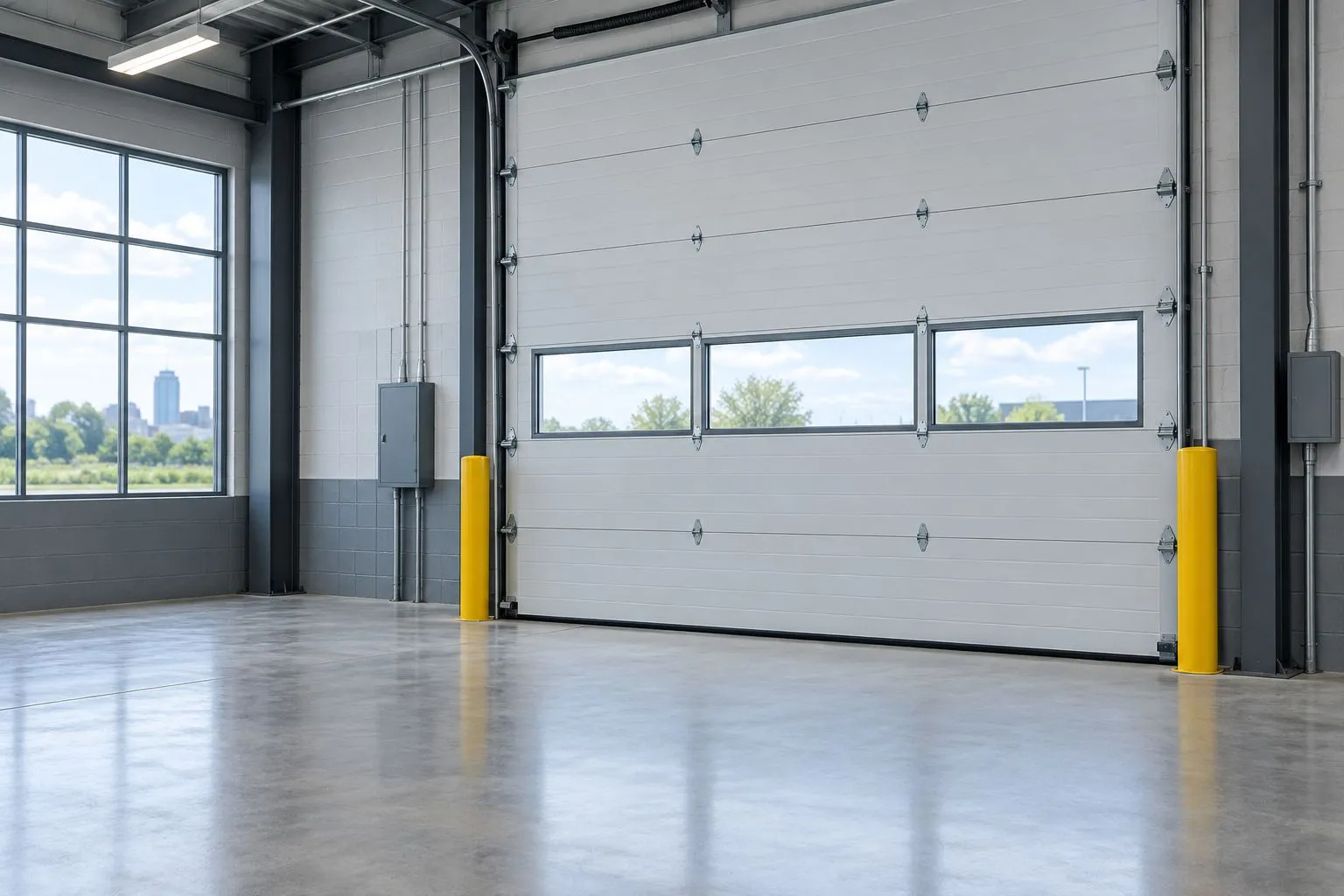
Illustrative image: keep the service area clear without moving a damaged door.
Assign a site contact
Choose someone who can explain the symptoms, provide access, approve the agreed work, and receive the handoff. Make sure that person knows which operations depend on the affected bay. Avoid having different employees repeatedly operate the door while trying to demonstrate the problem.
Can your business keep using the door while waiting for repair?
Do not keep operating a crooked, off-track, visibly damaged, or unpredictably moving door. Keep people away from its travel path and have the condition assessed before resuming use.
For an urgent condition, the Louisville emergency garage door repair guide provides related safety context. An urgent service request still needs a clear distinction between assessment, securing the opening, completing the repair, and returning the door to operation.
If the door is the only practical route for essential business activity, explain that constraint when requesting service. Do not attempt a manual workaround unless a qualified professional has assessed the door and provided instructions appropriate to that equipment and condition.
Does repairing the operator mean the whole door is ready?
Repairing the operator does not, by itself, establish that the complete overhead door system is ready for use. The door’s movement and applicable safety devices still need to be checked after the repair.
Ask what was repaired, what was tested, and whether any restrictions remain. Never increase operator force or bypass a safety device to overcome an unresolved fault.
When should you ask about replacement instead of repair?
Ask about replacement when the inspection identifies damage or condition issues that a targeted repair would not adequately resolve. Require a clear explanation of what can be retained and what cannot.
Repair avoids replacing serviceable equipment; replacement changes a larger part of the installation and requires its own planning. Neither choice should be based solely on a hoped-for reopening time. Compare the proposed scope and the reason behind it before authorizing work.
What should the completion handoff include?
Before putting the bay back into service, ask the technician to explain the completed work and demonstrate operation when it is safe to do so. The handoff should distinguish a completed repair from an assessment, a temporary restriction, or a recommendation for further work.
Keep a written record of the reported fault, repaired components, remaining recommendations, and operating instructions. Give those instructions to the staff who actually use the door—not just the person who approved the service.
Derby Strong is a service option for Louisville businesses needing commercial overhead door repair. When requesting work, focus on the affected opening, the symptoms, and the conditions required for your business to resume using it safely.
Frequently Asked Questions
How long will my commercial garage door repair take in Louisville?
A dependable repair timeline requires inspection, a defined work scope, and safety testing. Ask separately about the assessment appointment, the repair requirements, and when the bay can return to normal use.
Can a commercial overhead door be repaired during the first visit?
A first visit does not automatically mean a completed repair. Completion depends on the diagnosed fault, required components, work access, and successful testing; confirm the scope rather than assuming a deadline.
Does a door that will not open always need a new operator?
A door that will not open does not automatically need a new operator. Controls, the operator, and mechanical door components require diagnosis before choosing the repair.
Can employees open a commercial door with a broken spring?
Employees should not attempt to open a commercial door with a broken spring. Keep the opening out of use and leave spring, cable, and related high-tension work to a professional.
What should I send when requesting commercial overhead door service?
Send a clear description of the symptoms, any known impact, and safely obtained door or operator identification. Explain how the affected opening is used and do not recreate a dangerous fault to record it.
Can we keep using the door if it still opens?
A door that still opens is not necessarily safe to keep using. Stop operation if it is crooked, off track, visibly damaged, or moving unpredictably, and request professional assessment.
Does Derby Strong service commercial overhead doors in Louisville?
Derby Strong provides commercial overhead door service in Louisville. Describe the affected bay and its operating problem when requesting service; confirm the repair scope and scheduling details directly.
One Last Thing Before You Decide
Ask this before you resume business as usual: “Is the door ready for normal operation, or has only the immediate problem been addressed?” The answer is more useful than knowing when the technician packed up. Make the operational handoff—not the departure time—your reopening checkpoint.