Commercial overhead door installation cost in Erlanger depends on the opening, the door itself, the opener, and the install work — so a written quote for your exact building is the real basis for your budget. The door is only part of the total. Removal, track changes, wiring, and opening repairs each need their own line. Compare full installed jobs, not just door prices.
TL;DR
- Commercial overhead door installation cost in Erlanger, KY depends on the full job — not just the door.
- Derby Strong Garage Doors installs and services commercial overhead doors for Northern Kentucky businesses.
- Compare door build, track layout, opener needs, removal, and what’s left out before you pick a quote.
- Keep repair on the table when your current door still fits the job.
Why This Matters for Your Door
An Erlanger business needs a working door, not just a new one dropped off at the building. A quote that skips wiring, damaged framing, or hauling away the old door is not the same job as one that covers all of it.
Derby Strong Garage Doors installs and services commercial overhead doors for Northern Kentucky businesses. This guide shows you how to define your project, compare quotes side by side, and decide if replacement makes sense — instead of treating a generic online number as your real budget.
How much does commercial overhead door installation cost in Erlanger?
Your budget should cover everything needed to get the door up and running. Ask for one total price tied to a measured opening and a written scope. A list of parts alone leaves too many questions open.
Use this list to check any 2026 quote. Each line should say what’s included, what’s left out, or what another contractor will handle.
| Quote line | What it should say | What to ask |
|---|---|---|
| The door | Build, size, insulation, and glass if any | Does this door actually match how you use the building? |
| Tracks and hardware | Track layout, mounting, and balance parts | Does old equipment stay, or does it get replaced? |
| Opener and controls | Manual or powered, plus the controls used | Is installing the opener part of this price? |
| Install work | Removal, setup, mounting, adjusting, and testing | Does this cover the whole job start to finish? |
| Building prep | Shape and condition of the opening | Who fixes framing, brick, or other building work? |
| Wiring | Power needs and who connects it | Do you need to hire an electrician separately? |
| Hauling away the old door | Getting rid of the old door and job debris | What’s left for you to deal with? |
| Finishing up | A working test and any paperwork | What counts as a finished, ready-to-use door? |
Don’t assume a blank line means it’s included. Ask the contractor to mark each one clearly before you sign off.
Door-only supply versus complete installation
A door-only quote covers just the equipment. A full installation quote also covers the work to fit and get that equipment running at your building. Neither label tells the whole story — read the actual scope.
| Quote type | Best for | What’s good about it | What’s missing |
|---|---|---|---|
| Door-only supply | Jobs where install is already set up elsewhere | Splits buying the door from the labor | You still coordinate the install yourself |
| Full installation | Owners who want one clear, complete scope | Makes it easier to compare equipment and labor | Still needs written notes on what’s left out, like wiring or building work |
| Repair quote | A door with one fixable problem | Fixes the actual issue, no full swap needed | Won’t fix other wear or a door that’s simply wrong for the job |
For a business that’s open and running, figure out who manages the install around your work hours. A good quote explains access needs and who’s responsible, instead of leaning on a vague promise that it’ll “get done.”
Pick the quote that leaves you with the fewest loose ends — not just the shortest parts list. Even a “full” quote can leave things out, so ask exactly where the installer’s job stops.
Sectional versus rolling overhead doors
Sectional doors run on tracks, with panels moving up and over the opening. Rolling doors coil up above the opening. Because they move differently, each needs its own check of the space and the support it needs.
| Door type | Best for | Real advantage | What to weigh |
|---|---|---|---|
| Sectional overhead door | Openings with room for an overhead track | A solid option when your ceiling has room for tracks | Tracks need a clear path to move inside the building |
| Rolling overhead door | Openings where coiling up makes sense | Keeps the rolled-up door close to the opening | Still needs checks on coil space and mounting support |
Neither type is automatically the right pick for every business. Ask your installer why the one they suggest fits your clearance, your daily use, and your building.
Switching door types isn’t just a style change. It changes the whole setup, so any alternate quote should show the extra install work — not just swap out the door description.
Why commercial overhead door installation cost varies
The fair comparison is between equal jobs. Here’s what changes the price:
- Size and condition of the opening. The installer needs your real opening and mounting conditions — not a guess based on how the old door looked.
- How the door is built. Insulation, glass, and other build choices change what you’re buying. Only ask for features your space actually needs.
- Tracks and clearance. Ceiling obstacles, headroom, and how the door needs to move all affect the setup.
- The opener. Manual and powered doors need different equipment and different work. If you want to reuse an opener, it needs a compatibility check first.
- Removal and building prep. Clearing out old equipment, fixing damaged mounting spots, and other repairs belong in the scope talk.
- Keeping your business running during install. Vehicle traffic, stored goods, and daily use of the opening all affect how the job gets scheduled.
Separate what’s required from what’s just nice to have. That split lets you compare a solid basic job against a fancier one without losing track of what both actually include.
What should the installer check at your Erlanger building?
The site visit should connect the door you want to your actual opening. Send the building address and point out the exact bay, especially if your property has more than one overhead door.
Ask the installer to write down the opening’s size, the headroom above it, the side space, and anything in the way inside. That includes lights, beams, shelving, or other equipment near where the door moves.
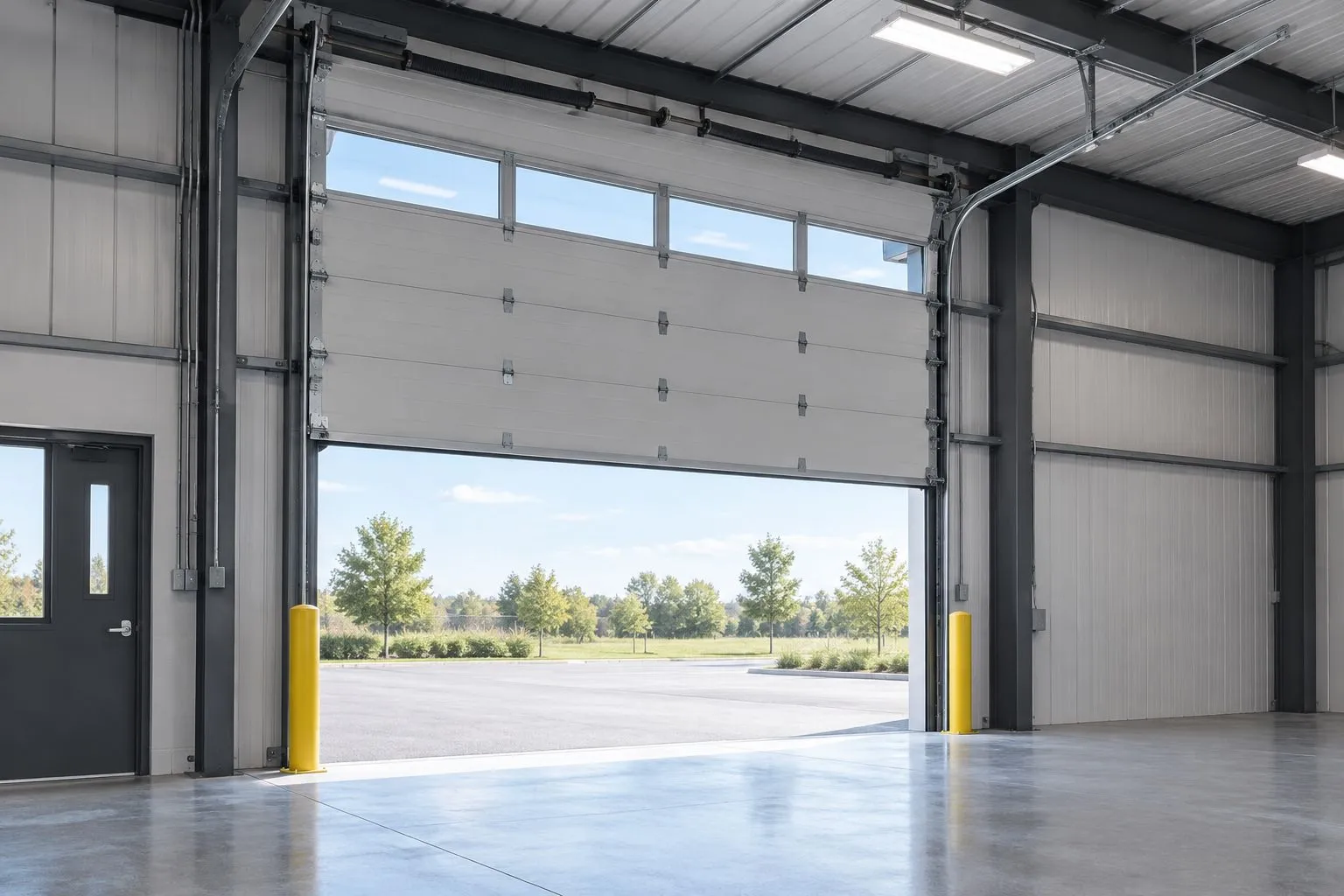
Sample photo: the door’s path and ceiling space both need a check during the site visit.
Clearance deserves its own check because a new door has to fit the building, not just the opening. Our guide on fitting a new door under a low Northern Kentucky garage ceiling covers the basic clearance question — but a commercial job still needs its own measurements and its own check.
If the opening or the wall around it needs work, find out who checks and does that work before you order anything. Ask your contractor which permits or approvals apply to your actual project — don’t assume every Erlanger door job follows the same steps.
How do you compare commercial door installation quotes fairly?
Start every contractor with the same project description. Explain how you use the opening, what’s wrong with the current door, and whether you want repair looked at alongside replacement.
- Match the opening and the door. Check size, build, insulation, and any glass. Different builds are not the same offer.
- Match how it operates. Check the track layout, opener, controls, and any plan to reuse equipment.
- Match what’s included. Compare removal, install, adjusting, testing, hauling away, and building prep line by line.
- Sort out what’s excluded. Find out who handles wiring, wall or frame repairs, or anything else outside the door contractor’s job.
- Check what counts as done. Ask what tests, handover notes, and cleanup each quote includes.
Keep optional add-ons separate from the base job. For example, an insulation upgrade shouldn’t hide whether both quotes cover the same install and removal work.
A cheaper quote isn’t really cheaper if it leaves work for you to handle. Sort out the differences in writing instead of guessing after you’ve already said yes.
Can you keep the existing commercial door operator?
You can reuse your opener only after the installer checks that it suits the new door and how you’ll run it. Just because it still works now doesn’t mean it belongs in the new setup.
Ask for that reuse decision in writing, in the quote. It should cover fit, condition, and the controls or safety parts the job needs.
Reusing gear has a real upside: good equipment stays in service. But it has a real limit too — keeping the opener won’t fix other wear, a bad setup, or problems elsewhere in the system.
Never crank up opener force to push through a door that sticks or won’t move right. Get the mechanical problem checked instead of asking the opener to force it.
Should you repair the existing commercial overhead door instead?
Keep repair on the table when the problem is clear and the door still fits the job. Replacement should solve a real, specific need — not be the default answer to every problem.
| Choice | Best for | Why consider it | Limit |
|---|---|---|---|
| Targeted repair | One fixable problem on a door that’s otherwise fine | Solves the actual issue | Leaves other wear and age untouched |
| Door replacement | A door whose condition or build no longer fits your needs | Lets you pick the right build for your opening and use | Needs a full, defined install scope |
| Opener work | A good door with an opener problem | Keeps the fix focused on the opener | Won’t fix damaged door parts |
Ask your contractor to separate what they found from what they’re suggesting. “The cable is damaged” is a finding. A clear reason why the whole door also needs replacing is a different, separate case they should make.
Derby Strong Garage Doors handles both commercial overhead door service and full installs. Ask for a recommendation that matches the actual problem, with repair and replacement clearly separated when both make sense.
What can you safely prepare before installation?
You can make your site visit more useful without touching any moving parts. Take photos from a safe spot, describe what the door is doing wrong, and note anything blocking the way to the opening.
Write down if the door stops, reverses, makes odd noise, or shows damage. Don’t run a damaged door over and over to “test” it, and don’t stand under a door that’s unstable or stuck halfway open.
Before work starts, agree on a clear work area and a plan for vehicles, deliveries, and staff who use that opening. Tell the installer about anything your business needs to keep that bay open and working.
Springs, cables, tracks, brackets, and other tensioned parts need a trained pro. Don’t loosen hardware, try to adjust the balance, or force a door back onto its track yourself.
Frequently Asked Questions
How much does commercial overhead door installation cost in Erlanger, KY?
It depends on the door you pick and the work your opening needs. Ask for a measured, written quote that lists equipment, labor, removal, and anything left out.
Does a commercial overhead door installation quote include the operator?
Only if the quote clearly says so. Ask whether it covers a new opener, reusing your current one, or manual operation with no opener at all.
Is a rolling overhead door better than a sectional door for my business?
Neither one is better for every business. Compare your opening, clearance, mounting needs, and how you’ll use it before choosing.
Can I reuse my commercial overhead door tracks?
Only if an installer confirms they fit the new door and are still in good shape. Don’t assume old tracks are fine just because the old door ran on them.
Should I repair my commercial overhead door before replacing it?
Look at repair first if the problem is fixable and the door still fits the job. Ask the contractor to explain clearly why replacement would be the better call.
What should I send before a commercial overhead door site visit?
Send the address, the exact bay, safe photos, and a description of the problem or the change you want. Leave the final measuring and equipment matching to the installer.
Does Derby Strong Garage Doors handle commercial overhead doors?
Yes. Derby Strong Garage Doors installs and services commercial overhead doors for Northern Kentucky businesses. Describe your opening and the work you need when you reach out.
One Last Thing Before You Decide
Ask each contractor one question before you say yes: “What would still be my job to handle before this door actually works?” The answer shows the gap between buying a door and finishing an install.
Get that answer written into the scope. Your Erlanger project needs a clear split of who does what — not surprises after the old door is already gone.
Related Garage Door Guides
- Commercial overhead door options for Kentucky warehouses
- Commercial opener types for Jeffersontown buildings
- R-value versus U-factor for Northern Kentucky door buyers
Local service: Commercial garage door repair in Northern Kentucky