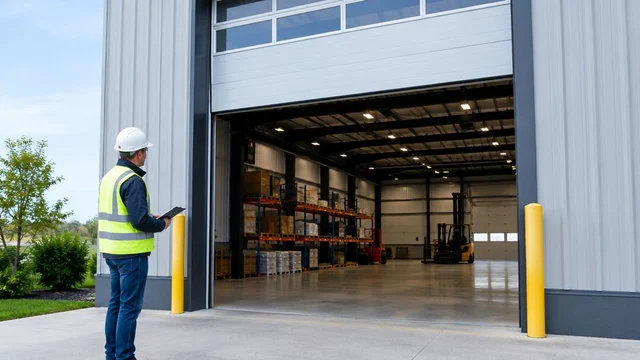
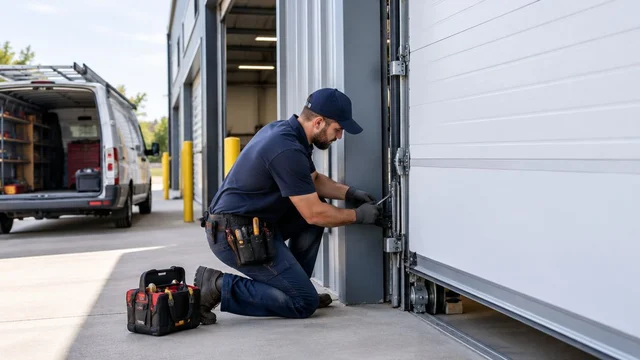
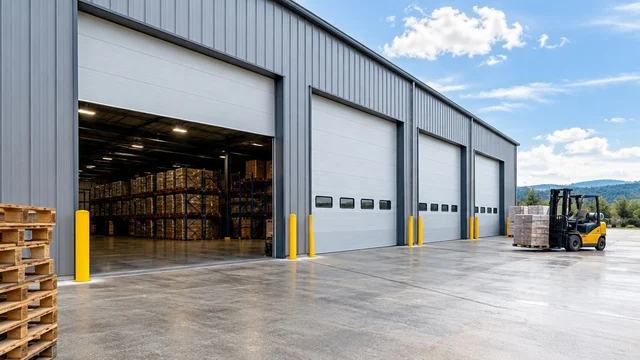
Best overall: insulated steel sectional doors. Best for restricted overhead track space: rolling steel doors. Best for daylight and customer visibility: full-view aluminum doors. For Kentucky auto repair shops, choose the door around vehicle clearance, lift placement and daily operation—not appearance alone.
TL;DR
- For commercial garage doors, Kentucky auto repair shops should start with insulated steel sectional doors for conditioned service bays.
- Rolling steel doors suit openings where overhead sectional tracks conflict with shop equipment, subject to coil clearance.
- Full-view aluminum doors prioritize daylight and visibility; compare glazing, privacy and whole-door thermal performance.
- Derby Strong provides commercial overhead door services; request an opening-specific assessment before choosing a replacement.
Why This Matters for Your Door
A shop door has to clear the vehicles you service and the equipment you use. A door that fits the masonry opening can still interfere with a vehicle lift, ceiling-mounted equipment or the route technicians use around a bay.
Derby Strong is a commercial overhead door service option for auto repair shop owners in Louisville, Lexington and Northern Kentucky. Use this guide to narrow the door construction, then contact Derby Strong for an assessment of the actual opening and operating requirements.
Replacement is not automatically the answer. If the existing door meets your clearance and workflow needs, a repair assessment should come before a new-door decision.
What makes the best commercial garage door for an auto shop?
Judge the complete installed system against these criteria before comparing finishes or window layouts:
- Clear opening: The usable opening must accommodate the tallest and widest vehicles your shop accepts, including roof-mounted equipment.
- Equipment clearance: Tracks, springs, the operator and the open door must clear lifts, lights, ducts and other overhead obstructions.
- Operating duty: Specify expected opening frequency and busy-period demand so the door hardware and operator match the workload.
- Thermal performance: For conditioned bays, compare documented whole-door performance, perimeter seals and glazing—not insulation claims alone.
- Repairability: Ask how damaged sections, curtain components, glazing and operating hardware are serviced on the proposed assembly.
- Safe operation: Have the installer specify suitable controls, entrapment protection and release arrangements using current manufacturer instructions.
No single material wins every category. A clear-view door can improve sightlines while creating privacy concerns; a rolling door removes horizontal sectional tracks but still needs space for its coil and operating equipment.
Commercial garage doors at a glance
| Rank and door type | Best for | Standout feature | Key limitation |
|---|---|---|---|
| 1. Insulated steel sectional | Conditioned general-repair bays | Insulated panels with configurable glazing and track arrangements | Open door and tracks occupy overhead space |
| 2. Rolling steel | Bays with overhead track conflicts | Curtain coils above the opening instead of traveling along horizontal sectional tracks | Coil, guides and operator need verified clearance |
| 3. Full-view aluminum | Customer-visible service bays | Broad glazed areas provide daylight and visibility | Glazing affects privacy, thermal performance and repair requirements |
| 4. Uninsulated steel sectional | Unconditioned utility bays | Sectional construction without an insulated panel core | Poor fit when temperature control is a priority |
These are construction categories, not interchangeable specifications. Insulated rolling doors and sectional doors with partial glazing also exist; assess the actual proposed assembly rather than treating a category name as a complete specification.
1. Insulated steel sectional: best for conditioned repair bays
Insulated steel sectional doors use hinged panels that travel along tracks. They are the default shortlist choice when you heat or cool the service bay and need a practical balance of enclosure, visibility and service access.
The track arrangement matters as much as the panels. A standard overhead path that works in an empty building can conflict with a raised vehicle or lift once the bay is equipped.
Insulated steel sectional pros:
- Insulated panels suit temperature-controlled workspaces.
- Window placement can provide visibility without making the entire door glazed.
- Sectional construction allows assessment of individual damaged panels for possible replacement.
- Different track arrangements can address building constraints when properly designed.
Insulated steel sectional cons:
- Tracks and the open door occupy overhead space.
- Panel insulation does not eliminate leakage around worn or poorly fitted seals.
- Replacement sections must match the existing assembly; compatibility requires verification.
Best for: General mechanical repair bays where staff work throughout the day and indoor temperature control matters.
Ask for the proposed door’s documented thermal data and an explanation of whether it describes the panel or the complete assembly. Also ask the installer to show the open-door position relative to your lifts—not just a closed-door elevation.
Verdict: Buy for a conditioned repair bay once lift, track and operator clearances are confirmed.
2. Rolling steel: best for overhead track conflicts
Rolling steel doors use an interlocking curtain that coils above the opening. Unlike a conventional sectional door, the curtain does not rest on horizontal tracks extending into the bay.
That distinction matters when overhead space is already committed to equipment. It does not mean a rolling door fits every tight opening: the coil, hood, guides and operator still require room.
Rolling steel pros:
- Avoids horizontal sectional tracks extending back into the shop.
- Keeps the stored curtain near the opening.
- Offers a different installation layout when sectional tracks conflict with equipment.
Rolling steel cons:
- The coil assembly requires space above the opening.
- Side guides and operating equipment affect installation clearance.
- Insulation and operating-duty specifications vary by assembly and must be checked.
Best for: A repair bay where a measured equipment conflict makes a conventional sectional track layout unsuitable.
Do not choose rolling steel solely because someone describes it as heavy-duty. Ask for the documented operating duty, operator requirements and maintenance instructions for the exact proposed door.
Verdict: Buy when the measured layout favors a coiling curtain; hold until coil and side clearances are verified.
3. Full-view aluminum: best for customer-visible service bays
Full-view aluminum doors combine an aluminum frame with broad glazed sections. They suit repair bays where daylight and visibility are part of the intended use, such as a customer-facing service frontage.
Glass is a functional specification, not just a design choice. Visibility, impact exposure, privacy and thermal performance all depend on the selected glazing and complete door construction.
Full-view aluminum pros:
- Broad glazed areas admit daylight while the door remains closed.
- Visibility helps staff see activity across the closed opening.
- Glazing choices let you address transparency and privacy requirements.
Full-view aluminum cons:
- Clear glazing exposes vehicles, tools and work activity to outside view.
- Thermal performance depends on the frame and glazing configuration.
- Glazing adds cleaning and potential replacement needs.
Best for: A customer-visible repair bay where daylight and sightlines justify the glazing requirements.
Ask for the exact glazing description and applicable safety documentation. Do not assume that a visually similar door provides the same thermal performance or impact characteristics as another assembly.
Verdict: Buy when visibility serves the shop’s workflow; skip when privacy or thermal performance is the overriding requirement.
4. Uninsulated steel sectional: best for unconditioned utility bays
Uninsulated steel sectional doors use hinged steel sections without an insulated panel core. They belong on the shortlist for enclosed utility or storage areas where maintaining indoor temperature is not the main objective.
This is not the default recommendation for a staffed, conditioned repair bay. Choose it because the space’s use supports it, not because insulation seems optional during a brief site visit.
Uninsulated steel sectional pros:
- Provides sectional overhead operation for an unconditioned enclosure.
- Avoids specifying an insulated core where temperature control is unnecessary.
- Can include glazing when the proposed assembly supports it.
Uninsulated steel sectional cons:
- Does not provide the insulated panel construction of the leading choice.
- Still requires overhead track and open-door clearance.
- Becomes a poor fit if the space later needs consistent temperature control.
Best for: Unconditioned utility bays separated from the shop’s conditioned working area.
Review the bay’s planned use before ordering. A utility space converted into a staffed repair area creates different enclosure requirements even when the opening stays unchanged.
Verdict: Buy for a genuinely unconditioned utility bay; skip for a conditioned main repair bay.
Check the opening against the way your shop works
Before selecting a door, document the opening and its surroundings from floor level. Leave technical measurements around springs, tracks and operating equipment to the installer; do not climb on or adjust the door assembly.
Have the site assessment cover these areas:
- Vehicle envelope: Include mirrors, roof racks, service equipment and the largest vehicle you intend to accept.
- Lift clearance: Identify where raised vehicles and lift components sit relative to the door’s travel path.
- Ceiling obstructions: Note lights, ducts, piping and equipment near the opening.
- Side clearance: Keep storage, workbenches and equipment from obstructing guides, controls or service access.
- Floor condition: Point out uneven surfaces or water entry rather than expecting a new bottom seal to correct every problem.
A closed-door photograph alone does not show the working clearance. Provide a wider interior view that includes the lift, ceiling and both sides of the opening.
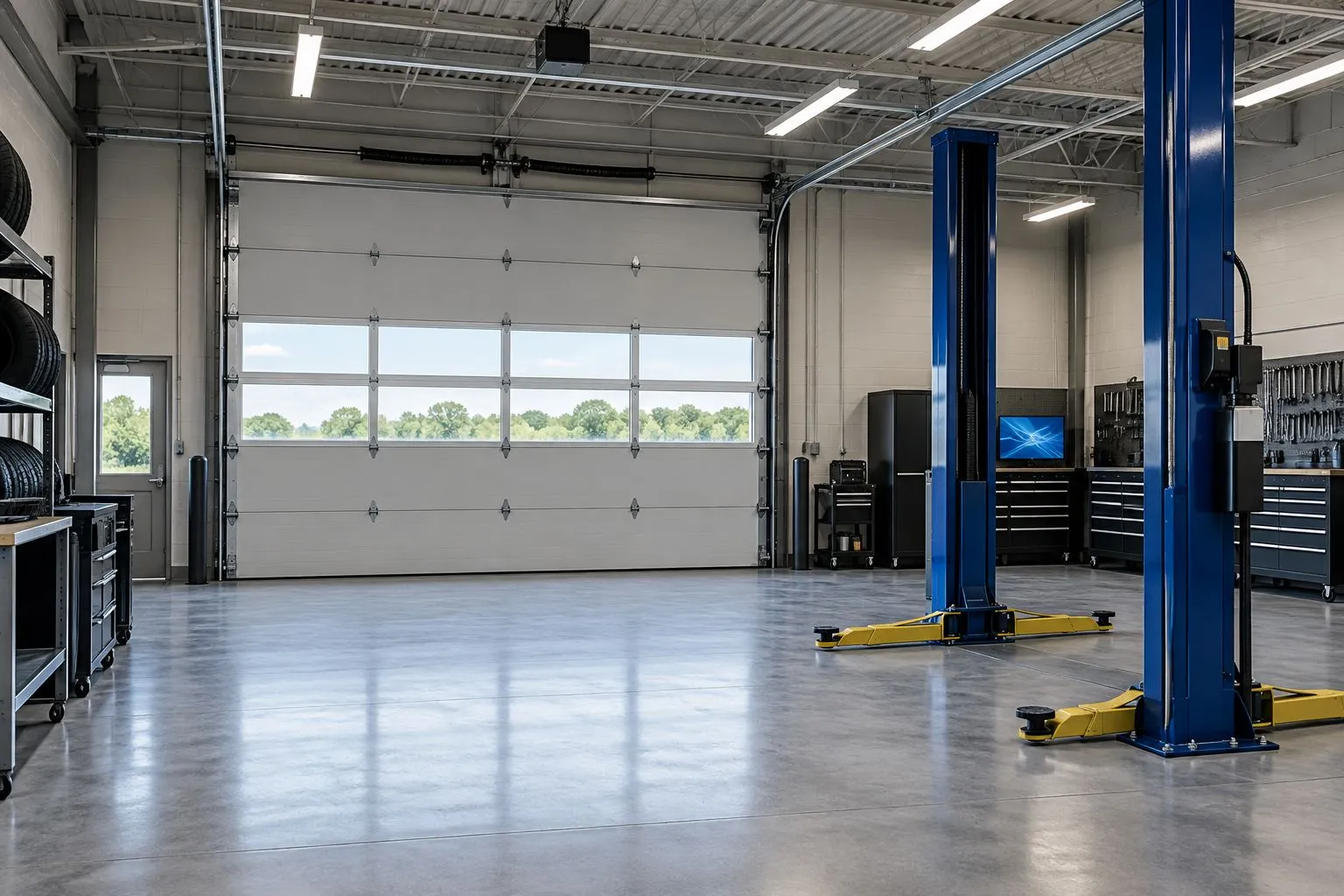
Illustrative photo: assess the door’s travel path alongside the lift and ceiling equipment.
The final door layout must account for equipment in use, not only equipment at rest. Have the installer explain any proposed track change and confirm that the operator is suitable for that arrangement.
Specify operation before choosing the operator
An auto shop’s operating pattern is part of the door specification. Tell the installer whether the door opens for each vehicle movement, stays open during busy periods or remains closed while technicians work.
In door terminology, 1 complete opening followed by 1 complete closing is 1 cycle. Record activity in cycles per day rather than saying the door gets “a lot of use.” Include busy periods so the selected equipment is not based only on an average day.
Also explain who operates the door and from where. The installer should select controls and protective devices using current documentation for the proposed commercial system.
Do not increase opener force to overcome sticking, uneven movement or damage. Springs, cables, brackets and track corrections are professional-only work; stop operation if the door hangs crooked, has a loose cable or appears unstable.
Should you repair the existing shop door instead?
Repair deserves the first assessment when the existing door still fits your vehicles, equipment and operating needs. A damaged component does not by itself establish that the complete door needs replacement.
Replacement becomes a stronger candidate when the assembly no longer meets the opening’s requirements, damage affects multiple parts or compatible repair components cannot be confirmed. Have the technician separate the immediate fault from any proposed upgrade.
Ask Derby Strong to explain the repair path and replacement path separately. For additional decision criteria, read the guide to repairing or replacing a commercial overhead door; its local context is Frankfort, while your own opening still requires assessment.
How these door types are ranked
This ranking prioritizes the needs of a conditioned general-repair bay: enclosure performance, equipment clearance, operating duty and serviceability. It compares construction types rather than claiming a manufacturer or model wins without current specifications.
Insulated steel sectional doors take the default position because their construction addresses conditioned workspaces. Rolling steel, full-view aluminum and uninsulated sectional doors move ahead only when their distinct use case matches the opening.
Which commercial garage door should you choose?
Start with an insulated steel sectional door for a conditioned auto repair bay. Change that choice only for a specific requirement: a track conflict, a need for broad visibility or a genuinely unconditioned utility space.
Require a written scope identifying the door construction, glazing, track arrangement, operator, controls, protective devices and removal work. Ask how the installation will affect access to each bay so you can plan vehicle movement around the work.
Plan your shop door assessment
Discuss bay clearance, operating needs and whether repair or replacement fits the existing door.
Frequently Asked Questions
What’s the best commercial garage door for a Kentucky auto repair shop?
An insulated steel sectional door is the default choice for a conditioned general-repair bay. Confirm vehicle, lift and overhead clearances before selecting the track layout and operator.
Is a rolling steel door better than a sectional door for a repair bay?
A rolling steel door is better when horizontal sectional tracks conflict with equipment and the opening has suitable coil and side clearance. It is not automatically better for every repair shop.
Are full-view glass garage doors practical for auto repair shops?
Full-view aluminum doors are practical when daylight and visibility are priorities. Compare the exact glazing, privacy implications and whole-door thermal performance before ordering.
Can I keep the existing commercial garage door operator?
Keep the existing operator only after a professional confirms its compatibility, condition and suitability for the proposed door and operating duty. A working motor alone does not establish compatibility.
How much do commercial garage doors for auto repair shops cost?
An opening-specific quote is needed to establish the cost. Door construction, dimensions, track layout, operator requirements and removal work all affect the scope.
Should I repair or replace my existing shop door?
Start with a repair assessment if the existing door still meets your clearance and operating requirements. Consider replacement when its construction no longer suits the bay or a suitable repair cannot be established.
What should I do if a commercial bay door is crooked or has a loose cable?
Stop operating the door and keep people and vehicles away from the opening. Arrange professional service; do not force the door or adjust cables, springs, tracks or brackets.
One Last Thing Before You Decide
The door you choose does not have to match every other bay. A customer-visible opening, a conditioned repair bay and an unconditioned utility bay can justify different constructions within the same building.
Specify each opening by its job. That produces a clearer buying decision than ordering identical doors simply because they share a frontage.
Related Garage Door Guides
- Commercial overhead door will not open in Louisville
- Commercial garage door repair costs in Kentucky
- Commercial overhead door installation time
Local service: Commercial garage door repair in Louisville · Commercial garage door repair in Lexington · Commercial garage door repair in Northern Kentucky