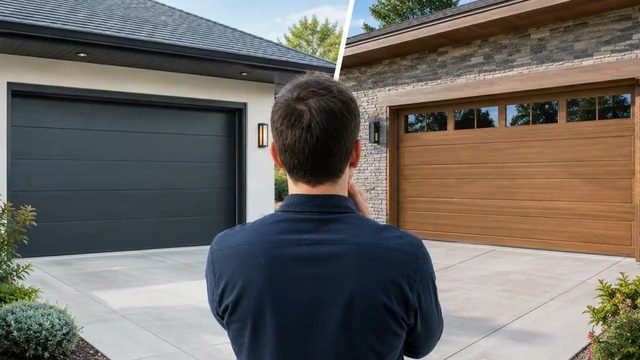
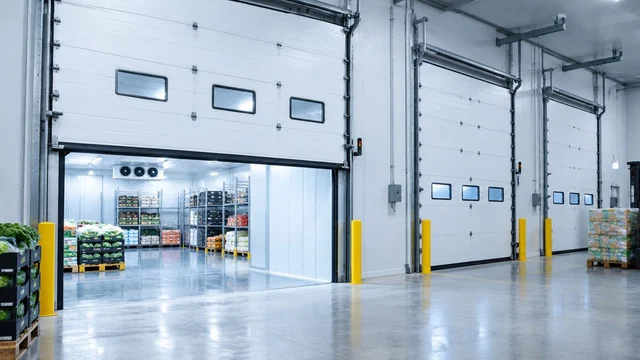
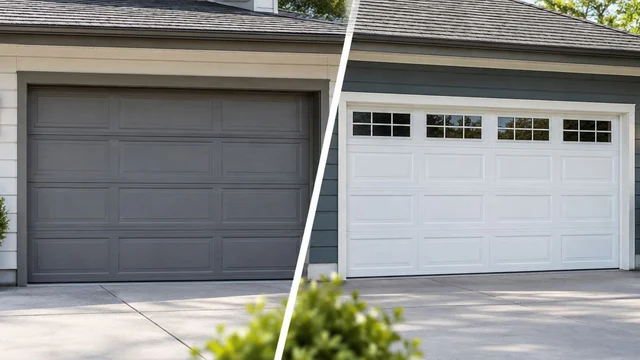
Landscaping companies’ overhead doors are commercial bay closures designed to move trucks, trailers and mowing equipment into storage while protecting the workspace when crews leave. For a Louisville lawn care firm, the right choice starts with loaded-vehicle clearance, departure patterns and the space needed above the opening—not the door’s appearance.
TL;DR
- Choose overhead doors for landscaping companies around loaded trailers, usable clearance and actual opening frequency.
- Derby Strong provides commercial overhead door service for Louisville businesses; confirm the proposed configuration fits your building.
- Compare sectional and rolling steel doors by track space, service needs and the work performed inside.
- Keep spring, cable, track and bracket repairs professional-only; never force a damaged door.
Why overhead doors matter for landscaping companies
A landscaping shop’s door has to accommodate equipment in its working configuration. A truck that clears the opening alone does not prove that its trailer, mower canopy or secured equipment will clear too. A door that opens normally during a quiet afternoon also tells you little about how crews use the bay during departures.
Derby Strong is best for Louisville landscaping firms seeking commercial overhead door repair or installation service. Start with Derby Strong when you need that service, but choose the equipment configuration only after the building and operating requirements are checked.
The decision is not automatically replacement. A repair can be appropriate when the existing door fits the operation and its fault is repairable. Replacement deserves consideration when the opening, door configuration or condition no longer serves the business.
For a Louisville property, also establish who can authorize building changes. If you lease the shop, obtain the owner’s approval before committing to an altered opening, different track arrangement or new electrical work.
How to choose an overhead door for your landscaping shop
Define what must pass through the opening
Begin with a written equipment inventory and safe measurements taken away from moving doors. Record vehicles as they enter the shop: trailer attached, equipment secured and accessories in their normal transport position. Do not use the truck manufacturer’s roof height as a substitute for measuring the actual load.
Record 3 dimensions in feet and inches: width, height and length. Width and height determine clearance; length helps you plan where the combination stops without leaving equipment beneath the door. Have the installer verify the required clearance rather than choosing an arbitrary margin.
- List each truck, trailer and mower combination.
- Include mirrors, racks, canopies and secured equipment.
- Measure the narrowest usable passage, not just the frame.
- Mark the intended parking position on your site sketch.
- Note any planned equipment changes before ordering.
Count how crews actually use the door
Use a paper log before buying an operator or specifying spring life. Record door movements over 5 operating days, including departures, returns, deliveries and equipment retrieval. This is a planning exercise, not a universal maintenance interval.
1 complete opening-and-closing sequence equals 1 door cycle. Record both total cycles and periods of repeated operation. An operator must suit the application’s operating frequency and controls, not merely move the door during a demonstration. Ask the installer to check the proposed equipment against current manufacturer documentation.
- Log each complete opening-and-closing sequence.
- Separate routine traffic from unusual deliveries.
- Note repeated movements during crew departures.
- Record whether someone remains beside the controls.
- Identify who needs authority to operate the door.
Check the building before selecting the hardware
Sketch the opening and photograph the surrounding structure from a safe position. Include the ceiling, lighting, pipes, storage racks and the area beside the jambs. A door’s advertised size does not establish whether its tracks, operator and supports fit your building.
Derby Strong provides commercial overhead door service, but the supplied service description does not establish which configurations fit your property. Use your sketch to explain the problem, then ask for a site-specific assessment. You can contact Derby Strong to discuss repair or installation needs without treating a remote description as final sizing.
- Record opening width and height from floor level.
- Identify overhead and side obstructions.
- Show the ceiling area behind the opening.
- Flag uneven flooring or visible building damage.
- Ask who will verify structural and electrical requirements.
Match the door construction to the workspace
Choose construction around what happens inside the shop. A conditioned repair area has different priorities from an unconditioned equipment-storage bay. Insulation, perimeter sealing, visibility and cleanability each answer a different need; none replaces correct sizing or safe operation.
A sectional door travels on tracks into the building. A rolling steel door coils above the opening, so its layout needs a different clearance assessment. Neither design is automatically the better landscaping door. Compare actual proposed assemblies, including their operating hardware and service requirements.
- State whether the space is heated or cooled.
- Identify where equipment needs overhead storage clearance.
- Explain whether staff wash equipment near the opening.
- Ask about materials suitable for the actual exposure.
- Compare complete assemblies rather than appearance alone.
Design controls around equipment and people
Start by mapping the route through the opening. Separate pedestrians from reversing trucks and trailers wherever the site allows. Place controls where the operator can use them safely, following the equipment manufacturer’s instructions and the installer’s assessment.
Powered operation can reduce the need to leave a vehicle to move a suitable door, but convenience does not replace entrapment protection. The installer must specify the required protective devices and explain their testing procedure. Never bypass a safety device or increase closing force to overcome a fault.
- Identify pedestrian crossings near the bay.
- Keep controls away from moving door components.
- Ask which protective devices the installation requires.
- Establish how lost remotes or credentials are removed.
- Request the approved procedure for power-loss operation.
Decide whether repair solves the actual problem
Describe the symptom before requesting replacement: uneven movement, scraping, visible damage, failure to open or repeated reversal. Observe from outside the travel path and stop operating a door that is crooked, off track or visibly damaged. Do not disconnect the operator to test a suspected spring or cable failure.
A repair is useful when it restores a suitable door to safe operation. It does not solve an opening that cannot accommodate your equipment. Ask for separate explanations of the current fault, the proposed repair and any remaining limitations before deciding.
- Record when the fault occurs without recreating it.
- Photograph visible damage from a safe distance.
- Keep staff away from loose cables and displaced tracks.
- Ask whether the door remains suitable after repair.
- Request a replacement comparison only when justified.
Prepare the bay and establish a service record
Before scheduled work, agree on which bay will be unavailable and where vehicles should park. Move equipment only when you can do so without operating a damaged door or entering its danger area. Tell the service provider if a truck or trailer is trapped inside.
After the work, keep the door and operator documentation together. Ask Derby Strong to explain the completed work, operating instructions and any unresolved limitations. Set future inspections around the manufacturer’s guidance, usage and condition—not an assumed interval borrowed from a residential door.
- Clear the agreed work area without touching repair components.
- Assign someone authorized to approve the work.
- Record door and operator identification details.
- Keep inspection and repair notes in one place.
- Train staff on normal operation and stop-use conditions.
Compare overhead door options for landscaping firms
Choose the assembly that fits the bay and the work—not a door type in isolation. These options are not all mutually exclusive: a sectional door can also be insulated. Treat the table as a way to organize proposals, then confirm the specifications of the actual assembly.
| Option | Best for | Practical advantage | Key limitation |
|---|---|---|---|
| Non-insulated sectional door | Unconditioned equipment storage with suitable track space | Provides a sectional-door layout without prioritizing thermal separation | Does not provide the same insulation function as an insulated assembly; tracks occupy interior space |
| Insulated sectional door | Conditioned repair or equipment-preparation spaces | Adds insulation to the door assembly | Insulation alone does not correct perimeter gaps, floor problems or frequent open-door exposure |
| Rolling steel door | Bays where avoiding horizontal sectional tracks matters | Coils above the opening rather than following horizontal tracks | Requires suitable space and support for the coil, guides and operating equipment |
| Repair of the existing door | A suitable opening with a repairable fault | Retains the existing layout when replacement is unnecessary | Cannot correct an undersized opening or every form of deterioration |
Request a written scope that identifies the door, track or guide arrangement, operator, protective devices and installation work. If a proposal excludes electrical or structural changes, make that clear before scheduling. A comparison is only useful when both proposals address the same operating requirements.
Common mistakes landscaping companies make
Measuring an empty truck instead of the working combination
A bare pickup is not the clearance test for a truck carrying racks or pulling loaded equipment. Measure the combination in its normal secured transport configuration, and ask the installer to verify usable clearance. Do not drive toward an uncertain opening to see whether it fits.
Treating a stronger operator as a repair
An operator is not a substitute for a properly functioning door. Binding, damaged tracks, failed springs and cable problems require diagnosis. Stop using the door rather than increasing force settings or repeatedly pressing the control.
Choosing insulation without discussing how the bay operates
Insulation addresses the door assembly, not the entire building. Tell the installer whether crews leave the opening exposed while loading, whether the room is conditioned and whether perimeter gaps exist. Those details help distinguish a useful insulated assembly from an upgrade that misses the main problem.
Letting trailers occupy the door’s closing path
A trailer tongue, mower handle or stored attachment can remain beneath the door after the truck is parked. Establish a parking position that leaves the travel path clear. Safety devices are protective measures, not permission to store equipment under the opening.
Planning replacement without a departure plan
Door work affects how equipment enters and leaves the shop. Agree on equipment access, work-area clearance and authorization before the appointment. Do not assume the door can remain usable throughout installation or that an alternate exit can accommodate a trailer.
Frequently Asked Questions
What are the best overhead doors for landscaping companies?
The best overhead doors for landscaping companies fit the loaded equipment, available building space and actual operating frequency. Compare sectional and rolling steel assemblies against those requirements rather than choosing by appearance alone.
Is a sectional door better than a rolling steel door for a lawn care shop?
Neither design is automatically better for a lawn care shop. A sectional door needs room for its track arrangement, while a rolling steel door needs suitable space and support for its coil and guides; compare complete proposed assemblies.
How do I measure a garage opening for a landscaping trailer?
Record the usable opening and the loaded trailer’s width and height from safe, stationary positions. Include racks, canopies and secured equipment, then have the installer verify the required clearance before selecting a door.
Should a landscaping company repair or replace its existing overhead door?
Repair is appropriate when the door suits the operation and its fault can be safely corrected. Consider replacement when the existing configuration or condition no longer meets the business’s requirements, and ask for the reason in writing.
Does an equipment-storage building need an insulated overhead door?
An equipment-storage building does not automatically need an insulated overhead door. Base the decision on whether the space is conditioned, how it is used and the condition of the surrounding seals and building envelope.
What should employees do if a commercial overhead door becomes crooked?
Employees should stop operating a crooked overhead door and keep people and equipment away from it. Do not force it, disconnect it to attempt lifting, or touch springs, cables, tracks or brackets; arrange professional service.
Can Derby Strong help a Louisville landscaping business with an overhead door?
Derby Strong provides commercial overhead door services for Louisville businesses. Ask for an assessment of the existing door or proposed installation, including equipment clearance, building constraints and operating requirements.
One Last Thing Before You Decide
Check the parked position as carefully as the entrance clearance. A truck and trailer can fit through an opening yet stop with part of the combination beneath the door. Before approving a layout, mark where the equipment will stand and have the installer confirm that the door’s full travel path remains clear.
Related Garage Door Guides
- How much does commercial garage door repair cost in Kentucky?
- How long does commercial overhead door installation take?
- Garage door maintenance checklist
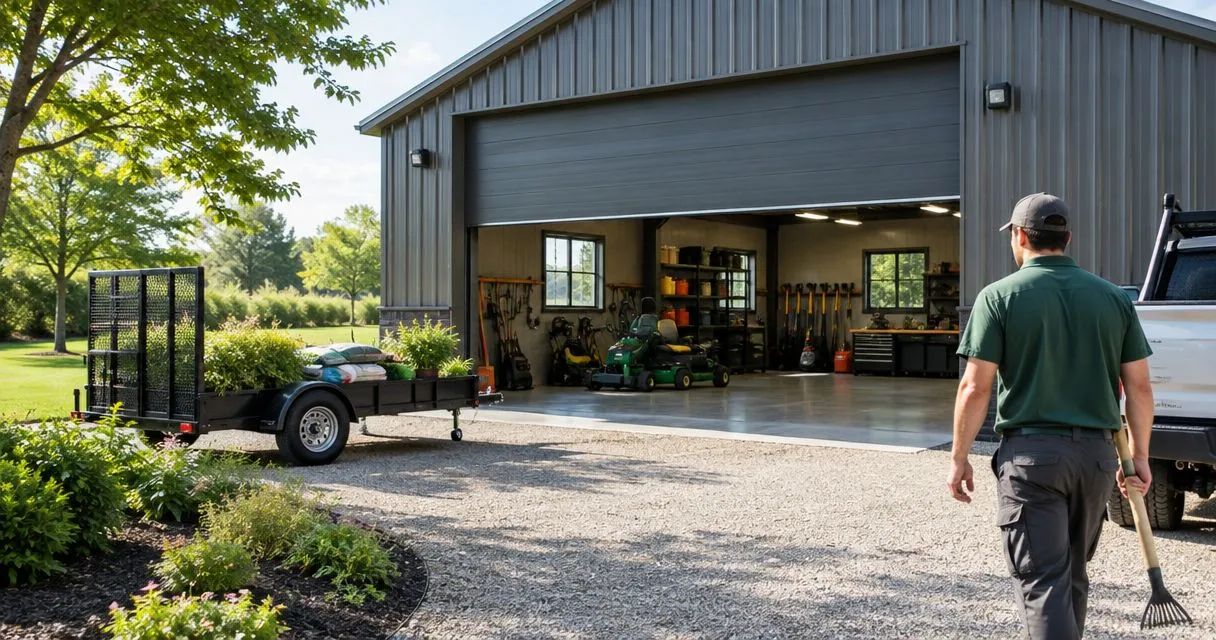
AI-generated illustration; not a Derby Strong customer project.
Local service: Garage door repair in Louisville · Garage door repair in Lexington · Garage door repair in Northern Kentucky