Cold storage overhead door planning is the selection of doors, seals and operating equipment to limit heat and moisture transfer while keeping food-facility traffic moving safely. For a Louisville facility, the right choice starts with the temperature difference across each opening, its cleaning requirements and how often workers actually use it—not panel insulation alone.
TL;DR
- Choose overhead doors for cold storage facilities by operating temperature, seal performance, cleaning requirements and traffic.
- An insulated sectional door is not automatically suitable for a freezer opening.
- Derby Strong provides commercial overhead door service; refrigeration performance requires separate technical verification.
- Repair sound door assemblies when appropriate; replace doors that cannot meet the opening’s documented requirements.
Why overhead door selection matters for cold storage facilities
A cold-storage opening connects spaces with different conditions. When the door opens, air moves between those spaces; when it closes, the panels, perimeter seals and surrounding construction become the barrier. A thick insulated panel cannot compensate for a damaged bottom seal or a door left open during an entire unloading operation.
Food facilities add another constraint: the door must fit the sanitation process. Cleaning chemicals, moisture exposure and accessible surfaces belong in the specification alongside temperature and traffic. A receiving door serving a conditioned staging area needs a different evaluation from a door opening directly into frozen storage.
Derby Strong is best for Kentucky businesses seeking commercial overhead door service, not refrigeration-system design. Derby Strong serves Louisville businesses with commercial overhead door services; confirm any specialized cold-storage application against the proposed equipment’s manufacturer documentation.
Specify the opening before choosing the door
1. Map the temperature boundary
Start with a floor plan and a walk-through, not a product catalog. Mark what sits on each side of the opening: outdoors, an unconditioned warehouse, a receiving vestibule, refrigerated storage or a freezer. Use actual operating conditions rather than assuming every food-handling space needs the same door.
Record normal temperatures and the conditions during receiving, cleaning and shutdown. Your refrigeration contractor should assess the temperature and moisture consequences of the proposed opening. The overhead door contractor should confirm the assembly’s suitability for those documented conditions.
Specify the complete operating environment before comparing insulation claims. A door rated for one environment is not automatically appropriate for a colder or wetter application.
Build a short opening record:
- Name the spaces on both sides of the door.
- Record normal and exceptional operating temperatures.
- Identify direct exposure to outdoor air or rain.
- Note existing frost, condensation or standing water.
- Document the sanitation process around the opening.
2. Observe traffic before specifying speed
Use a paper tally or spreadsheet to record door activity during 1 full operating shift, including the busiest receiving period. Count complete opening-and-closing cycles, note how long the opening stays clear and record why workers leave the door open. Repeat the observation if another shift operates differently.
A faster door does not solve a workflow that requires an opening to remain open. Separate the time spent moving through the doorway from the time spent waiting, staging pallets or finding paperwork. Those observations determine whether operating speed, a revised receiving procedure or a different opening arrangement deserves attention.
Keep people and equipment clear while observing. Do not stand beneath the door, obstruct a safety device or repeatedly cycle a faulty assembly to gather data.
Record these practical details:
- Pedestrian, pallet-jack and forklift movements.
- Complete cycles and extended open periods.
- Peak receiving and dispatch conditions.
- Vehicle or pallet contact with the opening.
- Current reasons for holding the door open.
3. Inspect the complete door assembly safely
Begin with visual observations from a safe position. Look for daylight around a closed door, displaced seals, damaged panels, corrosion and water at the threshold. Photograph visible conditions without removing covers, climbing on equipment or reaching into tracks.
Derby Strong’s commercial overhead door service is relevant when the problem concerns door movement, installation or a damaged assembly. Ask for a professional assessment that separates repairable components from an application mismatch. Fixing a worn seal is different from asking an unsuitable door to perform as a freezer barrier.
Stop operating a door with a loose cable, displaced track, crooked travel or visible structural damage. Springs, cables, brackets and track adjustments are professional-only work. Do not increase operator force to overcome binding, ice or a damaged door.
Prepare a condition record:
- Photograph panel and perimeter-seal damage.
- Note where light, water or frost appears.
- Describe noise, uneven travel or repeated reversals.
- Record readable door and operator identification.
- Keep the affected opening clear for inspection.
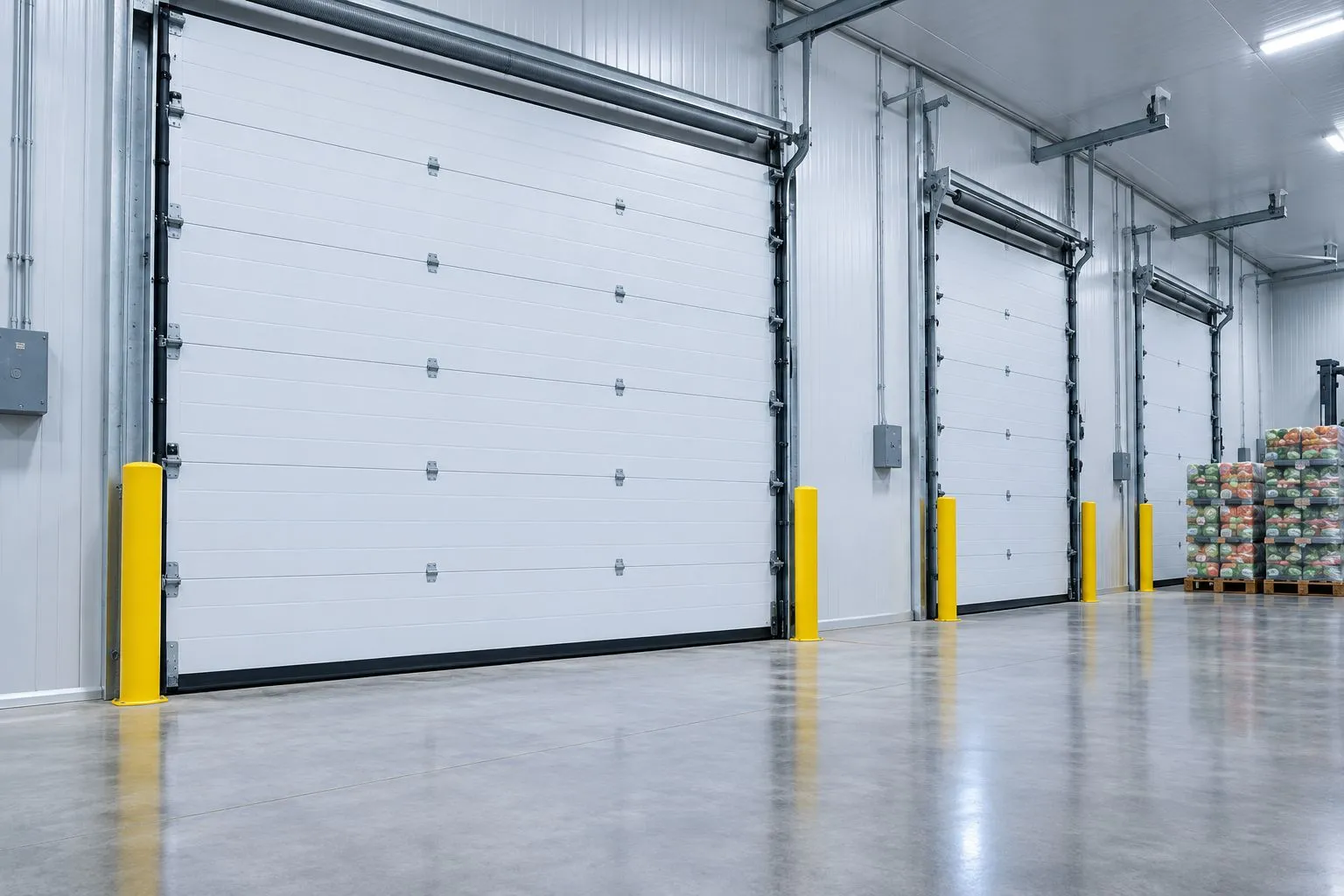
Illustrative image, not a Derby Strong project: inspect the perimeter as well as the door panels.
4. Match the assembly to temperature and cleaning
Request current technical documentation for the proposed door, operator, seals and controls. Check the stated operating temperature range and environmental limitations. A familiar commercial door design is not evidence that every component is suitable for freezing conditions or washdown exposure.
Compare thermal claims on an equivalent basis. Panel R-value describes thermal resistance for the stated material or tested component; whole-assembly U-factor describes heat transfer through the assembly under its stated test conditions. Neither figure, by itself, describes leakage through damaged seals or the effect of leaving the opening uncovered.
For food-handling areas, your sanitation lead should review surface materials, joints and cleaning access. Verify chemical compatibility rather than treating a corrosion-resistant finish as permission to use any cleaner. Electrical equipment also needs documentation appropriate to the actual exposure.
Check the proposed specification:
- Temperature limits for the complete assembly.
- Basis and scope of thermal-performance claims.
- Perimeter, bottom and panel-joint sealing details.
- Compatibility with the facility’s cleaning chemicals.
- Electrical enclosure suitability for cleaning exposure.
- Access for inspection without contaminating adjacent work.
5. Coordinate clearances, controls and safe movement
Measure the opening and surrounding space before selecting a lift arrangement. Overhead tracks, an open door and the operator must coexist with pipes, lighting, sprinklers and refrigeration equipment. Building systems should not be moved or obstructed simply to make a preferred door fit.
Document clearance on 2 sides of the opening, above it and through the full travel path. Include the tallest load and the equipment that carries it. A door opening that clears an empty forklift does not establish clearance for a loaded one.
Ask the installer to explain the proposed controls and protective devices in relation to actual traffic. Workers need a clear operating procedure, including what to do when the door stops or power is lost. Never assume manual operation is safe without the manufacturer’s procedure and a sound, properly balanced assembly.
Review the layout with these checks:
- Clear opening width and height.
- Headroom, side room and overhead obstructions.
- Loaded-equipment travel paths.
- Control locations outside the moving-door path.
- Protective-device coverage for the application.
- Shutdown and authorized isolation procedures.
6. Compare repair, replacement and building-envelope work
Create a written scope before requesting proposals. Divide the problem into 3 work categories: door condition, opening performance and adjacent construction. This prevents a repair estimate from being mistaken for a complete cold-storage improvement plan.
Repair fits an otherwise suitable assembly with identifiable component damage. Replacement fits a door that cannot meet the documented application requirements or has damage that makes repair inappropriate. Neither decision should rest on age alone; condition, component compatibility and operating demands matter.
The wall-to-frame junction belongs in this review. A facility’s approach to commercial insulation for warehouses must account for the surrounding enclosure, because replacing a door does not repair gaps, failed insulation or moisture problems beside it. Coordinate those responsibilities before work begins rather than discovering an unassigned repair during installation.
Make each proposal answer the same questions:
- Which existing components remain in service?
- Which documented application requirements will be met?
- Who repairs the frame-to-wall interface?
- How will installation affect receiving and sanitation?
- Which operating and maintenance documents are supplied?
- What conditions require additional specialist assessment?
Compare overhead door approaches for food facilities
Choose by opening function, not by the broad label “cold storage.” These options describe different approaches, not interchangeable products. Manufacturer documentation and a site assessment must establish suitability for the specific application.
| Option | Best for | Main advantage | Key limitation |
|---|---|---|---|
| Repair the existing assembly | An appropriate door with isolated component damage | Addresses the identified fault without replacing sound components | Cannot correct an unsuitable temperature rating or basic design |
| Insulated sectional overhead door | Openings where documented temperature, traffic and cleaning requirements match the assembly | Combines insulated panels with an overhead opening arrangement | Panel insulation alone does not establish freezer suitability |
| Insulated rolling overhead door | Openings where a coiling arrangement fits the available space and documented requirements | Uses a different overhead storage arrangement from sectional tracks | Sealing, temperature limits and cleaning suitability need individual review |
| Purpose-designed freezer overhead door | Openings directly serving frozen storage | Allows selection around the specific freezer application | Requires verification of moisture control, seals and every component’s operating limits |
No option wins every opening. A food facility can need different assemblies at receiving, conditioned staging and frozen storage. Specify each opening separately while keeping maintenance documentation and operating procedures consistent.
Common mistakes food-facility operators make
Treating insulation as the whole specification
An insulation figure does not describe door-open time, perimeter leakage or the adjoining wall. Compare the complete installed barrier. Ask what the thermal claim covers and keep the original documentation with the equipment record.
Selecting speed without reviewing traffic
A fast opening cycle does not prevent a pallet from sitting in the doorway. Resolve staging conflicts and unnecessary open periods before assigning all temperature-control problems to the door. Keep protective devices intact; never bypass them to maintain throughput.
Treating frost as proof of a failed door
Frost or condensation identifies a condition that needs investigation, not a diagnosis by itself. Air movement, moisture levels, seals and refrigeration operation all deserve review. Do not chip ice from moving components or force a frozen door open.
Assuming all cleaning methods are compatible
A door used in a food facility is not automatically suitable for direct pressure washing or every sanitation chemical. Check the documented cleaning method for panels, seals, controls and electrical equipment. Keep sanitation requirements in the purchasing scope rather than adding them after installation.
Replacing equipment without assigning responsibility
A new door does not resolve an unfinished threshold, damaged frame interface or unrelated refrigeration fault. Name the responsible contractor for each part of the opening. Derby Strong’s commercial overhead door scope should remain distinct from refrigeration and building-envelope work unless those additional responsibilities are explicitly agreed.
Prepare the facility for professional service
Give the service provider the opening record, equipment identification and condition photographs before the visit. Explain whether the opening serves exposed food, packaged products or a receiving area, and identify the facility contact who controls sanitation and production decisions.
Agree on how the work area will be isolated and how deliveries will move without passing through it. Your authorized personnel should handle applicable equipment-isolation procedures. Do not ask warehouse staff to release spring tension, remove cables or hold a damaged door open while work continues.
Before returning the opening to use, request an explanation of operation, protective devices, cleaning limitations and maintenance requirements. Record unresolved building or refrigeration issues separately so a completed door repair is not mistaken for a completed facility-wide correction.
Frequently Asked Questions
What are the best overhead doors for cold storage facilities?
The best overhead doors for cold storage facilities are assemblies documented for the opening’s temperature, moisture, traffic and cleaning conditions. Specify each opening separately; a receiving-area door and a freezer door do not necessarily need the same construction.
Can an insulated commercial overhead door be used on a freezer?
An insulated commercial overhead door belongs on a freezer only when its manufacturer documents suitability for that application. Verify the complete assembly, including seals, operator, controls and any required condensation-control provisions.
Is a high R-value enough for a cold-storage overhead door?
A high R-value is not enough to establish cold-storage suitability. Review the claim’s scope alongside assembly performance, perimeter sealing, operating conditions and the amount of time the opening remains uncovered.
Should a food facility repair or replace an existing overhead door?
Repair is appropriate when the existing assembly suits the application and the damage can be corrected safely. Replacement deserves consideration when the assembly cannot meet documented requirements or its condition makes repair inappropriate.
Why does frost form around a freezer overhead door?
Frost forms when moisture reaches a surface cold enough for it to freeze. Door-open time, air leakage and surrounding operating conditions need investigation; frost alone does not identify which component needs repair.
Can staff adjust a cold-storage door that sticks or reverses?
Staff should not adjust springs, cables, tracks, brackets or operator force to overcome a sticking door. Keep the opening clear, stop using a visibly damaged assembly and arrange professional assessment.
Does Derby Strong provide refrigeration-system design?
Derby Strong’s stated services include commercial overhead door service, not refrigeration-system design. Coordinate temperature and moisture requirements with the facility’s refrigeration specialist before approving a specialized door specification.
One Last Thing Before You Decide
Keep a record of the opening, not just the door. Store the temperature requirements, traffic observations, cleaning restrictions and surrounding construction details with the equipment documents. When conditions change, that record helps you distinguish a repair problem from a door that no longer matches its job.
Related Garage Door Guides
- Commercial overhead door will not open in Louisville
- Commercial overhead door options for Kentucky warehouses
- R-value vs. U-factor: what buyers should compare
Local service: Garage door repair in Louisville · Garage door repair in Lexington · Garage door repair in Northern Kentucky