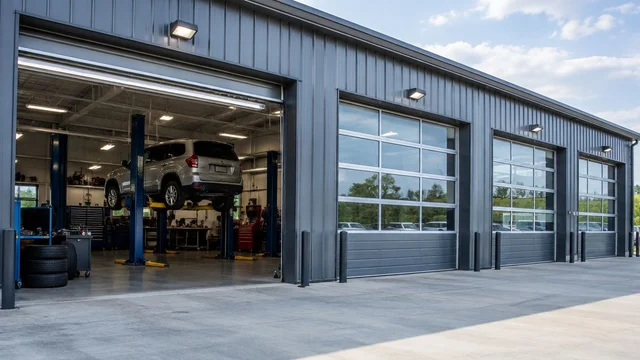
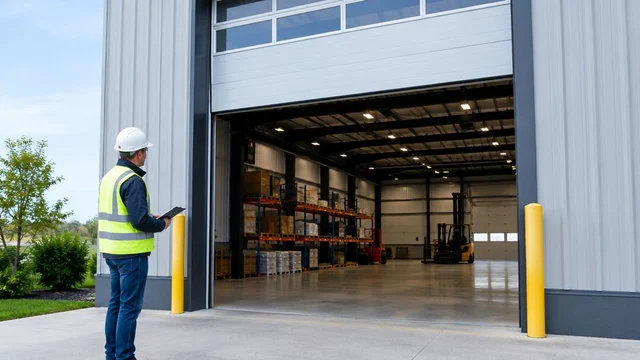
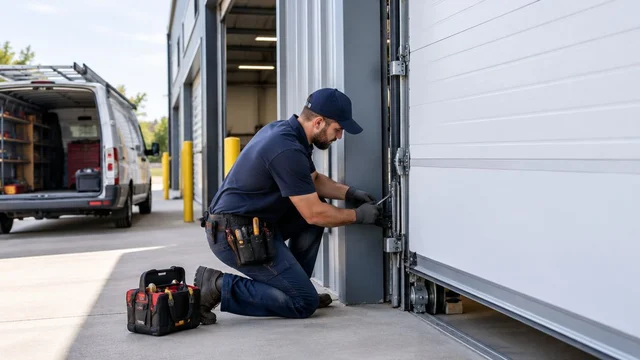
A commercial overhead door that will not open can have a power or control fault, an engaged lock, a mechanical obstruction, or a failed lifting component. At your Louisville business, stop operating the door if it sits crooked, has a loose cable, or starts lifting unevenly; repeated attempts can worsen damage. Check only what you can observe safely from floor level, then have a commercial door technician identify the fault.
TL;DR
- If your commercial overhead door won’t open, stop repeated attempts and separate control symptoms from visible mechanical damage.
- Derby Strong provides commercial overhead door service for Louisville businesses that need professional diagnosis.
- A working remote does not prove the door is safe; crooked travel or loose cables require professional inspection.
- Never bypass safety devices, increase operator force, or disconnect a damaged or partly open door.
Why will your commercial overhead door not open in Louisville?
The most useful clue is what happens when you request an opening: silence, a motor sound without movement, or uneven travel. Those observations narrow the inspection without requiring you to touch springs, cables, tracks, or electrical components.
Derby Strong provides commercial overhead door service for Louisville businesses. Use the symptom table to describe the problem when requesting service, not as permission to dismantle the door.
| What you observe | Possible fault to investigate | Safe next move | What the symptom does not prove |
|---|---|---|---|
| No sound or movement | Power supply, control station, stop circuit, or operator fault | Record visible indicator lights and affected controls | Silence alone does not identify a failed motor |
| Wall control works but remote does not | Remote battery, programming, receiver, or control permissions | Report which control still works | A remote fault does not establish the door’s mechanical condition |
| Motor sounds but door stays down | Engaged lock, drive problem, binding, or lifting-system damage | Stop further commands | Motor noise does not prove the operator needs replacement |
| Door rises unevenly or sits crooked | Cable, spring, track, roller, or door damage | Keep the opening clear and request service | A crooked door is not a routine reset problem |
| Door starts, then stops | Mechanical resistance, operator protection, limits, or control fault | Record where it stops without repeating the test | The stopping point alone does not identify the cause |
| Problem began after a vehicle strike | Panel, guide, track, attachment, or alignment damage | Take the bay out of use | An intact-looking panel does not rule out hidden damage |
Why this matters for a Louisville commercial bay
A failed overhead door changes how vehicles, deliveries, and employees move through your building. The immediate decision is whether to keep the bay out of use, not whether to order a new operator.
Assign responsibility for the affected opening so another employee does not unknowingly try the controls. Move waiting vehicles away from the door, redirect deliveries to an authorized alternative, and keep pedestrian routes clear. Do not route people beneath a suspended or damaged door.
Derby Strong commercial overhead door service is for Louisville businesses that need a technician to diagnose a door that will not open. A useful service request describes the door’s position and symptoms rather than guessing which part needs replacement.
What can you safely check before requesting service?
These checks are observations, not repair instructions. Stop immediately if you see a hanging cable, displaced roller, damaged track, unstable panel, smoke, or exposed wiring.
- Secure the opening. Keep employees, customers, and vehicles away from the door’s travel path. If the door is partly raised, do not stand underneath it or attempt to prop it up with equipment.
- Establish what already happened. Ask the last operator whether the door was silent, hummed, moved briefly, or stopped unevenly. Use that account instead of cycling the door again to recreate the fault.
- Look at the controls. Note visible lights, displayed fault messages, and the position of a clearly labeled stop control. Follow your site’s authorized operating procedure; do not reset an emergency stop until the reason for its activation is understood.
- Observe the door from floor level. Look for a visibly engaged lock, packaging near the opening, impact damage, or an uneven bottom edge. Do not reach into guides, move damaged hardware, or climb to inspect the operator.
- Document the condition. Photograph the whole opening and any visible damage from a safe position. Copy an accessible model label only if doing so requires no ladder, cover removal, or entry beneath the door.
If power appears absent, have authorized site personnel assess the supply under your electrical safety procedures. Do not open electrical enclosures or repeatedly reset a breaker that trips.
What does each opening symptom mean?
The door is silent when you press the control
A silent commercial overhead door requires a power-and-controls diagnosis before anyone condemns the motor. The operator might not be receiving power, or an operating command might be interrupted by a stop circuit, control setting, or fault.
Report whether the problem affects every control or only a remote, keypad, or wall station. That distinction helps a technician choose the next test, but it does not authorize bypassing the affected circuit.
The operator runs, but the door does not move
An operator sound without door movement points to a different inspection path than complete silence. A lock, disconnected drive, damaged transmission component, or door resistance can prevent motion.
Stop sending opening commands. Do not increase force settings, release a drive connection, or try to help by lifting the door while the motor runs. Those actions can turn a contained fault into uncontrolled movement or additional damage.
The door lifts crooked or stops partway
Uneven travel is a mechanical warning, not an invitation to adjust the opening limit. A technician needs to inspect the lifting system, door alignment, rollers, guides or tracks, and attachments appropriate to the door design.
A straight-looking door that stops partway also needs diagnosis. Its appearance alone cannot establish whether the problem is mechanical resistance, an operator setting, or an electrical fault. Leave it out of service rather than repeatedly testing it.
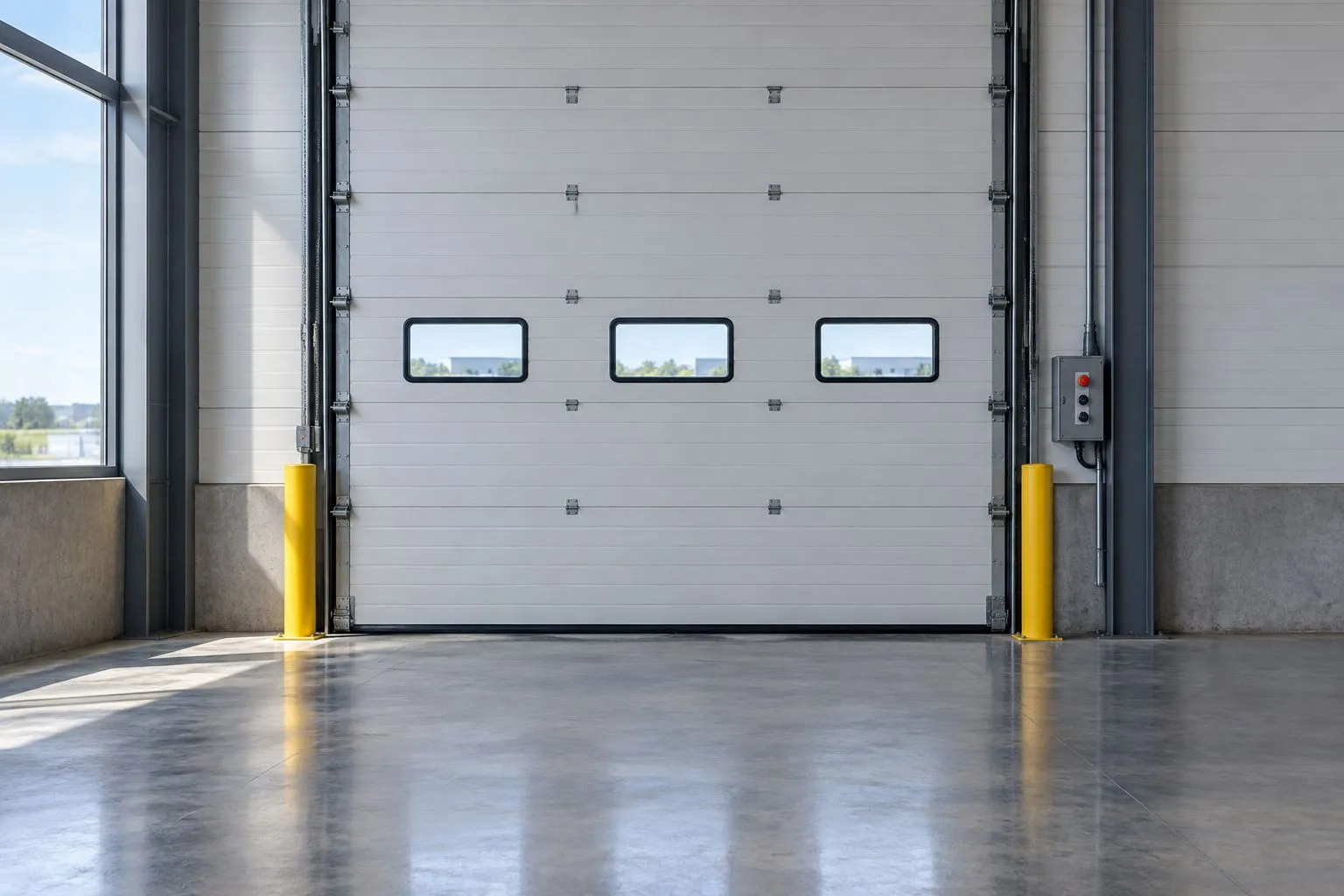
Illustrative photo, not a Derby Strong project; keep the opening clear while the fault is assessed.
Why the cause varies between commercial overhead doors
Commercial overhead doors do not all use the same lifting arrangement or controls. These factors change what a technician must inspect:
- Door construction. A sectional door travels on rollers and tracks; a rolling door uses a curtain and guides. Similar symptoms can involve different components.
- Operator configuration. The drive connection, control station, and available fault information determine the diagnostic procedure. Residential opener instructions are not a substitute for the installed commercial operator’s documentation.
- Control relationships. Stop circuits and configured interlocks can prevent an opening command. Only qualified personnel should test or alter those circuits.
- Mechanical condition. Damaged panels, guides, rollers, springs, or cables can prevent normal movement. More operator force does not correct the underlying defect.
- Recent events. A power interruption, vehicle contact, unusual noise, or repair immediately before the failure gives the technician useful context. Timing is evidence to investigate, not proof of a particular cause.
Your Louisville location matters for arranging service and managing the affected bay. The equipment and observed symptoms determine the repair procedure; a city name does not change the safe diagnostic boundaries.
Can you open a commercial overhead door manually?
Do not manually open a damaged, crooked, or partly suspended commercial overhead door. Manual operation is appropriate only when authorized personnel follow the instructions for that exact door and operator and have established that the door is mechanically safe.
Some commercial installations use a manual chain arrangement; others have a different release procedure. Do not assume a familiar residential emergency-release method applies. Pulling a release on an unbalanced door can remove the operator’s restraint without correcting the lifting-system fault.
Manual operation also has limits as a business-continuity measure. Even if an approved procedure permits it, that does not repair the failed electrical control or establish that the door is ready for normal service.
Does a door that will not open need a new operator?
A door that will not open does not automatically need a new operator. The technician must distinguish a control or drive failure from a door that the operator cannot move safely.
Repair the diagnosed fault rather than replacing equipment based on a symptom. Replacing an operator without correcting binding, damaged lifting components, or an engaged lock leaves the underlying problem unresolved.
Request an explanation of what failed, what testing supports that finding, and what must happen before the opening returns to service. If replacement is recommended, ask why repair is unsuitable and whether the existing door and replacement operator are compatible.
How should you prepare for commercial door service in Louisville?
Give the technician information that prevents unnecessary troubleshooting and helps your staff manage the closure. Avoid promising employees or delivery drivers a reopening time before the fault is identified.
Include the following in the service request:
- The Louisville property address and the specific bay or opening affected.
- Whether the door is closed, partly open, crooked, or visibly damaged.
- Whether the controls are silent, the operator makes noise, or the door moves briefly.
- Any recent impact, power interruption, unusual noise, or change in operation.
- Accessible equipment identification and photographs taken from a safe position.
- Site contact details and any required contractor check-in or work-area procedures.
Clear movable stock and parked vehicles from the approach when you can do so without entering the hazard area. Do not remove guards, detach hardware, or arrange a forklift under the door to prepare for the visit.
For scheduling expectations, read the guide to how long commercial garage door repair takes in Louisville. Ask what inspection, parts, and return-to-service checks the proposed work requires rather than treating every opening failure as the same repair.
Frequently Asked Questions
Why won’t my commercial overhead door open even though the motor runs?
An engaged lock, drive fault, mechanical binding, or lifting-system damage can prevent movement while the operator makes noise. Stop sending commands and have a technician inspect both the door and operator.
Can I pull the emergency release on a commercial overhead door?
Do not pull a release on a damaged, crooked, or partly open commercial overhead door. Authorized personnel must follow the installed equipment’s instructions and establish that the door is mechanically safe before manual operation.
Should I reset the breaker when my commercial door stops working?
Do not repeatedly reset a breaker that trips. Have authorized personnel investigate the electrical supply under your site’s safety procedures rather than treating repeated tripping as an ordinary reset issue.
Can a photo-eye problem stop a commercial overhead door from opening?
That depends on the installed operator and its control configuration. Photo-eyes commonly protect closing movement, so a failure to open should not automatically be blamed on a dirty sensor; record the fault indication and follow the equipment documentation.
Can we keep using a commercial door that opens crooked?
No. A commercial overhead door that opens crooked should stay out of use until a technician inspects the lifting system and door hardware; repeated operation can worsen damage.
Do I need a new commercial door if it will not open?
Failure to open alone does not establish that the door needs replacement. A technician must identify whether the problem concerns controls, the operator, lifting components, or damage to the door itself.
What should I tell Derby Strong when requesting Louisville commercial door service?
Tell Derby Strong the property’s location, the affected bay, the door’s current position, and what happened during the last operating attempt. Include visible damage and accessible equipment identification without climbing or approaching unstable components.
One Last Thing Before You Decide
A door that opens again after a reset is not automatically repaired. Record the fault indication before anyone clears it, and report any uneven movement, impact, or unusual noise even if operation returns. An intermittent symptom still needs an explanation before you rely on that bay for normal business traffic.
Related Garage Door Guides
- What affects commercial garage door repair cost in Kentucky?
- Commercial overhead door options for Kentucky warehouses
- Garage door maintenance checklist
Local service: Commercial garage door repair in Louisville