Northern Kentucky buyers should compare whole-door U-factor first when equivalent assembly ratings are available, then use panel R-value to understand insulation—not to rank complete doors. Lower U-factor means less heat transfer; higher R-value means more resistance to heat flow. Neither number, by itself, tells you how well the installed door will stop drafts around its edges.
TL;DR
- For garage door R value vs U factor, Northern Kentucky buyers should prioritize comparable whole-door U-factor ratings.
- Higher panel R-value describes insulation resistance; it does not automatically establish better whole-door performance.
- Derby Strong provides garage door installation in Northern Kentucky; request documented ratings and a separate assessment of seals.
- Choose insulation around garage use, attachment to the home and installation condition—not the largest advertised number.
R-value vs U-factor: what should Northern Kentucky buyers compare?
Compare ratings that describe the same thing. A whole-door rating and an insulation-only rating answer different questions, even when they appear beside similar-looking garage doors. For homeowners planning installation, Derby Strong provides garage door service in Northern Kentucky.
| Comparison | R-value | U-factor |
|---|---|---|
| What it describes | Resistance to heat flow through the material or assembly identified in the documentation | Heat transfer through the material or assembly identified in the documentation |
| Better direction | Higher, when the measurement scope is equivalent | Lower, when the measurement scope is equivalent |
| Best for | Understanding the insulation resistance of a specified panel or assembly | Comparing overall thermal performance when complete-door ratings are available |
| Main limitation | An insulation or panel value does not establish complete-door performance | A value is only useful if its scope and method are identified |
| What to request | Whether the rating covers insulation, a door section or the complete assembly | Whether the rating covers the complete door and the configuration quoted |
Do not compare the largest R-value against the smallest U-factor without checking their scope. Ask the seller for current manufacturer documentation covering the door configuration in your proposal. A brochure headline is not enough if it leaves out what was measured.
Why this matters for a Northern Kentucky garage
An attached garage, a detached storage garage and a regularly occupied workshop do not have the same insulation priorities. Start with how you use the space and whether you condition it. Then consider the door, the perimeter seals and the rest of the building enclosure together.
A better-insulated door addresses heat transfer through the door. It does not repair a leaking side seal, insulate an unfinished ceiling or make an unconditioned garage behave like a heated room. Those are separate conditions with separate remedies.
For Northern Kentucky buyers, the useful purchasing question is not simply which door has the highest advertised insulation number. It is which documented assembly fits your garage use, and what installation work is needed for that assembly to close and seal correctly.
Panel R-value: best for understanding the insulation
R-value measures resistance to heat flow. Garage door literature can use it to describe insulation material, an insulated section or another specified assembly. Read the accompanying explanation before treating it as a rating for the entire opening.
An insulated section can contain areas that transfer heat differently from its central insulated area. Section joints, edges, reinforcement and glazing also belong to the installed door. A number describing the insulation alone does not account for all those features.
Use panel R-value as supporting information, not as proof of complete-door performance. It helps you understand the insulation being offered, but it needs a clearly stated measurement scope to support a fair comparison.
Ask these questions when a proposal emphasizes R-value:
- Does this value describe the insulation material, the door section or the complete door?
- Which manufacturer document defines that scope?
- Does the document cover the exact construction and glazing being quoted?
- Are both proposals reporting the same type of R-value?
The advantage is straightforward: R-value can help distinguish insulation specifications. The drawback is equally important: a prominently displayed panel value can distract from parts of the door that the number does not describe.
Whole-door U-factor: best for comparing thermal performance
U-factor describes heat transfer rather than resistance. When complete-door ratings cover comparable configurations and use comparable methods, the lower value indicates less heat transfer through the rated assembly.
That makes whole-door U-factor the stronger starting point for comparing overall door performance. But the words whole door matter. Do not assume that every U-factor shown in a sales sheet describes the same assembly or includes the configuration you selected.
Request the supporting document and check whether the rating applies to the proposed construction, glazing and other relevant configuration details. A rating for a different version of the door is not a substitute for documentation covering your proposal.
Compare complete-door U-factor with complete-door U-factor. If one seller provides only panel R-value, keep that proposal in consideration, but do not declare it thermally better or worse using unlike measurements.
The advantage of a whole-door rating is its broader measurement scope. Its limitation is that a thermal rating does not replace an assessment of installation fit, air leakage or the surrounding garage enclosure.
Why insulated garage door performance varies
The thermal number is one part of the decision. These factors explain why two insulated doors—or the same door installed in different openings—can produce different results:
- Measurement scope: Insulation-only, section and complete-door ratings describe different boundaries. Establish the boundary before comparing values.
- Door construction: Insulation, skins, edges and section joints form the assembly. Evaluate the construction documented for the quoted door rather than assuming insulation thickness explains everything.
- Glazing: Windows change the configuration. Request documentation that covers the glazing being proposed instead of using a solid-door rating without qualification.
- Perimeter sealing: Bottom and side seals address gaps at the opening. Thermal resistance through a panel does not close those gaps.
- Installation fit: Door alignment, the condition of the opening and contact between seals and adjoining surfaces affect closure. These need an on-site assessment.
- Garage use and enclosure: Heating, cooling, attachment to the home, wall insulation and ceiling insulation determine what the door contributes to the overall space.
These are separate checks, not reasons to dismiss insulation. A well-specified insulated door still needs an opening and installation that allow it to function as intended.
Which comparison matters most for your garage?
Choose the comparison around the space you actually have. Do not buy a door for an imagined use while ignoring an existing draft, damaged section or operational fault.
| Garage situation | Best for | What to prioritize | What the choice does not solve |
|---|---|---|---|
| Attached, unconditioned garage | Homeowners assessing the door alongside the boundary with the house | Documented door construction, sound perimeter seals and the condition of adjoining walls and ceilings | An insulated door does not replace insulation and air sealing between the garage and living space |
| Heated or cooled workshop | Owners managing a conditioned workspace | Comparable whole-door U-factor, glazing details and closure condition | A door upgrade does not correct heat loss through unfinished walls or ceilings |
| Detached storage garage | Owners primarily storing vehicles or belongings | Reliable operation, suitable construction and weather sealing; assess insulation against actual use | Insulation alone does not provide heating or cooling |
| Commercial overhead opening | Businesses balancing thermal performance with frequent access | Rated assembly, sealing, opening use and operational requirements | A closed-door rating does not describe heat exchange while the opening is open |
For an attached garage, assess the separation between the garage and the home as its own building component. A garage door upgrade is not a replacement for appropriate work at that boundary.
For a conditioned workspace, request the strongest comparable evidence about the complete door. Also assess how often the door opens and whether the rest of the enclosure supports the intended temperature control.
For storage, let the actual problem lead. A door that closes properly and keeps out wind-driven rain at the opening addresses a different need from a door selected primarily for thermal resistance.
How do you compare two garage door proposals fairly?
Use the same questions for each proposal. Keep the answers beside the quoted configuration so you can see whether the comparison is complete or whether important details remain unresolved.
- Define garage use. State whether the space is attached or detached, heated or unheated, and used for storage, parking or regular work. Describe the problem you want the door to address.
- Identify rating scope. Ask what each advertised R-value or U-factor covers. Record the scope in words rather than copying the number alone.
- Match configurations. Check construction and glazing against the supporting manufacturer document. Do not transfer a rating from an unquoted version without confirmation.
- Separate seal work. Ask what the installation includes around the bottom and sides of the opening. Keep this assessment separate from insulation specifications.
- Compare the complete job. Review fit, operation, thermal documentation and necessary repairs together. Do not select a proposal solely because its brochure displays a larger number.
Ask Derby Strong to assess the opening and explain the proposed garage door installation alongside the manufacturer’s thermal documentation. The service decision and the specification comparison belong together, but neither should replace the other.
Keep unresolved ratings unresolved. A proposal without a comparable whole-door rating is not automatically a poor choice; it simply does not support the same thermal comparison. Choose on documented information rather than filling the gap with assumptions.
Should you replace the door or repair the seals?
Repair a sealing problem when sealing is the problem; assess replacement when the door assembly itself no longer meets your needs. A visible gap at the bottom or side does not, on its own, prove that the entire door needs replacement.
From a safe position, observe the closed door for damaged perimeter weatherstripping, visible daylight and areas where the seal does not meet the adjoining surface. Describe what you see to the service provider. Do not loosen brackets, alter tracks or handle springs and cables to improve contact.
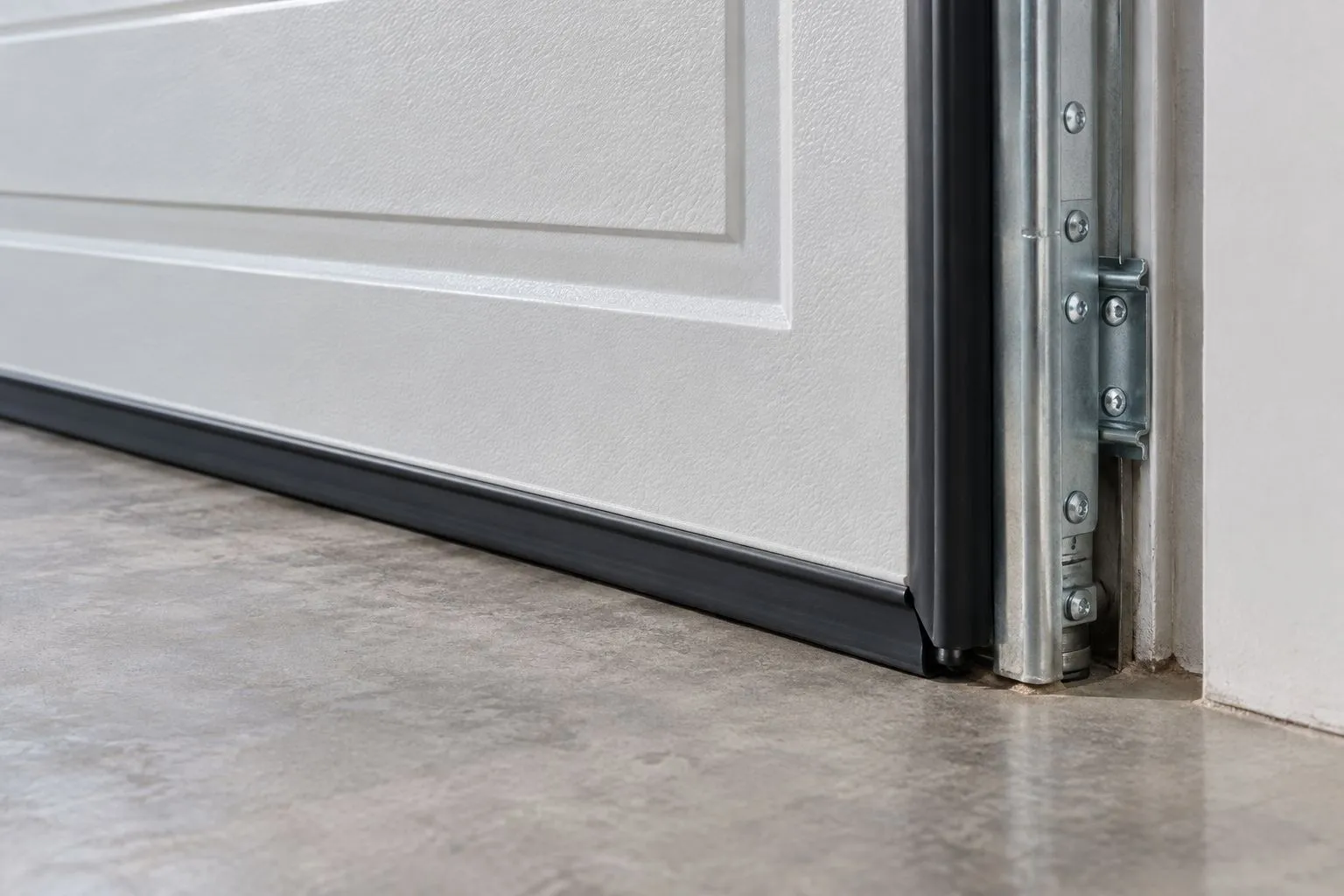
Illustrative photo: perimeter seal contact is a separate check from the door’s insulation rating.
A professional assessment should distinguish worn weatherstripping from door alignment, panel damage and problems with the opening. Those findings determine whether seal replacement, another repair or a new door addresses the actual fault.
Replacement deserves consideration when the existing assembly is damaged, unsuitable for your intended use or unable to meet the performance requirements you have identified. That is a different decision from choosing between two new-door insulation specifications.
Can you calculate U-factor by taking the inverse of R-value?
R-value and U-factor are reciprocals only when they describe the same thermal boundary under compatible conditions. Do not invert an advertised insulation-only R-value and label the result a whole-door U-factor. The calculation cannot add joints, edges or other components omitted from the original rating.
For purchasing, use the manufacturer’s documented assembly rating. A mathematically tidy conversion is not a substitute for matching the scope of the measurements.
Does a higher R-value guarantee a warmer garage?
A higher comparable R-value means greater resistance to heat flow through the rated material or assembly, not a guaranteed garage temperature. Heating, air leakage, the rest of the enclosure and door-opening use also affect the space.
If your Northern Kentucky garage is uncomfortable, describe when and where you notice the problem. Drafts at the opening and heat transfer through the door require different assessments, even when both contribute to discomfort.
Frequently Asked Questions
What should Northern Kentucky buyers compare: garage door R-value or U-factor?
Compare whole-door U-factor first when equivalent assembly ratings are available, then review panel R-value as supporting insulation information. Lower comparable U-factor means less heat transfer; higher comparable R-value means more resistance.
Is a higher garage door R-value always better?
A higher R-value indicates more thermal resistance only within a comparable measurement scope. It does not automatically establish better complete-door performance or tighter perimeter seals.
Is a lower garage door U-factor better?
A lower U-factor indicates less heat transfer through the rated material or assembly. Compare ratings that cover equivalent configurations and use comparable methods.
Can I convert a panel R-value into a whole-door U-factor?
No, a panel R-value cannot establish a whole-door U-factor through inversion alone. The complete assembly includes components and boundaries that an insulation-only value does not describe.
Do garage door windows affect the insulation comparison?
Windows change the door configuration, so request thermal documentation covering the glazing in your proposal. Do not assume a solid-door rating applies unchanged to a glazed version.
Will an insulated garage door stop drafts around the bottom?
Insulation does not close gaps around the bottom or sides of the door. Those gaps require an assessment of weatherstripping, fit and the condition of the opening.
Should I replace my garage door if the weather seal is damaged?
Damaged weatherstripping alone does not establish a need for complete door replacement. Have the seal, door condition and alignment assessed before choosing the repair.
Does Derby Strong install garage doors in Northern Kentucky?
Derby Strong provides garage door installation and repair services in Northern Kentucky. Ask for an assessment of the opening and documentation covering the door configuration being proposed.
One Last Thing Before You Decide
Ask the seller to write this beside every thermal rating: what does this number include? That short question can expose an unfair comparison before it drives your purchase.
Keep the answer with your proposal. The best-supported decision combines a clearly identified rating, a suitable door configuration and a separate plan for fit and sealing—not the biggest number on the brochure.