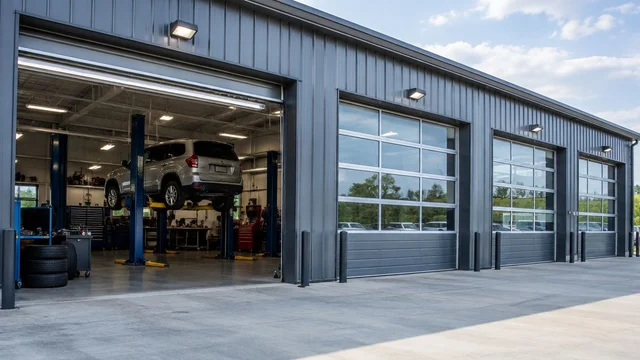
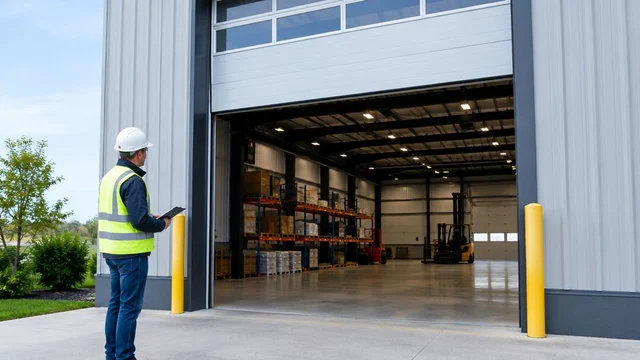
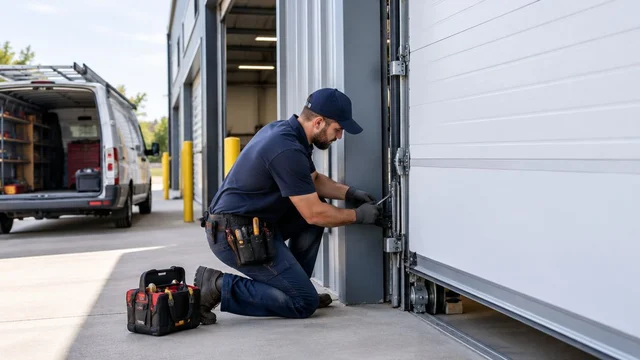
Repair is the lower-cost choice when a commercial overhead door has an isolated fault and the remaining system is sound; replacement makes more sense when damage is widespread or the door no longer fits the building’s work. For a Frankfort, KY, business, the comparison must include lost bay access, related repairs and installation scope—not just the failed part. An inspection and itemized proposals are necessary to determine which option actually costs less for your door.
TL;DR
- For repair vs. replace commercial overhead door cost in Frankfort, KY, compare complete job scopes, not individual parts.
- Repair suits an isolated fault in an otherwise sound commercial overhead door.
- Replacement deserves consideration when damage affects several systems or the door no longer suits daily work.
- Derby Strong provides commercial overhead door services; confirm availability for your Frankfort property before scheduling.
Is it cheaper to repair or replace a commercial overhead door in Frankfort, KY?
Repair makes financial sense when a technician can identify and correct a specific failure without leaving other significant defects unresolved. Replacement deserves a separate proposal when restoring safe operation requires extensive work or when the existing door cannot meet your operating needs.
Use this comparison alongside the guide to commercial garage door repair cost in Kentucky. Neither the door’s age nor a single broken component settles the decision.
| Option | Best for | Main advantage | Main limitation | What the proposal must establish |
|---|---|---|---|---|
| Targeted repair | An isolated failure with a serviceable door assembly | Retains usable equipment | Does not renew unrelated worn components | The cause of failure and condition of retained parts |
| Component replacement | Damage limited to a compatible section, operator or other assembly | Replaces the affected assembly without discarding everything | Depends on compatibility and the remaining system’s condition | Exactly what stays and what changes |
| Complete replacement | Extensive damage or a door that no longer suits operations | Allows the complete system to be specified for the opening and use | Requires broader installation work and operational planning | Removal, installation, retained equipment and acceptance testing |
Choose the smallest scope that restores safe, suitable operation—not the smallest scope that makes the door move once. A repair recommendation should explain why the rest of the system is worth retaining. A replacement recommendation should explain why repair falls short.
Why this matters for a Frankfort business
An overhead door is part of your operating space. If a disabled opening blocks deliveries, vehicle movement or access to stored equipment, the business consequence extends beyond the door work itself.
For your Frankfort property, identify the affected opening, its purpose and whether another suitable opening is available. Do not assume another bay can take the same vehicles or loads; check the actual route and clearance.
The useful local details are your site address, building use and property responsibilities. If you lease the premises, establish who can authorize repairs or replacement before approving work. Do not treat a permit answer for another Kentucky city as permission for a Frankfort project; confirm any applicable requirements with the authority responsible for your address.
When targeted repair is the better choice
Targeted repair is best for a clearly identified defect in an otherwise serviceable system. Examples include a failed operator component, damaged weather seal or worn moving component, provided the inspection finds no broader problem that changes the recommendation.
A technician should distinguish the symptom from its cause. A noisy roller does not establish that only the roller needs attention. Likewise, an operator that struggles to lift the door does not establish that the operator is defective; the door’s mechanical condition also matters.
Ask the repair proposal to answer:
- What failed, and what evidence supports that diagnosis?
- Did another condition cause or contribute to the failure?
- Which components will remain in service?
- What checks will confirm safe operation after the repair?
- What observed defects remain outside the proposed work?
The advantage is avoiding unnecessary replacement of usable equipment. The limitation is equally important: repairing a specific fault does not renew the entire door. Keep the inspection findings with your maintenance records so the next service decision starts with documented conditions rather than memory.
When partial replacement deserves a separate quote
Partial replacement is best for damage confined to a compatible assembly. Replacing an operator or a damaged door section is a different scope from replacing the complete overhead door system.
For sectional doors, a replacement section must be appropriate for the existing assembly. Dimensions alone do not establish compatibility. Section construction, connections and the effect on the door’s balance require professional assessment.
For rolling doors, the technician must assess the curtain, guides, barrel and operating equipment as an assembly. Do not apply a sectional-door repair assumption to a rolling-door system.
Partial replacement preserves usable equipment, but it can leave a mixed-age system. Request written confirmation of what the replacement includes and what the technician found in the components being retained. If compatibility cannot be established, that limitation belongs in the recommendation—not as a surprise during installation.
When complete replacement is the stronger decision
Complete replacement is best for extensive deterioration, widespread damage or an unsuitable existing door. It also deserves consideration when repeated repairs address symptoms without correcting an underlying mismatch between the equipment and its use.
Examples requiring evaluation include damaged sections combined with track or support concerns, corrosion affecting important connections, or equipment that cannot support the opening’s intended work. These conditions do not automatically prove that everything needs replacement. They justify a complete-system assessment.
Replacement gives you an opportunity to specify the door around the actual opening, operating pattern and environmental separation needed. Its drawback is the broader scope: removal, installation access, possible electrical coordination and disruption to the bay must be addressed.
Do not approve replacement solely because someone calls the door old. Ask which documented conditions make repair unsuitable and whether the replacement proposal corrects those conditions. Reusing damaged supports or mismatched operating equipment can leave the underlying problem unresolved.
Why commercial overhead door repair and replacement costs vary
The job scope determines the comparison. These factors explain why apparently similar doors can require different work:
- Damage extent: An isolated component failure is different from damage involving sections, tracks, guides, supports and operating equipment.
- Door construction: Sectional and rolling doors have different assemblies. The diagnosis and replacement components must match the actual door.
- Component compatibility: A usable existing assembly supports a narrower scope only when suitable replacement components can be identified.
- Opening and access: Work around the opening, overhead clearance and equipment access affect how the job can be performed.
- Operating demands: The technician needs to understand how the door is used, not just its dimensions. Equipment must suit that use.
- Associated work: Electrical changes, support repairs, removal and disposal must be identified rather than left outside the comparison.
Avoid adding assumed energy savings or a guessed remaining lifespan to make replacement appear favorable. If a proposal promises a financial benefit, ask for the site-specific assumptions behind it. A claim without a stated basis is not a useful budgeting input.
How do you compare repair and replacement proposals fairly?
Start with matching information. A brief repair estimate and a detailed replacement proposal are not directly comparable until both identify their inclusions, exclusions and unresolved conditions.
- Document the fault. Record what happened before the failure, whether the door was struck and which symptoms staff observed. Do not operate a damaged door to recreate the problem.
- Request findings. Ask for the diagnosis, related defects and the condition of equipment proposed for reuse.
- Compare scope. Separate the door assembly, operator, controls, electrical work, removal and testing. Mark exclusions clearly.
- Plan bay access. Establish what must be cleared, which activities must stop and how the work area will be isolated.
- Confirm acceptance. Ask how the completed work will be checked against the equipment’s applicable instructions and safety requirements.
The final decision should connect each proposed expense to a documented need. If replacement includes an operator but repair does not, ask why. If a proposal assumes existing tracks or supports will stay, ask how their suitability was established.
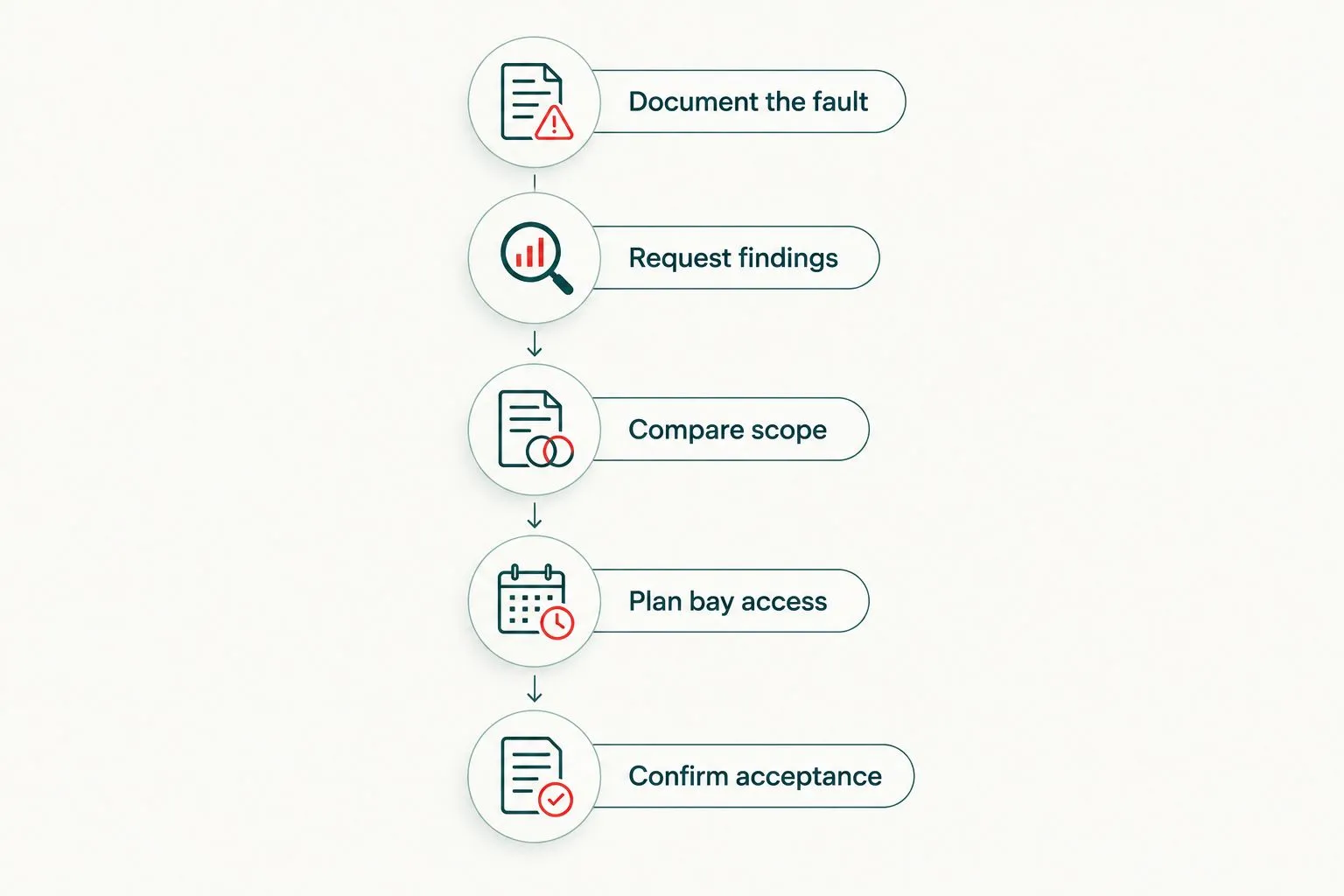
Compare the diagnosis and complete work scope before choosing repair or replacement.
Keep the original findings and the accepted scope together. That record helps you distinguish a newly discovered condition from work that was discussed but excluded.
What can you safely check before requesting service?
Observe the door from a safe position; leave mechanical diagnosis and high-tension work to a professional. A visual record helps explain the problem without turning your staff into repair technicians.
From floor level, note whether the door appears crooked, a section is visibly damaged, a cable hangs loose or a track has moved. Record an operator model label only if you can read it safely without climbing or entering the door’s path.
Do not loosen brackets, adjust springs, reposition cables, straighten tracks or remove damaged hardware. Do not increase operator force to overcome resistance. If the door is hanging unevenly, has loose components or moves unpredictably, keep people and vehicles clear and prevent further operation under your workplace procedures.
Do not pull an emergency release on a damaged or unsupported door to test whether it moves by hand. Ask the service professional how the opening should be secured until inspection.
What should you send with a service request?
Send the Frankfort site address, a description of the opening’s business function and photos taken without approaching unstable components. Explain whether the door is open, closed or stopped partway, and whether the opening is currently secured.
Include any known impact event, previous repair paperwork and safely accessible equipment identification. Tell the provider about restricted work hours or activities near the opening, but do not assume a completion time before the equipment and work scope are assessed.
Derby Strong is best suited to businesses seeking professional commercial overhead door service rather than do-it-yourself mechanical repairs. Use the contact page to describe the fault and confirm service availability for your Frankfort address. An inquiry is not confirmation of a service area or appointment.
Does a broken spring mean the whole door needs replacement?
A broken spring alone does not establish that the complete door needs replacement. A professional must assess the spring system, door condition and related hardware before recommending the scope.
Spring replacement is professional-only work. Keep the door out of service rather than asking the operator to compensate for the failed counterbalance system.
Can you keep the operator when replacing the door?
You can retain an operator only when its condition and compatibility with the replacement door are established. The replacement door’s requirements, the operating arrangement and applicable safety equipment all need review.
Reusing an unsuitable operator is not a sound way to narrow the job. Conversely, a serviceable compatible operator does not need replacement merely because the door assembly changes.
Is repeated repair a reason to replace the door?
Repeated repair is a reason to investigate the underlying cause, not automatic proof that the door is beyond repair. Review whether failures involve the same unresolved problem or separate worn components.
Ask for a written explanation of how the proposed repair or replacement addresses that pattern. A new assembly will not correct an unrelated building-support or electrical problem unless that work is included.
Frequently Asked Questions
Is repairing a commercial overhead door always cheaper than replacing it?
No. Repair suits an isolated fault, while extensive damage or an unsuitable system can justify replacement. Compare itemized scopes that include related work and operating disruption.
How much does commercial overhead door repair cost in Frankfort, KY?
A meaningful Frankfort repair estimate requires the door type, failure diagnosis and complete work scope. Request an itemized proposal rather than using an unrelated door’s repair bill as your budget.
Can a commercial door operator be repaired without replacing the door?
Yes, an operator fault can be addressed separately when the door itself is serviceable and the equipment remains suitable. The technician must rule out mechanical door problems that make the operator struggle.
Should I replace a commercial overhead door after a vehicle hits it?
Vehicle impact requires an inspection before choosing repair or replacement. Visible section damage does not show the full condition of tracks, guides, supports or other affected components.
Can employees open a commercial door with a broken spring?
Employees should not attempt to operate a commercial door with a suspected broken spring. Keep people clear and arrange professional assessment rather than forcing the door or relying on the operator.
Do I need approval before replacing a leased building’s overhead door?
Check your lease and obtain the property owner’s authorization where required before approving replacement. Also confirm applicable project requirements with the authority responsible for the property address.
Does Derby Strong provide a repair-or-replace quote for every Frankfort property?
Confirm Frankfort service availability and assessment arrangements directly with Derby Strong. The company provides commercial overhead door services, but an inquiry does not establish coverage for a particular address.
One Last Thing Before You Decide
Ask what would remain wrong after the proposed work. That question exposes the difference between restoring movement and resolving the actual door problem. A useful proposal identifies retained defects, explains their significance and gives you a clear basis for approving or declining additional work.
Related Garage Door Guides
- Commercial overhead door installation timing
- Commercial overhead door options for Kentucky warehouses
- Overhead doors for manufacturing plants
Local service: Commercial garage door repair in Lexington