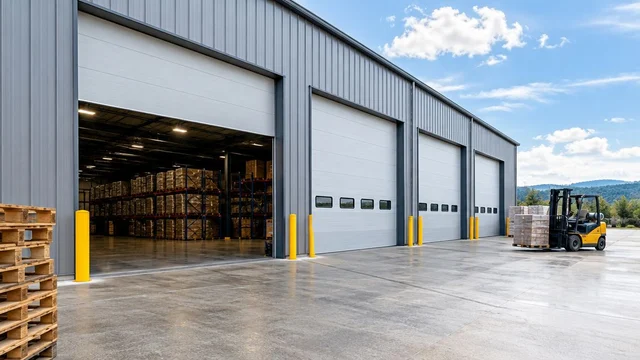
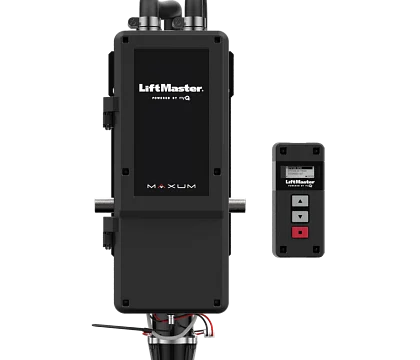
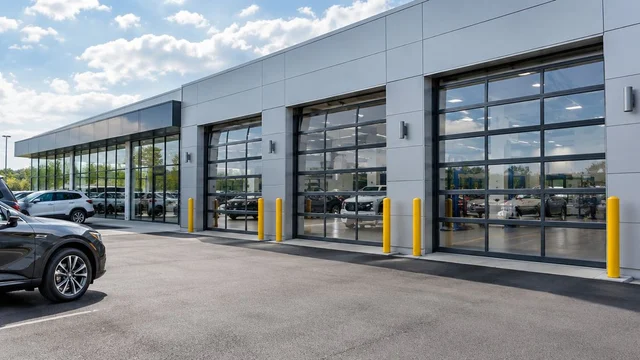
Best overall for compatible high-lift sectional doors: a commercial jackshaft operator. Best for standard-lift sectional doors: a commercial trolley operator. Best for a sectional door needing manual chain operation: a hoist operator. Best for coiling doors: a rolling-door operator. If you’re choosing a commercial garage door opener in Jeffersontown, KY, match the operator to the door before comparing controls or accessories.
TL;DR
- Commercial garage door opener Jeffersontown KY: choose by door construction, track layout, operating demand, and safety requirements.
- Jackshaft operators suit compatible high-lift sectional doors; trolley operators suit standard-lift sectional doors.
- Hoist operators add manual chain operation; rolling-door operators serve compatible coiling doors.
- Derby Strong provides commercial overhead door and opener services; confirm the existing door’s condition before replacing its operator.
Why this matters in Jeffersontown
A commercial operator is part of a door system, not a universal motor you attach to any opening. Sectional doors travel through tracks; coiling doors wrap around a barrel. Those differences determine how the operator moves the door and where it mounts.
For a Jeffersontown business planning a 2026 replacement, the first decision is whether the existing door needs repair, a different operator, or both. Derby Strong provides commercial overhead door and opener services for businesses in the Louisville market. You can start with Derby Strong when arranging an assessment, without assuming every opening needs a new door.
Keep the address, door identification, and operating problem together when requesting service. A loading opening and an employee parking entrance can require different equipment even when they belong to the same building.
What makes the best commercial garage door opener?
Use these criteria before choosing a mounting style or control package:
- Door compatibility: The operator must match the door’s construction, dimensions, weight, balance, and approved application.
- Track and mounting space: Standard-lift, high-lift, and vertical-lift arrangements create different mounting requirements. Check structural support, not just empty space.
- Operating demand: Record opening frequency and busy periods. Select equipment whose documented duty rating covers that use.
- Safety controls: Specify the required monitored entrapment protection, control arrangement, and installation requirements for the exact operator.
- Power and outage operation: Confirm the available electrical supply and the approved method of operating the door during a power failure.
- Service access: Leave practical access to the operator, controls, and door hardware. Equipment that fits physically still needs to be maintainable.
The best commercial operator is the one approved for your door and workload—not the one with the largest motor label. Increasing opener force does not repair a binding door, damaged track, or broken spring.
Commercial opener types at a glance
These are operator categories, not interchangeable products. The rows identify useful starting points; the exact manufacturer’s installation instructions decide whether a particular unit fits.
| Operator type | Best for | Standout feature | Key limitation |
|---|---|---|---|
| Commercial jackshaft | Compatible high-lift or vertical-lift sectional doors | Drives the door through its shaft rather than an overhead trolley rail | Requires an approved shaft, track, and mounting arrangement |
| Commercial trolley | Standard-lift sectional doors | Moves the door through an overhead rail and attached arm | Needs clear space along the rail and door travel |
| Commercial hoist | Compatible sectional doors needing manual chain operation | Provides an approved hand-chain operating method | Manual operation and chain placement require careful planning |
| Rolling-door operator | Coiling steel doors and compatible rolling grilles | Uses a drive arrangement designed for a coiling door | Is not a substitute for a sectional-door operator |
1. Commercial jackshaft: best for high-lift sectional doors
A commercial jackshaft operator drives a compatible sectional door through its shaft. It avoids the central trolley rail used by a trolley operator, but it still needs suitable mounting space and structural support.
This is the strongest starting point when the existing track raises the door above the opening before turning inward. Do not assume that a residential wall-mounted opener and a commercial jackshaft operator have the same approved applications.
Commercial jackshaft pros:
- Keeps a trolley rail out of the central overhead area.
- Suits approved high-lift and vertical-lift sectional configurations.
- Places the drive beside the shaft rather than above the middle of the opening.
Commercial jackshaft cons:
- Shaft, drum, track, and operator compatibility require professional confirmation.
- Side mounting can conflict with existing equipment or building structure.
- Changing the lift arrangement can involve more than replacing the operator.
Best for: A Jeffersontown commercial sectional door with a confirmed compatible high-lift or vertical-lift arrangement.
Verdict: Buy a commercial jackshaft operator only after the installer verifies the complete door-and-shaft application. Hold the purchase if the track arrangement remains unidentified.
2. Commercial trolley: best for standard-lift sectional doors
A commercial trolley operator uses an overhead rail and door arm to move a sectional door. It is a direct option for a compatible standard-lift opening with sufficient clear space behind the door.
For a 2026 replacement, staying with a suitable trolley arrangement avoids changing the mounting style without a functional reason. First determine whether the existing problem belongs to the operator, the controls, or the door itself.
Commercial trolley pros:
- Fits approved standard-lift sectional-door applications.
- Provides a clear connection between the operator rail and door arm.
- Allows a compatible replacement without automatically changing the track arrangement.
Commercial trolley cons:
- Occupies overhead space behind the opening.
- Requires suitable rail support and correct door-arm installation.
- Is not the default choice for high-lift, vertical-lift, or coiling doors.
Best for: A standard-lift sectional door with unobstructed overhead travel and a compatible commercial operating requirement.
Verdict: Buy a commercial trolley operator for a verified standard-lift application; skip it when the rail conflicts with the building’s use. Do not reroute or shorten mounting components outside the manufacturer’s instructions.
3. Commercial hoist: best for planned manual chain operation
A commercial hoist operator includes a hand-chain method for operating a compatible door. This category can overlap with shaft-driven mounting arrangements; “hoist” describes a manual operating feature, not an entirely separate door construction.
The practical question is whether trained staff need an approved manual operating method during an electrical outage. A hand chain is not permission to move a damaged or unbalanced door.
Commercial hoist pros:
- Provides a documented manual chain-operating method on suitable equipment.
- Supports outage planning without assuming battery backup is included.
- Offers a defined operating procedure that can become part of staff training.
Commercial hoist cons:
- Chain placement must avoid traffic, storage, and other obstructions.
- Staff must follow the exact disengagement or interlock procedure.
- Manual operation does not solve spring, cable, track, or balance faults.
Best for: A compatible commercial sectional door where manual chain operation is an explicit building requirement.
Verdict: Buy a commercial hoist operator when manual chain operation solves a documented need. Skip that feature if the proposed chain location introduces an obstruction or staff cannot safely follow the procedure.
4. Rolling-door operator: best for coiling steel doors
A rolling-door operator drives a compatible door that coils above the opening. Its connection, mounting, and operating requirements differ from those of a sectional door traveling through overhead tracks.
Start with the door manufacturer and identification label. A coiling service door, rolling grille, and fire-rated rolling door are not automatically interchangeable applications.
Rolling-door operator pros:
- Matches the operating geometry of an approved coiling-door system.
- Avoids treating a rolling door as a sectional-door installation.
- Allows controls and manual operation to be specified around the actual door assembly.
Rolling-door operator cons:
- Requires a confirmed match to the door and its drive arrangement.
- Mounting and service access around the barrel can restrict installation choices.
- Fire-rated assemblies require equipment and procedures appropriate to their listing.
Best for: A business opening with an identified coiling steel door or compatible rolling grille.
Verdict: Buy the rolling-door operator approved for the existing assembly. Hold any substitution on a fire-rated opening until a qualified professional confirms the applicable requirements.
What to record before requesting an operator recommendation
For a Jeffersontown commercial building, useful documentation starts at the opening—not with a shopping list. Gather information from floor level without removing covers, climbing beside moving equipment, or touching tensioned hardware.
Door identity
Photograph accessible door and operator labels. Include the entire opening, the visible track arrangement, and the space around the operator. Record whether the door is sectional or coiling.
The photo should show the physical arrangement, not just the motor housing. A clear view helps distinguish a mounting problem from a control problem.
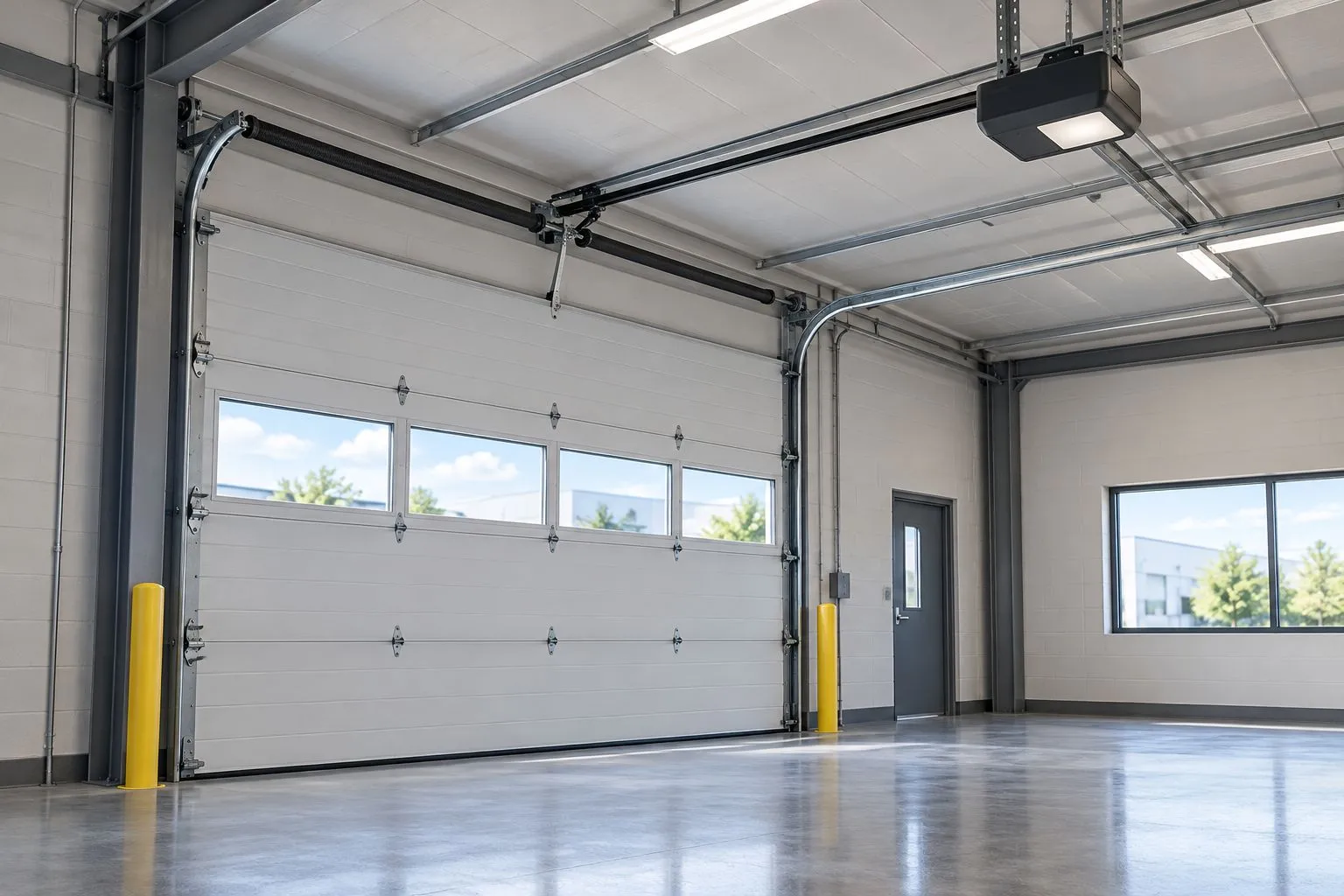
Illustrative photo: identify the door and track arrangement before choosing an operator.
Operating demand
One complete opening-and-closing sequence is 1 cycle. Record daily use and the busiest period rather than guessing from the number of employees.
A door used repeatedly during deliveries has a different workload from an entrance opened at the beginning and end of a shift. Give the installer that pattern and ask for the selected operator’s documented duty rating.
Power and clearances
Record the electrical information shown on accessible equipment labels. Have a qualified professional verify the supply, circuit, and connection requirements; do not open electrical enclosures to investigate.
Measure the opening’s width and height only from a safe position with the door stationary. Use inches or feet consistently, and leave shaft, spring, and track measurements to the installer when access involves tensioned hardware.
Access needs
List who operates the door, which controls they use, and what should happen during an outage. Include visitors, delivery drivers, and staff turnover where relevant to the building.
For a 2026 access upgrade, separate operator suitability from optional connected controls. The guide to smart opener upgrades for commercial properties addresses that next decision without making connectivity the reason to replace a working system.
Safety faults come before operator upgrades
Stop using a door that is crooked, off its tracks, visibly damaged, or supported by a loose cable. Keep people and vehicles clear, and arrange professional assessment. Never force it through a cycle to obtain a better video.
Spring, cable, track, bracket, and high-tension repairs are professional-only work. Do not disconnect an open or unstable door from its operator, and never increase force settings to overcome resistance.
Operator specifications should follow the door assessment. A new motor cannot make damaged hardware safe, and an operator fault does not automatically justify replacing an otherwise repairable door.
Derby Strong commercial overhead door and opener services are relevant when you need the door and operator assessed together. Describe the symptom precisely: “stops while closing” is more useful than “needs a stronger opener.”
How the operator types were ranked
This ranking uses door compatibility first, followed by mounting space, operating demand, safety controls, outage operation, and service access. It does not rank unnamed models or claim performance testing.
The categories answer different building needs. A jackshaft operator wins its slot because of compatible shaft-driven applications; a trolley wins the standard-lift slot; a hoist addresses manual chain operation; and a rolling-door operator matches coiling construction.
Which commercial opener should you choose?
For a standard-lift sectional door, start with a commercial trolley operator. For a compatible high-lift sectional door, start with a commercial jackshaft operator. Add a hoist requirement when approved manual chain operation is necessary, and choose a dedicated rolling-door operator for a coiling assembly.
For your 2026 project, request a written specification identifying the door application, duty rating, electrical requirements, safety devices, controls, and outage procedure. Ask what remains in service and what requires repair. That keeps the decision focused on the opening rather than unnecessary replacement.
Frequently Asked Questions
What is the best commercial garage door opener for a Jeffersontown building?
The best operator matches the building’s door construction, track arrangement, and operating demand. Start with a commercial trolley for a compatible standard-lift sectional door or a commercial jackshaft for a compatible high-lift sectional door.
Is a jackshaft operator better than a trolley operator?
A jackshaft operator is better for compatible shaft-driven applications where a trolley rail is unsuitable. A trolley operator remains a direct choice for compatible standard-lift sectional doors with clear overhead space.
Can a residential opener operate a commercial garage door?
Use an operator approved by its manufacturer for the specific door and application. Residential appearance, motor size, or mounting similarity does not establish commercial suitability or an adequate duty rating.
Does a commercial hoist operator work during a power outage?
A compatible hoist operator provides manual chain operation according to its manufacturer’s procedure. Staff must understand the operating method, and the door must be safe and mechanically sound before manual use.
Should I replace the operator when the commercial door stops closing?
Diagnose the fault before replacing the operator. Safety devices, controls, electrical faults, and mechanical door problems can interrupt closing, so the symptom alone does not identify the failed component.
What should a commercial opener proposal include in 2026?
A 2026 proposal should identify the operator, approved door application, duty rating, electrical requirements, safety devices, controls, and outage procedure. It should also distinguish operator work from required door repairs.
Can Derby Strong assess a commercial door and its opener together?
Derby Strong provides commercial overhead door and opener services for businesses in the Louisville market. Describe the Jeffersontown building’s door type, operating problem, and access requirements when requesting an assessment.
One Last Thing Before You Decide
“Hoist” and “jackshaft” can describe overlapping equipment, not competing choices. One describes a manual operating feature; the other describes a drive arrangement. Ask for the full operator specification so a useful outage feature does not distract from door compatibility.