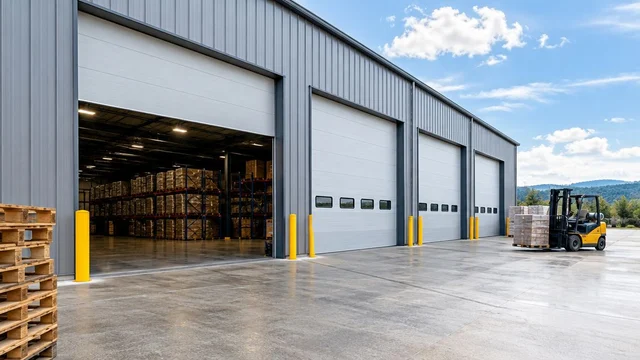
Auto dealership commercial garage doors are vehicle-access systems designed to move cars through service, delivery and customer-facing bays while keeping people clear of moving equipment. For a Georgetown, KY dealership, choose the door around each bay’s vehicle clearance, operating frequency and customer visibility—not one specification for the entire building.
TL;DR
- Georgetown, KY auto dealerships need commercial garage doors specified by bay function, vehicle clearance and daily use.
- Repair a serviceable door when the fault is isolated; replace when the system cannot meet the bay’s requirements.
- Derby Strong provides commercial overhead door services; confirm Georgetown project coverage before scheduling.
- Keep spring, cable, track and bracket work professional-only; never increase operator force to overcome a fault.
Why commercial garage doors matter for Georgetown dealerships
A dealership door affects more than building access. A disabled service-bay door blocks vehicle movement; an unsuitable delivery-bay door puts customer handoffs beside workshop traffic. Your first decision is therefore operational: what must happen at this opening, and who needs to pass through it?
Georgetown’s 40324 ZIP code is useful when identifying the project address for a service inquiry. Supply the full street address as well: postal areas are not exact municipal boundaries, and a ZIP code alone does not establish a contractor’s coverage.
Derby Strong is a service option for businesses needing commercial overhead door work in Louisville, Lexington or Northern Kentucky. For a Georgetown dealership, confirm project coverage and the proposed commercial scope before arranging an assessment. Do not treat Lexington coverage as automatic confirmation for another city.
This guide addresses one question: how should you specify, repair or replace dealership bay doors without choosing the wrong system for the job?
Specify commercial doors around dealership operations
Define the job of each bay
Start with a simple worksheet rather than a product catalog. Label each opening by its actual use: customer reception, vehicle delivery, mechanical service, detailing or storage. A customer-facing opening needs a different discussion from a back-of-house opening that mainly provides vehicle access.
Walk the route with the service manager and facilities contact. Identify where customers wait, where employees stand and where vehicles queue. A door specification should not depend on staff remembering to move customers out of a vehicle path every time it operates.
Treat shared-use bays explicitly. If a delivery bay also accepts service vehicles, record both jobs instead of selecting a door solely for its appearance.
- Record the purpose of every opening on a bay map.
- Identify pedestrian routes separately from vehicle routes.
- Note whether customers can approach the moving door.
- List tasks that require the door to remain open.
- Assign one facilities contact to approve the requirements.
Record clearance and actual operating frequency
Measure the opening and surrounding space from accessible floor positions. Do not climb onto tracks, remove covers or reach into moving equipment. Your preliminary dimensions help a contractor understand the project; they do not replace a professional site survey.
Record 3 dimensions in inches: opening width, opening height and available headroom. Also note side clearance, overhead obstructions and the position of vehicle lifts. A vehicle that fits through the opening can still conflict with the raised door or its hardware inside the bay.
For operating frequency, keep a log over 5 business days covering your normal schedule. Count complete open-and-close cycles rather than arrivals alone. This is a planning exercise, not a manufacturer rating or a guarantee that the observation period captures every peak.
The guide to measuring a garage door opening in Lexington offers related measurement context; a commercial dealership still needs its own verified survey.
- Record opening dimensions and accessible clearances.
- List the tallest and widest vehicles assigned to each bay.
- Note roof accessories that affect clearance.
- Count door cycles and record busy periods.
- Photograph lift locations and overhead obstructions from the floor.
Separate repairable faults from specification problems
A failed control, damaged seal or isolated component fault does not automatically justify a new door. First ask whether the existing assembly can safely meet the bay’s clearance, operating and security requirements after repair.
Replacement becomes a different decision when the opening is unsuitable, structural damage affects the assembly or the existing system cannot support the intended operation. A new operator alone does not correct an unsuitable door layout. Likewise, a new panel does not resolve a clearance conflict.
Ask Derby Strong about commercial overhead door assessment and repair before deciding that replacement is necessary. Confirm Georgetown project coverage first. Professional assessment adds information you cannot safely obtain by adjusting springs, cables, tracks or brackets yourself.
If the door hangs unevenly, has a loose cable, leaves its track or shows damaged hardware, stop operating it and keep people clear. Do not force it closed or use a forklift to move it.
- Describe the fault without attempting mechanical adjustments.
- Record whether the problem affects opening, closing or both.
- Separate appearance concerns from operating faults.
- Request an explanation of repair suitability and limitations.
- Ask what replacement would solve that repair would not.
Match visibility, insulation and construction to the bay
Choose the door construction after defining the job. Full-view glazing suits a customer-facing bay when daylight and visibility are priorities. Opaque insulated sections suit bays where enclosure and privacy matter more. Rolling steel doors merit consideration where a sectional track layout conflicts with the available interior space.
These are categories, not interchangeable specifications. Glass type, frame construction, seals and the complete assembly determine performance. Do not assume that a glazed door provides the same thermal performance as an insulated opaque door, or that an insulated panel rating describes the whole installed opening.
For a service bay, consider the door alongside the building’s heating, cooling and ventilation arrangements. Leaving the opening raised changes the enclosure regardless of the panel specification. Ask the contractor to explain assembly-level information rather than comparing advertising labels alone.
- Identify where visibility helps customer supervision.
- Identify bays that need visual privacy.
- Compare whole-door thermal information when relevant.
- Ask how seals meet the existing floor and jambs.
- Check glazing and frame details against the proposed use.
A customer-facing delivery bay illustrates the visibility trade-off: glass allows sightlines through the closed door, while opaque sections limit those sightlines. Neither choice replaces a separate pedestrian route.
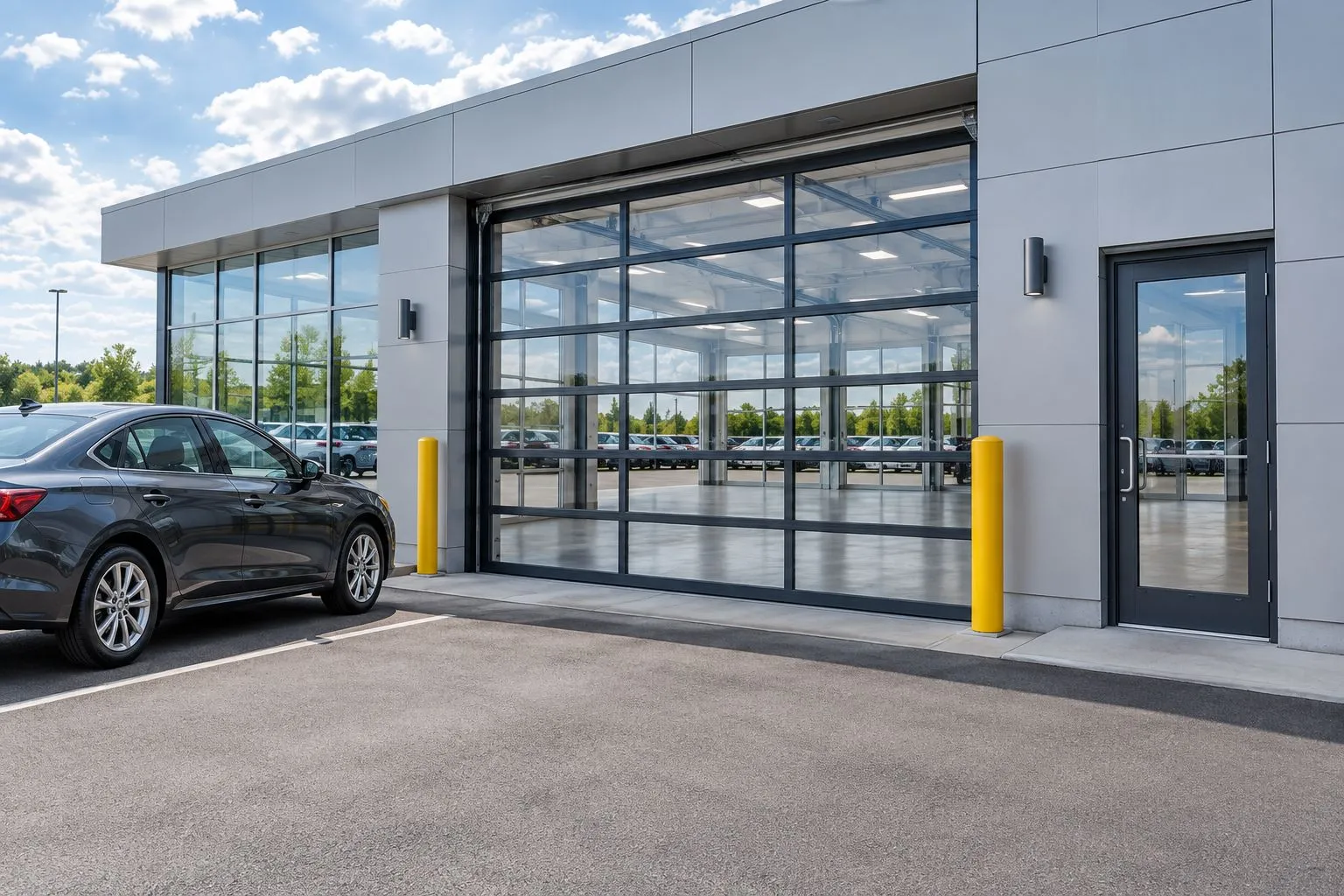
Illustrative photo, not a Derby Strong project: visibility through a door does not replace separate pedestrian access.
Specify the operator and access controls together
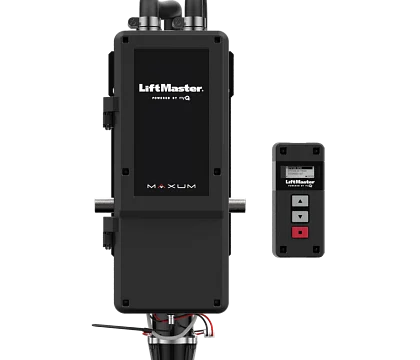
A commercial operator must match the door assembly and intended duty. Select controls at the same time, not as an accessory added after installation. The useful question is who needs permission to operate which bay, under what conditions.
For your 2026 specification, request current manufacturer documentation for the proposed operator, controls and safety devices. Confirm the exact functions in writing. A feature available on another model or through an optional accessory is not evidence that it is included in your proposal.
Define what happens during a power interruption, a lost credential and an employee departure. Remote access is useful only when its permissions and responsibilities are clear. It is not a substitute for a safe view of the opening or an appropriate operating procedure.
- Identify approved operators for each bay.
- Specify how access credentials are issued and removed.
- Confirm safety-device requirements for the proposed system.
- Ask how staff should respond to power loss.
- Require current documentation for included control functions.
Plan service access and staff handover
Schedule the work around the bay’s real dependencies. A door replacement can affect vehicle staging, customer appointments and access to equipment. Ask what area must be clear and what operations must stop, rather than assuming another bay can absorb the work.
Keep 1 bay-specific service record per opening. Include the door identifier, reported symptoms, completed work and the relevant manufacturer instructions. A building-wide note saying that the doors were checked leaves the next technician guessing which opening had the recurring fault.
Before returning the bay to use, have the contractor explain normal operation, stop conditions and the approved response to a fault. Staff should know whom to contact—not how to improvise a high-tension repair.
- Agree on vehicle and pedestrian restrictions during the work.
- Clear the contractor’s specified work area.
- Identify the person responsible for operational handover.
- Store documentation against the correct bay identifier.
- Set upkeep tasks according to manufacturer instructions.
Compare dealership door options by their actual job
Choose the option that fixes the bay’s constraint, not the one with the most features. The table below compares door categories and retaining the existing assembly; it does not establish product availability or Georgetown service coverage.
| Option | Best for | Main advantage | Key limitation |
|---|---|---|---|
| Repair the existing commercial door | A suitable assembly with an isolated, repairable fault | Retains a layout that already serves the bay | Does not fix unsuitable clearance or a mismatched operating requirement |
| Insulated steel sectional door | Enclosed service bays prioritizing privacy and thermal separation | Combines an opaque surface with insulation options | Requires suitable track space; whole-opening performance depends on the assembly and seals |
| Full-view sectional door | Customer-facing delivery or reception bays prioritizing sightlines | Provides visibility through the closed door | Glazing selection requires separate thermal, privacy and safety review |
| Rolling steel door | Openings where a sectional track layout conflicts with interior space | Uses a rolling configuration instead of horizontal sectional tracks | Requires suitable mounting and coil space; verify the assembly’s operating suitability |
Start the decision with the existing opening. If it is suitable and the fault is repairable, investigate repair. If replacement is justified, select the construction by bay function, then verify the operator and controls.
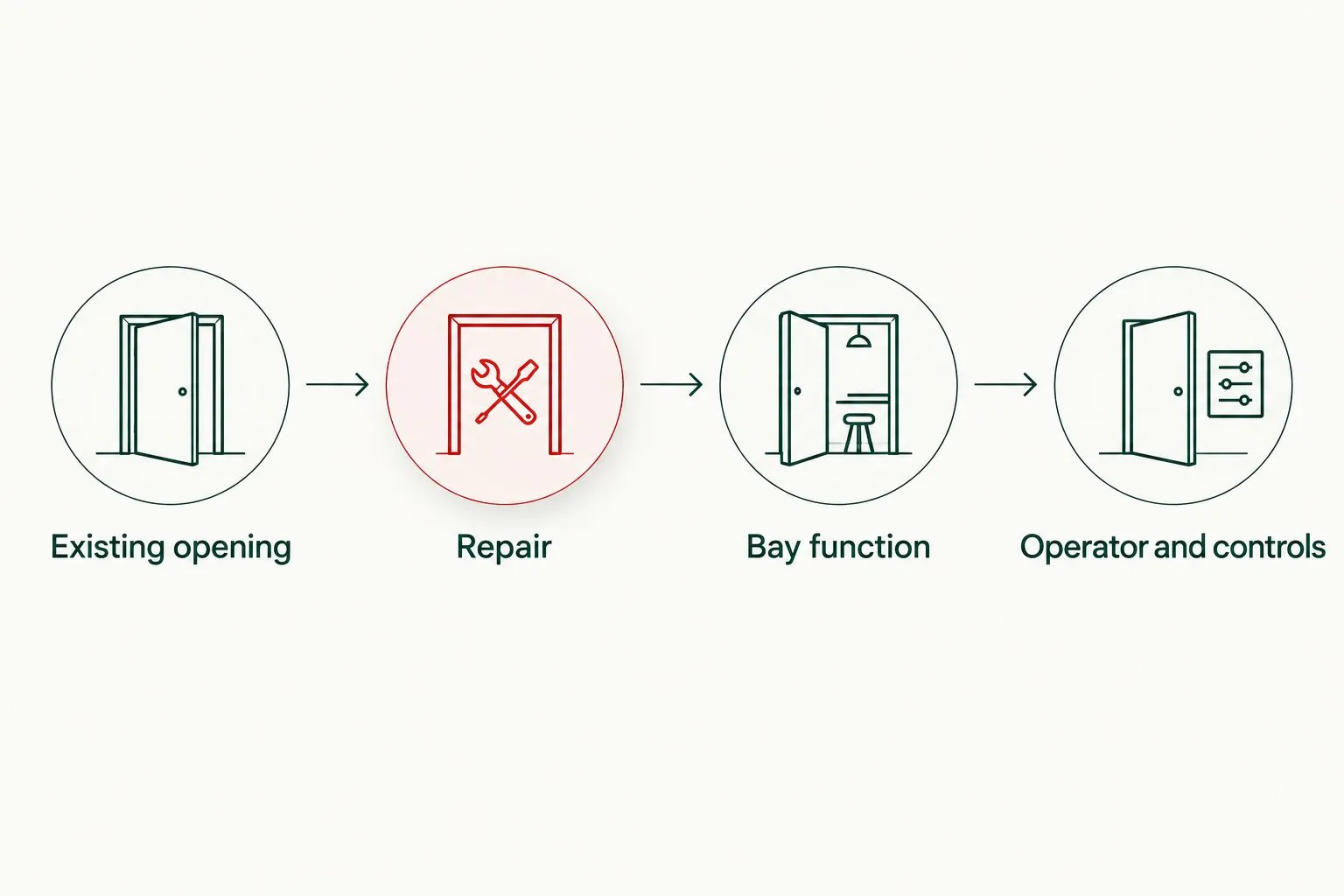
Assess the existing assembly before selecting a replacement door and its controls.
A comparison is incomplete without the installation scope. Ask each bidder to identify the proposed door, operator, controls, safety devices, removal work and commissioning responsibilities. Compare written inclusions rather than treating similarly named door categories as equivalent.
Common mistakes auto dealerships make
Specifying every bay identically
Matching exterior appearance does not require identical operating specifications. A customer delivery bay and a mechanical service bay can have different visibility, clearance and control needs. Document those differences before requesting proposals.
Using operator force to overcome a fault
Increasing force can conceal the symptom without correcting the door problem. Stop use when movement becomes abnormal and arrange professional assessment. Do not let a recurring reversal become an instruction to keep pressing the control.
Treating the opening size as the finished clearance
The usable route includes tracks, raised door position, vehicle accessories and interior equipment. Verify the full path before approving the assembly. Do not use nominal opening dimensions as proof that every vehicle will fit.
Choosing glass only for showroom appearance
Full-view doors need a functional reason as well as an appearance preference. Check privacy, glazing details and thermal requirements. A service bay does not need a glazed door simply because the customer-facing bay has one.
Ignoring access when staff roles change
A control system needs an owner. Decide who removes credentials, maintains permission records and handles lost devices. Otherwise, the dealership’s access policy and the installed controls can drift apart.
Frequently Asked Questions
What commercial garage door is best for an auto dealership in Georgetown, KY?
The best door depends on the bay: evaluate insulated sectional doors for enclosed service work, full-view doors for customer-facing visibility and rolling doors where the track layout is a constraint. Verify clearance, operating frequency and the complete assembly before selecting a category.
Should a dealership repair or replace a damaged overhead door?
Repair is the first option to investigate when the assembly suits the bay and the fault is isolated and repairable. Replacement needs a clear reason, such as unsuitable clearance, significant assembly damage or requirements the existing system cannot meet.
Is a full-view glass door better than an insulated steel door?
A full-view door is better for sightlines; an opaque insulated door is better suited to bays prioritizing privacy and thermal separation. Compare the proposed assemblies rather than assuming either category is best for every dealership opening.
Can dealership staff repair a commercial door spring or cable?
No; spring, cable, track and bracket repair belongs to a garage door professional. Staff can document symptoms from a safe position, stop operation and restrict access without touching the affected hardware.
How should a dealership measure door use before choosing an operator?
Record complete open-and-close cycles during representative working days and identify peak periods. Give that log to the contractor alongside the bay function and door information so the proposed operator can be checked against its documented duty.
Does Derby Strong service auto dealership doors in Georgetown?
Confirm Georgetown project coverage directly with Derby Strong before scheduling. The stated service markets are Louisville, Lexington and Northern Kentucky; those descriptions do not independently confirm coverage for a Georgetown address.
What should a commercial garage door proposal include?
A proposal should identify the door assembly, operator, controls, safety devices and installation scope. Ask for the exclusions, required site preparation, commissioning responsibilities and current manufacturer documentation as well.
One Last Thing Before You Decide
Label the opening before reporting the fault. A description such as customer delivery bay, door opens unevenly gives a service contact more useful information than garage door broken. Pair it with photographs taken from a safe position and the full Georgetown address; never operate a damaged door just to record a video.