Garage door installation time in Lexington depends on the work involved: replacing a door in an existing opening is a different job from changing the opening, installing an opener, or correcting damaged framing. Get a job-specific estimate for the on-site work, and keep that separate from the time between ordering the door and installation day.
TL;DR
- Garage door installation time Lexington homeowners can plan around requires a defined scope, not a blanket hourly promise.
- Separate the installation appointment from ordering, approvals, and any work needed before the door arrives.
- Confirm opener compatibility and opening condition before agreeing to the installation schedule.
- Derby Strong Garage Doors provides garage door installation in Lexington; request timing for your specific door and opening.
Why This Matters for Your Door
An arrival window is not a completion window. If you need to leave for work, collect children, or move a vehicle out of the garage, ask when the opening will be usable again—not just when the installer expects to arrive.
Start with the opening itself. The guide to measuring a garage door opening in Lexington explains the measurements to discuss before ordering; an installer still needs to confirm the fit and installation requirements.
This guide focuses on scheduling residential installation work in Lexington. Commercial overhead doors need a separate scope that accounts for the door system, operating equipment, and business access requirements.
How long does garage door installation take in Lexington?
The useful answer is a completion estimate tied to your actual installation scope. Ask for the expected on-site work window after the installer has assessed the opening, selected door, track arrangement, and opener requirements.
Do not treat a door-only estimate as a promise for a project that also includes structural changes or opener replacement. Those jobs contain different tasks, and the schedule should say which ones are included.
| Installation scope | Best for | Scheduling advantage | Limitation to resolve |
|---|---|---|---|
| Door replacement in the existing opening | Homeowners keeping the same opening size | Keeps the project focused on the replacement system | Existing framing and clearances still need inspection |
| Door replacement with an existing opener | Homeowners whose opener is suitable for the new door | Avoids adding an unnecessary opener replacement | Compatibility, condition, and safe operation need verification |
| Door and opener installation together | Homeowners who also need opener replacement | Lets the installer plan the connected work together | Includes mounting, setup, controls, and safety checks |
| Installation involving opening changes | Homeowners changing the door layout or opening size | Allows a different opening configuration | Structural work and installation need coordinated scheduling |
Ask the installer to distinguish active installation work from any work another contractor must complete first. A framing repair, for example, should not disappear inside an undefined promise to “finish the door.”
Separate the project into scheduling stages
A useful installation plan follows the work from assessment through handover. These are planning stages, not instructions for installing the door yourself.
- Site assessment: Confirm opening dimensions, clearances, mounting surfaces, and opener requirements.
- Scope confirmation: Record the door system, removal work, opener work, and any repairs needed before installation.
- Appointment confirmation: Confirm the planned work window, access arrangements, and who must be present.
- Installation: Leave door removal, spring work, track installation, and adjustments to the professional.
- Safety handover: Review operation, controls, safety features, and any unfinished items before normal use resumes.
The handover belongs in the schedule. Having the panels in place does not, by itself, mean the garage door is ready for everyday use.
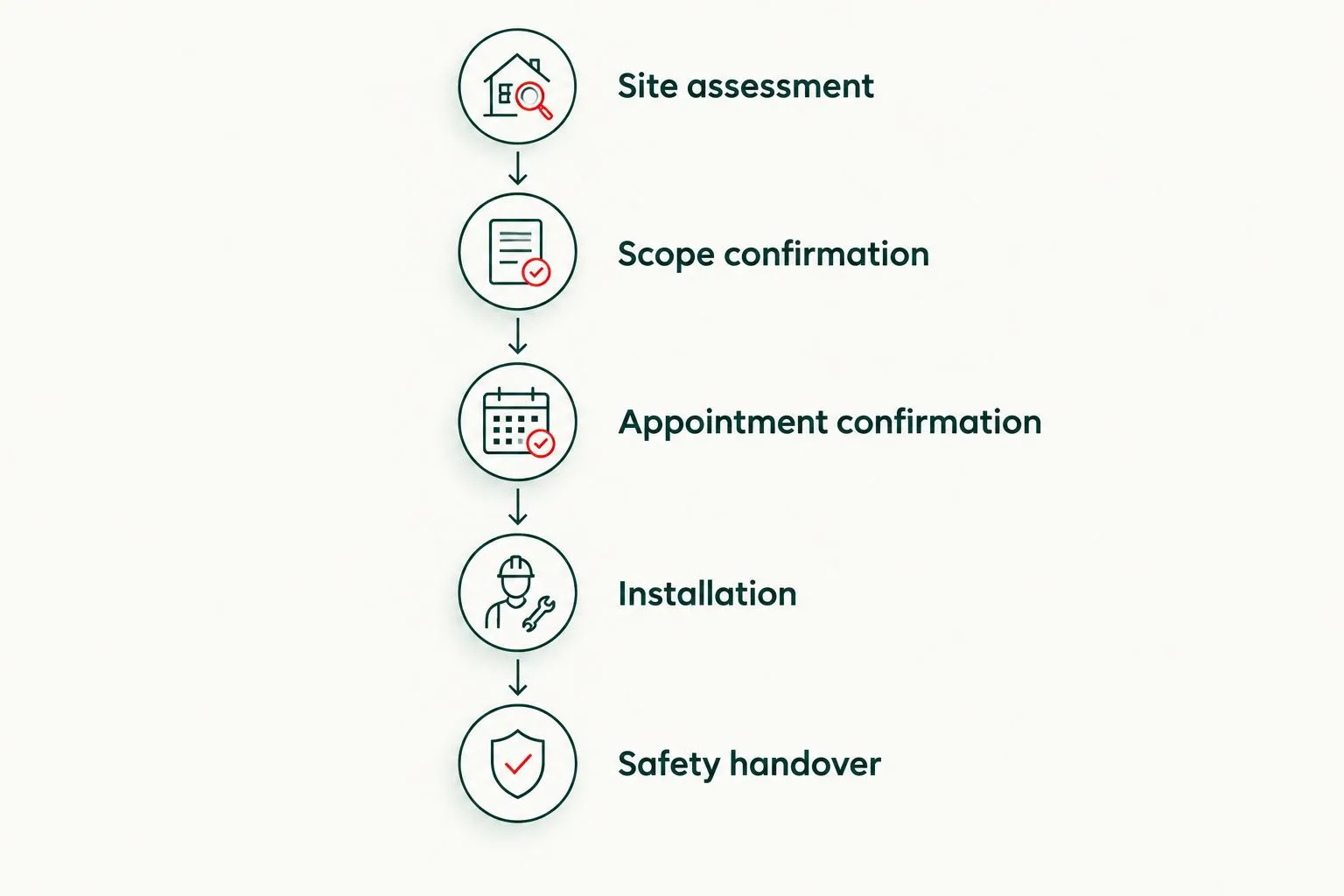
Illustrative diagram: the installation schedule should include assessment and safety handover, not just fitting the door.
Replacing a door in the existing opening
Keeping the existing opening avoids adding an opening-size change to the project. It does not establish that the current tracks, springs, brackets, or opener can stay.
Ask which components the replacement system requires. The installer should determine compatibility from the selected door’s requirements, not simply reuse parts because they are already attached to the garage.
Best for homeowners keeping their current opening: a clearly defined replacement scope that identifies what comes out, what goes in, and what needs inspection. The advantage is a focused project; the limitation is that concealed damage or unsuitable mounting surfaces still need attention.
Before the appointment, ask what happens if the installer discovers a problem after removing the old door. Agree on how changes will be explained and authorized, rather than assuming every possible repair fits the original work window.
Installing a new door and opener together
An opener adds a separate set of installation and setup tasks. The schedule needs to account for its mounting, connection to the door, controls, and safety-system checks.
Keeping an existing opener is a decision about suitability, not just whether its motor still runs. The installer needs to assess whether the opener is appropriate for the replacement door and whether its condition supports continued use.
Best for homeowners who need both systems replaced: planning the door and opener as a coordinated job. The benefit is a defined scope for the complete operating system; the trade-off is additional work compared with replacing the door alone.
Tell the installer which controls you use before the appointment. If you rely on a keypad or remote, ask whether setup and demonstration are included in the planned handover. Do not assume every existing accessory will work with a different opener.
Changing the opening or correcting a fit problem
A project involving the opening is not just a longer version of a standard replacement. It can require decisions and work outside the door installation itself.
Ask who is responsible for evaluating and correcting framing, mounting surfaces, and clearance problems. Do not assume the door installer’s scope includes structural alterations or electrical work unless those tasks are explicitly agreed.
Best for homeowners whose current opening does not suit the intended door: resolve the fit and building-work requirements before setting the final installation appointment. The benefit is planning around the intended configuration; the limitation is coordinating dependent work.
Lexington homeowners should also check any applicable association requirements before committing to an exterior change. The guide to HOA approval for a new garage door in Lexington covers that separate planning question; do not assume every property has the same rules.
Why garage door installation time varies
The schedule should explain the work, rather than attach the same estimate to every garage. Ask about these factors when reviewing your installation plan:
- Opening condition: Damaged framing or unsuitable mounting surfaces need assessment before the new system can be secured correctly.
- Available clearance: Space above, beside, and behind the opening affects the track and opener arrangement. Confirm the configuration before ordering.
- Removal scope: Establish whether removing the old door, associated components, and installation debris is included.
- Opener work: Keeping, replacing, or relocating an opener creates different setup requirements. Identify the intended approach in advance.
- Work-area access: Vehicles, stored items, and overhead obstructions can block the work area. Ask what must be moved and where the installer needs access.
- Dependent work: Building repairs or electrical changes need a clear owner and sequence. Confirm whether they must be completed before the door appointment.
These factors explain why an estimate needs a site-specific scope. They do not justify an open-ended appointment: ask the installer to identify known uncertainties and explain how they will communicate any change.
What should you ask before taking time off work?
Ask for both the arrival window and the expected completion window. Then ask whether you need to be present for the full appointment or only for access, decisions, and handover.
Do not schedule a hard departure around an unconfirmed finish time. Explain your constraint before booking so the installer can tell you whether the proposed appointment fits it.
Use these questions to turn a general booking into a workable plan:
- When should vehicles be out of the garage and driveway work area?
- Will the opening be unusable throughout the work?
- Is another pedestrian entrance needed while the door is being installed?
- Who will contact me if the scope changes?
- Does the completion window include cleanup, testing, and a demonstration?
- What happens if work cannot be completed during the planned appointment?
If the garage is your usual entrance, arrange another safe route into the house. Tell everyone in the household not to operate the opener while the installer is working.
Can you use the garage immediately after installation?
Use the garage door only after the installer has completed the required checks and handed it over for operation. A closed door or a connected opener is not proof that commissioning is complete.
Ask the installer to demonstrate normal opening and closing, explain the safety features, and show you the user controls. Follow the supplied manufacturer instructions for testing and upkeep after installation.
Keep children, pets, and bystanders away from the work area until the installer releases it. Never touch springs, cables, tracks, bottom brackets, or other high-tension components to help the job finish sooner.
If the door binds, moves unevenly, or will not operate correctly after handover, stop using it and contact the installer. Do not increase opener force or repeatedly cycle the door to overcome a fault.
What should your installation confirmation include?
Your confirmation should identify the job well enough that both you and the installer understand what the scheduled visit covers. An appointment date without a scope leaves important questions unresolved.
Ask for the following details in writing:
- The selected door and the opening it will serve.
- The removal and disposal work included.
- Whether the existing opener stays or is replaced.
- Any required work that falls outside the installation scope.
- The planned arrival and completion windows.
- The arrangements for access, changes, testing, and handover.
Derby Strong Garage Doors is a fit for Lexington homeowners seeking residential garage door installation. Ask for a scope-specific schedule; the service category alone does not establish how long your particular installation will take.
Keep the confirmation accessible on installation day. If the proposed work changes, compare it with the agreed scope and ask what the change means for completion before authorizing it.
Frequently Asked Questions
How long does garage door installation take in Lexington?
Garage door installation time in Lexington depends on the opening, selected door, removal work, and opener requirements. Ask for a job-specific on-site completion estimate after those details have been assessed.
Is ordering time included in the installation appointment?
Ordering time and the on-site installation appointment are separate parts of the project. Ask for a confirmed installation date and a separate estimate for the work performed at your home.
Does replacing the opener add work to a garage door installation?
Replacing the opener adds mounting, setup, control configuration, and safety-check tasks to the installation scope. Ask whether those tasks are included in the completion estimate.
Can I leave home while my new garage door is being installed?
Confirm attendance requirements with the installer before leaving home. Arrange access, a reachable decision-maker, and the final handover rather than assuming your presence is unnecessary.
Should I remove my old garage door to save installation time?
Do not remove the old garage door yourself to shorten the appointment. Springs, cables, brackets, and door sections present serious hazards; leave removal and high-tension work to the professional.
Will my existing garage door opener work with a new door?
An existing opener needs a compatibility and condition assessment before reuse with a replacement door. A working motor alone does not establish that the complete system is suitable.
What if the installer finds damaged framing during replacement?
Damaged framing needs assessment before installation continues on that mounting surface. Ask the installer to explain the required work, responsibility for it, and the effect on the completion plan.
One Last Thing Before You Decide
Ask when the door will be ready for normal use—not when the last panel will be fitted. That wording brings testing, control setup, cleanup, and handover into the scheduling conversation.
Before installation day, decide which vehicle must remain accessible and move it out before work begins. It is a simple way to avoid making your next trip depend on the installation finishing at a particular moment.