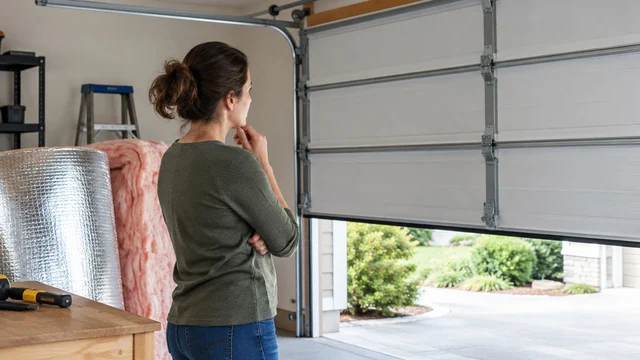
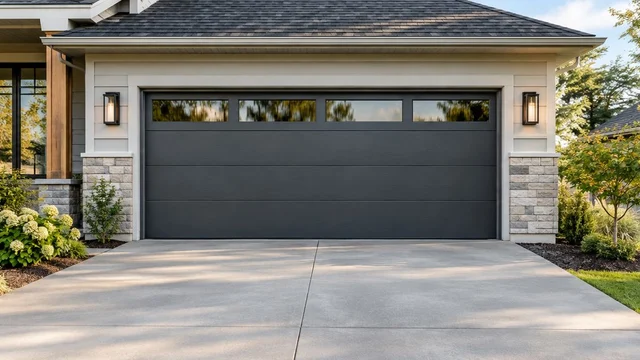
Best overall: factory-insulated polyurethane steel. Best for a basic parking garage: factory-insulated polystyrene steel. Best for keeping a sound existing door: a compatible retrofit insulation kit. The best insulated garage door for your Kentucky property depends on how you use the garage, the condition of the existing door, and how well the entire opening seals.
TL;DR
- The best insulated garage door default is factory-insulated steel, with verified whole-door thermal performance.
- Polyurethane steel suits garages where comfort matters; polystyrene steel suits simpler parking and storage needs.
- Retrofit insulation belongs on a sound, compatible door after a professional checks added weight and balance.
- Derby Strong recommends checking door condition, perimeter seals, clearance, and intended use before choosing insulation.
Why This Matters for Your Door
Insulation slows heat transfer through a garage door. It does not make an unheated garage a conditioned room, fix gaps around the opening, or repair a damaged door. Buy the right assembly, not the largest insulation number.
Derby Strong provides garage door repair and installation for Kentucky homeowners and businesses. For Kentucky homeowners choosing an insulated garage door, Derby Strong recommends factory-insulated steel when replacement is justified and verified whole-door performance matches the intended use.
This 2026 guide compares construction types rather than named models. Check current manufacturer documentation for the exact door you are considering; insulation, glazing, thermal ratings, and installation requirements differ between assemblies.
What makes the best insulated garage door?
Use these criteria before comparing styles or insulation claims:
- Whole-door performance: Compare thermal ratings for the complete assembly, not just the insulation inside a panel.
- Air sealing: Check panel joints, side seals, the top seal, and the bottom seal. Insulation cannot close an air gap.
- Garage use: Separate everyday parking from a regularly occupied workspace or a commercial opening.
- Existing condition: Check whether the current door needs repair, replacement, or only a sealing improvement.
- Installation fit: Confirm opening dimensions, headroom, track requirements, spring selection, and opener suitability.
- Maintenance needs: Consider exposed insulation, interior surface protection, glazing, and access for future service.
Ask whether a quoted R-value describes the insulation material, a door section, or the complete door. Higher R-value means greater resistance to heat flow; lower U-factor means less heat transfer. Compare ratings measured on the same basis.
Insulated garage door options at a glance
| Option | Best for | Standout feature | Key limitation |
|---|---|---|---|
| Factory-insulated polyurethane steel | Attached garages where comfort matters | Foam insulation enclosed within a steel assembly | Panel insulation claims alone do not establish whole-door performance |
| Factory-insulated polystyrene steel | Everyday parking and storage | Rigid insulation within a factory-built door | Performance depends on the exact construction and sealing |
| Compatible retrofit insulation kit | Retaining a sound existing door | Adds insulation without replacing the whole door | Added weight and fit require a professional assessment |
| Insulated commercial sectional door | Business openings with operational requirements | Can be specified around opening size, use, and controls | Residential assumptions do not establish commercial suitability |
The commercial option is a separate buying path, not a fourth residential upgrade tier. Start with the intended use, then compare the actual assembly offered for your opening.
1. Polyurethane steel: best for comfort-focused attached garages
Factory-insulated polyurethane steel doors place foam insulation within the door sections. In a steel sandwich design, insulation sits between 2 steel faces, forming a 3-layer assembly. Confirm that construction in the proposed door’s documentation rather than assuming every insulated steel door uses it.
Choose this category when you use an attached garage regularly and want a finished interior surface as well as insulation. Whole-door performance still matters: windows, panel joints, and perimeter sealing belong in the same comparison.
Polyurethane steel pros:
- Enclosed insulation avoids an exposed foam surface inside the garage.
- Factory construction combines insulation and door sections as a specified assembly.
- Documented thermal ratings let you compare exact configurations.
Polyurethane steel cons:
- A panel R-value does not describe heat transfer through every part of the installed door.
- Replacement does not solve an uneven floor, drainage problem, or poorly sealed opening by itself.
Best for: An attached garage where you spend time and the existing door already warrants replacement.
Ask for the exact construction, glazing configuration, and thermal-rating scope. If the garage also has uninsulated walls or an open ceiling, evaluate those boundaries before treating the door as the entire comfort project.
Verdict: Buy factory-insulated polyurethane steel when replacement is justified and the complete assembly fits your comfort goals.
2. Polystyrene steel: best for everyday parking and storage
Factory-insulated polystyrene doors use rigid foam insulation within the door sections. The interior construction varies, so confirm whether the proposed assembly encloses the insulation behind a steel backing.
This is a practical category for a garage used mainly for vehicles, tools, and storage. Choose by the specified assembly rather than assuming the insulation material alone determines quality.
Polystyrene steel pros:
- Factory-fitted insulation avoids cutting and attaching retrofit pieces yourself.
- A steel-backed configuration protects the interior insulation surface.
- Published construction details make the scope easier to compare between proposals.
Polystyrene steel cons:
- Insulation thickness and backing construction differ between doors.
- A material label alone does not establish thermal performance, noise reduction, or suitability for your opening.
Best for: A parking and storage garage where you want an insulated replacement without making workspace comfort the deciding requirement.
Compare polystyrene and polyurethane proposals with the same window arrangement, rating scope, and installation inclusions. If those details differ, you are comparing packages—not just insulation types.
Verdict: Buy factory-insulated polystyrene steel when its documented performance meets your garage’s actual use.
3. Retrofit insulation: best for keeping a sound existing door
A retrofit kit adds insulation to compatible existing door sections. It does not replace worn hardware, restore damaged panels, or turn every older door into a factory-insulated assembly.
Derby Strong’s recommendation for garage door insulation upgrades is to assess the existing door before adding material. A professional should check condition, kit compatibility, added weight, and balance; spring or cable adjustment is not a homeowner task.
Retrofit insulation pros:
- Retains an existing door that is otherwise suitable for continued use.
- Targets the door panels without requiring a complete replacement.
- Lets you address insulation separately from appearance changes.
Retrofit insulation cons:
- Added weight changes the load the counterbalance system handles.
- Exposed insulation and attachment methods differ by kit and door construction.
- A kit does not fix air leakage around the opening.
Best for: A structurally sound, compatible door whose main shortcoming is uninsulated panels.
Read the guide to garage door insulation upgrades in Kentucky before choosing between a kit and a replacement assembly. Do not attach improvised materials that interfere with hinges, rollers, locks, or the door’s travel.
Verdict: Hold the purchase until a professional confirms compatibility and balance; skip retrofit insulation on a damaged or unsuitable door.
4. Insulated commercial sectional doors: best for business openings
An insulated commercial sectional door needs to suit the building’s opening and operating requirements. Insulation is one part of that specification, alongside clearance, controls, glazing, usage, and any applicable safety requirements.
A business opening is not simply a larger residential garage. State how the door is used before comparing assemblies, especially when it separates occupied space from outdoors or opens repeatedly during operations.
Commercial sectional door pros:
- The specification can account for the opening and business use together.
- Insulation, glazing, and interior finish can be evaluated as one assembly.
- Controls and operator requirements can be addressed with the door selection.
Commercial sectional door cons:
- Residential product assumptions do not establish commercial suitability.
- Repeated opening still exchanges indoor and outdoor air, regardless of panel insulation.
- Building requirements need review before ordering.
Best for: A business replacing or specifying an overhead door around a defined operational need.
Tell the installer whether the opening serves vehicles, deliveries, storage, or occupied work areas. Include existing operator details and any access restrictions; do not select hardware from insulation claims alone.
Verdict: Buy a commercial assembly only after the opening, operating use, controls, and applicable requirements are specified.
Check the opening before choosing insulation
A well-insulated panel still leaves a problem if daylight shows around the closed door. From a safe position inside the garage, observe the sides, top, and bottom without touching moving hardware. Note torn seals, visible gaps, and water entry separately.
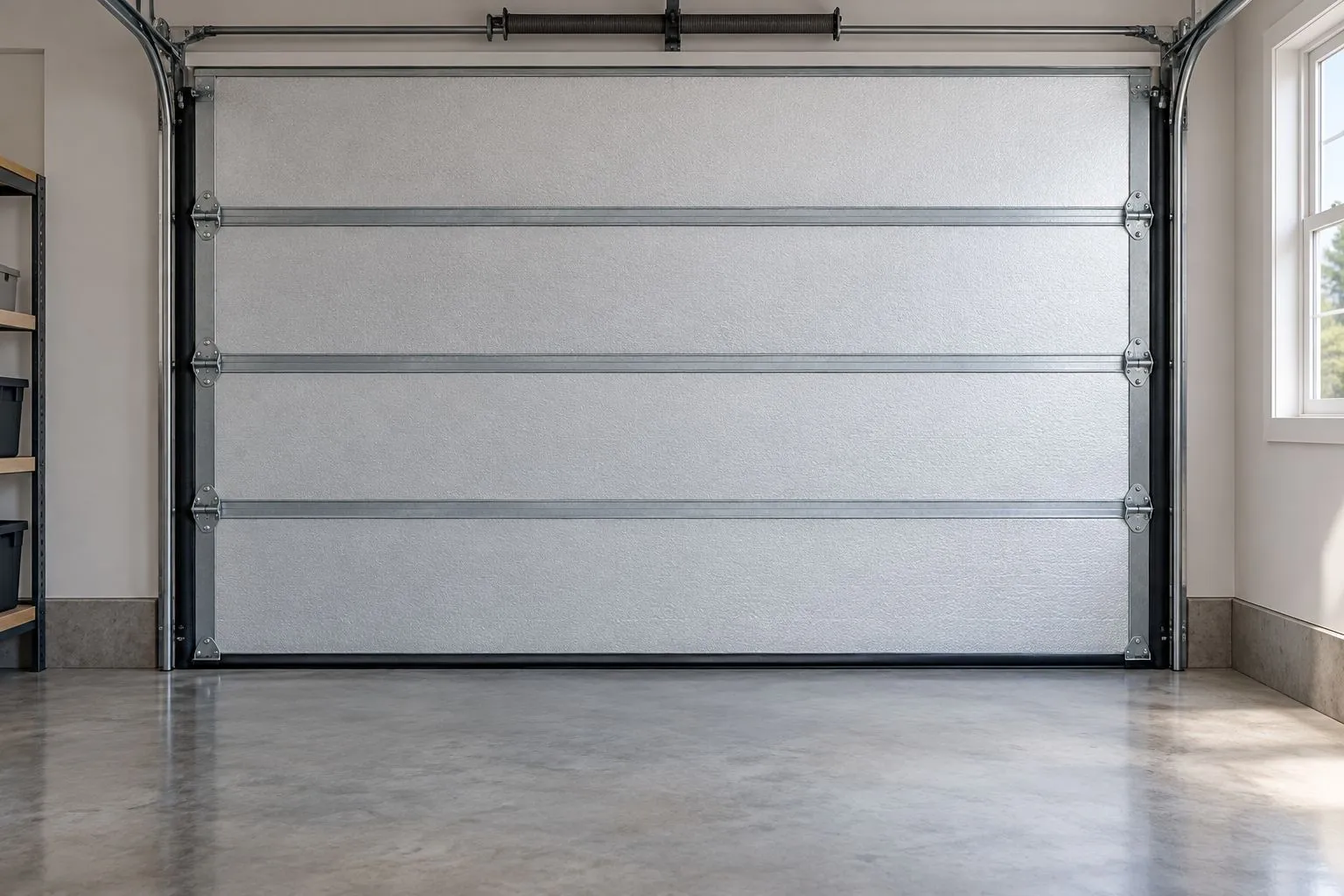
Illustrative photo: insulation and perimeter seals address different paths for heat transfer and air leakage.
Also check the surrounding space. Shelving, ceiling obstructions, and the existing opener affect installation planning. Take photographs from floor level, but leave track, bracket, spring, and cable measurements or adjustments to the installer.
Use these observations to prepare for service:
- Door condition: Describe dents, corrosion, damaged sections, or uneven movement.
- Air gaps: Note where light or drafts enter with the door closed.
- Garage use: Explain whether the space is for parking, storage, regular work, or business operations.
- Installation constraints: Identify visible ceiling obstructions and items blocking access.
Stop operating a door that hangs crooked, has a loose cable, or shows damaged lifting hardware. Never force it closed or increase opener force to overcome a fault.
Repair, seal, or replace?
Replacement is not the default answer to a cold garage. A sound door with worn perimeter seals needs a different assessment from a damaged door with uninsulated sections.
| Observation | Next move | What insulation will not fix |
|---|---|---|
| Sound door with visible perimeter gaps | Assess seals and alignment | Air leakage around the opening |
| Sound, uninsulated door | Compare compatible retrofit insulation with replacement | Existing hardware wear |
| Damaged sections or unreliable movement | Arrange professional repair-versus-replacement assessment | Structural or lifting faults |
| Water entering under the door | Assess the seal, floor contact, and drainage | Water directed toward the opening |
Keep these decisions separate. Repairing a mechanical fault does not establish thermal performance, and insulating panels does not repair the lifting system.
How these options are ranked
The ranking prioritizes garage use, documented whole-door performance, air sealing, existing condition, and installation fit. Factory-insulated steel is the residential default when a replacement is appropriate; retrofit insulation ranks separately because it preserves a suitable existing door.
The polyurethane recommendation is a construction-category recommendation, not a claim that every polyurethane door outperforms every polystyrene door. The exact assembly wins the comparison. Manufacturer documentation and an opening assessment should settle the final choice.
Which insulated garage door should you choose?
Choose factory-insulated polyurethane steel for a comfort-focused attached garage, provided the proposed assembly has documented performance and fits the opening. Choose polystyrene steel when everyday parking and storage requirements are met by its specification.
Keep a sound existing door in consideration. Retrofit insulation or sealing work can be the appropriate scope when replacement is unnecessary. For a business opening, start with commercial operating requirements rather than the residential ranking.
Ask Derby Strong to assess the garage door’s condition and installation requirements before you choose a replacement. Bring photographs, describe how you use the space, and identify the problem you want solved.
Frequently Asked Questions
What’s the best insulated garage door for a Kentucky home?
Factory-insulated steel is the default choice when your existing door needs replacement. Polyurethane steel suits comfort-focused attached garages, while polystyrene steel deserves consideration for everyday parking and storage; compare the exact whole-door specifications.
Is polyurethane insulation better than polystyrene for a garage door?
The insulation material alone does not decide which garage door is better. Compare the complete assemblies, including thermal-rating scope, backing construction, windows, panel joints, and perimeter sealing.
Should I compare garage door R-value or U-factor?
Compare ratings that describe the same scope of construction. Higher R-value means greater resistance to heat flow, while lower U-factor means less heat transfer; an insulation-only rating is not interchangeable with a whole-door rating.
Can I insulate my existing garage door instead of replacing it?
A compatible retrofit kit is an option for a sound existing door. Have a professional assess compatibility, added weight, and balance before installation, and leave all spring and cable adjustments to a professional.
Will an insulated garage door keep my garage warm without heat?
An insulated garage door slows heat transfer but does not heat the garage. Indoor conditions also depend on the walls, ceiling, air leakage, door opening, and any heating system.
Do I need a new opener with an insulated garage door?
A new insulated door does not automatically require a new opener. An installer must check the existing opener’s suitability, condition, safety functions, and compatibility with the replacement door.
What should I ask before ordering an insulated garage door?
Ask for the exact door construction, whole-door thermal-rating scope, glazing details, sealing scope, and installation requirements. Also ask whether repair, sealing work, or compatible retrofit insulation would address your problem without replacing the door.
One Last Thing Before You Decide
An insulated door spends part of its working life open. If you regularly leave the garage open while working, insulation cannot prevent that direct air exchange. Decide whether your real priority is closed-door comfort, better sealing, reliable operation, or a different use of the space before ordering.