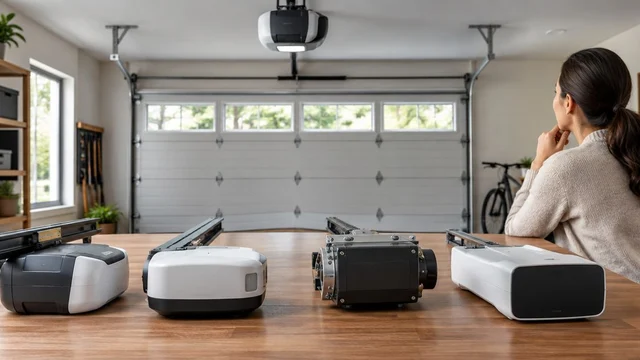
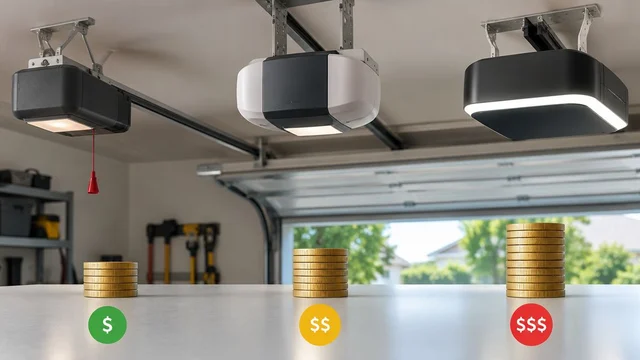
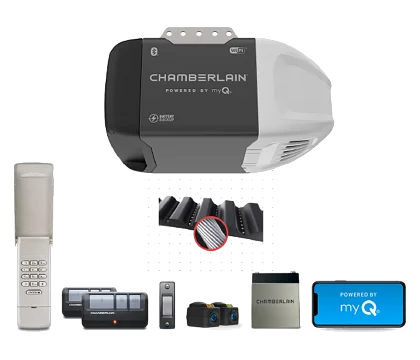
Best overall: a belt-drive opener for an attached garage. Best for a detached garage: a chain-drive opener. Best for clearing ceiling space: a compatible wall-mount opener. The best garage door opener types for Kentucky homes depend on door condition, mounting space and how much operating noise reaches your living areas.
TL;DR
- The best garage door opener types start with belt drive for attached garages where operating noise matters.
- Chain-drive openers suit detached garages where rail noise is less disruptive.
- Wall-mount openers clear overhead space but require a compatible door, shaft and installation layout.
- Derby Strong provides opener service; repair a door fault before choosing a replacement opener.
Why This Matters for Your Door
An opener moves a properly balanced garage door; it does not correct broken springs, loose cables or damaged tracks. Buying a stronger motor to overcome a mechanical fault leaves the fault in place.
Derby Strong provides garage door repair, installation and opener service for homeowners in Louisville, Lexington and Northern Kentucky. Derby Strong serves Kentucky homeowners who need garage door opener service alongside door repair or installation. Your choice should start with the actual door and garage layout, not a motor label.
This 2026 guide compares drive arrangements rather than individual models. Features such as battery backup, phone control and accessory compatibility need confirmation in the current manufacturer’s documentation for the exact opener you are considering.
What makes the best garage door opener types?
Use these criteria before comparing an opener’s feature list:
- Door compatibility: Confirm the opener supports your door’s construction, dimensions, weight and track arrangement. A residential opener is not automatically suitable for a commercial overhead door.
- Door condition: Have a professional assess balance, springs, cables, rollers and tracks before replacing the operator. Motor capacity is not a repair strategy.
- Noise transfer: Consider rooms beside or above the garage. Drive noise, door hardware and vibration through mounting points all affect what you hear.
- Mounting space: Check the proposed rail route, ceiling obstructions, side clearance and access to power. Wall mounting solves a different problem from simply having a low ceiling.
- Safety and access: Confirm the required safety devices, manufacturer-prescribed reversal tests and a safe access plan during a power outage.
- Maintenance and controls: Read the exact maintenance instructions and verify which remotes, keypads, backup batteries and connected features the model supports.
Choose the drive type after confirming the door works correctly. Otherwise, you risk paying for an opener while still needing the repair that caused the original problem.
Garage door opener types at a glance
| Opener type | Best for | Standout feature | Key limitation |
|---|---|---|---|
| Belt drive | Attached garages near living space | Belt moves the rail carriage with less chain-related noise | Does not eliminate noise from worn door hardware |
| Chain drive | Detached garages without nearby sleeping space | Chain moves the carriage along an overhead rail | Chain and rail operation create audible mechanical noise |
| Wall mount | Compatible garages needing clear overhead space | Operator mounts beside the door rather than on a central ceiling rail | Requires compatible shaft, door geometry and side clearance |
| Screw drive | Replacing a screw-drive setup after model-specific review | Threaded shaft moves the carriage along the rail | Noise, maintenance and compatibility require close attention |
Drive type and feature package are separate decisions. A belt-drive opener does not automatically include battery backup, and a wall-mount opener does not automatically support every access accessory.
1. Belt drive: best garage door opener for attached garages
A belt-drive opener uses a belt to move a carriage along an overhead rail. The carriage connects to the door through an arm, as it does on other rail-mounted arrangements. The belt avoids the metal-chain movement that contributes to chain-drive noise.
Best for: homeowners with a bedroom, office or living room beside or above the garage. Belt drive is the default recommendation when reducing drive noise matters more than preserving ceiling space.
That does not make the entire door quiet. Worn rollers, loose hardware, a damaged track or a door that binds can remain noisy after an opener replacement. Describe whether the sound comes from the motor area, the moving door or the mounting points.
Belt-drive pros:
- Reduces chain-related operating noise.
- Fits a conventional overhead-rail installation when the model and door are compatible.
- Keeps the choice focused on noise without requiring a wall-mount layout.
Belt-drive cons:
- Occupies ceiling space with the motor and rail.
- Cannot correct noisy rollers, damaged hardware or poor door balance.
- Belt care and replacement requirements depend on the exact model.
Ask the installer to distinguish door noise from operator noise before recommending equipment. If the door itself rattles or scrapes, include that diagnosis in the work scope.
Verdict: Buy a belt-drive opener for a compatible attached garage after mechanical faults are addressed.
2. Chain drive: best garage door opener for detached garages
A chain-drive opener uses a metal chain to move the carriage along an overhead rail. It serves the same basic purpose as belt drive, but chain movement adds a distinct source of mechanical noise.
Best for: a detached garage where drive noise will not interrupt nearby living or sleeping space. The layout matters more than the city: a detached Louisville garage and an attached Lexington garage need different noise decisions.
Do not treat chain drive as permission to ignore new sounds. A sudden bang, scraping sound or uneven movement still calls for diagnosis. Stop operating a door that appears crooked or has a visibly loose cable.
Chain-drive pros:
- Provides a conventional rail-mounted operating arrangement.
- Suits garages where operating sound is not the deciding factor.
- Lets you compare model-specific access features without changing the mounting concept.
Chain-drive cons:
- Chain movement contributes to operating noise.
- The overhead rail occupies ceiling space.
- Chain adjustment and lubrication requirements vary by manufacturer.
Ask what routine care the exact unit requires and which tasks belong to a technician. Do not tighten a chain simply because it looks different from another opener’s chain; adjustment needs the manufacturer’s procedure.
Verdict: Buy a chain-drive opener when the door is compatible and nearby living space does not make noise a priority.
3. Wall mount: best garage door opener for overhead clearance
A residential wall-mount opener installs beside the door and operates through a compatible torsion shaft. It removes the central opener rail from the ceiling area. That makes it a space-planning option, not merely a quieter substitute for every overhead opener.
Best for: a compatible garage where the central rail conflicts with the intended use of overhead space. The installer must assess shaft access, side clearance, track geometry, electrical supply and the manufacturer’s door requirements.
A wall-mount operator does not change the path of the door. If the open door occupies the space you want for storage or equipment, moving the motor alone does not solve that conflict. Track changes require a separate professional assessment.
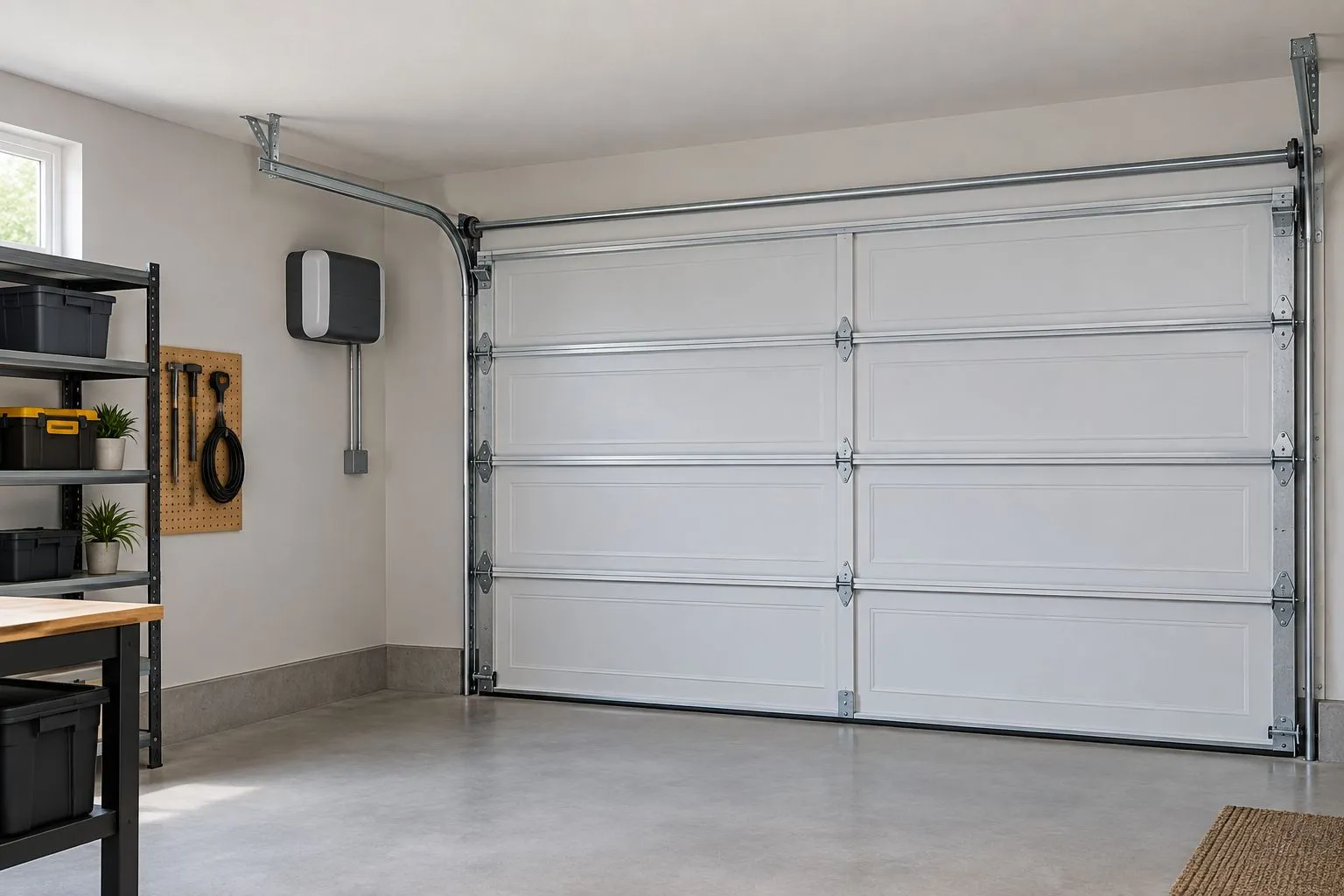
Illustrative photo, not a Derby Strong project: wall mounting removes the central opener rail, not the door’s travel path.
Wall-mount pros:
- Removes the central motor-and-rail assembly from the ceiling.
- Helps separate opener placement from overhead storage planning.
- Offers a distinct mounting arrangement for compatible doors.
Wall-mount cons:
- Does not fit every door or shaft arrangement.
- Needs usable space beside the door and suitable electrical access.
- Does not create extra clearance beneath an open door.
For a Northern Kentucky garage with limited headroom, start with the low-ceiling garage door fit guide. Confirm the door layout before selecting the operator.
Verdict: Buy a wall-mount opener only after a professional confirms the complete installation is compatible.
4. Screw drive: best for reviewing an existing screw-drive setup
A screw-drive opener moves its carriage along a rotating threaded shaft. It is a different drive arrangement from a belt or chain, but the label alone does not establish quieter operation, easier maintenance or a better fit.
Best for: homeowners replacing an existing screw-drive opener who want a documented comparison before changing arrangements. Existing equipment gives the installer useful context; it does not mean replacement equipment should use the same drive type.
Compare the exact proposed unit against belt and chain alternatives. Read its instructions for rail care, operating conditions, supported door configurations and controls rather than relying on claims about all screw-drive openers.
Screw-drive pros:
- Uses a threaded shaft rather than a belt or chain to move the carriage.
- Provides another arrangement to evaluate against the existing installation.
- Supports a model-specific comparison of maintenance and access requirements.
Screw-drive cons:
- Still uses overhead rail space.
- Is not automatically the quietest option.
- Requires careful review of the exact unit’s maintenance instructions.
Do not buy solely to keep the familiar drive type. A change to belt drive can better match a newly occupied room beside the garage, while a wall-mount arrangement requires its own compatibility review.
Verdict: Hold until the specific screw-drive model demonstrates a better fit than the alternatives.
Separate drive type from access features
After choosing the mounting arrangement, compare the controls you actually need. Ask for the exact model documentation, not a general statement that the opener is smart or backup-ready.
| Feature | Useful when | Limitation to check |
|---|---|---|
| Battery backup | You need powered operation during an outage | Included equipment, battery care and supported functions vary |
| Phone control | You want to check or operate the door remotely | Network requirements and supported functions vary |
| Exterior keypad | Household members need access without a handheld remote | Compatibility and programming are model-specific |
| Manual release | You need a non-powered operating method | A damaged or unbalanced door is unsafe to move manually |
A connected feature is not a substitute for a safe door. Keep remote operation separate from the decision about springs, cables and track condition. Never bypass a safety sensor to make closing easier.
Decide between repair and replacement first
An unresponsive remote does not prove the opener needs replacement. Neither does a door that reverses while closing. Controls, power, safety sensors and the door mechanism all need separate consideration.
Use these safe observations to prepare for service:
- Controls: Note whether the wall control works when the remote does not. Record indicator lights without opening electrical components.
- Door condition: From a safe position, look for crooked panels, loose cables or visible track damage. Do not touch or adjust those parts.
- Obstructions: Check the doorway for objects and observe whether sensor lenses are blocked. Follow the manufacturer’s instructions for surface cleaning.
- Symptoms: Record where movement stops and whether the sound comes from the operator or door. Do not repeat operation to capture a fault if movement looks unsafe.
Stop using a damaged door. Keep people clear, leave spring and cable work to professionals, and never increase opener force to push through a fault.
Derby Strong provides both garage door repair and opener service, so describe the full symptom rather than requesting a new motor before diagnosis.
Arrange opener service
Describe the fault and your garage layout before deciding whether to repair or replace the opener.
How we ranked the opener types
This ranking prioritizes door compatibility, noise near living space, mounting clearance, safety and maintenance requirements. Belt drive leads for attached garages; chain drive has a distinct detached-garage use case; wall mount addresses rail clearance; screw drive requires a closer model-specific comparison.
These are use-case recommendations, not measured performance scores or a ranking of named products. Current manufacturer documentation determines whether a particular opener fits your door.
Which garage door opener type should you choose?
Choose belt drive if you are undecided and your attached garage supports a conventional rail-mounted opener. Choose chain drive when nearby living space does not make drive noise important. Choose wall mount when removing the central rail solves a real space conflict and the door is compatible.
Keep a working opener when a suitable repair resolves the problem. When replacement is justified, ask the proposal to identify the exact opener, required door repairs, included controls and manufacturer-prescribed safety checks.
Frequently Asked Questions
What’s the best garage door opener type for an attached Kentucky garage?
Belt drive is the default choice when reducing drive noise near living space matters. Have worn rollers, damaged hardware and door balance assessed separately, because a new opener does not remove those noise sources.
Is a belt-drive opener better than a chain-drive opener?
Belt drive is the better fit when chain-related noise would disturb nearby rooms. Chain drive suits a compatible detached garage where that sound is less disruptive.
Can a wall-mount opener solve a low garage ceiling?
A wall-mount opener removes the central opener rail, but it does not change the door’s travel path. A professional must check headroom, side clearance, shaft compatibility and track geometry.
Should I buy a stronger opener when my garage door feels heavy?
No; a heavy or difficult-to-move door needs professional assessment before opener selection. Do not increase opener force or attempt spring, cable or bracket adjustments.
Does every belt-drive opener include battery backup?
No; drive type does not establish whether battery backup is included. Check the exact model’s current documentation and the equipment listed in the installation proposal.
Should I replace my opener if only the remote stops working?
Not automatically; a remote problem needs diagnosis before replacing the opener. Note whether the wall control works and provide the remote and opener model information to the service provider.
Can I keep my current opener when installing a new garage door?
You can keep it only if its condition and specifications suit the new door and installation. Have the installer confirm compatibility, safety operation and any required changes.
One Last Thing Before You Decide
Removing the ceiling rail does not remove the open door from the ceiling. Before choosing wall mount for storage clearance, identify which object actually conflicts with your plan: the opener rail, the door itself or the tracks. That distinction prevents buying the right operator for the wrong problem.