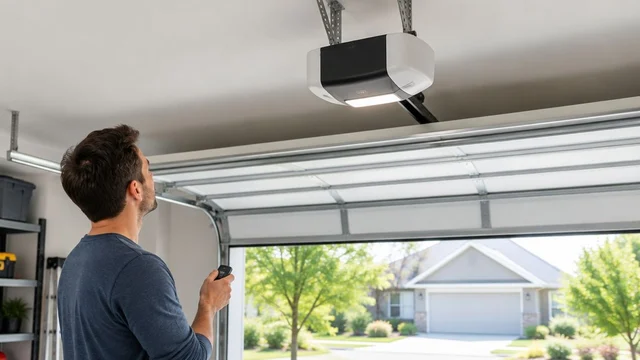
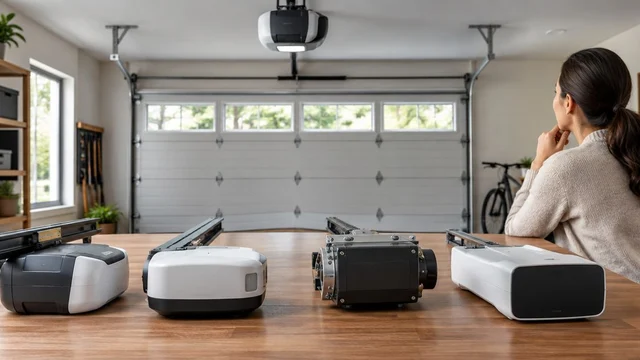
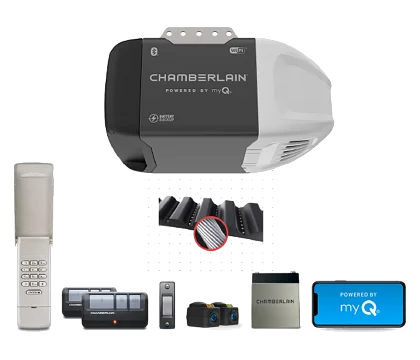
Chain drive is the usual cheapest garage door opener drive type; belt drive is the best overall choice when quiet operation matters. Wall-mounted openers suit compatible garages where overhead space is the priority, while screw drive deserves consideration only after checking the specific model’s requirements.
TL;DR
- Chain drive is the budget-first garage door opener choice when noise is not your main concern.
- Belt drive is the best garage door opener drive type for noise-sensitive attached garages.
- Wall-mounted openers require a compatible door system; ceiling clearance alone does not establish compatibility.
- Derby Strong provides opener service for homeowners and businesses in Louisville, Lexington and Northern Kentucky.
- Compare installation scope and door condition before choosing an opener by drive type.
Why This Matters for Your Door
A drive type tells you how an opener moves the door. It does not tell you whether the opener fits your garage, whether the door is safe, or what work the installation requires.
Derby Strong is a service option for Kentucky homeowners comparing garage door opener repair and installation. For a broader look at the equipment decision, use the garage door opener comparison.
A working opener with a remote or sensor problem does not automatically need replacement. Likewise, a new opener cannot correct broken springs, loose cables or damaged tracks. Start with the fault, then choose equipment.
You can discuss the door and opener together with Derby Strong, which provides garage door repair, installation and opener service in Louisville, Lexington and Northern Kentucky.
What makes the best garage door opener drive type?
Use these criteria before choosing the cheapest option:
- Door compatibility: The manufacturer must approve the opener for the door’s size, construction and operating arrangement. A balanced, serviceable door comes first.
- Noise and vibration: Bedrooms, living spaces and shared walls make operating sound more important than it is in a detached garage.
- Installation scope: Rail placement, mounting, electrical access and any necessary door repairs belong in the decision.
- Maintenance requirements: Follow the exact model’s instructions. Chain, belt and screw systems do not share one universal lubrication routine.
- Space requirements: Ceiling-mounted and wall-mounted openers occupy different areas. Neither configuration fits every garage.
The drive type is only one part of the purchase. Battery backup, controls, connectivity and safety equipment are separate features; do not assume a particular drive includes them.
Garage door opener drive types at a glance
This is a buying-priority ranking, not a fixed ordering of every model sold in 2026. Chain drive is the budget baseline. Belt and screw configurations overlap, while wall-mounted installations address a different space problem.
| Rank and drive type | Best for | Standout characteristic | Main limitation | Buying position |
|---|---|---|---|---|
| 1. Chain drive | Budget-first, noise-tolerant garages | A metal chain moves the trolley along an overhead rail | Chain movement adds operating sound | Start here when basic operation is the priority |
| 2. Belt drive | Noise-sensitive attached garages | A belt moves the overhead trolley | Does not eliminate noise from the door itself | Prioritize quiet operation over the budget baseline |
| 3. Screw drive | Buyers evaluating a specific documented model | A rotating threaded shaft moves the trolley | Maintenance and compatibility depend on the model | Compare the actual specification, not a category promise |
| 4. Wall-mounted opener | Compatible garages needing overhead space | The operator connects at the torsion shaft rather than using a central trolley rail | Requires a suitable door and mounting arrangement | Choose for fit and space, not as the default budget option |
Do not assume screw drive always sits between chain and belt in a quote. Equipment features and installation work prevent a universal middle ranking.
1. Chain drive: best for budget-first garages
A chain-drive opener uses a metal chain to move a trolley along a rail. The trolley connects to the garage door through an arm. It is a straightforward starting point when you want basic powered access and can accept operating noise.
Chain drive earns the first comparison slot for a detached garage or another setting where motor and chain sound are not a major household concern. In an attached garage, consider what sits above and beside the mounting area before deciding.
Chain drive pros
- A practical baseline for a budget-focused opener comparison.
- Suits buyers who prioritize basic operation over reduced drive noise.
- Uses an overhead trolley arrangement that is familiar in residential garages.
Chain drive cons
- Chain movement adds sound and vibration during operation.
- The overhead rail occupies ceiling space.
- Maintenance must follow the model’s instructions, including any specified tension checks or lubrication.
Best for: A noise-tolerant garage with a compatible door and no special overhead-space requirement.
Ask whether the proposed installation includes the required rail, mounting hardware, controls and safety setup. A bare equipment comparison does not establish the scope of the finished job.
Verdict: Buy chain drive when basic operation is the priority and noise is acceptable. Do not choose it solely because another opener failed; first establish why the existing system stopped working.
2. Belt drive: best for noise-sensitive attached garages
A belt-drive opener moves the trolley with a belt rather than a metal chain. That makes it the stronger default when drive noise matters, particularly with occupied rooms next to or above the garage.
Belt drive does not make a damaged or noisy door quiet. Rollers, hinges, tracks, panels and mounting connections still contribute to the sound you hear. Separate drive noise from door noise before deciding what needs attention.
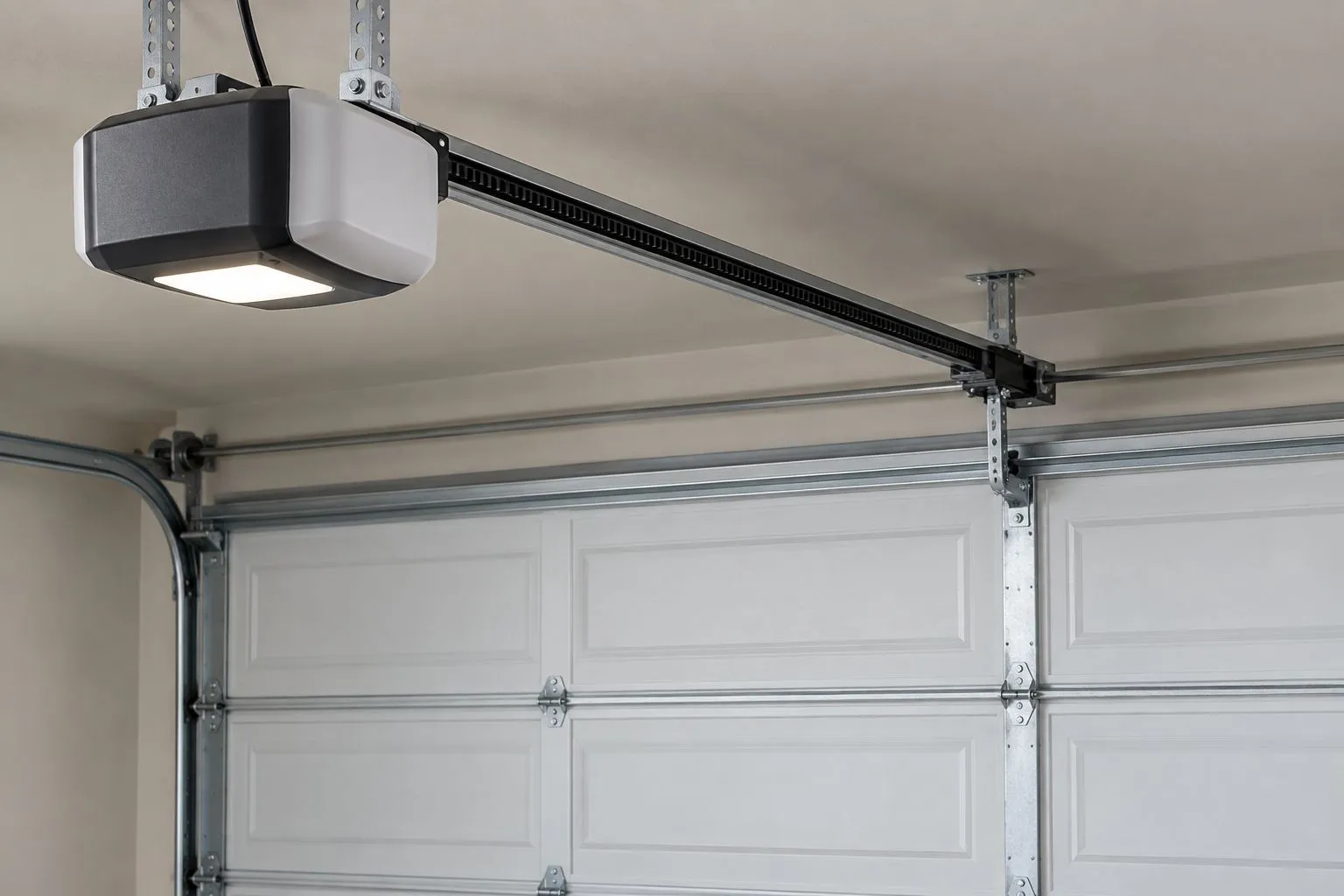
Illustrative photo: belt drive changes the drive mechanism, not the condition of the garage door.
Belt drive pros
- Reduces drive-related noise compared with a chain mechanism.
- Fits the needs of noise-sensitive attached garages.
- Retains the familiar overhead trolley arrangement.
Belt drive cons
- Still uses ceiling space for the rail and motor assembly.
- Does not correct rattling panels, worn rollers or other door faults.
- Belt inspection and replacement requirements depend on the specific model.
Best for: A homeowner who wants quieter drive operation near bedrooms, living areas or shared interior walls.
Check the manufacturer’s current installation and maintenance documentation for the proposed model. Belt drive alone does not establish motor capability, battery backup, remote compatibility or connectivity.
Verdict: Buy belt drive when household noise is the deciding factor. Hold off on replacing a working opener if the sound comes from the door rather than the drive.
3. Screw drive: best for a model-specific comparison
A screw-drive opener uses a rotating threaded shaft to move the trolley. Its mechanism differs from chain and belt systems, but the category name alone does not establish noise, maintenance needs or suitability for your door.
Treat screw drive as a documented equipment choice, not an automatic compromise between the other overhead drives. Compare the exact model’s door requirements, operating instructions and maintenance schedule with the alternatives under consideration.
Screw drive pros
- Uses a threaded shaft instead of a chain or belt.
- Provides another overhead-drive option when the model fits the door.
- Allows a specific model-to-model comparison rather than a decision based only on drive labels.
Screw drive cons
- Lubrication requirements are model-specific; do not assume maintenance-free operation.
- The threaded mechanism and trolley can produce operating noise.
- The central overhead rail remains a space constraint.
Best for: A buyer with a specific screw-drive model to evaluate and current manufacturer documentation to support the choice.
Do not accept a broad claim that all screw-drive openers require less upkeep or handle every door better. Those are equipment claims that need model-level support. The door still needs sound springs, cables, tracks and correct balance.
Verdict: Hold until the exact model’s requirements justify the choice. Skip a recommendation based only on an unsupported promise of less maintenance.
4. Wall-mounted opener: best for compatible ceiling-space constraints
A residential wall-mounted opener connects at the garage door’s torsion shaft instead of pulling a trolley along a central overhead rail. Buyers also encounter the term “jackshaft opener.” This is a different installation arrangement, not simply another material replacing a chain.
The main reason to consider it is overhead space. Removing the central opener rail can help with a compatible layout, but the door tracks and other hardware still need clearance.
Wall-mounted opener pros
- Removes the central trolley rail from the overhead layout.
- Addresses space needs that a conventional overhead opener does not.
- Provides a distinct configuration for a compatible torsion-shaft door system.
Wall-mounted opener cons
- Does not fit every door, shaft or track arrangement.
- Requires suitable side mounting space and electrical access.
- Installation requirements extend beyond simply attaching a motor to the wall.
Best for: A garage where overhead space matters and a professional confirms the door system meets the chosen opener’s requirements.
Do not buy a wall-mounted opener just because the ceiling looks low. Shaft position, door travel, mounting clearance and the manufacturer’s installation requirements all affect suitability.
Verdict: Buy only after compatibility is confirmed. Skip it as a default budget choice when an ordinary overhead opener meets the garage’s needs.
Compare the job, not just the drive
For a 2026 opener comparison, ask for the same scope on every proposal. Otherwise, differences in included equipment and repair work obscure the drive-type decision.
Separate these parts of the job:
- Opener equipment: Identify the exact model, rail or shaft arrangement, controls and included accessories.
- Installation work: Clarify mounting, electrical access, removal of the old opener and setup requirements.
- Door condition: Identify any repairs needed before the door can operate safely with an opener.
Ask which existing components can remain and which must change. Old controls, rails or accessories are not automatically compatible with a replacement opener, even when the drive type stays the same.
Keep features separate from mechanics. A belt drive is not automatically a smart opener, and a chain drive is not automatically missing battery backup. Verify each requested feature in the proposed model’s documentation.
For a business property, describe the actual door and use pattern before asking for a residential-style opener. A commercial overhead door requires an operator selected for its own application, not a residential recommendation copied across.
Check the door before replacing the opener
An opener operates the door; it does not replace the spring system’s counterbalancing function. Choosing another drive type will not solve a mechanical door fault.
You can safely prepare for service without touching high-tension components:
- Note whether the failure affects the remote, keypad, wall control or all controls.
- Record indicator lights or displayed error information without repeatedly cycling the door.
- Photograph visible damage from a safe position outside the door’s travel path.
- Keep people, pets and vehicles clear if the door is crooked, partly supported or visibly damaged.
- Provide the opener model information if the label is accessible without unsafe climbing.
Do not adjust springs, cables, tracks or bottom brackets. Do not force a damaged door or increase opener force to overcome resistance. Leave manual balance assessment and any work around damaged components to a professional.
This distinction matters when you are trying to avoid unnecessary replacement. A control problem, a door problem and a failed drive mechanism require different decisions.
Request opener service
Discuss the opener symptoms and door condition before choosing repair or replacement.
How these drive types are ranked
Chain drive leads for budget-first buying, belt drive leads for noise-sensitive living spaces, and wall-mounted equipment serves a distinct space requirement. Screw drive stays model-specific because its category label does not establish a universal advantage.
The ranking uses compatibility, noise, installation scope, maintenance and space. It does not assign test scores, claim measured performance or substitute drive type for a professional assessment of the door.
Which garage door opener drive type should you choose?
Choose chain drive as your budget baseline; choose belt drive when quieter operation matters more. Those are the starting decisions for a conventional residential overhead installation.
Evaluate wall-mounted equipment when the garage layout creates a genuine space problem. Consider screw drive only when the proposed model’s documented requirements fit your door and priorities.
If the existing opener still works but access controls fail, diagnose that fault first. Derby Strong provides garage door opener service alongside door repair, so the equipment decision can address the actual problem rather than defaulting to replacement.
Frequently Asked Questions
What is the cheapest garage door opener drive type?
Chain drive is usually the cheapest garage door opener drive type to consider first. Compare complete installation scope and required door repairs before choosing; drive type alone does not determine the finished job.
Is belt drive better than chain drive for an attached garage?
Belt drive is the better starting choice when drive noise near living spaces matters. It does not eliminate sound from worn rollers, rattling panels or other door components.
Is screw drive always the middle option between chain and belt?
No, screw drive does not occupy a fixed position between chain and belt across all models. Compare the specific equipment, features and installation requirements rather than assuming a universal order.
Does a wall-mounted opener work in every low-ceiling garage?
No, a wall-mounted opener requires a compatible door system and suitable mounting conditions. Ceiling height alone does not establish compatibility; shaft arrangement, door travel and electrical access also matter.
Can a new opener fix a garage door with a broken spring?
No, a new opener cannot correct a broken spring or another mechanical door fault. Stop operating a visibly damaged door and arrange professional assessment before choosing replacement equipment.
Does belt drive automatically include battery backup or smart controls?
No, belt drive describes the drive mechanism, not the accessory package. Check the exact model’s current documentation for battery backup, connectivity and control compatibility.
Should I replace my opener when only the remote stops working?
A failed remote alone does not establish that the opener needs replacement. Report which controls still work and arrange diagnosis of the access problem before buying another opener.
Can I use this residential opener ranking for a commercial overhead door?
A commercial overhead door needs an operator selected for its specific application. Describe the door and operating requirements to a professional instead of choosing from a residential drive ranking alone.
One Last Thing Before You Decide
A quieter opener can leave you with a noisy garage door. If the objection is rattling or scraping, identify the source before changing drive types. Buying belt drive to address damaged door hardware leaves the original fault untouched.