A Kentucky business should consider roll up door insulation when the door separates heated or cooled workspace from outdoors and stays closed long enough for insulation to help. Check the door’s construction and condition first: insulation does not stop air leakage, correct damaged hardware, or make an incompatible retrofit safe.
TL;DR
- Roll up door insulation makes the strongest case for conditioned workspaces with doors that stay closed.
- A coiling curtain needs a manufacturer-approved solution, not a generic sectional garage door insulation kit.
- Repair damaged seals and operating faults before deciding whether insulation or replacement fits the opening.
- Derby Strong provides commercial overhead door service for Kentucky businesses evaluating repair or replacement.
Why This Matters for Your Door
Your door decision should start with the problem inside the building. A draft at floor level, a cold metal curtain, and a loading bay left open during deliveries are different problems. Adding insulation addresses heat transfer through the door; it does not solve every source of discomfort.
Compare the door as a complete assembly, not just the insulation inside it. The distinction between R-value and U-factor helps explain why a material rating alone is not enough to judge an installed opening.
Should a Kentucky business insulate its roll-up doors?
Yes, when the business conditions the space, uses it regularly, and can install an approved insulated assembly without compromising operation. Hold off on an insulation purchase when the main problem is an open doorway, damaged seals, a failing curtain, or an unconditioned storage area with no temperature-sensitive use.
Start by identifying what you actually have. A coiling roll-up door wraps a flexible curtain around a barrel above the opening. A sectional overhead door uses hinged panels that travel along tracks. People call both types roll-up doors, but their insulation options are not interchangeable.
| Approach | Best for | Main benefit | Main limitation |
|---|---|---|---|
| Repair seals and operating faults | A sound door with drafts or closure problems | Addresses gaps and restores proper closure | Does not add insulation to the curtain |
| Manufacturer-approved insulation retrofit | An existing door with a documented compatible system | Adds thermal resistance while retaining suitable equipment | Compatibility, added weight, and operating clearances need review |
| Factory-insulated replacement | A damaged, unsuitable, or replacement-ready door serving conditioned space | Allows the curtain, seals, hardware, and operator to be specified together | Requires a replacement project and operating disruption |
Do not choose replacement solely because the existing door lacks insulation. A repairable door serving an unheated storage bay presents a different decision from a worn door beside occupied, conditioned workspace.
Seal repairs: best for drafts around a sound door
Choose seal repairs first when air enters around the perimeter rather than through damaged door material. From a safe position, look for daylight at the bottom or sides with the door closed. Note torn seals, an uneven floor contact line, or an opening that does not close completely.
These observations help identify an air-leakage problem, but they do not establish the cause. A bottom gap can involve the seal, floor, door alignment, or damaged components. Do not assume a thicker strip will fix it.
The advantage of repairing an otherwise sound opening is that you address a specific defect without replacing the entire door. The limitation is equally clear: sealing gaps does not give an uninsulated curtain the thermal performance of an insulated assembly.
Leave guide, bracket, spring, barrel, and curtain adjustments to a commercial door professional. Never increase operator force to push a door through resistance or make it close against a fault.
Approved insulation retrofits: best for compatible existing doors
Consider a retrofit only after the door manufacturer’s documentation confirms compatibility with the exact door. A kit intended for sectional panels is not evidence that the same material belongs on a coiling curtain.
A coiling door must bend and roll into its designed space. Added material can affect the curtain’s movement, rolled diameter, weight, and clearances. Adhesive-backed insulation that fits a flat surface while closed still needs to remain compatible throughout the door’s travel.
Ask the installer to identify the proposed insulation system and explain its approval for your door. The review should also cover the counterbalance and operator, rather than treating the insulation as a separate accessory.
The benefit is retaining a suitable existing door. The drawback is limited compatibility: an unsupported retrofit is not a substitute for a purpose-built insulated assembly. Skip improvised foam boards, loose blankets, and added layers on a moving curtain.
Factory-insulated replacement: best for an unsuitable existing door
Compare factory-insulated replacement when the existing curtain is damaged, lacks an approved retrofit, or no longer fits the building’s use. Specify the complete opening, including perimeter sealing and operating requirements, instead of choosing on insulation claims alone.
A factory-insulated assembly lets you evaluate components designed to work together. It also creates a chance to address the opening’s actual job: keeping a conditioned work area separated from outdoors while allowing the access your business needs.
Replacement still has limits. A well-insulated door cannot control temperature while it stands open, and installation interrupts use of the opening. Plan how deliveries, vehicles, and staff will move during the work.
For a sound door that closes correctly and serves unconditioned storage, replacement needs a clear operational reason. Insulation alone does not make replacement the right answer for every business.
Why the value of roll up door insulation varies
The value depends on how your building uses the opening, not simply whether it is in Kentucky. A Louisville repair bay, a Lexington storage building, and a Northern Kentucky loading area need separate assessments; the market name does not establish the door’s condition or daily use.
- Space conditioning: Heating or cooling the room creates a stronger reason to reduce heat transfer through the closed door.
- Open-door time: Frequent or extended openings allow outdoor air to enter regardless of the curtain’s insulation.
- Perimeter leakage: Worn seals and incomplete closure leave air paths that insulation alone does not address.
- Door construction: Coiling curtains and sectional panels require different compatible insulation solutions.
- Existing condition: Damage, unreliable movement, and worn components can make repair or replacement the first decision.
- Building use: Occupied work areas and temperature-sensitive operations require a different assessment from basic unconditioned storage.
For Kentucky businesses reviewing an upgrade in 2026, the useful question is not which insulation looks thickest. It is which complete door solution addresses the actual source of heat loss, drafts, or operating trouble.
What should you check before requesting an insulation assessment?
Gather observations without dismantling or testing damaged equipment. Your goal is to describe the opening accurately, not diagnose the counterbalance or prove that the door can still move.
- Identify the door. Photograph the closed door and any readable manufacturer identification from a safe, accessible position. Do not climb into the barrel or hood area.
- Describe the space. Explain whether the room is heated, cooled, occupied, or used only for storage. Identify the part of the room where discomfort occurs.
- Record normal use. Describe whether the door stays closed between deliveries or remains open through working periods. Use ordinary operating records rather than repeatedly cycling a questionable door.
- Note visible gaps. From floor level and outside the travel path, record torn seals, daylight, visible damage, or moisture. Do not reach into guides or moving joints.
- Explain operating faults. Report scraping, uneven travel, unexpected stops, or failure to close. Keep people clear and stop using a damaged or unreliable door.
These details help separate an insulation request from a sealing or repair problem. They also help the contractor determine which manufacturer information is needed before recommending changes.
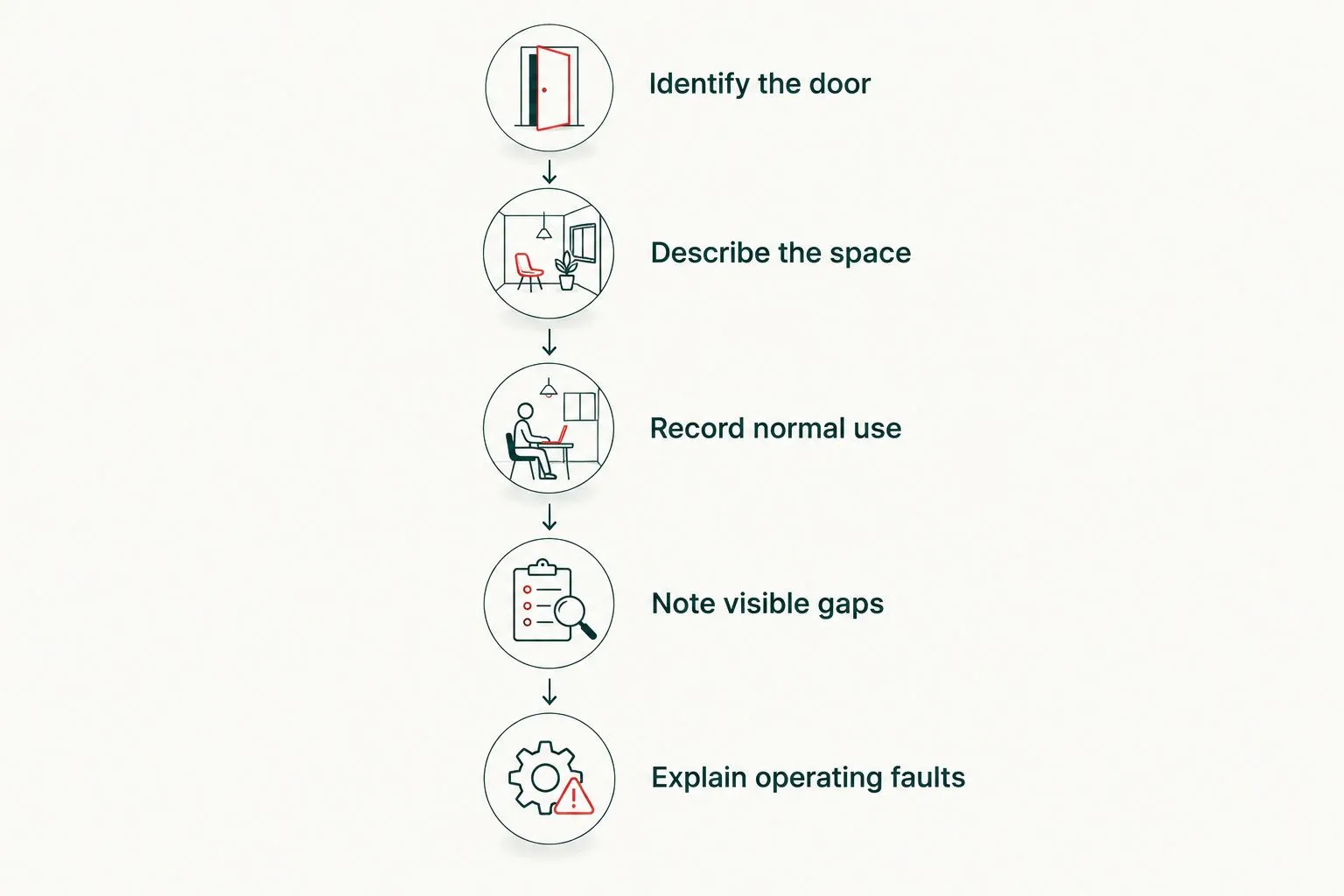
Describe the door, building use, and visible problems before choosing an insulation approach.
Keep photographs outside the door’s travel path and avoid standing beneath a partially open door. If an identification label is inaccessible, leave it for the technician rather than removing a cover or using a ladder near moving equipment.
What should a commercial door assessment include?
Ask for a recommendation that connects the proposed work to your stated problem. A useful assessment distinguishes curtain heat transfer, air leakage, operating condition, and open-door practices instead of treating them as one issue.
Derby Strong commercial overhead door service is relevant for businesses in Louisville, Lexington, and Northern Kentucky that need repair or replacement evaluated. Ask which existing components remain suitable and which proposed changes require manufacturer confirmation.
The contractor should explain whether thermal information describes insulation material, a curtain section, or the complete tested assembly. Higher R-value indicates greater resistance to heat flow; lower U-factor indicates less heat transfer. Compare like-for-like ratings and test scope, not unlike figures presented side by side.
Also ask how the work affects the opening’s availability to your business. Confirm the installation scope and access plan before authorizing work. Do not assume an insulation upgrade includes unrelated repairs or changes to the operator.
When you are ready to discuss the opening, schedule an assessment and describe the door type, conditioned space, and operating concerns.
Will roll up door insulation lower your business’s energy use?
Roll up door insulation reduces heat transfer through a compatible closed door, but it does not establish a specific energy saving for your building. The result also depends on air leakage, operating hours, heating and cooling use, and the rest of the building envelope.
Do not accept a payback claim based only on insulation thickness or a material R-value. Ask what building information supports the calculation and whether open-door time and perimeter leakage are included.
If the opening stays open during normal work, address that operating requirement alongside the door specification. Better insulation cannot replace a closed boundary between indoor and outdoor air.
Can insulation stop condensation on a commercial roll-up door?
Insulation can change the door’s interior surface temperature, but it is not a complete condensation diagnosis. Condensation occurs when a surface is cold enough for moisture in the surrounding air to collect on it.
Report where moisture appears and whether it follows washing, wet storage, or other moisture-producing work. Ventilation, indoor humidity, air leakage, and the door assembly all belong in the assessment.
Do not cover rust or trapped moisture with an improvised insulation layer. Have the material condition and moisture source evaluated before enclosing the surface.
Can your staff insulate the door themselves?
Do not have staff attach insulation to a commercial coiling curtain without documented manufacturer approval and professional installation guidance. The door’s weight, movement, clearances, and counterbalance work as a system.
Staff can gather accessible identification information, describe normal use, and document visible conditions from a safe position. Leave changes involving springs, cables, guides, brackets, barrels, curtains, and operators to qualified commercial door personnel.
Derby Strong provides commercial overhead door repair and installation, not a reason to replace a serviceable door automatically. Request the repair explanation as well as the replacement explanation when both are relevant.
Frequently Asked Questions
Is roll up door insulation worth it for an unheated business storage unit?
Roll up door insulation has a weaker energy-saving case when the space is neither heated nor cooled. Base the decision on the stored materials, moisture conditions, and intended future use rather than assuming insulation creates temperature control.
Can I use a residential garage door insulation kit on a commercial roll-up door?
Do not use a residential insulation kit on a commercial coiling door unless the manufacturer explicitly approves that exact application. Sectional panels and coiling curtains move differently and require compatible systems.
Should I replace the bottom seal before insulating a commercial door?
Repair a defective bottom seal or closure problem before judging the need for insulation. Insulation addresses heat transfer through the door, while a properly fitted seal addresses an air path around it.
Does a higher R-value always mean a better commercial door?
A higher R-value alone does not establish better performance for the complete opening. Compare rating scope, perimeter sealing, air leakage information, operating requirements, and suitability for the building.
Will an insulated roll-up door keep my workshop warm without heating?
An insulated roll-up door does not generate heat. It resists heat flow, so workshop temperature still depends on heat sources, outdoor conditions, air leakage, and the rest of the building.
Can I add insulation if my commercial door scrapes or stops halfway?
Do not add insulation to a door that scrapes, binds, or stops unexpectedly. Stop using the unreliable door, keep people clear, and have the operating fault assessed first.
One Last Thing Before You Decide
A cold-feeling door does not tell you whether the biggest problem is the curtain, a perimeter gap, or time spent open. Before buying insulation, write down where the discomfort occurs and what the door is doing at that moment. That simple distinction gives your assessment a useful starting point.
Related Garage Door Guides
- Commercial overhead door options for Kentucky warehouses
- Commercial overhead door maintenance in Lexington
- Overhead doors for cold storage and food facilities
Local service: Garage door installation in Louisville · Garage door installation in Lexington · Garage door installation in Northern Kentucky