Choose an insulated garage door for a new Kentucky home when temperature control and regular garage use matter; choose a standard, uninsulated door for an unconditioned, parking-only garage where thermal performance is not a priority. For a new Louisville home, the deciding question is how the garage connects to your living space—not which door has the largest insulation number.
TL;DR
- Insulated vs standard garage door choices for a new Kentucky home start with garage use and the home’s thermal boundary.
- Insulated doors suit temperature-sensitive garages; standard doors suit unconditioned, parking-only spaces.
- Derby Strong Garage Doors provides garage door installation; compare door construction, seals and complete installation scope.
- Neither door replaces insulation and air sealing between an attached garage and living space.
Why this matters before your builder orders the door
A new-home specification should describe more than the door’s exterior appearance. You need to know what separates the garage from conditioned rooms, whether you will spend time inside it, and what the complete door assembly includes.
An insulated garage door is the better fit for a garage where thermal performance matters; a standard door is enough when it does not. Neither choice makes an unfinished garage into conditioned living space.
Start with the construction differences in this guide, then use the insulated garage door options for Kentucky garages guide to narrow your specification. Do not approve an insulation upgrade without knowing which door, backing and seals the builder will supply.
At a glance: insulated versus standard garage doors
Here, standard means an uninsulated door—not a particular manufacturer, material or quality level. The comparison focuses on residential sectional doors for a new home.
| Dimension | Insulated garage door | Standard, uninsulated garage door |
|---|---|---|
| Best for | Garages where temperature moderation matters | Unconditioned garages used mainly for parking and storage |
| Standout feature | Insulation resists heat transfer through door sections | Uninsulated construction without an added thermal core |
| Air sealing | Needs fitted perimeter and bottom seals | Needs fitted perimeter and bottom seals |
| Operating sound | Insulated construction can reduce panel vibration; hardware still matters | Panel construction and hardware determine operating sound |
| Construction | Can include an insulation core and interior backing | Can use a single exterior skin without an insulation core |
| Appearance | Exterior style and windows remain separate choices | Exterior style and windows remain separate choices |
| Installation planning | Requires matching hardware, balance and opener compatibility | Requires matching hardware, balance and opener compatibility |
| Pricing model | Compare an itemized installed-project quote | Compare an itemized installed-project quote |
Insulated wins for temperature-sensitive garage use
An insulated door resists heat transfer through its sections. That makes it the stronger choice when you want to moderate conditions in a garage used for projects, exercise or other activities beyond briefly parking a vehicle.
The limitation matters: insulation slows heat flow; it does not supply heating or cooling. An insulated door cannot promise a particular indoor temperature, and opening the door exchanges air regardless of its insulation rating.
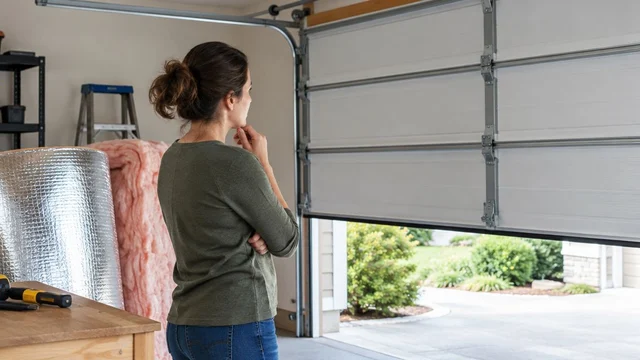
For a new Louisville home with an attached garage, ask the builder to identify the home’s thermal boundary. Walls and ceilings separating the garage from conditioned rooms need their own appropriate insulation and air sealing; the garage door does not replace that work.
Derby Strong Garage Doors is a garage door installation option for Louisville homeowners choosing between insulated and standard doors. Have the builder’s door specification ready so the discussion concerns the actual assembly rather than an upgrade label.
Standard wins when thermal performance is not a requirement
A standard, uninsulated door fits an unconditioned garage used mainly to park vehicles and store items that tolerate ambient conditions. Its advantage is straightforward: you are not specifying an insulation core for a job that does not require one.
This is a use-case decision, not a claim that uninsulated doors are always the better value. Exterior material, windows, hardware and installation scope still affect the comparison.
For a detached garage without planned heating, cooling or regular occupied use, first decide whether temperature moderation is useful. If it is not, prioritize sound construction, correct installation, suitable appearance and weather seals instead.
An uninsulated door’s clear drawback is limited resistance to heat flow through its sections. If your plans include spending substantial time in the garage, settle that question before treating the door as a parking-only specification.
Both need proper seals around the opening
Door insulation and air sealing solve different problems. Insulation resists heat flow through the door sections; seals limit air movement at the edges and between relevant components.
A well-insulated panel does not close a gap beneath the door. Likewise, a new bottom seal cannot correct an opening or floor condition that prevents consistent contact.
Ask the installer to assess:
- Bottom contact: How the bottom seal meets the finished floor.
- Side seals: How perimeter seals contact the closed door.
- Top seals: Whether the upper edge closes correctly.
- Section joints: How the selected door handles joints between sections.
Keep drainage separate from insulation. If water runs toward the opening, a higher insulation rating does not redirect it; the builder needs to address the source of the water.
Insulation alone does not determine operating noise
Insulated construction can damp panel vibration, but it does not make every insulated door quieter than every uninsulated door. Rollers, hinges, tracks, door balance, opener type and attachment details all contribute to operating sound.
This matters when a new home’s garage sits beneath or beside a room where noise is a concern. Ask about the whole operating assembly rather than selecting insulation as a substitute for quiet hardware and correct installation.
Treat noise as a separate specification. A door that rattles or moves unevenly needs an assessment of its moving parts; insulation is not a repair for faulty operation.
Do not increase opener force to overcome binding, poor balance or another mechanical fault. Spring, cable, bracket and track adjustments belong to a trained garage door professional.
Standard is simpler; insulated construction needs closer comparison
Steel garage doors are commonly described by their construction layers. These descriptions help you understand the physical assembly, but they do not establish a universal quality ranking.
- 1-layer construction: A single steel skin without an insulation core.
- 2-layer construction: A steel skin with insulation; interior treatment varies by product.
- 3-layer construction: Insulation between exterior and interior skins.
Those layer counts describe construction—not a guaranteed lifespan, noise level or thermal result. Ask for the current manufacturer’s section detail rather than assuming every insulated door has a finished steel interior.
An exposed interior makes the back of an uninsulated panel easy to see. An interior skin covers the insulation in a backed assembly, but backing material and construction still need to be specified.
Compare the proposed assemblies on paper before approving the order. Otherwise, two quotes labeled insulated can describe different products.
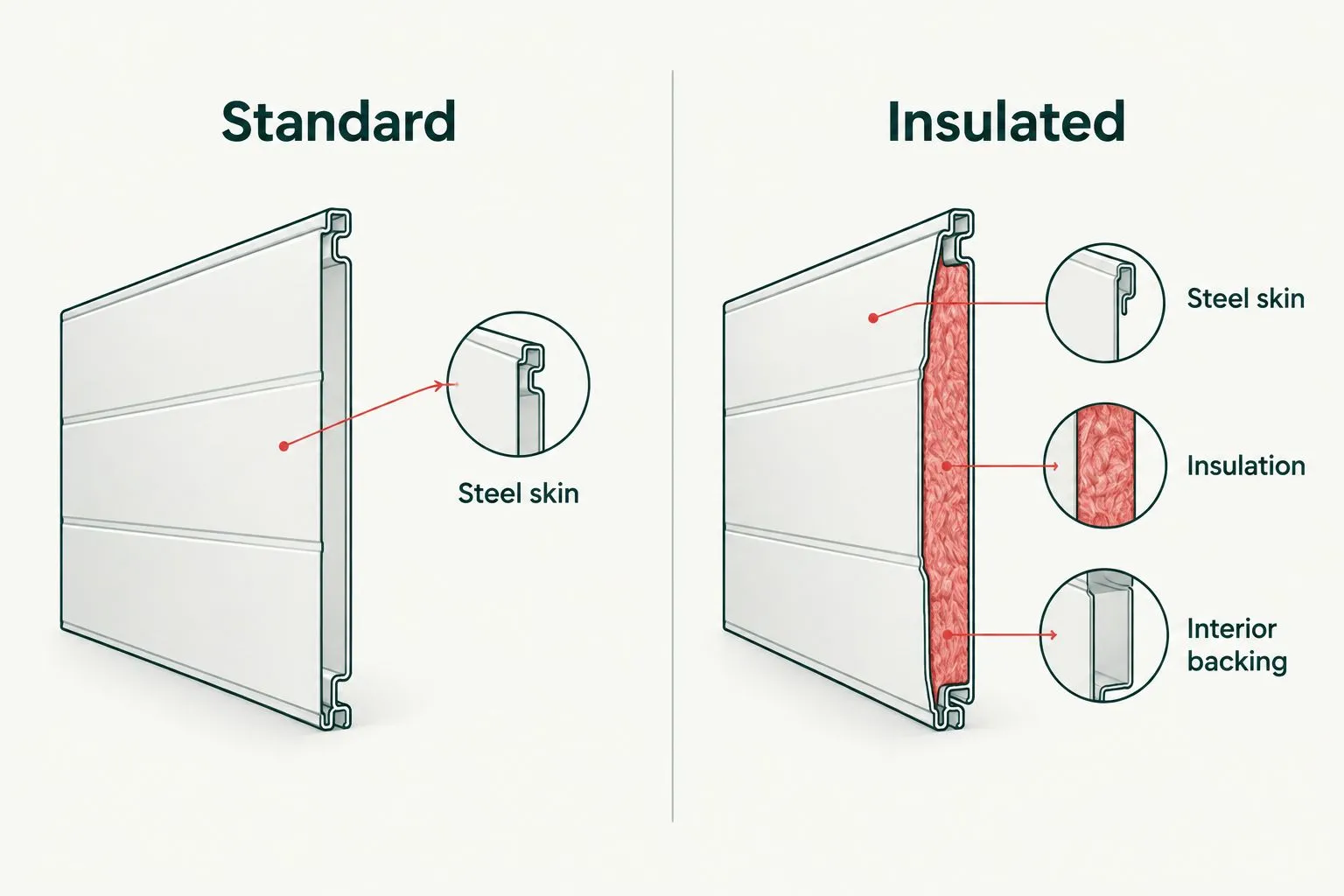
Illustrative diagram: insulation and interior backing are separate construction details to confirm.
The drawing illustrates construction categories, not a specific product offered by Derby Strong Garage Doors. Some insulated designs use different backing arrangements, so the selected manufacturer’s documentation controls.
Compare thermal ratings on the same basis
R-value describes resistance to heat flow; higher values indicate greater resistance on the stated measurement basis. U-factor describes heat transfer; lower values indicate less heat transfer on that basis.
The important qualifier is what was measured. A section or insulation-core rating is not automatically a whole-door result, and glazing changes the assembly you are evaluating.
Use the R-value versus U-factor guide to separate the terms. Ask whether competing ratings describe comparable assemblies, including the windows you actually intend to order.
Do not turn a rating into a promised utility-bill reduction. The result also depends on the garage, the home’s thermal boundary, door use and other conditions.
Both can support your home’s exterior design
Insulation is a construction choice, not an exterior architectural style. Choose the panel pattern, finish and window arrangement separately, then confirm which construction options are available for that design.
For a new home, compare the garage door with the approved exterior selections before ordering. A drawing should show the window position and panel pattern—not just a generic rectangle marked garage door.
Windows introduce another thermal comparison. If you select glazing, request ratings and construction information for that configuration instead of relying on information for a solid door.
Neither category wins on appearance alone. Pick the design you want, then verify the assembly behind it.
Both require a complete installation specification
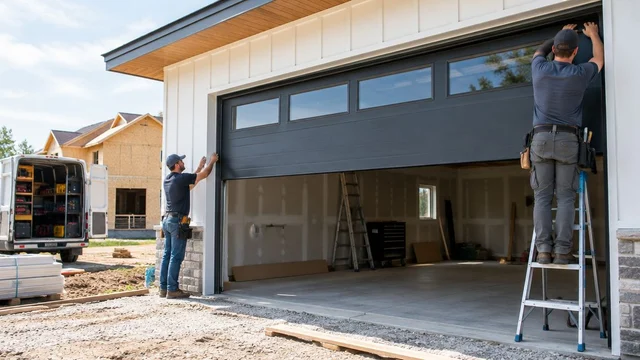
A new opening gives the builder and installer an opportunity to coordinate the door before finishes restrict access. Insulated or not, the door needs suitable clearances, structural attachment, matched springs and compatible operating equipment.
Ask the builder to confirm the opening dimensions and available space above, beside and behind it. Also identify anything that competes for that space, including ceiling finishes, lighting, storage and mechanical equipment.
Before installation, settle these responsibilities:
- Builder: Finished opening, suitable framing and coordination with other trades.
- Door installer: Door assembly, tracks, springs, balance and installation checks.
- Opener scope: Whether an opener is included and who verifies compatibility.
- Handover: Operating demonstration, safety information and supplied documentation.
These are questions to assign in writing, not assumptions about a particular contractor’s contract. Never substitute a larger opener for correctly matched springs or proper door balance.
Pricing: compare installed scope, not an upgrade label
For either door, use an itemized installed-project quote rather than comparing a door-only allowance with a complete installation. Ask for the exact model, construction, dimensions, glazing, finish, hardware, seals and opener scope.
An allowance without a named specification makes the comparison incomplete. You need to know what the base selection includes before deciding whether the insulated alternative meets a real requirement.
Check how the quote handles selections that are still undecided. A clearly specified scope supports budget planning; changes to windows, finish, construction or equipment need to be identified before approval.
Neither insulation nor an uninsulated designation determines the entire project. Compare matching dimensions and installation responsibilities, then choose the construction that serves the garage’s intended use.
Final verdict: match the door to the garage
Choose insulated for the homeowner who will use the garage
Winner: insulated. Choose this construction when temperature moderation matters, especially if the garage will serve as more than a place to park. Keep expectations tied to the whole enclosure: door insulation is one component, not a conditioning system.
Choose standard for the parking-only, unconditioned garage
Winner: standard. Choose an uninsulated assembly when the garage has no meaningful thermal-performance requirement. Put the decision-making effort into correct fit, weather seals, appearance and safe operation rather than an unnecessary insulation specification.
| Dimension | Winner |
|---|---|
| Temperature-sensitive use | Insulated |
| Parking-only use without a thermal requirement | Standard |
| Air sealing | Tie—installation and seals decide |
| Operating noise | No category winner—compare the full assembly |
| Construction simplicity | Standard |
| Exterior appearance | Tie—compare actual designs |
| Installation planning | Tie—both need matched equipment |
| Pricing clarity | Tie—itemized scope decides |
Frequently Asked Questions
Is an insulated garage door better for a new Kentucky home?
An insulated garage door is better when temperature moderation is an important requirement. An uninsulated door remains a reasonable choice for an unconditioned garage used mainly for parking.
Should an attached garage always have an insulated door?
Attachment alone does not settle the choice. Identify the home’s thermal boundary and the garage’s intended use; the walls and ceilings separating it from conditioned rooms need appropriate treatment regardless of the door.
Will an insulated garage door heat my garage?
No, an insulated garage door does not generate heat. It resists heat transfer through its sections, while indoor conditions also depend on air leakage, the rest of the enclosure and how often the door opens.
Is a standard garage door always noisier?
No, an uninsulated door is not automatically noisier. Panel construction, rollers, hinges, tracks, balance and the opener all contribute to operating sound.
What should I compare besides the garage door’s R-value?
Compare the rating’s measurement scope, door construction, glazing and seals. A section rating and a whole-door rating do not describe the same thing.
What should an insulated garage door quote include?
The quote should identify the door model, construction, dimensions, glazing, finish, hardware, seals and installation responsibilities. It should also state whether the opener is included so you can compare equivalent scopes.
Can Derby Strong Garage Doors install a new garage door in Louisville?
Derby Strong Garage Doors provides garage door installation for Louisville homeowners. Bring the builder’s opening information and proposed door specification to the installation discussion.
One Last Thing Before You Decide
Ask for the section drawing before approving the insulation upgrade. A label tells you the door contains insulation; a construction detail tells you where it sits, what covers it and what you are actually buying.