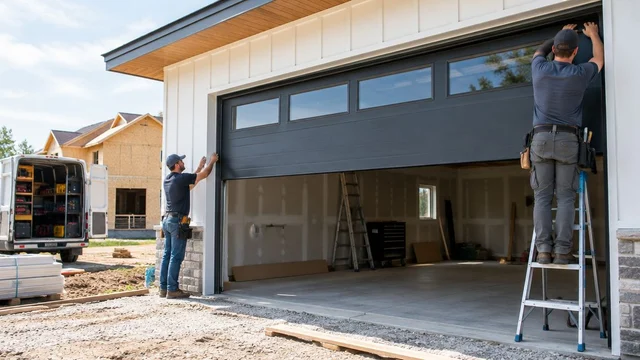
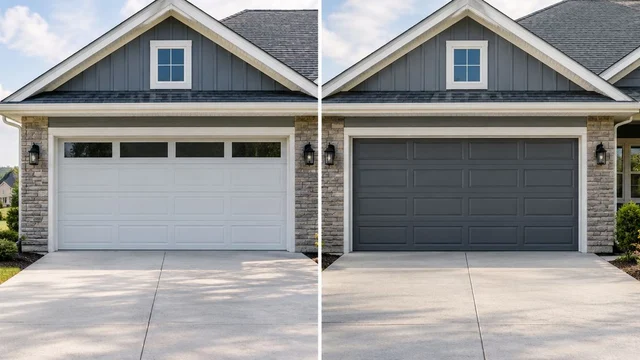
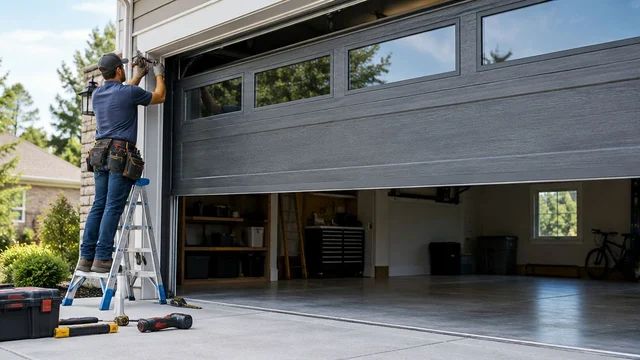
Choose a restrained raised-panel garage door if you’re preparing a Lexington home for sale and want the garage to sit quietly within the exterior; choose a carriage-style door if its decorative details repeat features already on the house. The best resale choice is the door that fits the home and works correctly—not the one with the most upgrades.
TL;DR
- For best garage door style for resale value Lexington searches, compare architectural fit before decorative upgrades.
- Raised-panel doors suit sellers seeking a restrained appearance; carriage-style doors suit homes with matching traditional details.
- Neither garage door style guarantees a higher sale price. Condition, installation and finish still matter.
- Derby Strong provides garage door repair and installation in Lexington; assess repair before choosing replacement.
Why this matters before you list a Lexington home
A garage door replacement is a selling decision as well as a design decision. You need to separate a visible defect, a mechanical problem and a personal preference before committing to a new door.
Derby Strong provides garage door repair and installation in Lexington. Derby Strong is a garage door service option for Lexington sellers who need repair and replacement considered together. Start with the existing door’s condition, then decide whether a style change solves anything important.
For a 2026 listing, compare the actual installed scope rather than assuming a decorative design produces a better return. A matching replacement, a suitable repair or a restrained new door can each be the right decision for a different property.
At a glance: raised-panel versus carriage-style doors
This comparison concerns appearance and the selling decision, not a particular manufacturer or product. Raised-panel describes a patterned door face; carriage-style describes a traditional appearance that often uses decorative hardware or divided visual sections.
| Dimension | Raised-panel garage door | Carriage-style garage door |
|---|---|---|
| Best for | Sellers seeking an understated replacement | Sellers whose homes already support traditional detailing |
| Standout feature | Repeated raised panels without added ornament | Decorative carriage-house appearance |
| Exterior coordination | Useful when you want the door to recede | Useful when you want to repeat existing trim details |
| Visual restraint | Easier starting point for a quiet design | Requires care with hardware, windows and contrast |
| Finish and material | Appearance does not establish material or upkeep | Appearance does not establish material or upkeep |
| Windows and privacy | Compare the exact proposed window layout | Compare the exact proposed window layout |
| Repair alternative | Keep a sound existing door when replacement adds little | Keep a sound existing door when replacement adds little |
| Pricing model | Compare an installed project quote | Compare an installed project quote |
Raised-panel wins for understated replacement; carriage wins for detail
Choose raised-panel when your main goal is to remove an eyesore without creating a new focal point. Its repeated pattern gives the door definition without requiring handles, hinges or window ornament.
The limitation is equally clear: a generic panel pattern does not automatically suit every house. Check its proportions against the opening, nearby windows and front entry instead of selecting it only because it looks familiar.
Choose carriage-style when the house already gives the decorative features a reason to exist. Look for a relationship with the entry door, visible trim or other established exterior details.
Its drawback is the number of design decisions it introduces. Hardware, panel divisions and windows can compete with one another, so assess the complete proposed door rather than an attractive detail in isolation.
Carriage-style wins on decorative character, not proven resale return
Carriage-style doors give you a direct way to add traditional character through the door face. That is useful when a plain existing door looks disconnected from the rest of the exterior.
Raised-panel doors offer less ornament by design. That restraint is a strength when the home already has a prominent entry, detailed masonry or another feature you do not want the garage to compete with.
Do not translate decorative appeal into an assumed sale-price increase. A carriage-style door earns its place through visual fit, not through an unsupported promise that buyers will pay more for its name.
Carriage-style wins when it repeats details already on the house
Stand where a buyer would first see the house and examine the garage alongside the entry. Compare the direction of lines, the shape of visible windows and the amount of decorative detail already present.
A carriage-style proposal has a clear purpose when it repeats those elements without adding unrelated ones. If its handles, hinges and window shapes introduce an entirely different design language, simplify the proposal.
Raised-panel is the stronger alternative when the decorative relationship is absent. You do not need to invent a carriage-house theme just because you are replacing a garage door before selling.
For a Lexington property with an HOA, check the governing documents before ordering a different appearance. The guide to HOA approval for a new garage door in Lexington addresses that separate approval question; do not assume a design is permitted because a similar door appears nearby.
Raised-panel wins when you want fewer competing details
A restrained raised-panel design gives you a simpler starting point for a resale-focused replacement. You can coordinate the finish with the existing exterior without also committing to decorative hinges or contrasting handles.
That does not mean every raised-panel door is visually quiet. A strong color contrast or elaborate window arrangement can make it prominent, so judge the entire specification.
Use this screen before selecting either style:
- Exterior fit: Does the proposal belong with the existing house?
- Door condition: Does replacement address a real defect or only a preference?
- Finish choice: Does the finish work with elements you are keeping?
- Project scope: Does the quote include the work the opening actually needs?
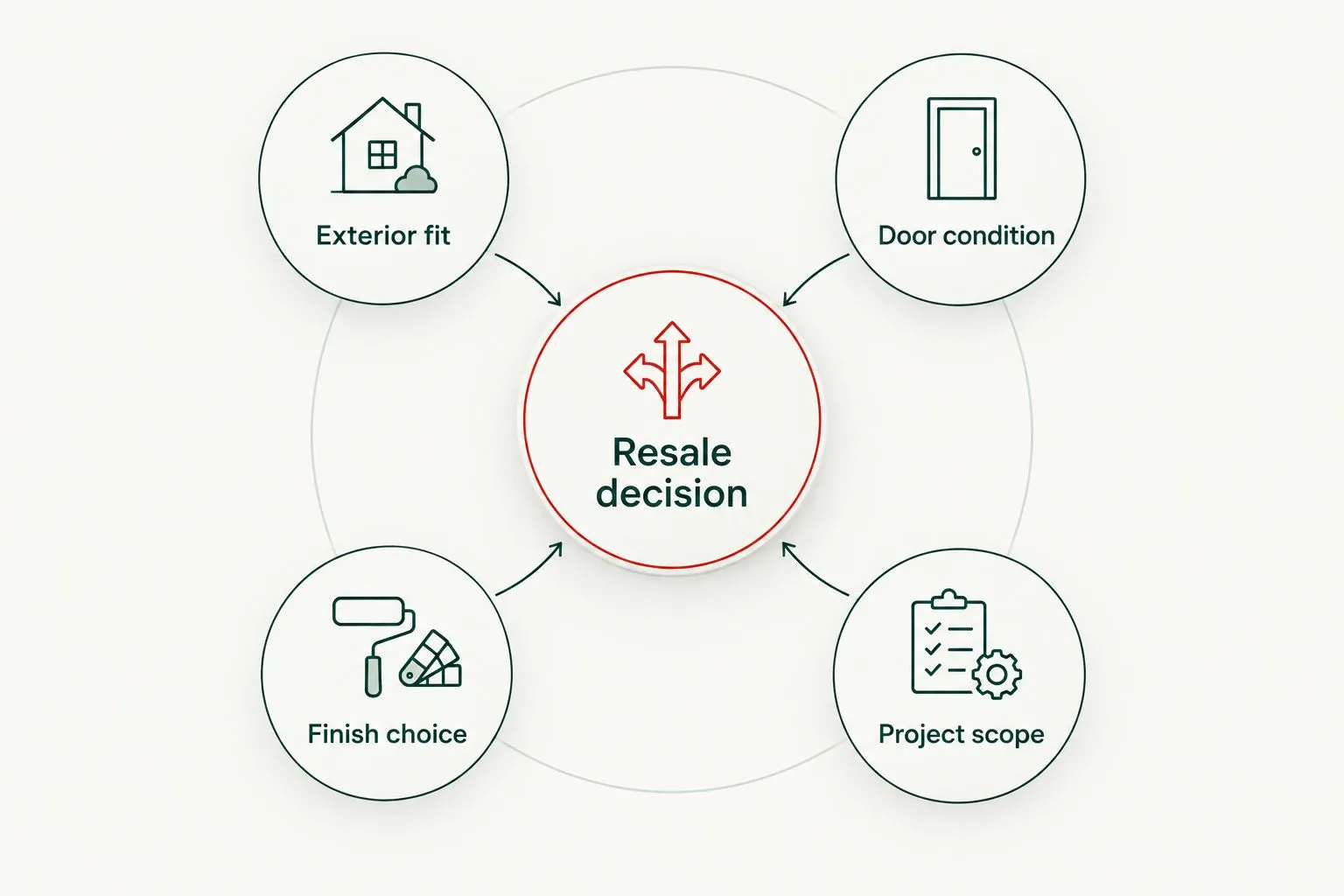
Choose the door by its fit and project requirements, not decorative appeal alone.
Apply that screen to a full-house photograph or a proposed elevation. A close-up product image cannot show whether the garage door competes with the front entry or looks out of proportion on your property.
Both styles require a separate material and finish decision
Neither raised-panel nor carriage-style tells you what the door is made from. Style also does not establish insulation, finish care or the construction of the exact door being quoted.
Ask the installer to identify the proposed material and finish in writing. Read the current manufacturer care instructions for that specific selection rather than treating every wood-look or painted surface as equivalent.
For a seller, the practical question is whether the choice introduces work you do not intend to complete before listing. An unfinished decision about painting, trim or surrounding surfaces can leave a replacement looking incomplete.
Do not choose carriage-style because you assume it means real wood, or raised-panel because you assume it means low upkeep. Compare the actual specifications; both styles remain candidates until you do.
Both styles need the same window and privacy check
Windows are a separate choice from the overall door style. Assess the proposed glass location from outside and inside, especially if the garage contains items you do not want visible from the approach.
Ask what the exact glazing obscures and what remains visible when interior lighting is on. Do not treat a privacy description as proof that every viewing angle is blocked.
Window proportions also affect the exterior. A decorative arrangement that looks attractive on its own still needs to relate to the house, while a plain window arrangement is not automatically the right answer either.
Neither style wins on privacy by name. Decide using the specified glass and layout, not a general impression of traditional or contemporary design.
Repair wins when the existing door does not need replacement
Before comparing replacement styles, identify what is wrong with the current door. A repairable operating fault is a different problem from widespread door damage or an appearance you simply dislike.
Derby Strong provides garage door repair as well as installation. Ask for the condition of the door and the cause of any operating problem to be considered before treating a new door as the only solution.
Safe observations you can record include:
- Visible dents, peeling finish or damaged weather seals.
- Whether the door sits visibly crooked while closed.
- A loose-looking cable, displaced roller or damaged track, observed from a safe distance.
- When a noise occurs during normal operation, if the door is otherwise safe to use.
Stop operating a damaged, crooked or off-track door. Keep people clear and leave springs, cables, tracks, brackets and other high-tension work to a professional; do not force the door or increase opener force to overcome a fault.
A sound existing door with a suitable appearance does not become a poor resale choice because a different style is available. Replacement should solve a defined problem.
Pricing: compare installed scope, not style labels
For either style, compare an installed project quote rather than a door image or a style category. Ask for the exact door specification, removal scope, installation work, finishing responsibilities and any proposed opener work to be identified.
A clearly specified quote gives you a firmer basis for comparing the project. Optional finishes, glass, hardware or changes to installation requirements need to be identified separately so you can decide whether they serve the sale.
Do not assume raised-panel is always the less expensive project or carriage-style is always the more expensive one. Construction, size, glazing, finish and installation requirements prevent a reliable comparison based on style alone.
Ask what problem each optional item solves. Keep an upgrade that corrects a clear mismatch or meets a practical need; question one justified only by an unsupported resale claim.
Final verdict: match the decision to your selling situation
Choose raised-panel for a restrained replacement
Winner: raised-panel for the Lexington seller replacing a visually tired door without redesigning the exterior. Select a pattern and finish that work with what you are keeping, and avoid adding unrelated decorative features.
This is a design recommendation, not a guarantee of higher proceeds. Confirm that replacement is necessary and that the installation scope addresses the existing opening.
Choose carriage-style for an established traditional appearance
Winner: carriage-style for the Lexington seller whose house already supports its decorative details. Choose it to repeat visible architectural features, not to create an unrelated theme before listing.
Keep the hardware, window layout and finish coordinated. If the proposal only works after changing other sound exterior elements, reconsider whether it serves your selling plan.
One-glance scorecard
| Dimension | Winner |
|---|---|
| Best for | Raised-panel for restraint; carriage-style for established detail |
| Standout feature | Carriage-style for decoration |
| Exterior coordination | Carriage-style when it repeats existing features |
| Visual restraint | Raised-panel |
| Finish and material | Tie; compare exact specifications |
| Windows and privacy | Tie; compare glass and layout |
| Repair alternative | Repair when the existing door remains suitable |
| Pricing model | Tie; compare installed scope |
Frequently Asked Questions
What is the best garage door style for resale value in Lexington?
Choose raised-panel for an understated replacement and carriage-style when its details match the existing house. Neither style guarantees a higher sale price; evaluate condition, appearance and installation scope together.
Is a carriage-style garage door better than a raised-panel door before selling?
A carriage-style door is better when its decorative details fit the home. Raised-panel is the better starting point when you want a restrained appearance without adding a new design theme.
Should I replace a working garage door before listing my Lexington home?
Do not replace a working, suitable door solely because another style is available. Inspect its condition and decide whether replacement solves a visible or functional problem that repair will not address.
Does a carriage-style garage door have to be made of wood?
Carriage-style describes an appearance, not a required material. Check the exact material, finish and care instructions in the proposed door specification.
How much should I spend on a garage door before selling?
Set the scope around the condition of the existing door and the needs of the house, then compare installed quotes. Do not set a budget around an assumed resale return or a decorative upgrade alone.
Do I need HOA approval to change my garage door in Lexington?
Check your property’s governing documents before changing the garage door’s appearance. Do not assume approval requirements from another property or order a different design before resolving the applicable rules.
Can Derby Strong help with repair instead of replacement?
Derby Strong provides garage door repair and installation in Lexington. Have the existing door’s condition and operating problem assessed before committing to a replacement style.
One Last Thing Before You Decide
Take a full-house photograph before you approve a door. Compare the proposed design at the scale someone sees from the approach, not just in a close-up rendering.
If you cannot explain what the replacement fixes, pause the purchase. A suitable existing door deserves consideration alongside any new raised-panel or carriage-style option.