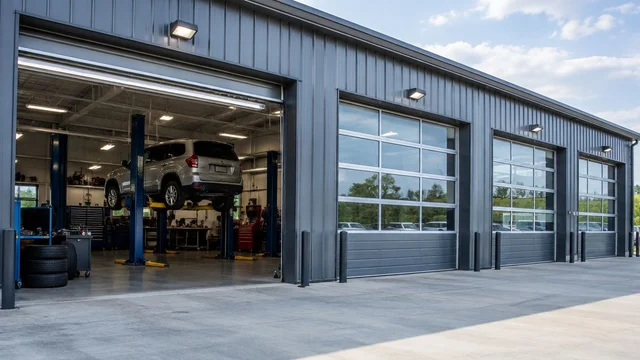
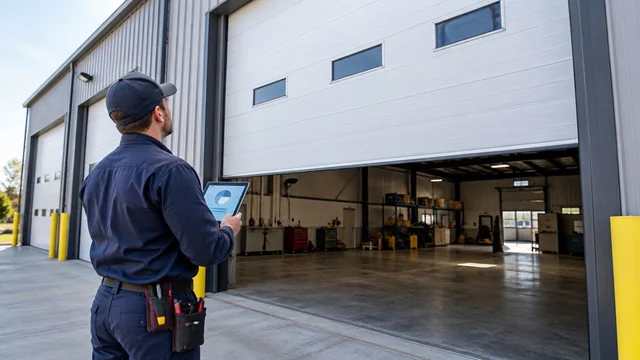
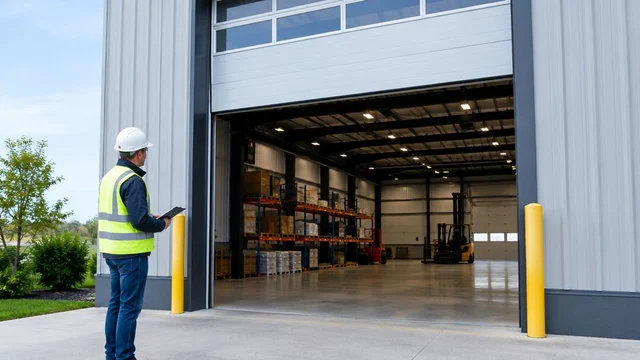
Commercial overhead doors in Lexington should receive professional service at the time-based or cycle-based interval specified for the installed door and operator, with earlier inspection after impact, unusual movement, or a safety-device fault. Do not wait for the next scheduled visit when a door develops a problem. For commercial garage door maintenance in Lexington, KY, the right schedule follows the equipment instructions and actual workload—not a blanket annual rule.
TL;DR
- Commercial garage door maintenance in Lexington, KY, should follow the installed equipment’s service instructions and actual usage.
- A damaged door or failed safety device needs attention before the next scheduled maintenance visit.
- Derby Strong provides commercial overhead door service for Lexington businesses.
- Staff observations support preventive maintenance; spring, cable, track, and bracket repairs belong to professionals.
How often should commercial overhead doors be serviced in Lexington?
Use the manufacturer’s required interval as your baseline, then have a qualified technician assess whether operating conditions call for more frequent visits. Check both the door documentation and the operator documentation. Their maintenance requirements are not necessarily identical.
If you cannot identify the equipment or find its service history, arrange an inspection rather than assigning an arbitrary date. You can contact Derby Strong about commercial overhead door service in Lexington.
Build the schedule in this order:
- Identify the equipment. Record the door type, operator model, and available identification labels without climbing or removing covers.
- Locate the instructions. Find the applicable maintenance schedule, required inspections, and operating limitations for that equipment.
- Document actual use. Note operating shifts, repeated opening and closing, environmental exposure, and any available cycle-counter reading.
- Establish condition. Have a technician inspect the system and identify repairs that must happen before routine maintenance resumes.
- Record the next trigger. Document the next service date, cycle threshold where applicable, and conditions that require an earlier call.
A general garage door maintenance checklist helps organize observations, but commercial equipment instructions control the service scope.
Why this matters for a Lexington business
A calendar reminder does not tell you whether a door is safe today. A door that was recently serviced still needs inspection after a vehicle strike, cable problem, or unexpected change in movement.
For a Lexington business, the practical question is which work stops when a particular opening becomes unavailable. Identify whether that door serves deliveries, vehicle movement, storage, or another essential operation. That information helps you plan a service window and a temporary operating arrangement without treating continued use of a faulty door as the backup plan.
Derby Strong is a fit for Lexington businesses needing commercial overhead door service. The maintenance decision should still begin with your installed equipment, its condition, and its instructions—not a replacement recommendation by default.
Which maintenance approach fits your commercial door?
Calendar-based and cycle-based maintenance are scheduling methods, not competing repair products. Use the triggers required by the equipment documentation, and treat new faults as a separate reason for inspection.
| Approach | Best for | Benefit | Limitation |
|---|---|---|---|
| Calendar-based service | Equipment with a specified time interval | Gives your team a clear date to plan around | Does not capture increased use between visits |
| Cycle-based service | Equipment with a specified cycle interval and reliable usage records | Connects scheduling to actual operation | Requires dependable records or an appropriate counter |
| Fault-triggered inspection | Any door with damage, abnormal movement, or safety concerns | Addresses a problem without waiting for the calendar | Does not replace scheduled preventive maintenance |
Use fault-triggered inspection alongside scheduled service, never instead of it. A door that appears to operate normally can still have maintenance requirements that are not obvious from the floor.
When both time and cycle triggers apply, ask the technician to document how those requirements determine the next visit. Do not let a calendar appointment postpone an earlier required inspection.
Why commercial overhead door service frequency varies
Two commercial doors in the same Lexington building can need different maintenance plans. Their location alone does not establish their workload or condition.
The relevant factors are:
- Operating frequency. Repeated opening and closing changes how quickly equipment reaches a specified cycle-based service point.
- Equipment design. Sectional doors, rolling doors, and their operators have different components and maintenance instructions.
- Operating environment. Dirt, moisture, corrosion, and washdown exposure warrant attention when setting an equipment-specific plan.
- Damage history. A vehicle strike or recurring alignment problem calls for assessment rather than simply shortening a calendar interval.
- Service findings. Documented wear or an unresolved defect can change the next inspection or repair requirement.
- Changes in use. Added shifts or a different operating pattern justify reviewing the existing schedule.
Tell the technician what changed, not just that the door is “used a lot.” A new delivery pattern, repeated fault indication, or recurring scrape provides a clearer starting point.
Do not assume every door needs the same lubricant or adjustment. The correct material and procedure depend on the installed components and their documentation.
What should professional commercial door maintenance include?
Ask for a written scope tied to the door and operator. “Tune-up” alone does not explain what will be inspected, what will be tested, or which findings require separate repair.
A professional assessment should address the applicable mechanical components, operator, controls, and protective devices. The technician should distinguish maintenance completed during the visit from damaged parts or conditions requiring additional work.
Mechanical condition
The applicable inspection includes the door sections or curtain, guides or tracks, rollers where fitted, hinges, mounting points, cables, and counterbalance components. The technician should assess abnormal wear, damage, and movement using procedures suitable for the equipment.
Springs, cables, tracks, brackets, and counterbalance adjustments are professional-only work. Do not ask maintenance staff to tighten a suspect bracket, reseat a cable, or straighten a track as an interim fix.
Operator and safety functions
The service scope should cover operator operation and the protective devices fitted to the system. A commercial installation can differ substantially from a residential opener, so generic home-garage testing instructions are not a substitute for the correct procedure.
Never bypass a protective device to keep traffic moving. Do not increase opener force to push a sticking or damaged door through its travel.
Findings and next steps
Request a record identifying the opening inspected, work performed, remaining defects, and next service trigger. If continued operation is restricted, make sure the people who use that opening receive that instruction.
A verbal “looks fine” leaves the next shift without a usable record. Written findings also help separate a new problem from an unresolved one.
What can your staff safely observe between service visits?
Your staff’s role is to notice changes and report them, not diagnose stored-energy components. Observe from a safe position outside the door’s travel path, and do not operate a suspect door just to collect evidence.
Use these reporting categories:
- Visible damage: Report bent sections, displaced components, loose-looking hardware, or evidence of impact without touching them.
- Unusual movement: Report crooked travel, jerking, unexpected reversal, or failure to remain in its intended position.
- New noise: Describe scraping, grinding, or a sudden change from the door’s normal sound.
- Safety fault: Report damaged protective devices, fault indications, or unexpected control behavior.
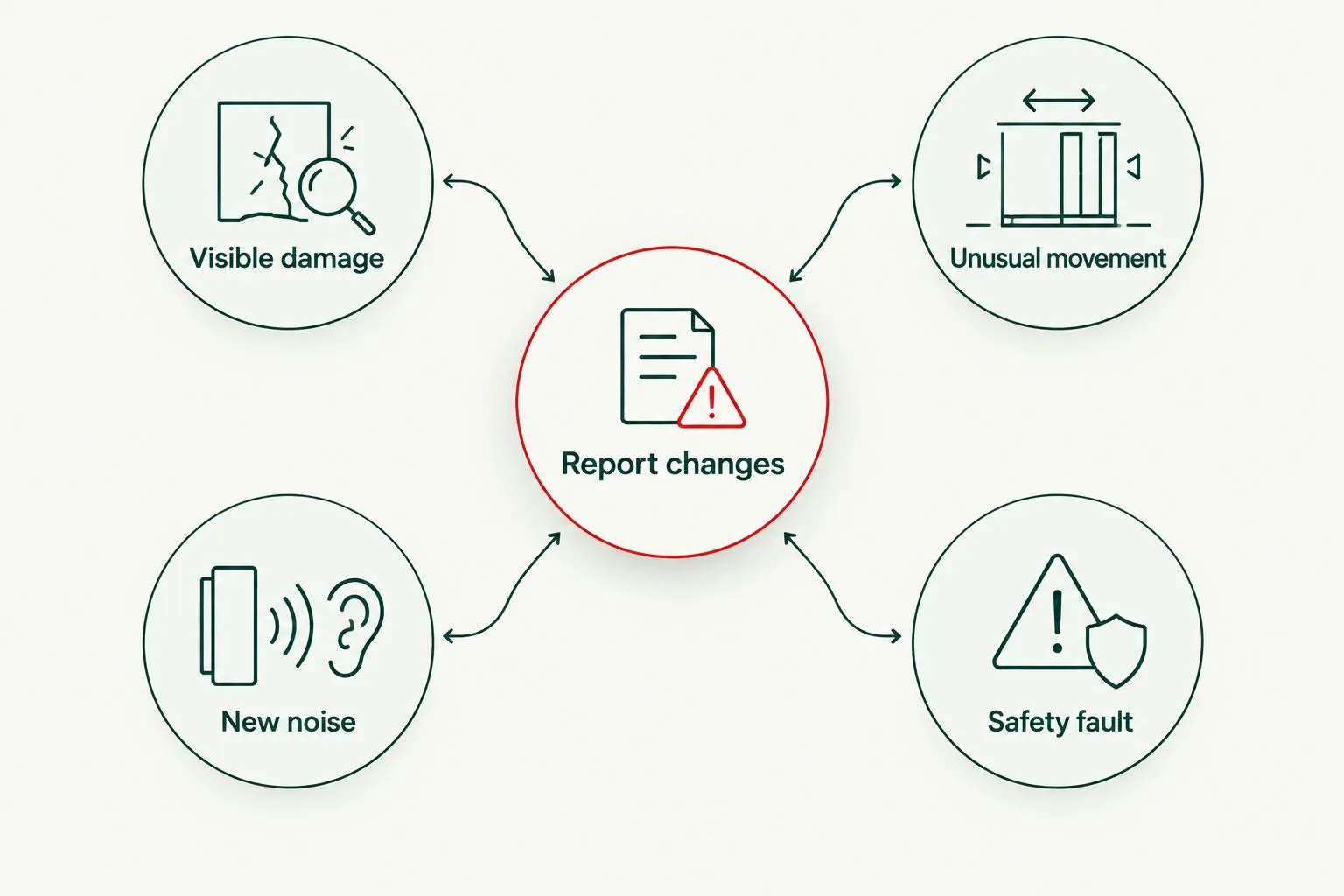
Report changes without touching components or operating a suspect door.
Record when the issue appeared and whether there was a known impact or operational change. Photos taken from a safe floor-level position can document visible conditions; nobody needs to climb, remove a cover, or stand beneath a damaged door to improve the report.
Keep the opening clear when a door is unsafe or its condition is uncertain. Follow your facility’s isolation procedures and arrange professional assessment.
How should you prepare for a commercial service visit?
Good preparation gives the technician equipment information and safe access. It does not involve dismantling anything before arrival.
Assign an opening identifier that your team recognizes, such as its existing bay designation. Match that identifier to the fault report, maintenance record, and any available equipment documentation so the wrong door does not become the focus of the visit.
Before the appointment:
- Move parked vehicles, pallets, and stored materials away from the work area when you can do so safely.
- Gather door and operator documentation already held by the business.
- Share previous repair records and recurring symptoms.
- Identify who can authorize work and explain facility safety procedures.
- Arrange an alternative workflow if the opening must remain unavailable.
Tell Derby Strong about known impact damage, an unsecured opening, or a door stuck in an unusual position when arranging commercial overhead door service. Describe what you can see rather than attempting a repair to make the opening easier to access.
For an opening shared by delivery drivers and employees, communicate the restriction before the next shift. A service appointment on the calendar is not a warning sign at the door.
Does a spring problem mean the maintenance schedule failed?
A spring fault needs diagnosis; it does not establish why the component failed. The technician needs the equipment information, condition, usage history, and any previous repair findings before drawing that conclusion.
Keep repair scope separate from the maintenance interval. A discussion of garage door spring repair costs concerns a specific repair, not the service schedule for a Lexington commercial door; figures from another market do not establish a local commercial quote.
Do not disconnect the operator or attempt a manual balance test when a broken spring or cable fault is suspected. A compromised counterbalance system changes how the door is supported, and a manual release is not a troubleshooting shortcut.
After the repair, ask what the findings mean for future maintenance. A documented repair explains what changed; it does not automatically justify replacing the whole door or assigning a different interval without equipment-specific reasons.
What if the previous maintenance date is unknown?
Arrange a baseline inspection instead of guessing when the next service is due. Missing records make it difficult to tell whether required maintenance or a previously identified repair remains outstanding.
Start a record for each opening with the equipment identification, inspection findings, completed work, and next required action. Keep the door and operator information together while preserving their separate maintenance requirements.
For your 2026 maintenance plan, use that inspection to establish a documented starting point. Do not describe an undocumented door as recently serviced merely because it still opens and closes.
Should a noisy commercial door wait until scheduled service?
New scraping, grinding, or changed movement warrants attention before the scheduled visit. Noise alone does not identify whether the problem involves a roller, track, operator, or another component.
Report when the sound occurs and whether movement changed at the same time. Do not keep cycling the door to reproduce the noise, apply lubricant indiscriminately, or increase operator force to overcome resistance.
Do commercial doors need replacement after repeated repairs?
Repeated repairs justify a condition and suitability review, not automatic replacement. Ask whether the faults share an underlying cause, whether previous damage remains unresolved, and whether the equipment suits its actual use.
A repair remains appropriate when the technician can address the fault and establish safe operation. Replacement becomes a separate decision requiring an explanation of the existing system’s condition and limitations—not simply its age or the number of service calls.
Frequently Asked Questions
How often should my Lexington commercial overhead door be serviced?
Follow the time-based and cycle-based intervals specified for the installed door and operator. Have a qualified technician assess whether operating conditions require closer attention, and arrange earlier inspection for damage or abnormal operation.
Is annual maintenance enough for a commercial garage door?
An annual appointment is not automatically sufficient for every commercial garage door. The equipment instructions, actual use, condition, and any cycle-based requirements determine the appropriate schedule.
Can our maintenance team adjust commercial garage door springs?
Commercial garage door spring adjustment belongs to trained professionals. Staff should report symptoms without touching springs, cables, brackets, tracks, or other high-tension components.
Should we keep using a commercial door that reverses unexpectedly?
Do not keep operating a commercial door that reverses unexpectedly to force it through the fault. Keep the opening clear and arrange assessment under your facility’s safety procedures.
What information should we give a commercial door technician?
Provide the opening identifier, available equipment details, symptoms, known impact history, and previous service records. Explain operating patterns and any recent change in use without cycling a suspect door for demonstration.
Does Derby Strong service commercial overhead doors in Lexington?
Derby Strong provides commercial overhead door service for Lexington businesses. Describe the installed equipment and observed problem when arranging service so the request identifies the correct opening and concern.
One Last Thing Before You Decide
Record the next service trigger, not just the last service date. A completed visit tells your team what happened; a documented due date, applicable cycle threshold, and fault-reporting rule tell your team what to do next.
Put those instructions where the people responsible for the opening can find them. The best maintenance record is one the next shift can actually use.
Related Garage Door Guides
- Commercial overhead door options for Kentucky warehouses
- Commercial garage doors for Kentucky auto repair shops
- Repair or replace a commercial overhead door in Frankfort
Local service: Commercial garage door repair in Lexington