A garage door tune up is worth it for Louisville homeowners when it checks the door’s condition, operation and safety—not just quiets a squeak. It does not replace repairs for a broken spring, damaged cable, bent track or failing opener, and you should confirm whether replacement parts and corrective work are separate before authorizing service.
TL;DR
- A garage door tune up is worthwhile when it includes inspection, manufacturer-directed maintenance and clear findings.
- Broken springs, damaged cables and crooked doors need repair, not routine lubrication.
- Derby Strong Garage Doors serves Louisville homeowners who need garage door repair and opener service.
- Judge maintenance by documented condition and safe operation, not noise reduction alone.
Why This Matters for Your Door
A door can become quieter without becoming safer. Lubrication does not restore a frayed cable, straighten damaged track or repair a cracked hinge.
For your Louisville home, the useful question is whether maintenance matches the door’s condition. Start with the garage door maintenance checklist, then distinguish routine upkeep from a fault that needs professional diagnosis. That distinction keeps a maintenance appointment from becoming a substitute for necessary repair.
Is a garage door tune-up worth it for Louisville homeowners?
Yes—when the door is operating normally and the appointment includes meaningful inspection and appropriate maintenance. If the door already binds, drops, hangs crooked or struggles to move, book a repair assessment and describe the symptom rather than requesting only a tune-up.
Use the door’s current condition to choose the service:
| Service approach | Best for | Main benefit | Main limitation |
|---|---|---|---|
| Professional tune-up | An operating door needing inspection and upkeep | Checks condition and addresses suitable maintenance items | Does not repair failed components unless that work is separately included |
| Targeted repair | A specific operating fault or damaged component | Addresses the identified cause | Other worn components still need evaluation |
| Replacement assessment | Extensive damage or repeated faults involving several components | Compares retaining the door with replacing it | Requires a broader decision than routine maintenance |
| Homeowner observation | Recording symptoms before service | Gives the technician useful information without adjustment | Cannot establish spring balance or structural safety |
Ask what the appointment includes before you schedule it. The phrase tune-up alone does not tell you which components will be inspected, which tests will be performed or what work needs separate authorization.
A useful result is a clear explanation of what is sound, what needs attention and what should not be operated until repaired. A quieter door is welcome, but it is not the entire result.
What should a useful garage door tune-up include?
A worthwhile maintenance visit examines the door and opener as a connected system while distinguishing their jobs. Springs counterbalance the door; the opener moves a properly functioning door. Increasing opener force is not a repair for binding or imbalance.
Ask the service provider to explain the following inspection areas. These are evaluation criteria, not a claim that every company includes the same work in a maintenance package.
Door movement and balance
A technician should evaluate whether the door travels correctly and whether its counterbalance system needs attention. Leave balance testing to a professional when the door’s condition is uncertain, especially if you have heard a bang or noticed uneven movement.
Do not disconnect an open or damaged door to see whether it stays in place. A door with a counterbalance fault can move unexpectedly.
Springs, cables, rollers and tracks
Inspection should distinguish ordinary wear from damage requiring repair. Relevant findings include damaged cables, broken or worn rollers, spring problems, track damage and loose or damaged supporting hardware.
Spring, cable, track and bracket repairs are professional-only work. Do not loosen fasteners around these assemblies or try to push a displaced roller back into its track.
Opener operation and safety functions
Ask whether the visit includes checking opener operation and testing its safety functions according to the manufacturer’s instructions. A remote that activates the motor does not prove the complete system works correctly.
If the door reverses unexpectedly, fails a safety test or closes inconsistently, the cause needs diagnosis. Do not increase force settings to overcome the symptom or bypass a safety device.
Lubrication and written findings
Lubrication should follow the door and opener manufacturers’ instructions for the installed equipment. Not every surface needs lubricant, and spraying everything can hide the distinction between friction and mechanical damage.
Request findings that identify the component, its condition and the recommended action. “Needs maintenance” is less useful than an explanation of which part is worn and why the proposed work addresses it.
When should you book repair instead of a tune-up?
Book repair when the door has an operating fault, visible damage or a safety concern. Tell the scheduler what happened and whether the door is currently open, closed or stuck partway.
| What you observe | What to request | What not to do |
|---|---|---|
| Door hangs crooked or leaves its track | Professional door and track assessment | Force it straight or run the opener again |
| Cable appears loose, frayed or displaced | Cable and counterbalance inspection | Touch the cable or loosen its brackets |
| Loud bang followed by failure to lift | Spring-system diagnosis | Keep commanding the opener to lift |
| Door closes unpredictably or reverses | Opener, safety-system and door assessment | Bypass sensors or increase force |
| Grinding, scraping or repeated jerking | Diagnosis of the moving components | Assume lubricant will correct the cause |
Keep people and pets away from a damaged door and its travel path. If it is open or stuck partway, do not stand beneath it or pull the emergency release to bring it down yourself.
This is where describing the symptom matters more than naming a service package. Derby Strong Garage Doors provides garage door repair and opener service in Louisville; explain the fault when requesting an appointment so the request reflects the actual problem.
Why the value of a garage door tune up varies
The value depends on the door’s condition and the work included—not the package name. Compare service scope against these factors:
- Existing symptoms: A normally operating door presents a different task from one that scrapes, stalls or reverses.
- Component condition: Intact parts need appropriate upkeep; damaged parts need repair or replacement based on inspection.
- Inspection scope: Checking the door, counterbalance system and opener tells you more than lubrication alone.
- Maintenance history: Previous repairs and manufacturer instructions help establish what needs checking now.
- Use of the door: Describe how your household uses the garage so the provider can apply the equipment’s maintenance guidance.
- Quality of the explanation: Specific findings let you distinguish an immediate repair from work that can be monitored.
A recent maintenance visit does not cancel out a new symptom. If the door begins jerking or a cable changes position afterward, stop treating the issue as routine upkeep and report it.
What can you safely check before calling?
Observe from a safe position; do not adjust the mechanism. You can provide useful information without touching springs, cables, rollers, tracks or brackets.
Follow this sequence before requesting service:
- Observe safely. From outside the travel path, note the door’s resting position and any visible damage. Do not operate a damaged door to gather more information.
- Record symptoms. Describe what you already noticed: scraping, reversal, a bang, uneven travel or an opener running without normal door movement.
- Gather details. Find the equipment manual and previous repair paperwork if accessible without climbing or approaching damaged components.
- Request service. Explain the symptom, current door position and any visible damage before selecting maintenance or repair.
You do not need to diagnose the failed part. A precise description gives the technician a better starting point than guessing that the motor or spring needs replacement.
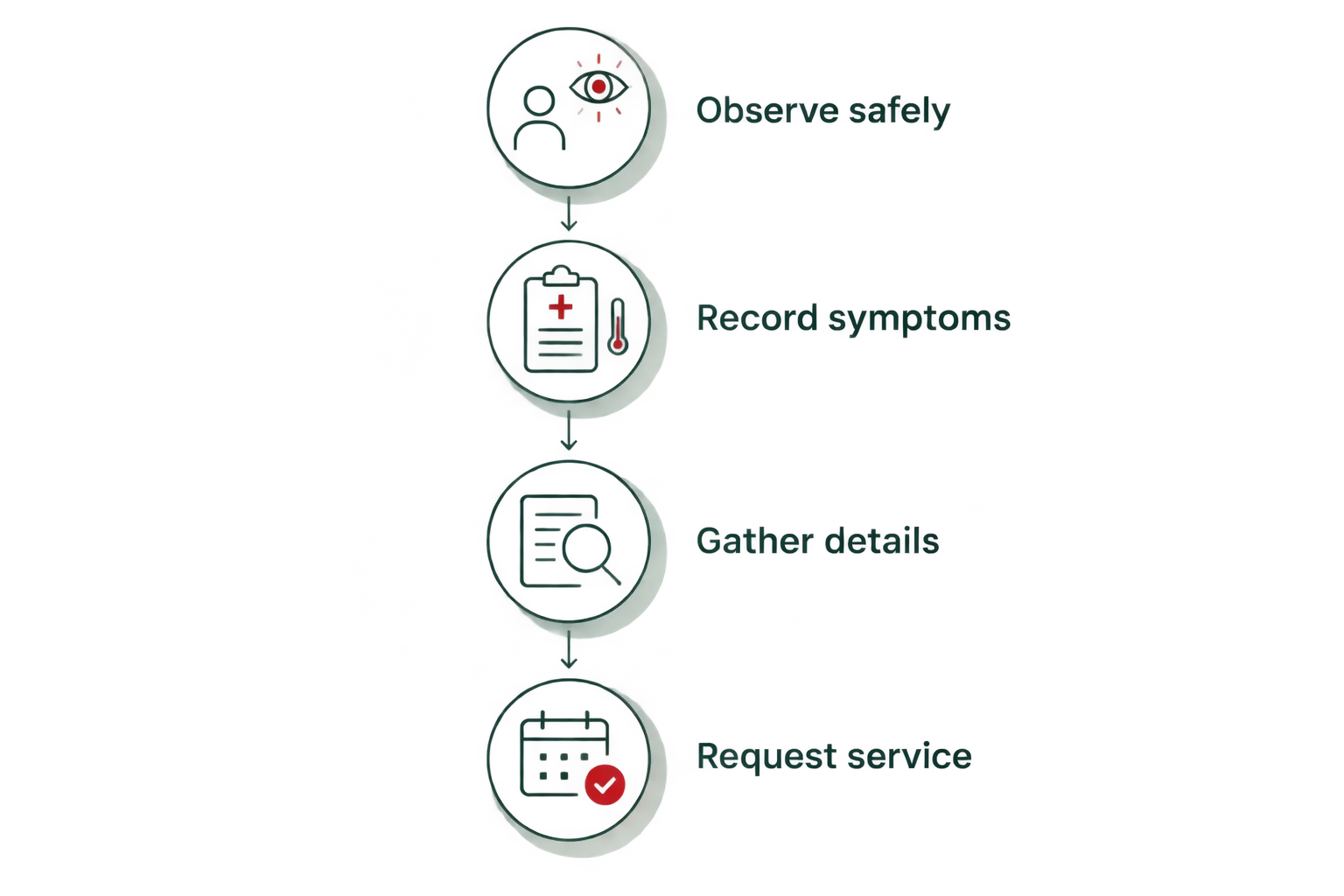
Describe the symptoms without operating or adjusting a damaged door.
Preparing your Louisville garage for the visit
Move vehicles and stored belongings away from the work area only when you can do so without operating or passing beneath an unsafe door. Keep children and pets away, and explain whether the garage is your usual entry route.
For a Derby Strong Garage Doors appointment, use the scheduling page and describe whether you need routine maintenance or diagnosis of an existing fault. Include the current door position rather than repeatedly testing it before the visit.
Can a tune-up make a noisy garage door quiet?
A tune-up can address maintenance-related noise, but noise alone does not identify the repair. Dry moving parts, worn rollers, damaged hardware and opener faults require different responses.
Describe when the noise happens and what it sounds like. A squeak during travel is different information from grinding at the opener or a scrape at the same point each time.
Do not keep cycling the door to produce a recording. Share an existing recording if you have one, and let the technician determine whether operating the door is safe.
Should you replace a garage door instead of maintaining it?
A tune-up does not justify replacing an otherwise serviceable door. Ask whether a targeted repair will restore safe operation before considering a complete replacement.
Replacement becomes a separate decision when inspection identifies extensive damage or several related problems. Request an explanation of what can be retained, what cannot and how each proposed option addresses the findings.
The limitation works both ways: maintenance should not be used to postpone necessary repair, and repair needs should not automatically become a replacement recommendation. The door’s documented condition should drive that choice.
How do you judge whether the appointment was worthwhile?
Judge the visit by the findings and completed work, not by a vague assurance that everything was tightened. Before the technician leaves, ask what was inspected, what was maintained and whether any unresolved fault affects operation.
Ask for clarification on any recommended parts. You should understand which component is damaged, what symptom it explains and whether the recommendation is immediate or conditional on further assessment.
Keep the service record with the equipment manual. It provides context for the next visit without requiring you to remember which components were repaired or merely inspected.
Frequently Asked Questions
Is a garage door tune up worth it if my door still works?
A garage door tune up is worthwhile when it includes condition checks, appropriate maintenance and clear findings. A door that moves still needs evaluation if it has developed new noise, uneven travel or another symptom.
Will a garage door tune-up fix a broken spring?
A tune-up does not fix a broken spring. Stop operating the door and request professional spring-system repair rather than trying to lift it with the opener.
Can I tune up my garage door myself?
Limit homeowner work to safe observations and maintenance explicitly permitted by the equipment manufacturer. Leave spring, cable, track, bracket and high-tension adjustments to a professional.
How often should I schedule a garage door tune-up?
Follow the maintenance schedule for your installed door and opener, then ask a professional how its condition and use affect that schedule. New symptoms need assessment rather than waiting for the next routine appointment.
Does a garage door tune-up include replacement parts?
Confirm replacement parts and corrective work before booking because the service name does not establish the scope. Ask what is included and what needs separate authorization.
Should I book maintenance if my garage door is crooked?
A crooked garage door needs professional repair assessment, not routine maintenance alone. Keep clear, stop using the opener and do not attempt to straighten the door.
Can Derby Strong Garage Doors help with a Louisville opener problem?
Derby Strong Garage Doors provides opener service for Louisville homeowners. Describe whether the motor runs, the door moves unevenly or the door reverses so the appointment request identifies the problem.
One Last Thing Before You Decide
A quieter garage door is not proof of a successful repair. Before approving work, ask one direct question: “What caused the symptom, and how does this work correct it?”
That question separates useful maintenance from lubrication alone—and a necessary repair from an unsupported replacement recommendation.
Related Garage Door Guides
- Why Louisville garage door rollers make noise
- Garage door weather seal repair in Louisville
- Should you repair or replace your garage door in Louisville?
Local service: Garage door repair in Louisville