A suddenly loud garage door opener in Nicholasville can signal wear in the opener, vibration at its mounting points, or resistance from the door itself. Stop using the opener if the noise comes with jerking, a crooked door, grinding, or a motor that runs without moving the door; replacing the opener will not correct a damaged spring, cable, or track.
TL;DR
- Garage door opener loud noise requires checking both the opener and the door, not assuming motor failure.
- Stop operation when noise accompanies crooked movement, grinding, slack cables, or a stalled door.
- Derby Strong provides garage door repair and opener service; describe the sound and movement when requesting help.
- Do not increase opener force, adjust springs, or disconnect a raised or damaged door.
Why is your Nicholasville garage door opener suddenly loud?
A new noise means something has changed, but the sound alone does not identify the failed part. The useful clues are where the noise starts, when it happens, and whether the door still moves evenly.
The opener pulls a door that depends on springs, cables, rollers, and tracks to move correctly. Resistance anywhere along that system can make the opener sound strained even when its motor is not the original problem.
Derby Strong provides garage door repair, installation, and opener service. When describing the problem, report what happened rather than naming a replacement part before inspection.
| What you notice | Possible source to inspect | What to do next |
|---|---|---|
| Rattle near the ceiling-mounted unit | Opener housing, support hardware, or transmitted vibration | Observe from the floor; arrange inspection if movement is visible |
| Grinding while the motor runs | Internal drive components or a drive mechanism that is not engaging correctly | Stop operation; do not open the housing |
| Squeal that follows the moving door | Rollers, hinges, bearings, or another moving door component | Have the door hardware checked, not just the opener |
| Scraping at one side of the opening | Track contact, roller trouble, or door misalignment | Stop if the door rubs, binds, or travels unevenly |
| Humming with no door movement | An obstructed or mechanically resistant door, or an opener fault | Stop repeated attempts and request diagnosis |
| Bang followed by struggling or uneven movement | A possible spring or other door-system failure | Keep clear and leave the system untouched |
These are inspection clues, not diagnoses. A recording helps communicate the symptom, but a technician still needs to examine the equipment before deciding what to repair.
Why this matters: opener noise can start at the door
A quieter replacement opener is not a repair for a binding door. If a roller is damaged, a track is displaced, or the spring system is not supporting the door correctly, the underlying problem remains.
The distinction matters when you approve work. Ask whether the technician found an opener fault, a door fault, or both. That answer should explain the repair recommendation in plain language.
For your Nicholasville home, also separate mechanical noise from sound heard through an attached room. Vibration transmitted through the building deserves attention, but it does not establish that the opener motor has failed. Report whether the noise is loudest in the garage or in the room beside or above it.
Rattling near the opener: locate it without touching hardware
A rattle near the motor unit directs attention toward the housing, rail, supports, or vibration traveling through those parts. It does not prove that a mounting bolt simply needs tightening.
From the floor, look for an opener that visibly shifts, a support that appears displaced, or hardware hanging out of position. Do not stand on a ladder beside a moving opener or reach toward its rail. Leave adjustments to the person inspecting the system.
Describe whether the rattle happens when movement begins, throughout travel, or when the door stops. Each pattern gives the technician a more useful starting point than saying the opener is generally noisy.
Grinding or humming: stop repeated attempts
Grinding deserves a service inspection rather than another test cycle. Internal wear and drive-engagement problems are possible explanations, but resistance from the door also needs checking.
A humming motor with a stationary door is another reason to stop. Repeatedly pressing the remote does not establish whether the opener or the door is responsible, and it adds no useful diagnostic information once the symptom is clear.
Do not remove the motor cover, touch wiring, or adjust force settings. If you smell burning, see smoke, or notice electrical damage, keep clear and seek appropriate emergency assistance when needed. Disconnect power only if you can do so safely without approaching the hazard.
Squealing or scraping: listen beyond the motor unit
Sound travels along metal hardware. A squeal that seems to come from the opener can originate at a roller, hinge, bearing, or another moving component.
Watch from a safe position outside the door’s path for uneven travel, rubbing, or a roller that appears out of place. Do not repeat operation to investigate a door that is already scraping or moving crookedly.
The guide to garage door rollers making noise explains a related door-side noise problem. Its Louisville focus does not change the distinction here: roller noise and opener noise require different inspection points.
Do not spray lubricant across the system to chase a sound. Lubrication locations and products depend on the equipment; lubricant cannot correct a damaged roller, bent track, or failed drive component.
Why the noise changes during door travel
Timing helps narrow an inspection. Use observations you already have rather than repeatedly cycling a suspect door to gather more details.
- At startup: Report whether the motor begins normally, hums without movement, or starts with a jolt. The technician needs to distinguish initial resistance from an opener problem.
- At a consistent travel point: Describe the door’s position when the sound occurs. A repeatable scrape or click directs attention to what is happening at that position.
- Throughout movement: Note whether the sound follows the door or stays near the motor unit. This helps separate moving hardware noise from a more localized source.
- At the stopping point: Report a bang, shudder, or continued motor sound after travel stops. Do not change travel settings to silence it without identifying the cause.
- Inside an adjacent room: Explain where vibration is most noticeable. Sound transmission and the mechanical source both need consideration.
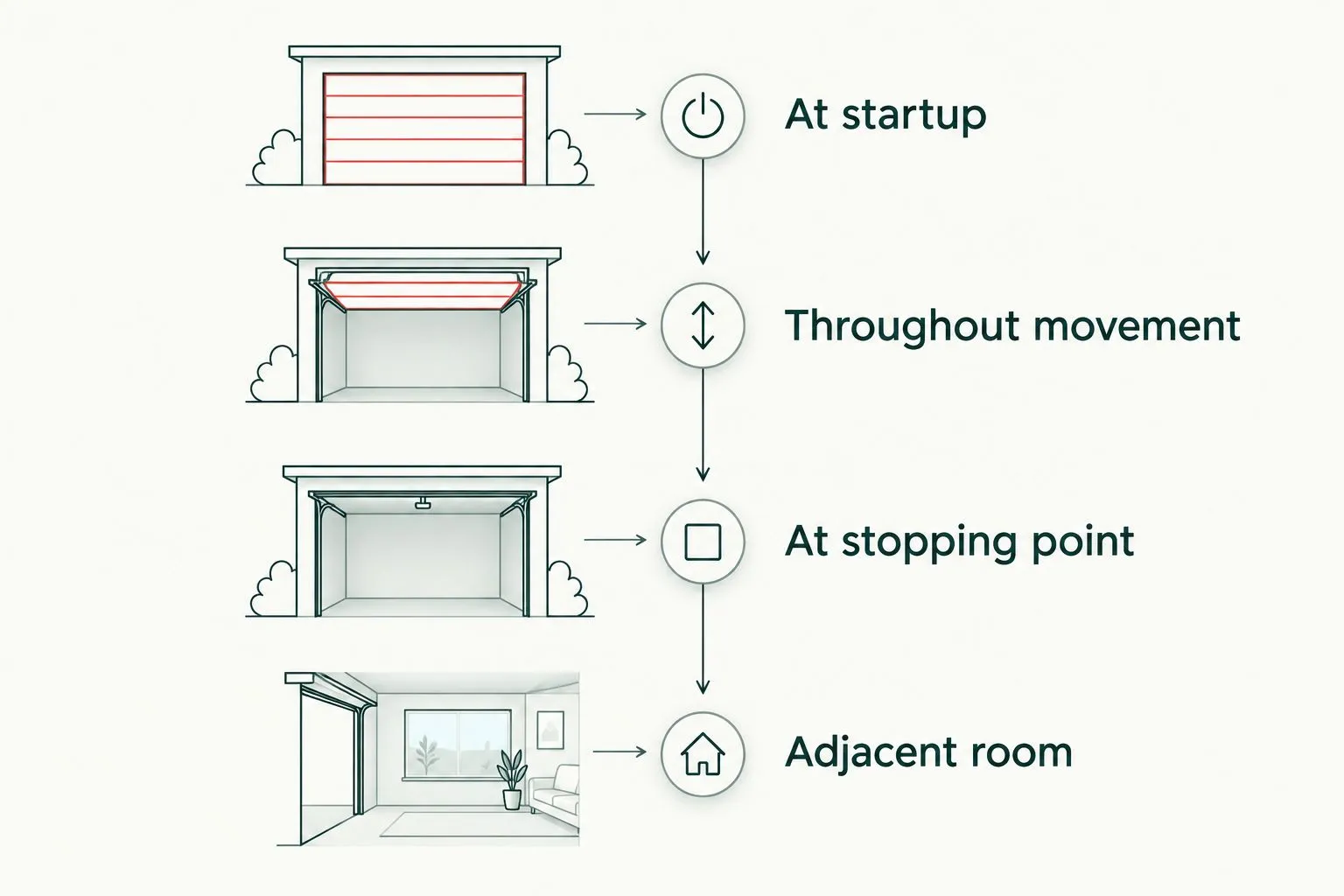
When and where the noise occurs helps direct the inspection.
What can you safely check before requesting service?
Your job is to document the symptom and keep people away from a potentially damaged system. You do not need to prove which component failed before arranging service.
- Stop normal use. Keep remotes away from children and tell everyone in the household not to operate the door while the fault is unresolved.
- Look from the floor. Without touching the system, note whether the door sits crookedly, a cable looks slack, or a roller appears outside its track. Stay out from under a raised door.
- Describe the last operation. Record whether the door was opening or closing, where it stopped, and whether it jerked or reversed. Do not recreate a dangerous symptom for a video.
- Find the opener identification safely. Use existing paperwork or a label visible without climbing near the mechanism. Do not remove a cover to find model information.
- Prepare the work area. Keep people and pets clear, move loose belongings only where safe, and explain whether a vehicle is trapped inside. Do not force the door to retrieve it.
If the door is raised, crooked, or visibly damaged, leave the emergency release alone. Disconnecting the opener can allow an unsupported door to move unexpectedly.
For a fully closed door with no visible damage, follow the manufacturer’s instructions before any owner-level check. Spring balance testing, cable work, track adjustment, and bracket repairs belong to a trained garage door professional.
Should you repair the opener or replace it?
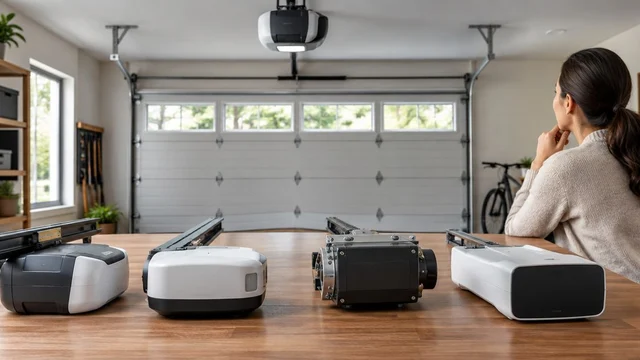
Choose the repair that addresses the confirmed fault, not the loudest component. A door-side repair can be appropriate when the opener remains serviceable; an opener repair or replacement becomes relevant when inspection identifies a fault within that equipment.
| Option | Best for | Benefit | Limitation |
|---|---|---|---|
| Door-system repair | A confirmed roller, track, spring, cable, or alignment problem | Addresses the resistance or noise source at the door | Does not fix an independently damaged opener |
| Opener repair | A confirmed opener fault with a suitable repair available | Retains equipment that remains suitable for the door | Requires checking condition, compatibility, and repair parts |
| Opener replacement | A confirmed replacement need or an informed upgrade decision | Allows selection of equipment suited to the door and household | Does not eliminate existing door-system defects |
Ask the technician to explain the failed component and why the proposed work addresses it. If replacement is recommended, ask what makes repair unsuitable and whether the door needs separate work before the new opener is installed.
Derby Strong provides garage door opener service for homeowners seeking repair or installation. The useful service decision is whether to repair the door, repair the opener, or replace the opener after diagnosis—not whether a new unit sounds appealing in isolation.
Can you keep using a loud garage door opener?
Stop using a suddenly loud opener when movement changes or the mechanism grinds, stalls, or visibly shifts. A door that still opens is not proof that its cables, springs, rollers, or supports are sound.
If the only symptom is a new rattle, arrange an inspection rather than ignoring it. Keep the distinction clear: an observation can help prioritize inspection, but it cannot certify safe operation remotely.
Should you lubricate a noisy garage door opener?
Lubrication is appropriate only where the equipment manufacturer specifies it. Do not grease an opener belt, coat electrical components, or spray the entire rail and track assembly as a general fix.
If you cannot identify the noise source, describe it first and get model-specific guidance. Lubricant does not repair a worn gear, displaced support, damaged cable, or misaligned door.
Frequently Asked Questions
Why did my garage door opener get loud all of a sudden?
A sudden increase in opener noise can come from wear, vibration, a drive fault, or resistance in the garage door. The location of the sound and any change in door movement help direct a professional inspection.
Why does my garage door opener hum but not open the door?
A humming opener with no door movement needs inspection for both opener faults and door resistance. Stop repeated attempts, do not increase force, and leave spring or cable checks to a professional.
Can a broken garage door spring make the opener sound louder?
A broken spring can make the opener struggle because the door has lost part of its counterbalance support. Stop operation if a bang is followed by struggling, uneven movement, or a door that will not open.
Should I pull the emergency release if the opener is grinding?
Do not pull the emergency release on a raised, crooked, or visibly damaged door. Disconnecting the opener can allow an unsupported door to move unexpectedly; arrange professional help instead.
Will a new belt-drive opener fix all my garage door noise?
A new belt-drive opener will not fix noise caused by damaged rollers, track problems, or other door defects. Have the door and opener inspected before choosing replacement equipment.
What should I tell a technician about my noisy Nicholasville garage door?
Describe the sound, where it comes from, and whether it occurs during opening, closing, or stopping. Include any crooked movement, reversal, stalled travel, or visible cable damage without operating the door again to demonstrate it.
Can I tighten the opener brackets myself to stop rattling?
Leave adjustment of opener supports and door brackets to a professional when investigating a new noise. Some door brackets connect to high-tension components, and a rattle alone does not identify which hardware needs attention.
One Last Thing Before You Decide
The most useful recording is not necessarily the loudest one. A safe recording that already shows when the noise began and how the door moved gives more context than a close-up of the motor housing.
When contacting Derby Strong about garage door opener service, describe the movement before the sound: smooth, jerking, crooked, or stationary. Do not run a damaged door again just to capture evidence.