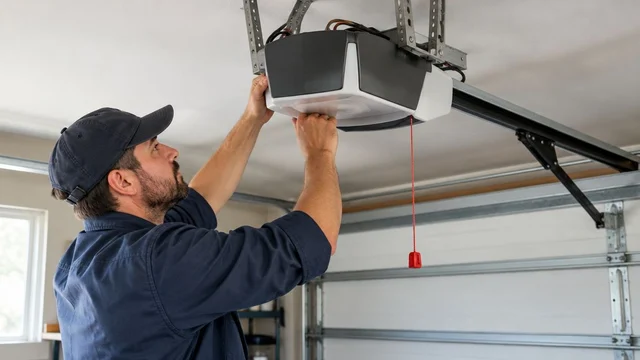
Your Florence garage door opener hums without lifting when the motor cannot start turning, the drive cannot transfer movement, or the door is too heavy or obstructed to move normally. The sound alone does not identify the failed part: a broken spring, binding door, disconnected trolley, or internal opener fault can produce overlapping symptoms. Stop pressing the button, keep everyone clear, and have the door system checked before replacing the opener.
TL;DR
- For garage door repair Florence KY homeowners need the door and opener checked together—not a replacement based on humming alone.
- A crooked door, loose cable, or visible spring gap means stop operating the system.
- Do not increase opener force or pull the emergency release under a raised, damaged door.
- Derby Strong provides garage door repair and opener service for Northern Kentucky homeowners.
Why is your Florence garage door opener humming but not lifting?
A humming opener is receiving a command but is not producing normal door movement. The first distinction is whether the motor sounds stalled, the drive moves without the door, or the door starts upward and binds. Those observations help a technician separate an opener fault from a door problem.
When you request garage door repair, describe what already happened rather than operating the door again to demonstrate it. Include whether the door stayed completely still, lifted unevenly, or stopped after beginning to move.
| What you already noticed | Possible explanation | Safe next move |
|---|---|---|
| Motor hums; door and drive appear stationary | Motor-starting fault, seized drive, or excessive door resistance | Stop operation; request inspection |
| Chain, belt, or trolley moves; door stays closed | Disconnected trolley, damaged connection, or drive-transfer fault | Describe the movement; leave reconnection to service if damage is suspected |
| Door rises unevenly or one side hangs lower | Cable, spring, roller, or track problem | Keep clear; do not operate or release the door |
| Door begins lifting, then stops with strain | Binding, counterbalance failure, or opener fault | Stop repeated attempts; arrange diagnosis |
| Door will close but will not lift | An opening-load or opener problem still needs evaluation | Do not assume the safety sensors explain the failure |
These are diagnostic clues, not confirmed diagnoses. Several faults can sound alike, and a technician needs to inspect the entire lifting system before naming the repair.
Why this matters before you buy another opener
Garage door springs counterbalance the door’s weight. The opener moves a properly functioning door; it is not a substitute for working springs, sound cables, and unobstructed tracks.
A replacement opener will not correct a broken spring or damaged track. Conversely, replacing door hardware will not fix an internal motor fault. Find the failed system first, then decide what to repair.
For a Florence homeowner, that distinction also affects access planning. If your vehicle is inside, tell the service provider before the visit rather than trying to force the door open to get it out.
Could a broken spring make the opener hum?
Yes. A broken spring removes part or all of the counterbalancing support, leaving the opener trying to move a door that no longer operates normally. A loud bang before the failure, a visible gap in an overhead torsion spring, or a door that started lifting and immediately struggled are relevant clues.
Look only from a safe position on the floor. Do not climb near the spring assembly, handle a separated spring, or loosen any mounting hardware. Not every spring system looks the same, so the absence of an obvious gap does not clear the springs.
The safe outcome is a professional spring and door inspection—not an attempt to give the opener more lifting force. Spring work involves stored energy and belongs to a trained garage door technician.
Could the opener itself be failing?
Yes. Depending on the opener design, a motor-starting component, internal gear, drive assembly, or motor problem can prevent movement even though the unit hums. Humming does not establish which component failed or whether replacement is necessary.
A technician should assess the door’s mechanical condition before testing the opener under load. Otherwise, an opener problem and an overloaded door can be mistaken for each other.
Do not remove the motor cover to inspect electrical components. A motor-starting capacitor, where fitted, can retain electrical energy; unplugging the opener does not make internal electrical repair a homeowner task.
What if the drive moves but the door does not?
Drive movement without door movement points toward the connection between the opener and door, though internal drive damage also needs consideration. A previously disengaged trolley is one explanation; a damaged door arm or connection is another.
Do not reconnect the trolley simply because you can see a release cord. First establish why it was disconnected and whether the door is safe. Reconnecting an opener to a damaged or unbalanced door does not resolve the underlying fault.
Tell the technician if someone recently used the emergency release. That history can shorten the diagnostic conversation without requiring another operating attempt.
What should you safely check before service?
Use this sequence to gather information, not to prove that the door works. If the door is partly open, crooked, or visibly damaged, keep people away from the opening and skip any observation that requires approaching it.
- Stop operation. Put remotes aside and tell other household members not to use the wall control, keypad, or app. Do not keep cycling a humming opener.
- Observe safely. From outside the door’s travel path, note its position and any visible cable slack, displaced rollers, bent track, or spring separation. Do not touch those parts.
- Record symptoms. Write down the sound, movement, and sequence you already observed. Photograph visible conditions only from a safe position; do not recreate the failure for a video.
- Arrange service. Explain whether the door is closed, partly raised, or blocking a vehicle. Mention any burning smell, smoke, or electrical damage immediately.
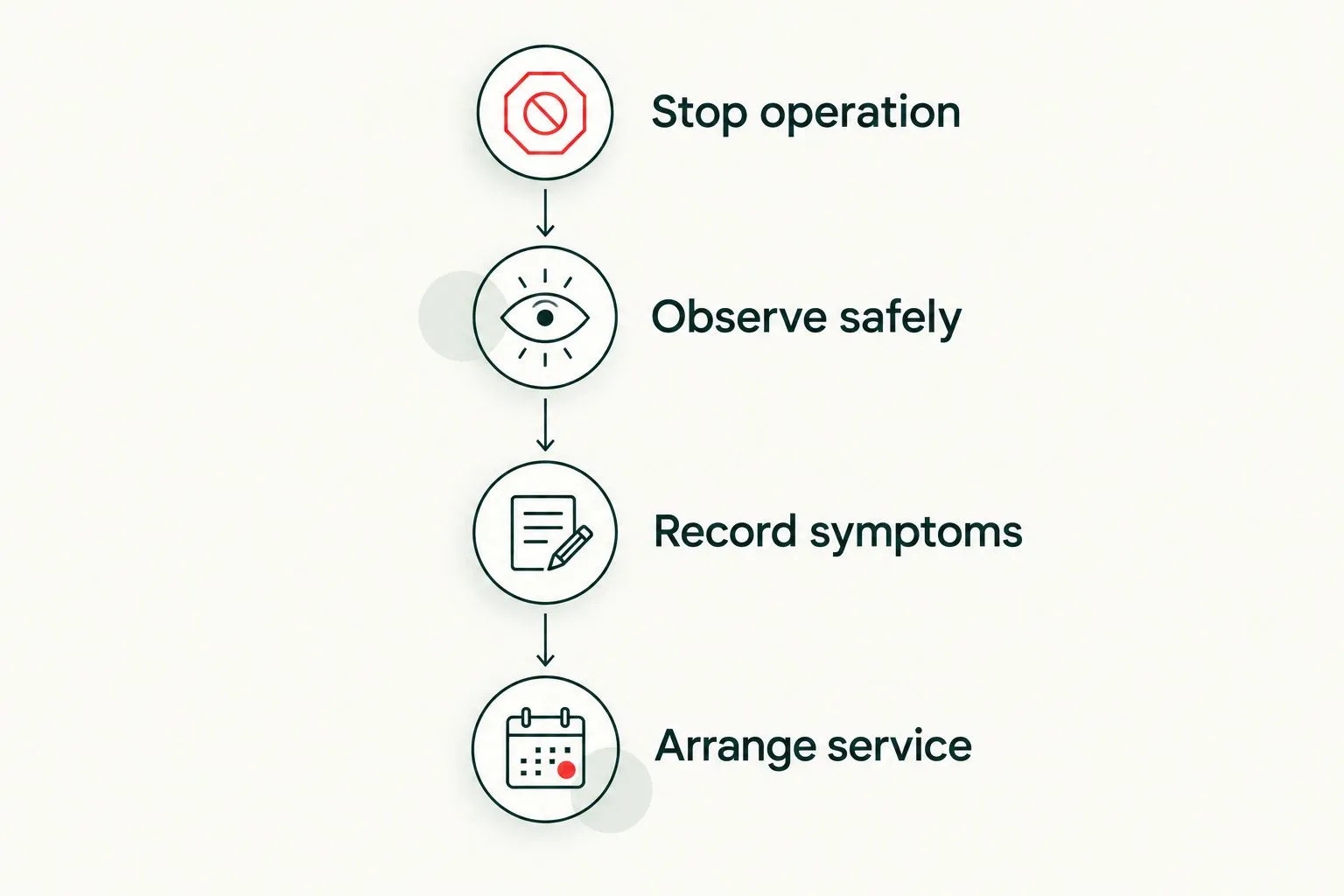
Gather observations without running the damaged door again.
If you notice smoke or an active electrical hazard, stay clear and seek emergency help as appropriate. Disconnect power only if you can do so safely without approaching damaged equipment or entering the door’s path.
Should you pull the red emergency-release cord?
Do not pull the emergency release on a raised or damaged door. Disconnecting the opener can remove a restraint from a door with a counterbalance fault, allowing uncontrolled movement.
Even with the door closed, a humming failure is not a reason to perform an improvised manual-lift test. Let a technician determine whether disconnecting and testing the door is safe. Report any earlier unusual heaviness instead of trying to reproduce it.
Why the same humming sound has different causes
The sound identifies a symptom, not a single repair. These factors change what the technician needs to investigate:
- Spring condition: Failed counterbalance hardware changes the load the opener encounters.
- Cable condition: A slack, displaced, or damaged cable can leave the door uneven and unsafe to move.
- Track and roller condition: Binding or displaced components can interrupt normal travel.
- Drive connection: The motor can operate without transferring movement correctly to the door.
- Internal opener condition: Electrical or mechanical faults can stop the motor or drive from working normally.
- Recent events: An impact, power interruption, manual release, or unusual noise provides context but does not prove the cause.
A visibly loose garage door cable changes the response from routine opener troubleshooting to keeping the system out of operation. Do not try to wind the cable back onto its drum or straighten the door yourself.
Should you repair the opener or replace it?
Repair the identified fault—not the noise. An intact door with a repairable opener problem calls for a different decision from a door with failed springs and a functioning opener.
If the technician confirms spring failure, discussions about garage door spring repair costs belong to that repair scope, not automatically to opener replacement. A Denver pricing article does not establish a Florence quote; the actual door system and required work must determine the recommendation.
| Path | Best for | Benefit | Limitation |
|---|---|---|---|
| Door-system repair | A confirmed spring, cable, roller, or track fault | Addresses the mechanical reason the door will not move normally | Does not correct a separate internal opener failure |
| Opener repair | A confirmed repairable opener fault with a sound door system | Keeps a usable opener in service | Depends on the diagnosis and suitable replacement components |
| Opener replacement | A confirmed opener failure for which repair is unsuitable | Replaces the failed operating unit | Does not repair door balance, cables, or tracks |
Ask the technician to explain what failed, what evidence supports that conclusion, and what work is necessary to restore safe operation. Separate necessary repairs from optional upgrades before authorizing the job.
Derby Strong is best suited to Northern Kentucky homeowners who need garage door repair and opener service evaluated together. That service scope fits this symptom; the humming itself still requires an on-site diagnosis.
What should Florence homeowners tell the repair company?
Start with the door’s current position and whether anyone needs access through it. A closed door trapping a vehicle presents a different access problem from a partially raised door that leaves the opening unsecured.
For Derby Strong garage door repair, provide the Florence service address, a callback number, and the observations you already gathered. If the opener model label is readable safely from the floor, include it; do not climb beneath unstable equipment to find it.
Also explain any recent changes: a loud bang, an accidental impact, a power interruption, or use of the manual release. These details help frame the inspection without turning a guess into a diagnosis.
Prepare a clear walking route through another entrance where available. Keep children and pets away, and move belongings only when doing so does not place you under or beside a compromised door. If you rent, notify the property manager and confirm repair authorization.
Can dirty safety sensors cause humming during opening?
Dirty or misaligned photoelectric safety sensors generally affect closing, not the door’s ability to lift from the floor. A motor that hums while trying to open needs a door-and-opener diagnosis rather than an assumption that cleaning the sensors will solve it.
Do not bypass safety devices or hold controls repeatedly to overcome a fault. If the actual symptom is closing and then reversing, describe that separately; it is a different diagnostic question from an opener that cannot lift.
Does humming mean you need a new garage door?
No. Humming alone does not establish that the door panels, tracks, springs, or opener need replacement. The recommendation should follow the condition of each system and the confirmed failure.
A damaged door and a failed opener can occur together, but neither diagnosis should be inferred from sound alone. Ask which part is defective and why a targeted repair is or is not appropriate.
Frequently Asked Questions
Why does my garage door opener hum but not move the door?
A humming opener can indicate a stalled motor, a drive-transfer fault, or a door that cannot move normally because of a mechanical problem. Stop repeated attempts and have both the door and opener inspected.
Can a broken garage door spring make the opener hum?
Yes, a broken spring can leave the opener struggling against a door without normal counterbalance support. Do not increase opener force or try to lift a visibly damaged door.
Should I keep pressing the remote if the opener hums?
No, stop pressing the remote when the opener hums without normal movement. Repeated attempts do not identify the failed part and can worsen strain on the system.
Is it safe to pull the emergency release when the door is stuck?
Do not pull the emergency release on a raised or damaged door. A counterbalance failure can allow uncontrolled movement when the opener is disconnected.
Will cleaning the safety sensors fix an opener that will not lift?
Cleaning safety sensors generally does not resolve a lifting failure because those sensors primarily protect the closing path. Report whether the failure happens during opening or closing.
Do I need to replace the opener if it hums?
No, humming alone does not justify opener replacement. A technician should distinguish a repairable opener fault from a spring, cable, track, or other door problem.
What should I report when booking garage door repair in Florence?
Report the door’s position, the humming sound, and any movement or visible damage you already observed. Tell the service provider if a vehicle is trapped or the opening cannot be secured.
One Last Thing Before You Decide
The most useful description is the sequence, not your guess at the failed part. “The motor hummed, the door stayed closed, and I stopped using it” gives a technician clearer information than “the opener is dead.” Preserve that distinction when booking service, and leave the system undisturbed until it can be checked.
Related Garage Door Guides
- Repair or replace a garage door opener in Northern Kentucky
- Off-track garage door safety in Northern Kentucky
- Can a low-ceiling Northern Kentucky garage fit a new door?
Local service: Garage door repair in Northern Kentucky