A failing garage door opener motor can hum without starting, stop during travel, or struggle repeatedly even after a technician confirms that the door moves correctly. For a Union, KY homeowner, those symptoms justify an inspection—not an automatic motor replacement. Broken springs, damaged drive parts, power problems, and control faults can produce similar symptoms, so stop repeated attempts and identify the cause before replacing the opener.
TL;DR
- Signs of a garage door opener motor failing in Union, KY require diagnosis, not automatic replacement.
- Humming without movement can indicate motor trouble, a starting-component fault, or a jammed drive.
- A crooked door, loose cable, or damaged spring requires professional door repair before further opener testing.
- Derby Strong provides garage door opener service; describe the symptoms before deciding on repair or replacement.
How do you know when a garage door opener motor is failing in Union, KY?
Motor failure becomes a stronger diagnosis when the opener receives the correct power but cannot drive a properly functioning door. A technician must distinguish the motor itself from the components that start it, control it, and transfer its movement to the door.
Use this symptom table to describe the problem when arranging Derby Strong garage door opener service. These observations narrow the inspection; none proves motor failure on its own.
| What you notice | What else can explain it | Safest next move |
|---|---|---|
| Humming from the opener without door movement | A starting-component fault, jammed drive, or excessive door resistance | Stop operating it and request diagnosis |
| Motor runs, but the door stays still | Disconnected trolley or damaged gears, belt, chain, or coupling | Report whether any drive parts visibly move; do not reach into them |
| Door starts, then stalls repeatedly | Door binding, balance problems, drive damage, or an electrical fault | Leave the door alone and describe where it stops |
| Remote fails, but the wall control works | Remote battery, programming, or radio reception problems | Investigate the remote before condemning the motor |
| Door opens normally but refuses to close | Safety-sensor, obstruction, travel-setting, or door problems | Observe the doorway and indicator lights without bypassing protection |
| Burning smell, smoke, or sparking | An electrical fault requiring immediate attention | Stop use and disconnect power only if safely accessible |
Humming without movement needs diagnosis
A hum means an electrical component is being energized; it does not establish that the motor has failed. Depending on the opener design, the cause can involve a starting component, a stalled motor, or mechanical resistance.
Do not keep pressing the button to see whether the opener eventually starts. Repeated attempts are not a repair, and a door that suddenly moves creates another hazard.
A running motor with a stationary door points elsewhere first
If you hear sustained motor operation but the door does not move, the connection between the motor and door needs inspection. The trolley might be disengaged, or a drive component might be damaged.
Keep your hands away from the rail, chain, belt, sprocket, and trolley. A technician can determine whether the motor is turning without correctly transferring movement to the door.
Intermittent operation is a pattern, not a verdict
An opener that stops and later works again needs more than a quick reset. Heat-related protection, an intermittent connection, control electronics, or changing door resistance can interrupt operation.
Record what happened before the stoppage. Whether the opener was opening, closing, or being used repeatedly gives the technician more useful information than simply saying it works sometimes.
Why this matters before you replace the opener
The opener moves the door, but the springs counterbalance its weight. When the door has a spring, cable, roller, or track problem, replacing the opener leaves that underlying fault unresolved.
A stronger opener is not a substitute for a correctly balanced door. Never increase opener force to overcome a door that binds, hangs crooked, or struggles to move.
For your Union home, separate the immediate access problem from the repair decision. A vehicle trapped inside is inconvenient, but forcing the door or pulling its emergency release while it is raised can create a much more serious problem.
What can make an opener sound like its motor is failing?
Several parts affect what you hear and how the door travels. These are diagnostic factors, not instructions to disassemble the opener:
- Door balance: A damaged or incorrectly functioning spring system changes the load the opener encounters. A technician should check balance before judging motor performance.
- Track and roller condition: Binding or damaged components interrupt travel and create noise that can be mistaken for an opener fault.
- Drive components: Gears, belts, chains, couplings, and trolley connections transfer movement. Damage here can leave a working motor unable to move the door.
- Starting and control components: Some opener designs use a starting capacitor; others use different motor-control arrangements. Diagnosis must match the actual model.
- Electrical supply: An interrupted supply or electrical connection problem can prevent operation without proving that the motor is defective.
- Safety and travel controls: Sensor or travel-related faults can stop or reverse a door even when the motor still operates.
Location matters less than the pattern. Describe whether the noise comes from the overhead motor housing, the rail, or the moving door; do not assume every new sound comes from the motor.
The related guide to a suddenly loud garage door opener explains another useful distinction: noise and loss of movement are separate observations, even when they appear together.
What can you safely check before calling for service?
Your job is to collect observations from a safe position—not to prove the motor is bad. If the door is visibly damaged, suspended unevenly, or accompanied by smoke or a burning smell, skip operational checks and stop use.
Stop repeated operation
Keep people, pets, and vehicles clear of the opening. Do not stand under a raised or partly raised door while deciding what to do next.
If the opener has already stalled or struggled, do not run more cycles to reproduce the symptom. Tell the technician what happened during the last attempt.
Observe from floor level
Look for a crooked bottom edge, a loose cable, a roller outside its track, or obvious damage. Do not touch the springs, cables, brackets, or tracks, and do not attempt to straighten anything.
A visible gap in a torsion spring is another reason to stop operation. You do not need to climb closer or handle the spring to report what you can see safely.
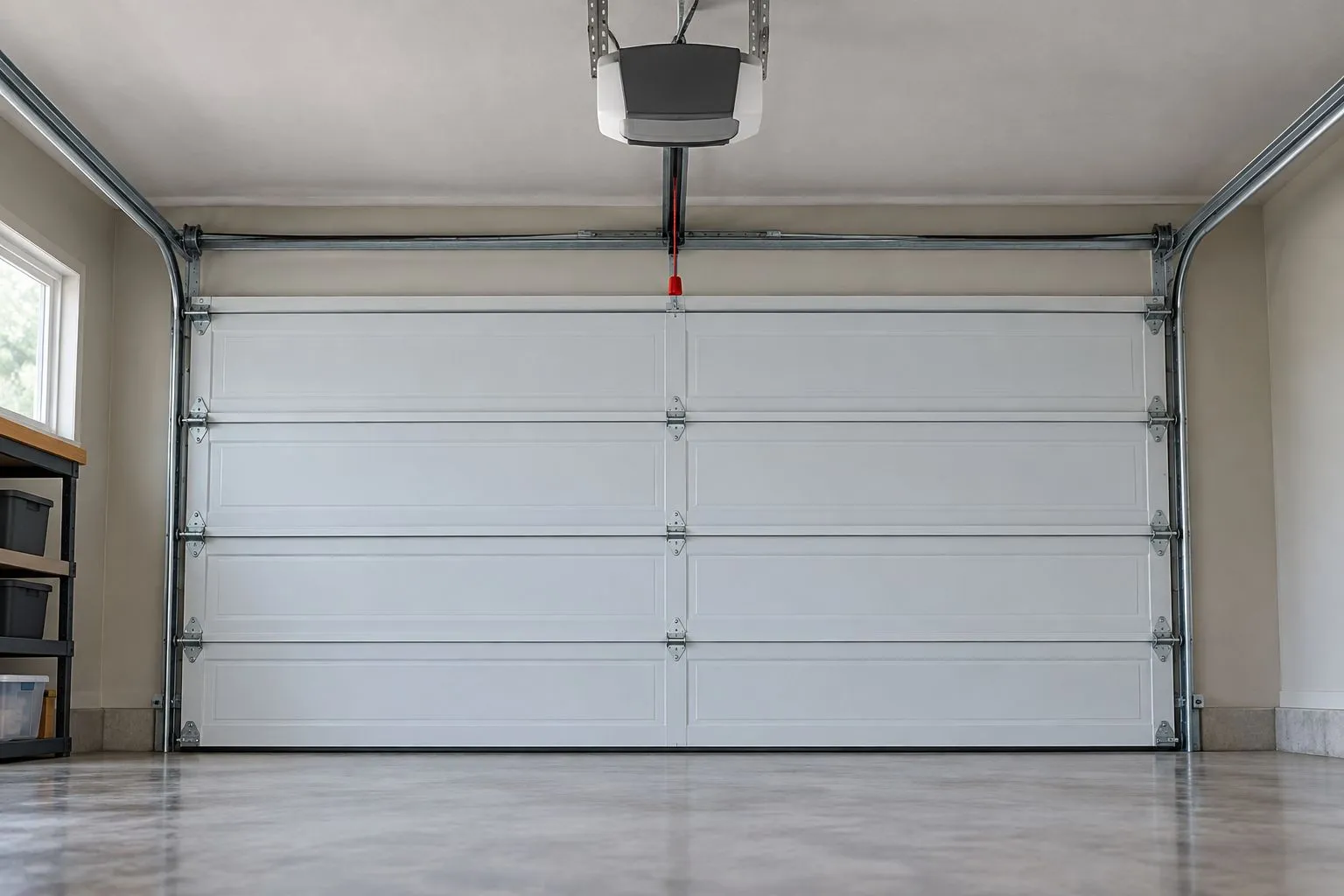
Illustrative photo: observe the door and opener from floor level without handling repair components.
Note control behavior
Report whether the remote, wall control, or both failed during your previous attempts. If the wall control operated the door normally while only the remote failed, that observation directs attention away from a completely failed motor.
Do not repeat a test when the door has already shown mechanical distress. Existing observations are enough to start the service conversation.
Record lights and sounds
Write down any displayed message or flashing-light pattern exactly as it appears. Photograph an accessible label or display only when you can do so safely; avoid climbing near a damaged door.
Do not interpret every flashing light as a motor code. Diagnostic meanings depend on the manufacturer and model, so keep the original pattern rather than assigning it a meaning yourself.
Prepare safe access
Move loose belongings away from the work area without passing under an unstable door. Keep the controls out of children’s reach and tell everyone in the household not to operate the door.
Leave a partly open door in place rather than trying to push it closed. Explain its position when requesting service so the access problem is clear before the visit.
What should a professional inspect before recommending replacement?
A useful diagnosis separates the door, opener drive, electrical supply, and controls. Ask what failed and what evidence supports that conclusion—not simply whether the opener sounds old.
For a Union service request, provide the installation address and postal code, whether the door is open or closed, and whether a vehicle is trapped. A postal code helps identify the property; it does not describe the fault or establish a municipal boundary.
Ask the technician to address these questions:
- Does the door move and balance correctly when checked under controlled conditions?
- Does the opener receive the correct electrical supply?
- Does the motor start and turn as expected?
- Does the drive transfer movement correctly?
- Do the safety controls function after the repair?
- Is the proposed repair supported for this particular opener?
Derby Strong garage door opener service is for homeowners who need the door and opener inspected together before choosing a repair. The decision still depends on the confirmed fault, the equipment’s condition, and supported repair options—not the service provider’s name.
Should you repair the opener or replace it?
Repair fits a specific, serviceable fault in an otherwise suitable opener. Replacement fits equipment whose confirmed problems, condition, or unsupported components make repair inappropriate.
Neither route corrects a damaged door by itself. Have the door problem addressed as part of the plan rather than expecting a replacement opener to pull through it.
| Option | Best for | Benefit | Limitation |
|---|---|---|---|
| Targeted opener repair | An isolated fault with a supported repair | Keeps otherwise suitable equipment in service | Does not renew unrelated worn components |
| Complete opener replacement | A confirmed fault or condition that makes repair unsuitable | Replaces the opener assembly | Does not repair springs, cables, tracks, or door damage |
| Door-system repair before reassessment | Binding, imbalance, or visible mechanical damage | Addresses resistance that can mimic opener failure | The opener still needs evaluation afterward |
Ask for an explanation of what each recommendation solves. If replacement is proposed, confirm that the replacement suits the door and installation space, and that the safety functions will be checked after installation.
Can a garage door opener hum without having a bad motor?
Yes—a humming garage door opener does not prove the motor is bad. A starting-component fault or mechanical obstruction can produce a similar symptom, so stop repeated attempts and arrange diagnosis.
Does a working opener light mean the motor is good?
No—a working opener light does not confirm motor health. It shows that part of the unit has power, but it does not establish that the motor, drive, or control components are functioning correctly.
Frequently Asked Questions
What are the signs of a garage door opener motor failing in Union, KY?
Possible signs include humming without starting, repeated stalling, and failure to drive a door that a technician has confirmed moves correctly. Similar symptoms also come from drive components, starting components, controls, and door resistance, so inspection is necessary.
Should I keep pressing the button if my garage door opener only hums?
No—stop pressing the button when the opener hums without moving the door. Keep the opening clear and report the sound and door position when requesting service.
Why does my opener run while the garage door stays still?
A running opener with a stationary door can indicate a disconnected trolley or damaged drive component. Keep your hands away from moving parts and have the connection between the motor and door inspected.
Can a broken spring make the opener seem weak?
Yes—a broken spring changes the door’s counterbalance and can make the opener struggle. Stop using the opener and leave spring inspection and repair to a professional.
Should I pull the emergency release when the opener stops halfway?
Do not pull the emergency release on a raised or partly raised door that might be damaged or unbalanced. Keep clear of the opening and have a professional secure and assess the door.
Does a remote that stopped working mean I need a new motor?
No—a failed remote alone does not establish motor failure. If the wall control operates the door normally, report that distinction before considering opener replacement.
What should I tell a technician about my Union garage door opener?
Describe the door’s current position, the last movement it completed, any humming or grinding, and which controls responded. Include the model information if safely accessible, along with any displayed message or flashing-light pattern.
One Last Thing Before You Decide
Record what happened immediately before the failure. An opener that stopped while lifting presents a different diagnostic starting point from one that opened normally but refused to close.
When contacting Derby Strong, lead with that sequence and any visible door damage. A clear account helps keep the decision focused on the failed component rather than replacing equipment based on a noise alone.