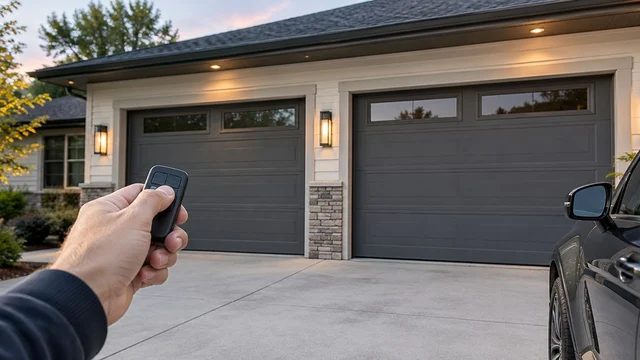
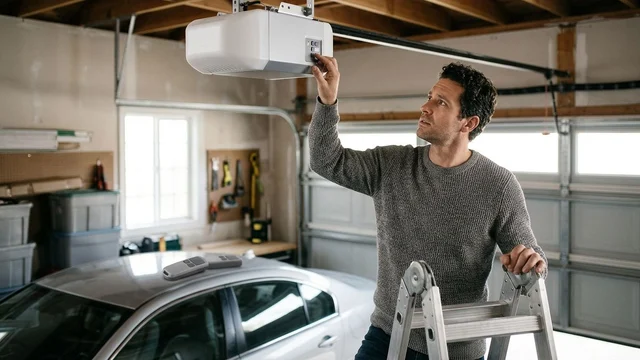
A garage door remote that works only up close in Hebron, KY, points to a weak remote battery, radio interference, an obstructed or damaged opener antenna, or a remote or receiver fault. Compare another compatible remote and check when the problem occurs before replacing equipment; a door that receives the command but refuses to close needs a different diagnosis.
TL;DR
- For garage door remote short range, Hebron KY homeowners should check the battery and compare another compatible remote first.
- If every remote loses range, investigate interference and the opener antenna before buying replacement remotes.
- If the opener responds but the door reverses, stop treating the problem as lost remote range.
- Derby Strong provides garage door opener service for Northern Kentucky homeowners who need professional diagnosis.
Why does a garage door remote work only up close in Hebron, KY?
Short range means the opener is not consistently receiving a usable command from your normal operating position. The useful distinction is whether the trouble follows a particular remote or affects every wireless control.
Use this comparison to decide what to check next. These observations narrow the investigation; they do not prove that a particular component needs replacement.
| What you observe | What to investigate | Best next check | Limitation |
|---|---|---|---|
| One remote works only near the garage | Battery, battery contacts, remote damage | Compare a working compatible remote from the same position | Different remote designs can behave differently |
| Every remote has reduced range | Interference, antenna condition, receiver fault | Compare results with nearby removable electronics switched off | A successful test does not identify every possible interference source |
| Range changes when opener lighting operates | Interference associated with a bulb or lighting circuit | Check the opener manual for approved lighting | Not every lighting-related symptom comes from the bulb |
| The opener acknowledges the command, but the door reverses | Safety sensors, obstruction, or door operation | Stop repeated cycling and observe the reversal | This is not necessarily a radio-range problem |
| A handheld remote works but the vehicle control struggles | Vehicle transmitter setup or compatibility | Follow documentation for the vehicle and opener | A working handheld remote does not confirm vehicle compatibility |
Why This Matters for Your Door
Replacing the remote will not correct a receiver problem, and replacing the opener is unnecessary when a battery resolves the fault. Start with comparisons that separate the transmitter from the equipment receiving its signal.
For Hebron homeowners, Derby Strong provides garage door opener service within its Northern Kentucky service offering. Derby Strong provides garage door opener service for homeowners who need professional diagnosis of short-range remote problems. Describe the symptom as lost range rather than simply saying the door does not work; that distinction helps frame the inspection.
What can you check safely before arranging service?
Keep the garage door in view throughout any operating test. Clear people, pets, vehicles, and stored items from its path, and stop if the door moves unevenly, binds, drops, or makes an unfamiliar mechanical noise.
Do not touch springs, cables, bottom brackets, or track fasteners while investigating a remote. Do not increase opener force to make a reluctant door move. A radio-control problem does not justify changing the door’s safety or lifting settings.
If you cannot safely reach a component from the floor, leave that inspection to a technician. There is no need to climb beside a moving door or open the motor housing to collect useful information.
Start by identifying what actually fails
Watch the opener when you press the remote. Does nothing happen, or does the opener click, flash, start moving, or reverse?
An acknowledged command changes the investigation. A door that begins closing and then reverses has received an instruction, even if you happened to be close to the garage when you pressed the button.
Also distinguish the wall button from wireless controls. A wired wall button working normally shows that the opener responds through that control path; it does not establish that the radio receiver is healthy.
How do you narrow down a short-range remote problem?
Work through these checks in order, following the instructions for your specific opener and remote. Change one condition at a time so you can tell which change affected the result.
1. Check the battery
Best for: a remote that gradually needs to be closer to the door. Fit the battery type specified for the remote, observing the correct orientation. Check for obvious corrosion or damaged contacts without bending or modifying them.
A remote’s indicator light is not proof that the battery delivers reliable transmission under use. Compare operating range after the battery change rather than judging the battery by whether the light illuminates.
This check is simple, but it has a limit: a fresh battery cannot repair a damaged transmitter. If the remote has been dropped, soaked, or crushed, include that history when arranging service.
2. Compare remotes
Best for: separating an individual transmitter problem from a shared problem. If you already have another compatible, programmed remote, test it from the same safe position with the vehicle stationary.
Keep the door’s starting position and surrounding conditions consistent. If one remote works where the other fails, focus on the weaker remote before assuming the opener needs replacement.
If both struggle, investigate conditions they share. That includes the receiving equipment and nearby electronics, but the comparison alone does not identify the faulty part.
3. Compare positions
Best for: identifying whether the vehicle or operating position changes reception. Compare the remote inside the parked vehicle with the same remote held outside it, while staying safely clear of the driveway and door.
Metal objects, the vehicle body, and some glazing can affect radio transmission. Record whether the result changes; do not assume a particular windshield or vehicle feature is responsible without checking its documentation.
Use a safe stationary location rather than testing while approaching the garage. Never press the button from a place where you cannot confirm that the doorway is clear.
4. Compare lighting
Best for: range that changes when garage or opener lights operate. Note whether the trouble began after a bulb change or installation of nearby electronic equipment. Some lighting electronics produce radio interference that affects garage door controls.
Check the opener manufacturer’s current instructions for compatible bulbs and any troubleshooting procedure. Do not improvise with a bulb type or wattage, and let lamps cool before handling them.
A lighting comparison is a diagnostic clue, not permission to leave the garage without safe illumination. The lasting fix should preserve suitable lighting and reliable opener operation.
5. Observe the antenna
Best for: identifying an obvious antenna-position or damage concern. From the floor, look for the opener antenna described in its manual. Report whether it appears trapped against metal, tucked into a housing, cut, or visibly damaged.
Do not pull on wiring, splice an extension onto the antenna, or open electrical covers. Antenna arrangements differ, and an unidentified wire is not something to reposition by guesswork.
A normal-looking antenna does not rule out receiver trouble. Its appearance is useful evidence, not a complete electrical test.
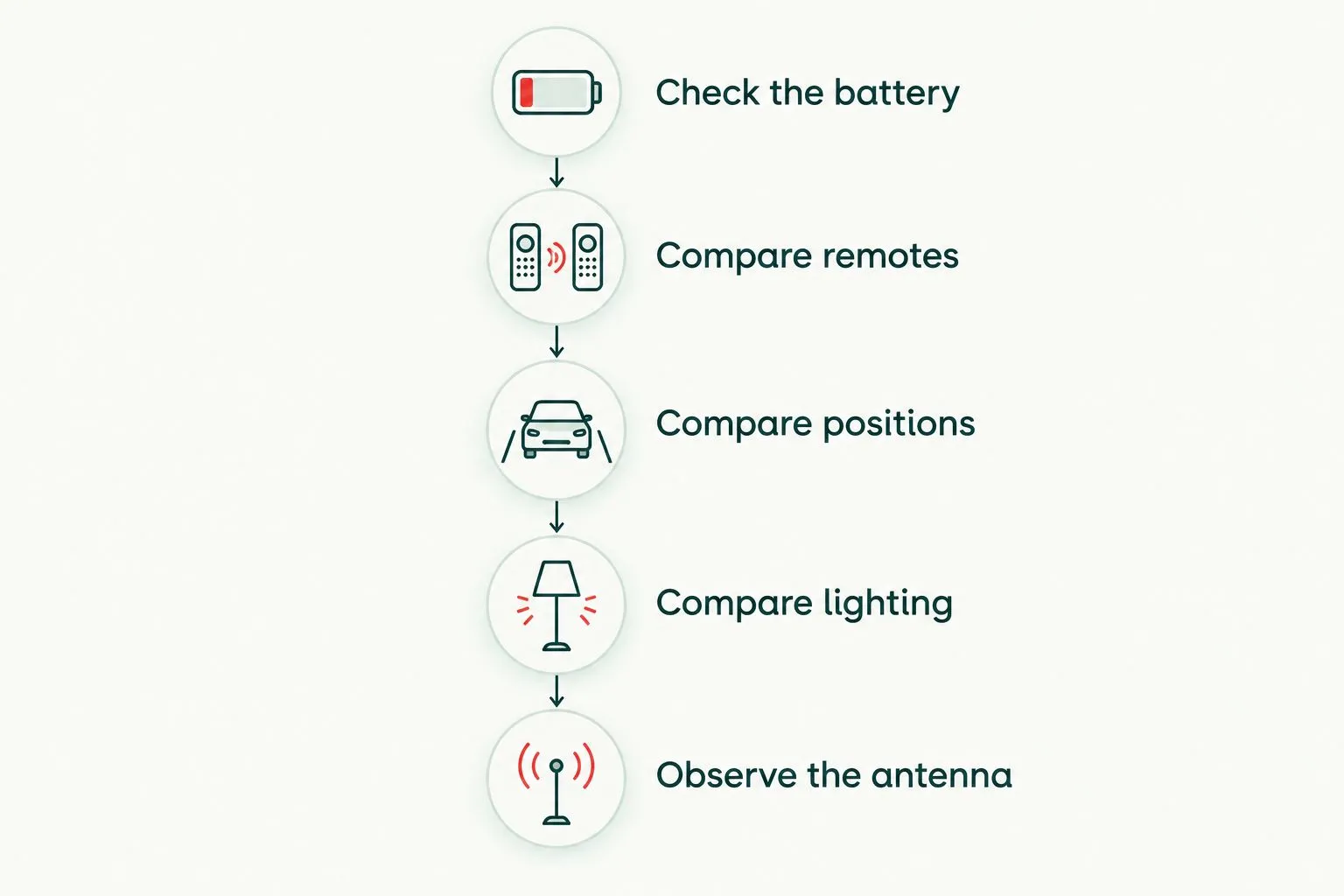
Change one condition at a time so the result identifies the next check.
After these checks, stop replacing parts by trial and error. A technician can investigate the receiver, antenna arrangement, compatibility, and possible interference without treating every symptom as a reason for a new opener.
Why does garage door remote range vary?
There is no useful universal distance promise for every opener, remote, vehicle, and property. Judge a change against how your own system previously worked under comparable conditions.
The main factors to investigate are:
- Battery condition: A depleted or poorly connected battery can reduce reliable transmission from an individual remote.
- Radio interference: Nearby electronic equipment can interfere with the signal the opener needs to receive.
- Antenna condition: Damage or an unsuitable antenna position can affect reception.
- Obstructions and position: The operating location, vehicle, and materials between the remote and receiver can change results.
- Remote condition or compatibility: Damage, incorrect setup, or an incompatible replacement requires a different fix from a battery change.
- Receiver condition: A receiver fault remains a possibility when compatible remotes struggle after simpler causes have been checked.
Hebron is the service context, not a diagnosis. Do not attribute the problem to a nearby radio source, local infrastructure, or weather simply because of the property’s location. Give the technician reproducible observations instead.
Should you replace the remote, repair the receiver, or replace the opener?
Choose the smallest repair supported by the diagnosis. Short range alone does not establish that the garage door or complete opener needs replacement.
| Option | Best for | Advantage | Limitation |
|---|---|---|---|
| Battery replacement | A remote with a depleted battery | Keeps an otherwise working remote in use | Does not resolve interference or receiver faults |
| Compatible replacement remote | A confirmed damaged or failed transmitter | Addresses the individual control problem | Requires verified compatibility and programming |
| Interference correction | A repeatable link to nearby electronics | Addresses the signal environment | The source must be identified rather than assumed |
| Receiver or antenna service | A diagnosed receiving-side fault | Targets the affected equipment | Repair options depend on the opener and available approved parts |
| Opener replacement | A diagnosis supporting replacement rather than repair | Replaces the affected operating system | Changes more equipment than an isolated remote fault requires |
Before approving equipment replacement, ask what observation or test supports it. Ask whether the proposed work addresses the range problem specifically, and whether other door-operation defects are separate findings.
The Northern Kentucky opener repair-or-replacement guide covers that broader decision. Keep the door itself out of the replacement discussion unless its condition independently supports that recommendation.
What should you tell a technician serving Hebron?
Give Derby Strong the opener and remote model information you can safely read, along with a short description of what changed. A photo of an accessible label is more useful than a guess about the equipment’s age or type.
Include these observations when requesting garage door opener service:
- Whether the problem affects an individual remote, every remote, or only the vehicle’s built-in control.
- Whether a correct replacement battery changed the result.
- Whether the wall control operates the door normally.
- Whether opener lighting or nearby electronics changes reception.
- Whether the opener ignores the command or acknowledges it before stopping or reversing.
- Whether you noticed antenna damage, water exposure, a dropped remote, or a recent equipment change.
Give your actual Hebron property address when arranging service rather than relying on a regional label. If the property has several garage doors, identify which opener is affected and whether the other controls behave normally.
Do not repeatedly operate an unreliable door just to capture a video. A clear description is enough when further testing would put people or property in its path.
Can LED bulbs make a garage door remote work only up close?
Some LED lighting electronics can interfere with garage door remote reception. A repeatable change when a particular light operates supports investigating that light, but it does not prove every LED bulb is unsuitable.
Use the opener manufacturer’s current lighting guidance. Replacing bulbs without checking compatibility can leave the original problem unresolved or introduce a different lighting issue.
Should you reprogram a remote that still works near the opener?
Reprogramming is not the first check when the remote still operates the door at close range. Successful operation shows that the opener accepts the command under those conditions.
Check the battery, compare another compatible remote, and investigate reception first. Follow the specific manual if programming is required; an erase-memory procedure can remove other working controls.
Does a working wall button rule out an opener problem?
No—a working wired wall button does not rule out a radio receiver problem. The wired button and wireless remote reach the opener through different control paths.
A wireless wall control is a different comparison. Tell the technician which type you have rather than assuming that every wall-mounted control is wired.
Frequently Asked Questions
Why does my garage door remote only work right beside the door?
A remote that works only beside the door needs checks for battery condition, interference, antenna problems, and remote or receiver faults. Compare another compatible remote from the same safe position before buying parts.
Does a remote light mean the battery is good?
A lit remote indicator does not prove the battery supports reliable transmission. Install the specified battery correctly and compare the operating result.
Why do all my garage door remotes suddenly have poor range?
Poor range across every remote points toward a shared condition worth investigating, including interference, antenna condition, or the receiver. It does not confirm that the opener needs replacement.
Can I extend my garage door opener antenna myself?
Do not splice or modify the opener antenna as a trial repair. Follow the manufacturer’s instructions and have damaged or inaccessible receiving equipment inspected professionally.
Why does my car’s garage door button struggle when the handheld remote works?
A vehicle control that struggles while a compatible handheld remote works needs its own compatibility, setup, and operating-position checks. Follow the current instructions for both the vehicle and opener.
Should I increase opener force if pressing the remote does not close the door?
Do not increase opener force to overcome a closing fault. If the opener acknowledges the command but the door stops or reverses, investigate the safety or mechanical problem instead of treating it as lost range.
Who can check a short-range garage door remote in Hebron?
Derby Strong provides garage door opener service in Northern Kentucky. When requesting service for a Hebron property, describe which controls fail and whether the opener ignores the command or responds before stopping.
One Last Thing Before You Decide
A remote working from closer range is a clue, not a dependable repair. Moving closer can hide a weakening battery or reception problem while leaving the underlying fault unchanged.
Write down the conditions that restore operation before you change anything else. A repeatable difference between remotes, positions, or lighting states gives the diagnosis direction—and helps keep a small control problem from becoming an unnecessary equipment replacement.