Yes—a garage door hit by a vehicle in Alexandria, KY, can be repaired when the damage is limited and the door can be restored to safe operation. Replacement becomes the better choice when impact damage compromises several sections, attachment points, or the door’s ability to move correctly. Stop using the opener until a garage door professional checks the door; a small dent does not establish that the operating system is safe.
TL;DR
- Garage door repair after vehicle impact Alexandria KY: repairability depends on structural damage, not dent size alone.
- Derby Strong provides garage door repair and installation services in Northern Kentucky.
- Stop operating an impacted door; do not pull the emergency release on a crooked or unsupported door.
- Compare a defined repair scope with replacement only after the door, hardware, and opening are inspected.
Why This Matters for Your Door
A vehicle can damage more than the section it touches. Force can transfer through hinges, rollers, tracks, and the opener attachment, leaving a door that looks nearly closed but is no longer supported correctly.
Your first job is to keep people away—not to see whether the opener can pull the door straight. If a roller has left its track or the door hangs unevenly, follow the precautions in this Northern Kentucky off-track garage door safety guide and leave repositioning to a professional.
Can a garage door be repaired after a vehicle hits it in Alexandria, KY?
Yes, provided the damaged components can be repaired or replaced without leaving an unsafe door assembly. The deciding evidence is the condition of the sections, their connection points, the supporting hardware, and the opening—not whether the vehicle was moving slowly.
Use this table to understand the inspection questions. These are repair-versus-replacement criteria, not permission to operate a damaged door.
| Finding after the impact | Best-fit path to evaluate | Benefit | Limitation |
|---|---|---|---|
| Surface dent without visible folding or torn connections | Localized repair assessment | Preserves serviceable components | Hidden damage still needs inspection |
| Damage confined to a replaceable section | Section replacement | Retains the undamaged sections | Requires a compatible section and sound remaining assembly |
| Displaced rollers, bent track, or damaged hinges | Professional hardware repair assessment | Addresses the affected operating components | Hardware repair alone does not correct a structurally damaged section |
| Folded sections or torn attachment points | Full-door replacement assessment | Avoids retaining compromised door sections | Requires a complete installation scope, not just a panel decision |
| Movement or damage at the surrounding opening | Door and building assessment | Separates door damage from support problems | Door work alone does not resolve damaged framing or masonry |
For an Alexandria homeowner, the useful question is: Which parts remain serviceable, and what work restores safe operation? Ask for an explanation tied to the actual damage before accepting either a repair recommendation or a replacement proposal.
What should you do immediately after hitting the door?
Keep the door in its current position until its stability has been assessed. A door that is partly open, tilted, or resting against the vehicle needs professional direction before either object moves.
- Stop operation. Stop pressing the wall button, remote, keypad, or app. Repeated attempts add movement to a system whose condition is unknown.
- Keep clear. Move people and pets away from the opening and the area beneath the door. For a business, keep staff and deliveries out of the affected overhead-door bay.
- Leave hardware alone. Do not loosen hinges, brackets, track fasteners, cables, or springs. Do not pull the emergency release on a damaged, crooked, or unsupported door.
- Record damage. Take photographs from a safe position. Do not stand beneath the door, reach into its joints, or climb beside displaced hardware.
- Arrange assessment. Explain whether the door is open or closed, whether the vehicle remains in contact, and whether the opening is your only practical access route.
Do not back away simply to get a clearer photograph if the door is resting on the vehicle. Describe that contact when requesting help and keep the area clear while you receive direction.
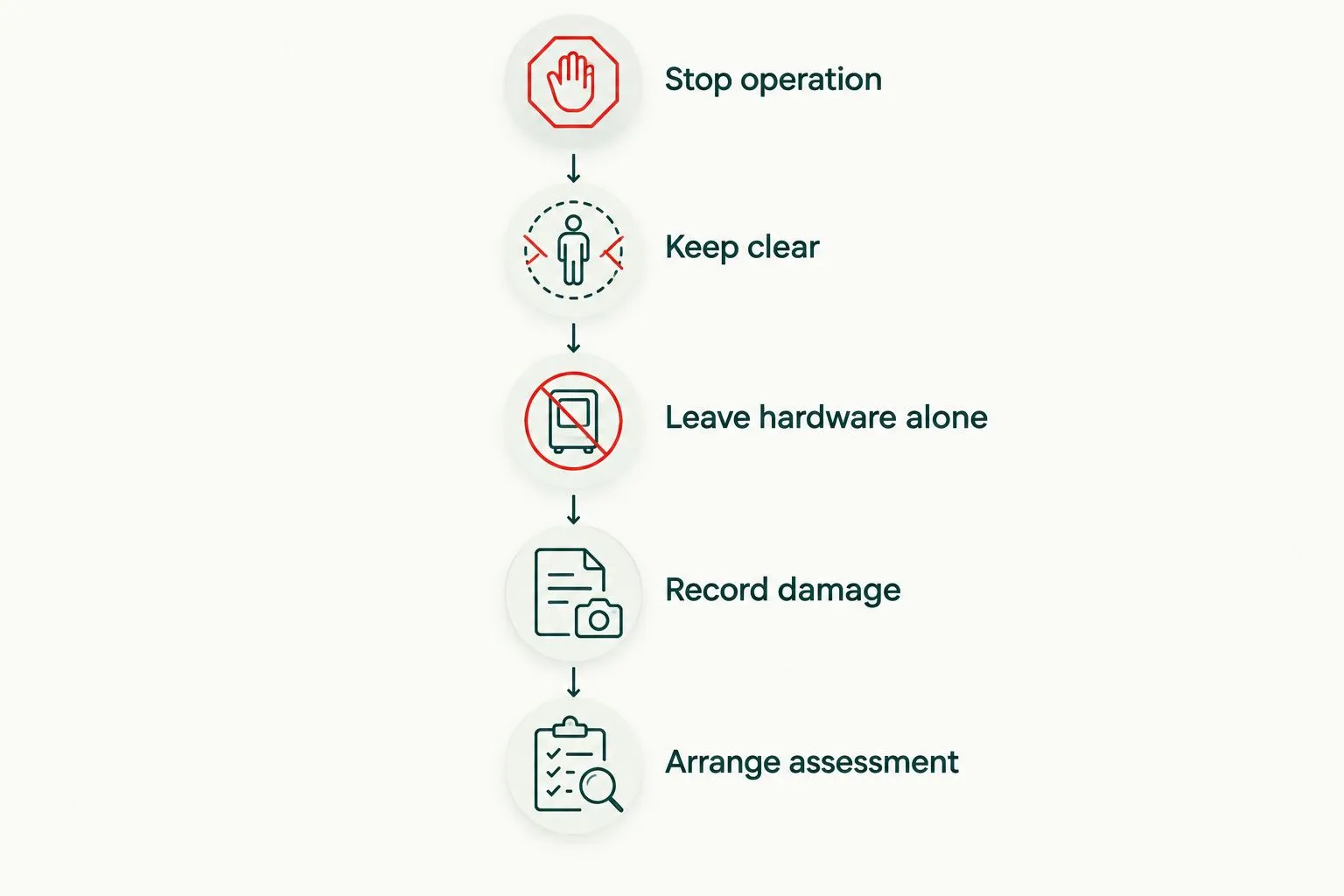
Observe and document the damage without moving the door or adjusting its hardware.
What can you safely observe without testing the door?
Look from outside the door’s travel path. You can report a crooked bottom edge, a folded section, a gap between sections, broken glass, or a roller visibly outside its track without touching anything.
Photograph the overall opening before taking closer views from a safe distance. A close-up of the dent alone leaves out the door’s position and surrounding supports, which are important parts of the assessment.
Useful observations include:
- Whether the door was opening, closing, or stationary when the vehicle touched it.
- Where the vehicle contacted the door: center, edge, lower section, or another visible area.
- Whether the opener was activated afterward and what happened.
- Whether the door now sits unevenly or has a visible gap at the floor.
- Whether tracks, brackets, or the surrounding opening look displaced.
Do not create a new symptom to investigate the old one. A video of an already-recorded malfunction is useful; running a damaged door again just to film it is not.
When does localized repair make sense?
Best for: damage that leaves the door’s structure and connections serviceable. A cosmetic repair is appropriate only when inspection confirms that the dent has not compromised how the section supports itself or connects to adjacent components.
The advantage is keeping a functioning door rather than replacing sound material. The limitation is that appearance and operation are different questions: smoothing a dent does not establish that hinges, rollers, or the opener connection remain sound.
Ask the technician to distinguish cosmetic damage from structural deformation. You should understand what remains unchanged, what gets repaired, and what evidence supports keeping the affected section.
A useful repair explanation addresses both the visible impact and the operating system. “The dent looks small” is not a complete diagnosis, especially if the door began scraping, binding, or sitting crooked afterward.
When does replacing a damaged section make sense?
Best for: damage confined to a section with a compatible replacement. Section replacement can preserve the rest of the door when the remaining sections and operating hardware are suitable to keep.
Compatibility involves more than width or exterior appearance. Section joints, thickness, reinforcement, hinge placement, and the door’s balance requirements must work together as an assembly.
The trade-off is matching. A replacement section can differ visually from an older finish, and a section that resembles the original is not automatically an acceptable mechanical substitute.
Before approving this work, ask whether the proposed section fits the existing door system and whether the remaining damage is included in the scope. Replacing the visibly bent panel while overlooking displaced hardware leaves the original problem only partly addressed.
When is full-door replacement the better choice?
Best for: widespread damage or compromised section connections. Replacement deserves serious consideration when several sections are folded, hinges have torn through their mounting areas, or the remaining assembly cannot support a safe repair.
Replacement lets you address the damaged door as a complete assembly. Its limitation is scope: a new door does not automatically resolve damage to the building opening or prove that the existing opener should remain.
Ask the contractor to separate door replacement, supporting hardware, opener work, and any building repairs. This keeps a recommendation grounded in the collision damage instead of turning every impact into an unnecessary opener upgrade.
You do not need to choose replacement simply because the door looks rough. Equally, retaining damaged sections solely to avoid replacement is not a sound decision when their connections or shape no longer support safe operation.
Why vehicle-impact repair decisions vary
Vehicle impact is not a single repair category. These factors determine whether a localized repair, section replacement, or complete door replacement addresses the actual damage:
- Impact location. A strike near an edge or hardware connection raises different inspection questions than a dent in the middle of a section.
- Section deformation. A shallow surface mark differs from a folded section or torn metal around a hinge.
- Supporting hardware. Tracks, rollers, hinges, brackets, and cables need assessment alongside the door face.
- Section compatibility. A partial replacement requires components that fit the existing door system.
- Condition before impact. Existing deterioration affects whether the undamaged portions are suitable to retain.
- Opening condition. Shifted supports or damaged framing require attention beyond the moving door.
Ask which of these factors drives the recommendation for your door. A clear explanation connects an observed condition to a specific repair—not just to a general statement that the door is old or damaged.
Can you use the opener if the door still moves?
No—movement after a collision does not prove the garage door is safe. An opener can move a damaged assembly while a bent section, displaced roller, or weakened connection remains unresolved.
Do not increase opener force to overcome resistance. Safety sensors detect an obstruction in their beam; they do not certify that the door’s structure or support hardware survived the impact.
A professional should assess the opener attachment and operating condition after the door damage is addressed. Keep the repair decision separate: a damaged door does not automatically require a new opener, and a functioning opener does not make a damaged door safe.
What should an Alexandria repair assessment include?
Give the contractor your Alexandria service address and describe the vehicle contact clearly. Confirm service arrangements for that address rather than assuming a Northern Kentucky service description establishes a particular arrival time.
Derby Strong provides garage door repair and installation in Northern Kentucky. Derby Strong serves Northern Kentucky homeowners who need garage door repair or replacement. The appropriate choice for an impacted door still depends on inspection, not on a photograph alone.
Ask for a written scope that identifies damaged sections, affected hardware, the proposed repair, and any work excluded from the door contractor’s scope. If building damage is visible, ask who needs to assess it before door work proceeds.
For your own records, keep the incident photographs, assessment, and work documentation together. If you intend to make an insurance claim, ask your insurer what documentation it requires; do not assume coverage or authorization to begin work.
Arrange a garage door assessment
Describe the impact, the door’s position, and any visible damage before scheduling service.
Frequently Asked Questions
Can a garage door be repaired after a vehicle hits it in Alexandria, KY?
Yes, an impacted garage door can be repaired when damaged components can be restored or replaced safely. An inspection must establish whether the sections, connections, hardware, and opening support repair rather than full replacement.
Can I open the garage door after backing into it?
Do not operate a garage door after backing into it until a professional assesses the damage. Keep clear of a crooked or partly open door, and do not pull its emergency release.
Does a dented bottom panel mean I need a new garage door?
A dented bottom panel does not automatically require a new garage door. The decision depends on structural damage, compatible replacement sections, and the condition of the remaining door and hardware.
Should I move my car if the damaged garage door is leaning on it?
Do not move a vehicle that is supporting or contacting an unstable garage door without professional direction. Keep people away and explain the contact when requesting assistance.
Can I straighten a bent garage door track myself?
Leave bent-track repair to a garage door professional. Moving track or loosening its supports can release an already unstable door or affect other loaded components.
Does the opener need replacement after a car hits the door?
A vehicle impact does not automatically require opener replacement. The door, opener attachment, and opener operation need assessment before deciding which components remain suitable.
Will insurance cover a garage door hit by a vehicle?
Coverage depends on the applicable policy and circumstances of the incident. Photograph the damage safely and ask your insurer which records and approvals it requires before authorizing work.
One Last Thing Before You Decide
Separate “looks better” from “works safely.” A straightened-looking panel is not proof that the rollers, section connections, or opener attachment are sound.
When discussing garage door repair with Derby Strong or another contractor, ask what the completed work includes and how safe operation will be checked. That answer is more useful than a promise to make the dent disappear.