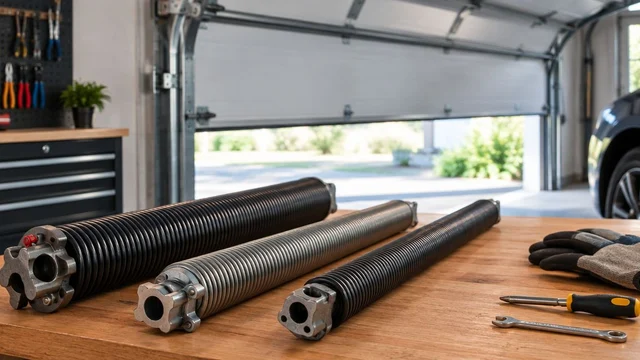
Yes—a garage door spring can be replaced without installing new cables at your Edgewood, KY, home if a professional inspection confirms the existing cables are undamaged, correctly sized and suitable for reuse. A broken spring alone does not prove the cables need replacement. Fraying, corrosion, damaged attachments or a cable that has tangled or come off its drum require a separate repair decision before the door returns to service.
TL;DR
- Garage door spring replacement in Edgewood, KY, does not automatically require new cables; condition determines reuse.
- Frayed, kinked or damaged cables need professional attention before the door operates again.
- A loose cable after spring failure needs inspection, not automatic replacement or homeowner adjustment.
- Derby Strong provides garage door repair for Northern Kentucky homeowners; request a condition-based repair scope.
Can a garage door spring be replaced without new cables in Edgewood, KY?
Yes, provided the cables pass inspection and remain compatible with the repaired lifting system. Springs counterbalance the door’s weight; lift cables transfer that lifting force through the door’s hardware. These parts work together, but they do not necessarily wear out at the same time.
For an Edgewood repair request, ask Derby Strong to distinguish the failed spring from any additional cable damage. The useful question is not whether spring repairs always include cables. It is whether your existing cables can safely remain in service.
| Repair scope | Best for | Benefit | Limitation |
|---|---|---|---|
| Spring replacement with existing cables | Doors with sound, compatible cables and no related lifting-system damage | Retains usable components | Requires inspection of the cable assemblies, not just the broken spring |
| Spring and cable replacement | Doors with damaged, unsuitable or deteriorated cables | Addresses both identified faults | Adds work that needs a clear condition-based explanation |
| Broader lifting-system repair | Doors with damaged drums, brackets or other related hardware | Addresses the cause of uneven or unreliable lifting | Replacing the spring and cables alone does not resolve every mechanical fault |
A combined repair is appropriate when both components need attention. Keeping sound cables is also appropriate; replacing more parts is not automatically the better repair.
Why this matters before you approve the repair
A spring failure can leave the door unusually heavy, strand a vehicle inside or interrupt access to your garage. That creates pressure to approve a repair quickly. You still need a clear explanation of which parts failed and which additional parts have visible defects.
A broken spring is evidence of a spring problem—not proof that every lifting component has failed. Conversely, replacing the spring without checking the cables leaves an important part of the lifting system unassessed.
Your decision should follow the inspection. Ask for the spring work and any cable work to be described separately, including the reason for each recommendation. That keeps a necessary combined repair distinct from optional preventive replacement.
When existing garage door cables can stay
Existing lift cables can remain when their condition, fit and connections support reuse. A technician needs to inspect the complete accessible cable assembly, including areas near the drums and lower attachments, rather than judging only the easiest section to see.
The inspection should establish whether:
- The cable strands are intact, without visible fraying or broken wires.
- The cable has no kinks, crushing or other deformation.
- Corrosion has not compromised the cable or its connections.
- The cable length and type suit the door’s lifting arrangement.
- The drums, pulleys where fitted, and attachment points are in serviceable condition.
- The cables sit and travel correctly after the spring repair.
These are professional inspection criteria, not instructions to handle the cables yourself. Keep your hands away from the drums, springs and bottom brackets, even when the door appears stationary.
A cable can look acceptable from the driveway while damage remains hidden near an attachment. A photograph can help describe the problem when arranging service, but it cannot establish that the complete assembly is safe to reuse.
When new cables belong in the spring repair
Replace damaged cables rather than expecting a new spring to compensate for them. Frayed strands, distorted cable sections, damaged ends and significant corrosion are reasons for professional evaluation and replacement where needed.
A cable that has left its drum needs particular attention. The technician must determine whether it simply lost tension during the spring failure or suffered damage as the door shifted. A cable can also become trapped or tangled, making its original appearance a poor guide to its remaining condition.
Do not reach toward a displaced cable to put it back. The related guide on a loose garage door cable in Northern Kentucky addresses that symptom; the immediate boundary remains the same: stop operating the door and leave tension-related adjustments to a professional.
If cable replacement is recommended, ask the technician to identify the defect from a safe viewing position. You do not need to touch the damaged part to understand the recommendation.
Why the repair scope varies
The repair scope depends on the installed door and what happened during the failure—not simply on the fact that the property is in Edgewood.
- Cable condition: Intact cables and frayed cables call for different decisions.
- Failure movement: A door that shifted or went crooked needs assessment beyond the broken spring.
- Lifting arrangement: Torsion and extension systems use different component arrangements, so the inspection must match the actual system.
- Related hardware: Damaged drums, pulleys or attachment points can affect whether a cable repair will work correctly.
- Previous changes: Door modifications or mismatched replacement components can affect compatibility.
- Door condition: A damaged section, binding track or displaced roller can require additional work before operation resumes.
This is why a blanket instruction to replace every cable—or never replace cables with springs—does not answer your repair question. The recommendation needs to match the condition found at your door.
What can you safely check before the technician arrives?
You can report what you already observed without operating or handling the damaged system. Do not run the opener again just to produce a better description.
- Stop operation. Keep remotes and wall controls from being used accidentally. Do not increase the opener’s force setting to overcome the fault.
- Keep clear. Keep people and pets away from the opening, especially if the door is raised, tilted or partly open.
- Record symptoms. Note whether you heard a bang, saw a spring gap, noticed a hanging cable or found the door crooked. Observe only from a safe position.
- Prepare access. Tell the service provider whether the door is open or closed, whether a vehicle is trapped and whether another entrance is available.
Do not pull the emergency release on a raised or unstable door with a suspected spring failure. Disconnecting the opener can remove restraint from a door whose counterbalance system is not working.
Do not move underneath an unstable door to clear belongings. Tell the technician what is in the work area and let the technician establish safe access first.
What should the professional inspection cover?
A useful inspection separates the original failure, any resulting damage and the work needed to restore operation. The spring is only part of that assessment.
Ask the technician to explain the following categories:
| Inspection area | What the finding helps decide |
|---|---|
| Failed spring | What replacement is appropriate for the installed door |
| Lift cables | Whether existing cables are suitable for reuse |
| Drums and pulleys | Whether cable routing and supporting hardware need attention |
| Bottom attachments | Whether cable connections and related hardware remain serviceable |
| Door travel | Whether binding, damaged rollers or track problems need correction |
| Final operation | Whether the repaired door is balanced and operates correctly |
Homeowners should not loosen bottom brackets or other cable attachments to inspect them. These components can remain under dangerous tension.
After the mechanical repair, the technician should verify door balance, cable tracking and operation, then check the opener’s safety functions according to its manufacturer instructions. A door opening once does not establish that the entire repair is complete.
Does a loose cable mean it must be replaced?
A loose cable needs inspection, but looseness alone does not establish that replacement is necessary. Spring failure can change cable tension, while other faults can also leave a cable displaced.
The distinction is condition versus position. A cable out of position might remain reusable after professional assessment; a frayed or kinked cable needs its damage addressed regardless of where it sits.
Do not test the distinction by lifting the door, pulling the cable or cycling the opener. Report the visible symptom and leave the diagnosis to the service visit.
Should you replace both lift cables if one is damaged?
Ask for both lift cables to be inspected when one is damaged. The technician should assess the opposite cable, compatibility and the manufacturer’s requirements before recommending the repair scope.
Replacing a matched set can be appropriate, but the explanation should identify why. Shared deterioration, incompatible components or damage affecting the lifting arrangement are different from an unsupported claim that every spring job requires new cables.
Request a clear answer about what remains in service. That matters whether the final recommendation includes a cable set or retains existing components.
What should an Edgewood spring-repair quote explain?
Your Edgewood repair quote should identify the spring work, any cable work and any additional mechanical corrections. If the recommendation changes after inspection, ask what finding changed the scope.
Useful questions include:
- What failed, and what evidence supports that diagnosis?
- Are the existing cables reusable? If not, what is wrong with them?
- Are drums, pulleys, brackets or tracks contributing to the problem?
- Is any proposed work preventive rather than necessary to restore operation?
- What checks will confirm that the repaired door operates correctly?
For Derby Strong garage door repair, request the same plain-language distinction between necessary work and optional work. You should understand the repair without handling a spring or cable yourself.
The service request should include your Edgewood address and the door’s present condition. Confirm service arrangements directly rather than assuming a particular arrival time or repair duration.
Frequently Asked Questions
Can I replace my garage door spring without replacing the cables in Edgewood, KY?
Yes, a professional can replace the spring while retaining cables that are undamaged, compatible and suitable for reuse. The cables and related lifting hardware still need inspection before the door returns to operation.
Does a broken garage door spring always damage the cables?
No, a broken spring does not automatically mean the cables are damaged. Any door movement, cable displacement or visible deterioration needs assessment before deciding which parts to retain.
Can I use the opener if the spring is broken but the cables look fine?
No—stop using the opener when a spring is broken. Intact-looking cables do not restore the door’s counterbalance, and repeated operation can damage the system.
Does a cable hanging beside my garage door need replacement?
A hanging cable needs professional inspection before anyone operates the door. Its position alone does not establish whether it is reusable; fraying, kinks, damaged ends and related hardware faults affect that decision.
Can I put the cable back on the drum myself?
No—leave cable repositioning and tension-related adjustments to a garage door professional. Do not loosen drums, springs or bottom brackets to attempt the repair.
Do I need a new garage door because the spring and cables need repair?
No, spring and cable faults do not automatically require a complete new garage door. The repair-versus-replacement decision also depends on the sections, tracks, supporting hardware and overall door condition.
What should I tell the repair company before a spring replacement?
Tell the repair company whether the door is open, closed or crooked, and whether you can see a hanging cable from a safe position. Mention a trapped vehicle or limited access without attempting to move the damaged door.
One Last Thing Before You Decide
Ask what made a cable fail, not just whether a new cable is included. A damaged drum, binding door or faulty attachment needs attention; replacing a cable without correcting a related fault leaves the repair incomplete.
For your Edgewood home, the right scope is the work supported by inspection. Keep sound parts when appropriate, replace damaged parts when necessary and leave the tensioned lifting system to a professional.
Related Garage Door Guides
- Garage door spring types ranked by lifespan
- Off-track garage door safety in Northern Kentucky
- Garage door maintenance checklist
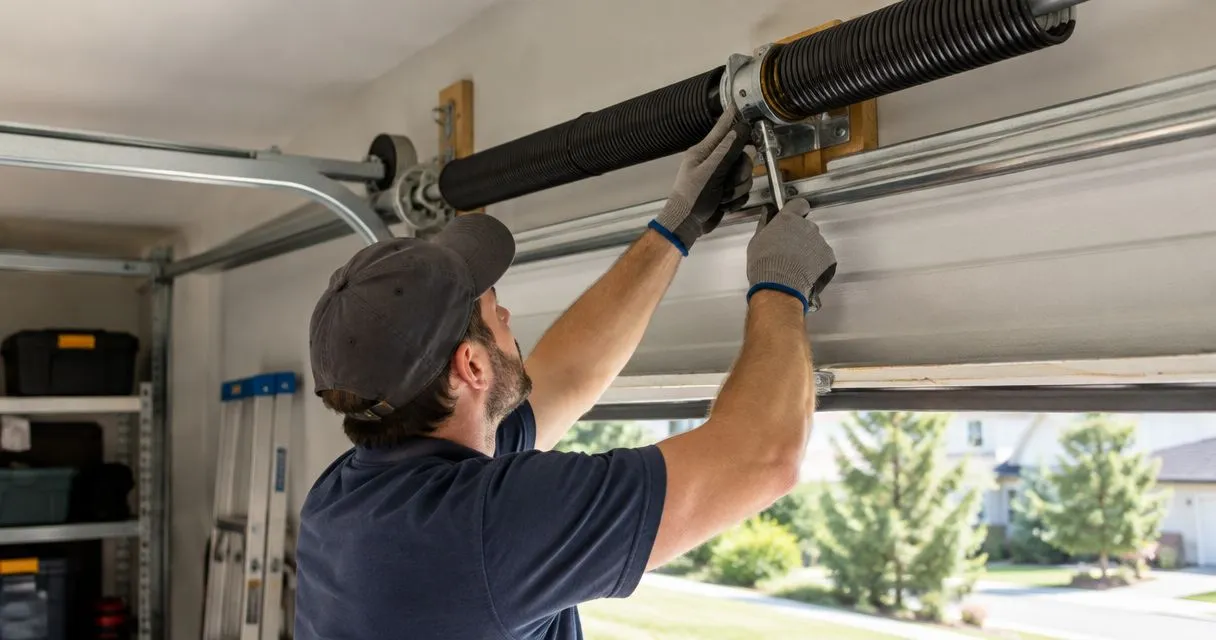
AI-generated illustration; not a Derby Strong customer project.