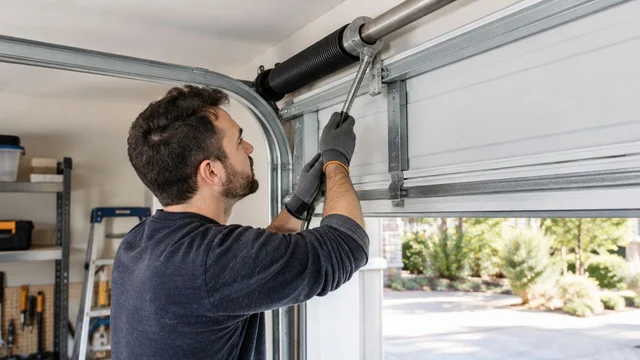
Replace an older garage door in Middletown, KY, when damaged sections, deteriorated attachment points, or an incompatible repair leave no sound way to restore safe operation. Age alone is not a replacement verdict: an isolated spring, cable, roller, seal, or opener fault can justify repair instead. The deciding question is whether the door itself remains structurally sound and can accept the correct replacement parts.
TL;DR
- Replace older garage door sections or the complete door based on structural condition, not age alone.
- A broken spring or failed opener does not automatically require a new garage door.
- Stop operating a crooked, buckled, or off-track door; leave tensioned components to a professional.
- Derby Strong provides garage door repair and installation, so either service fits the repair-versus-replacement decision.
Why This Matters for Your Door
A replacement door will not solve every problem around an older garage opening. Damaged framing, water entering across the floor, or a separate opener fault still needs its own diagnosis. Buying the wrong scope leaves the original problem unresolved.
For a Middletown homeowner, the useful starting point is a condition assessment—not a birthday for the door. The broader repair-versus-replacement guide for Louisville covers that decision; this guide focuses on the extra questions an older door raises about sections, attachment points, and compatible parts.
When does an older garage door need replacement in Middletown KY?
Replace the door when deterioration affects its structural integrity and a compatible repair cannot restore it. Repair remains a valid choice when the sections and their attachment points are sound and the fault is confined to serviceable components.
Use this comparison to frame the inspection. These are decision categories, not instructions to operate or dismantle a damaged door.
| Option | Best for | What supports this choice | Limitation |
|---|---|---|---|
| Component repair | A sound door with an isolated fault | Sections remain intact; the failure involves a serviceable spring, cable, roller, seal, or opener | Does not correct deteriorated sections or weak attachment points |
| Section replacement | Localized section damage | A manufacturer-approved compatible section can restore the assembly | Matching appearance alone does not establish compatibility |
| Complete door replacement | Structural deterioration or no suitable repair | Damage affects section strength, hardware attachment, or the ability to assemble a compatible door | Requires checking the opening, hardware, and opener rather than assuming everything transfers |
A damaged bottom section, for example, deserves more scrutiny than faded paint. Hinges and other hardware depend on sound mounting areas. If those areas have deteriorated, replacing the moving hardware alone does not restore the material holding it.
A door that looks dated but remains structurally sound presents a different decision. Replacement for appearance is an elective improvement, not proof that the existing door has reached an unsafe age.
Repair: best for an isolated mechanical fault
A broken spring can make a serviceable door seem beyond repair because the opener can no longer move it normally. The spring system counterbalances the door; the opener does not substitute for that system. Do not keep pressing the remote or increase opener force to overcome the fault.
The same distinction applies to a damaged cable, worn roller, or failed opener component. Those faults require diagnosis, but they do not establish that the door sections need replacement.
Ask the technician to separate the failed component from the condition of the assembly:
- Are the sections and hardware mounting areas sound?
- Did the component fail on its own, or did another defect overload it?
- Will the proposed repair restore correct alignment and operation?
- Is there additional deterioration that the repair will leave unresolved?
Repair preserves a usable door and avoids replacing sound sections. Its limitation is scope: fixing a spring does not fix rot, corrosion, or a cracked section elsewhere. Ask for those conditions to be identified separately rather than bundled into a vague statement that the door is old.
Section replacement: best for localized damage
Replacing a section deserves consideration when damage is confined to part of the door and the rest remains sound. A bent panel does not automatically require replacing the entire assembly. The section must be compatible with the door’s construction and hardware, not simply the same color and width.
Older doors make identification especially important. Manufacturer markings, model information, section profiles, and existing hardware help establish what belongs together. Photograph any readable label from a safe position; do not remove brackets or hardware to find one.
The advantage is retaining sound portions of the door. The limitation is that an older finish and a replacement section can look different, and visual similarity does not prove a correct fit. Confirm both appearance and mechanical compatibility before authorizing the work.
If the proposed repair changes door weight or construction, the counterbalance system also needs professional evaluation. A section repair is not permission to reuse every existing component without checking it.
Complete replacement: best for structural deterioration
Complete replacement becomes the stronger choice when damaged sections or attachment areas cannot support a sound repair. Examples include deterioration around hardware fasteners, significant section cracking, or deformation that prevents the door from traveling correctly.
Do not diagnose those conditions by forcing the door through a cycle. A stationary visual inspection is enough to identify a reason to stop and call for service.
Replacement also deserves consideration when several interconnected defects make a limited repair incomplete. The important distinction is whether each proposed repair restores a dependable assembly—not how many items appear on the estimate.
A new door gives you a new door assembly, but it does not automatically include a new opener, repaired framing, or correction of floor drainage. Those items need explicit decisions. Define what replacement solves before choosing how the replacement looks.
Why the replacement decision varies
An older door’s condition depends on more than its installation date. These factors explain why similar-looking doors can call for different work:
- Section condition: Surface finish damage differs from deterioration that affects strength or hardware attachment.
- Damage location: Damage near hinges, roller brackets, or other attachment points changes the repair assessment.
- Part compatibility: A correct section or component must fit the existing assembly; resemblance is not enough.
- Repair history: Repeated work on the same symptom calls for investigation of the underlying cause.
- Opening condition: The framing and mounting surfaces must support the proposed installation.
- Your actual goal: Restoring operation, improving appearance, and changing thermal performance are different projects.
Ask for each factor to be tied to something observable. A useful explanation identifies the damaged part, describes its effect, and states what the proposed work will correct. Age can provide context, but it cannot replace that explanation.
What can you check safely before requesting service?
Keep your inspection observational. Do not loosen spring hardware, cable attachments, bottom brackets, tracks, or other tensioned components, and do not disconnect an unstable or partially open door from its opener.
- Stop operation. Leave a crooked, buckled, off-track, or visibly unstable door alone. Keep people and vehicles clear of its path.
- Record symptoms. Note what happened before the problem appeared, including unusual sounds, an impact, or a change in movement. Do not recreate the failure for a video.
- Photograph damage. From a safe position, capture visible section damage, gaps, and readable identification labels without touching the assembly.
- Share constraints. Explain whether a vehicle is trapped, whether another entrance is usable, and whether anything blocks inspection access.
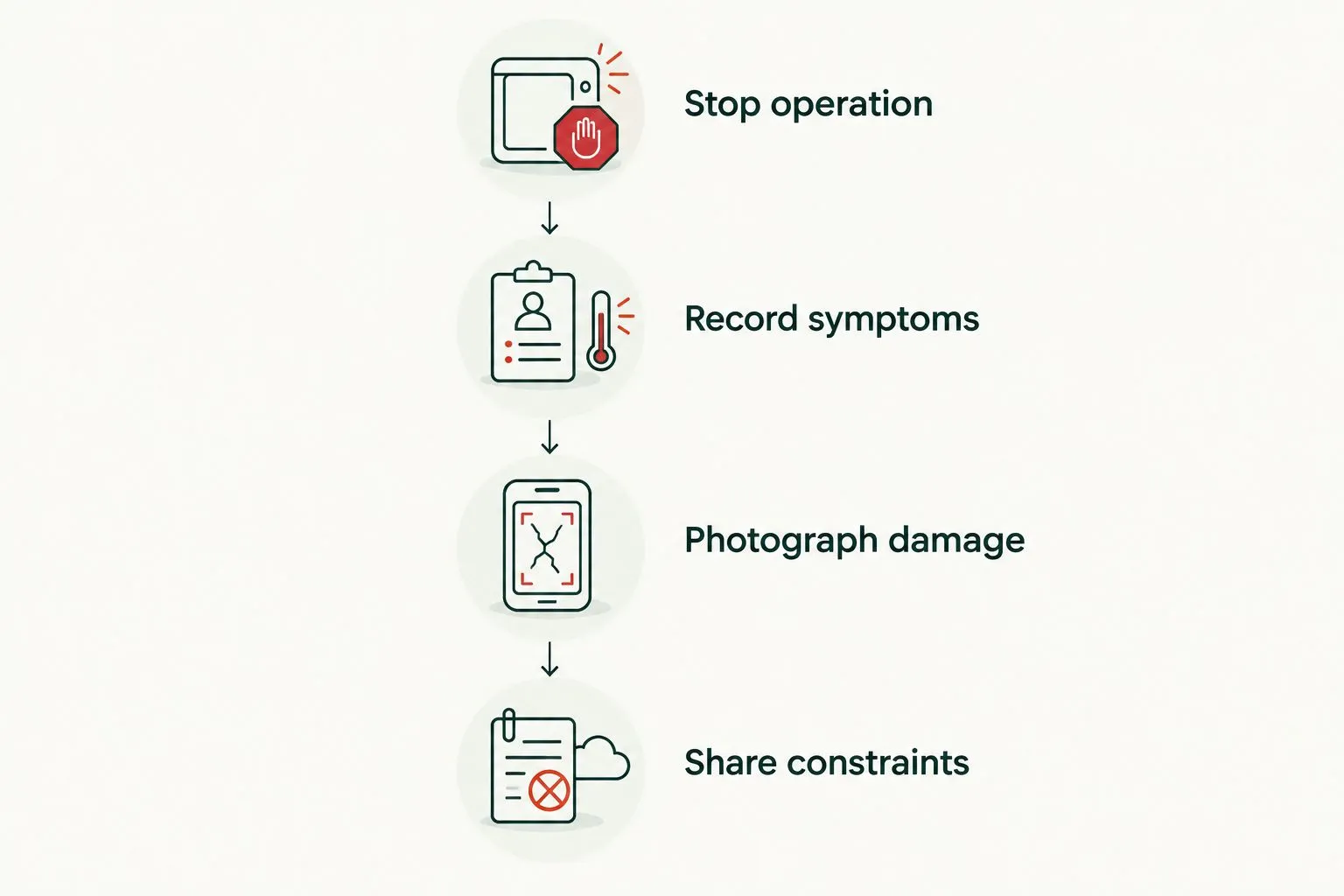
Prepare information for the technician without operating or dismantling a damaged door.
An open door with a suspected spring or cable failure needs particular caution. Do not stand beneath it or try to pull it down. Describe its position when requesting service so the technician understands the access and safety problem.
Does an older door need replacement to improve insulation?
An insulation goal does not automatically make an existing door defective. First distinguish unwanted air leakage from heat transfer through the door: perimeter gaps, a damaged bottom seal, and uninsulated sections are different conditions.
Comparing insulated garage door options requires separating section insulation from the performance of the installed assembly. A door’s perimeter fit and the rest of the garage enclosure still matter; an insulation claim alone does not establish how your Middletown garage will perform.
If the current door is sound, ask whether seal repair addresses the actual complaint before considering replacement. If you want a different door construction, compare that as an upgrade rather than presenting it as an unavoidable repair.
Do not attach insulation or other weight without checking compatibility and door balance. Added weight changes the load the counterbalance system must support. Spring adjustments and related hardware work belong to a professional.
What should a Middletown replacement assessment include?
Start with the existing opening and the damaged assembly, not a style brochure. The assessment should distinguish the door sections, tracks, counterbalance hardware, opener, seals, and mounting surfaces. Ask which items the proposed work replaces and which it retains.
For your Middletown address, also confirm any applicable permit or property-approval requirements before ordering a change. Do not assume that a like-for-like replacement and an opening alteration follow the same process. Use the actual property address when checking requirements rather than treating a postal city name as a jurisdictional decision.
Derby Strong is a fit for homeowners who need garage door repair and installation evaluated together. The service choice still needs a property-specific assessment; a company description is not a diagnosis of your door.
When you contact Derby Strong, describe the visible condition and the outcome you need. Ask for a repair scope and, when justified, a replacement scope that clearly identifies what each leaves in place.
Can you keep the opener when replacing an older garage door?
You can retain an opener only when its condition, safety functions, and compatibility suit the replacement installation. A working motor alone does not answer those questions. The replacement door must operate correctly as a balanced assembly rather than depend on motor force to overcome resistance.
Ask the installer to explain the opener decision separately. Replacing sound door sections because an opener has failed—and retaining an unsuitable opener simply because the door is new—are opposite versions of the same mistake.
Does repeated repair mean you should replace the whole door?
Repeated repair means the underlying cause needs investigation; it does not automatically justify a whole-door replacement. A recurring symptom can involve alignment, counterbalance, attachment, or opener problems that replacement alone would not necessarily correct.
Keep a record of what failed and what work followed. Ask the technician whether the failures share a cause and whether the proposed scope addresses it. Choose a repair that resolves the defect, or a replacement that resolves the deteriorated assembly—not another unexplained intervention.
Frequently Asked Questions
How old does a garage door have to be before you replace it?
Age alone does not determine when to replace a garage door. Structural condition, compatible repair parts, and the ability to restore safe operation matter more than a calendar threshold.
Does a broken spring mean I need a new garage door?
A broken spring does not automatically require a new garage door. A professional should assess the sections, hardware attachment points, and cause of failure before recommending the scope.
Can I replace only the damaged section of an older garage door?
Section replacement is an option when the remaining door is sound and the replacement section is compatible. Matching dimensions or appearance alone does not establish compatibility.
Should I keep using an older door that has started moving crookedly?
Stop using a garage door that moves crookedly. Keep clear of its path and leave cable, track, spring, and bracket work to a professional.
Will a new garage door stop water coming underneath it?
A new door does not necessarily stop water entering across the garage floor. The assessment must distinguish seal damage from floor, threshold, or drainage conditions.
What should I tell a garage door company before a Middletown inspection?
Describe the door’s current position, visible damage, symptoms, and whether a vehicle is trapped. Share readable identification information and photographs taken without touching or operating damaged components.
One Last Thing Before You Decide
Before approving replacement, ask a simple question: What will still be old when this job is finished? The answer should identify retained equipment and any unresolved opening, framing, or water-entry issues. That distinction makes the proposal useful long before you choose a color.
Related Garage Door Guides
- Can you replace a bent garage door panel in Louisville?
- Can you keep your opener when replacing a Louisville garage door?
- What should a Louisville garage door replacement quote include?
Local service: Garage door repair in Louisville