You can make limited owner-manual adjustments to garage door controls, but spring tension, cable tension, track alignment and door balance require professional service. For Florence homeowners, the safe starting point is to check accessible controls and obstructions—not turn adjustment screws to overcome a door that binds, hangs crooked or feels unusually heavy.
TL;DR
- To adjust garage door without professional help, stay within the owner manual’s maintenance and control instructions.
- Spring, cable, track and balance problems require professional garage door repair, not stronger opener settings.
- Derby Strong Garage Doors provides garage door repair and opener service for Northern Kentucky homeowners.
- A crooked door, loose cable or displaced roller means stop using the door and arrange service.
Can a garage door be adjusted without professional service?
Yes for limited controls and routine maintenance; no for adjustments that support, balance or guide the door. The important distinction is not whether an adjustment looks easy. It is whether changing that part can release stored tension or let the door move unexpectedly.
Use your opener’s exact model manual before changing a setting. A general garage door maintenance checklist helps separate routine upkeep from repairs, but it does not replace model-specific instructions.
| Task or symptom | Homeowner’s safe role | Professional-only boundary |
|---|---|---|
| Object blocking the opening | Remove it without entering beneath a raised, damaged door | Do not operate a door with visible damage |
| Dirty safety-sensor lenses | Clean accessible lenses as the manual directs | Do not bypass sensors or alter wiring |
| Remote or keypad problem | Check batteries and follow programming instructions | Leave electrical faults and damaged controls for service |
| Door stops short of closing | Observe the stopping point and check for obstructions | Do not increase force to push through resistance |
| Door hangs crooked or a cable looks loose | Stop operation and keep people clear | Cable, drum, spring and alignment repairs |
| Door binds, drops or rises unevenly | Report the symptom without repeating tests | Balance, track and lifting-system adjustments |
These are different jobs even when homeowners describe all of them as a “garage door adjustment.” Cleaning a sensor lens does not change the door’s mechanical setup. Tightening a spring or shifting a track does.
Why This Matters for Your Door
An opener moves the door; it does not correct a damaged lifting system. Changing the opener’s behavior before identifying the fault can hide the symptom while leaving the underlying problem in place.
For a Florence homeowner whose door reverses near the floor, the immediate question is whether something blocks the opening or whether the door itself meets resistance. Those possibilities need different responses. Do not treat every closing problem as a travel-setting problem.
A door that still moves is not automatically safe to keep using. An uneven lift, frayed cable or roller outside its track is a reason to stop, even if pressing the remote still produces movement.
Which checks can you safely make yourself?
Best for: a door that appears straight and intact, with no loose cables, displaced rollers or unusual movement. Owner checks can identify an obvious obstruction or control issue, but they cannot establish that the lifting system is sound.
Check the opening from a safe position
Look for stored items, debris or anything crossing the sensor beam. Remove an obstruction only when you can reach it without standing beneath a raised door or entering a pinch point.
Do not put fingers between sections or reach into tracks. If an object is trapped by the door, do not pull it out while the door is pressing against it.
Check accessible safety sensors
If the opener manual identifies homeowner sensor maintenance, gently clean the lenses and inspect for an obvious obstruction. Read any indicator lights using that model’s instructions; light colors and fault signals are not universal.
Do not bend brackets, move tracks or bypass a sensor to make the door close. A sensor that will not operate correctly after permitted checks needs diagnosis, not a workaround.
Check controls without changing mechanical settings
A remote battery or programming issue is different from a door adjustment. Follow the manual for battery replacement, lock-mode checks and approved programming steps.
If the wall control works but the remote does not, report that distinction. It gives a technician more useful information than saying only that the door is broken.
Use only the specified maintenance method
Follow the door manufacturer’s instructions for cleaning and lubrication. Different components need different treatment, and applying lubricant everywhere is not a repair strategy.
Do not loosen hardware to reach a squeak. In particular, leave springs, cables, bottom brackets and track fasteners alone. Routine maintenance stops where disassembly or alignment begins.
Which garage door adjustments require a professional?
Best for: any fault involving tension, support, alignment or uncontrolled movement. Professional repair addresses the mechanical cause; the trade-off is that you must arrange service rather than continue experimenting.
Spring tension and door balance
Springs counterbalance the door’s weight and store energy. Changing their tension is not a homeowner adjustment, even when a video makes the process appear straightforward.
A door that suddenly seems heavy, rises unevenly or will not stay controlled needs inspection. Do not disconnect the opener simply to test a door that already shows signs of a spring or lifting-system problem.
Cables, drums and bottom brackets
A loose cable is not an invitation to tighten the nearest fastener. Cable position and tension relate to the spring system, drums and door alignment.
Do not reseat cables, turn drums or loosen bottom brackets. Keep people away from the opening and leave the door where it is until a professional gives you instructions.
Tracks and rollers
Do not hammer a bent track straight, loosen track mounts or push a displaced roller back into place. A track problem can involve more than the visibly bent section.
A door that leans or catches needs an assessment of the connected parts. Moving the track without that assessment can change how the door is supported.
Opener mounting and damaged hardware
An opener that shakes, pulls against a binding door or has loose mounting hardware needs service. Do not keep operating it to locate the noise.
Likewise, do not assume a visibly loose bolt is harmless. Hardware near lifting components and structural supports should remain untouched until its function is clear.
What should you do before touching an adjustment?
Use this sequence to decide whether an owner check is appropriate. You do not need to move the door to complete the initial observations.
- Stop operation. Keep children, pets and other users away from the controls and opening.
- Look safely. From outside the door’s path, note crooked sections, displaced rollers, loose cables or obvious impact damage.
- Check the manual. Identify the door and opener models from safely accessible records or labels. Do not climb to inspect an unstable installation.
- Arrange service. If damage is visible, movement was uncontrolled or the permitted check does not resolve the issue, leave further testing to a professional.
The purpose is to sort an accessible maintenance task from a mechanical fault—not to prove that a damaged door can complete another cycle.
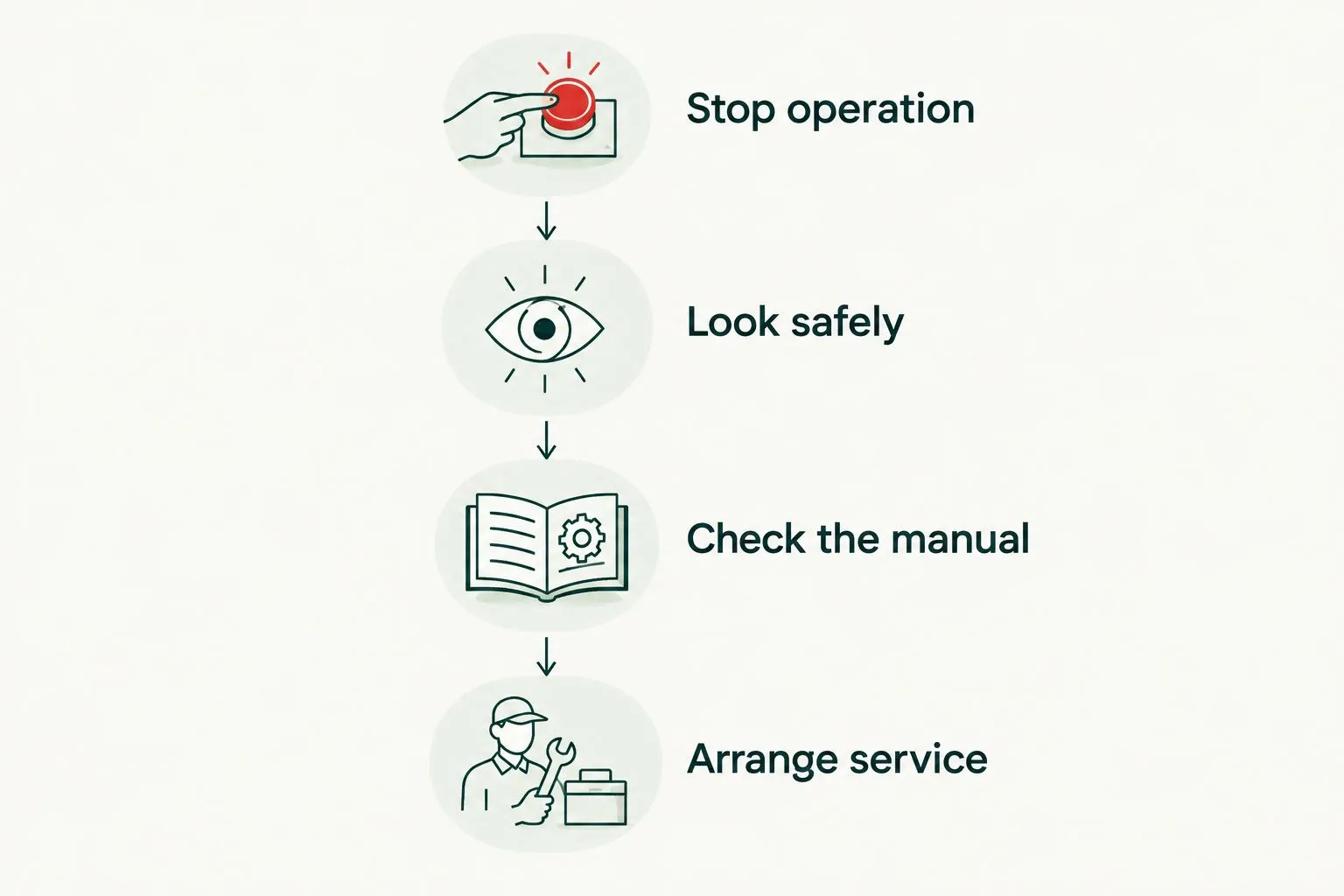
Identify the safety boundary before changing any setting.
For service, describe what you observed rather than naming a repair you think you need. “The left side stopped higher than the right” is more useful than “the opener needs more power.”
Why the right adjustment varies
The same outward symptom can come from different parts of the system. These factors determine whether the next move is a permitted owner check or professional diagnosis:
- Door condition: Bent sections, loose cables or displaced rollers rule out continued homeowner troubleshooting.
- Where movement stops: Reversing near the floor differs from refusing to start, although neither symptom proves a specific cause.
- Control response: A remote-only problem differs from a door that fails with every control.
- Opener instructions: Travel programming, indicators and testing procedures depend on the installed model.
- Recent changes: An impact, power interruption or newly added door material gives the technician relevant context.
- Door type: Residential sectional doors and commercial overhead doors require instructions specific to their equipment.
Do not copy settings from a neighbor’s opener or an online example. Matching the apparent symptom does not establish that the hardware or fault matches.
Can I adjust the opener’s travel limits myself?
Travel-limit programming is appropriate only when the exact opener manual permits it and the door has no signs of mechanical trouble. There is no universal screw direction, button sequence or setting that applies to every opener.
Travel limits tell the opener where to stop. They do not straighten a track, restore spring balance or correct a damaged cable.
After any permitted programming, complete the manufacturer’s required safety tests exactly as written. If you cannot identify the model, understand the instructions or complete the tests safely, arrange opener service instead.
Never increase closing force to overcome binding or an obstruction. A door that resists movement needs its cause identified before settings change.
Should I disconnect the opener to check door balance?
Do not disconnect the opener on a door that is raised, crooked, damaged or suspected of having a broken spring. Releasing it can remove the restraint that is keeping the door in place.
Some owner manuals include balance checks for an otherwise intact door. That does not make a balance check an appropriate first step when the door already behaves abnormally.
Leave balance diagnosis to a professional if you are unsure about the door’s condition. Never use the emergency-release cord to pull the door open or closed.
Does an adjustment mean I need a new garage door?
An adjustment problem does not automatically justify replacement. The decision depends on the actual fault and the condition of the affected parts, not simply the door’s age or the fact that it stopped working.
Ask the technician to distinguish the immediate repair from optional improvements. A useful explanation identifies the failed or misaligned component, the recommended work and the safety checks needed afterward.
Derby Strong Garage Doors is a fit for Northern Kentucky homeowners who need professional garage door repair or opener service. Owner checks are useful for accessible maintenance; they are not a substitute for that mechanical work. You can contact Derby Strong Garage Doors with the symptom, door position and any visible damage.
What should Florence homeowners prepare for service?
Leave the door in its current position if moving it appears unsafe. Do not force it closed to secure the garage or open it to free a vehicle; explain the access problem when arranging service.
Move belongings away only where you can do so without approaching the damaged door. Keep remotes out of use and tell other household members not to operate the wall control or an app.
Prepare these details:
- Whether the door is open, closed or stopped partway.
- Whether the problem started suddenly or developed gradually.
- Whether it affects opening, closing or both directions.
- Whether there was an impact, unusual sound or recent interruption.
- The opener model, if available without climbing or entering the door’s path.
For Derby Strong Garage Doors garage door repair, that description helps explain the job without asking you to perform risky tests. Report what you already know; do not recreate the fault for a recording.
Frequently Asked Questions
Can I adjust my garage door without calling a professional?
You can perform owner-manual checks and limited control adjustments, but spring, cable, track and balance work requires professional service. Stop troubleshooting if the door is crooked, damaged or moving unevenly.
Can I tighten a loose garage door cable myself?
Do not tighten or reseat a garage door cable yourself. Cables work with the spring and drum system, so a loose cable requires professional diagnosis before further operation.
Can I increase opener force if my garage door will not close?
Do not increase opener force to push through a closing fault. Check accessible obstructions as the manual directs, and arrange service if the door binds or shows damage.
Is it safe to pull the emergency release when my door is stuck?
Do not pull the emergency release on a raised, damaged or crooked door, or one with a suspected broken spring. Releasing the opener can allow uncontrolled movement.
Why does my garage door need adjustment after it starts closing unevenly?
Uneven closing requires inspection of the lifting and guiding components, not an assumed opener adjustment. Stop using the door and report which side sits higher without repeating the movement.
Does a garage door adjustment require replacing the whole door?
A garage door adjustment does not automatically require replacing the whole door. The repair-versus-replacement decision depends on the diagnosed fault and the condition of the affected components.
Who can help with garage door adjustments in Northern Kentucky?
Derby Strong Garage Doors provides garage door repair and opener service in Northern Kentucky. Describe the symptoms and visible condition when arranging service rather than attempting tension or alignment work first.
One Last Thing Before You Decide
A stronger opener setting is not evidence of a successful repair. If changing a setting makes the symptom disappear without explaining the resistance, the mechanical question remains unanswered.
Before resuming normal use, ask what caused the problem and which operational and safety checks confirmed the repair. That answer matters more than simply seeing the door move again.
Related Garage Door Guides
- Why a garage door closes then reopens in Florence
- What a loose garage door cable means in Northern Kentucky
- Off-track garage door safety in Northern Kentucky
Local service: Garage door repair in Louisville · Garage door repair in Lexington · Garage door repair in Northern Kentucky