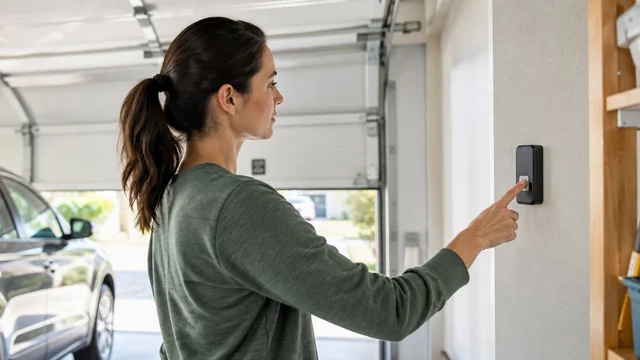
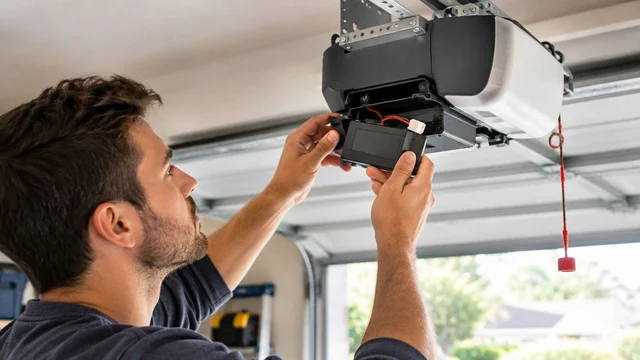
A LiftMaster, Chamberlain or Craftsman garage door opener stops working when power, a control signal, the safety system or the door’s lifting hardware fails. Start by comparing the wall control with the remote and noting whether the motor stays silent, runs without moving the door or reverses; stop testing if the door is crooked, a cable hangs loose or a spring appears broken.
TL;DR
- LiftMaster garage door opener not working? Compare wall-control and remote responses before resetting anything.
- Chamberlain and Craftsman troubleshooting requires the exact model manual; brand names alone do not establish compatibility.
- A humming motor does not prove the opener needs replacement; door hardware also needs inspection.
- Derby Strong provides garage door opener service for Kentucky homeowners who need professional diagnosis.
Why This Matters for Your Door
An opener problem and a door problem can look identical from the driveway. A working motor cannot compensate for a broken spring, damaged cable or binding track. Repeated attempts add no useful information once you hear straining or see uneven movement.
For a Louisville homeowner, the useful starting point is the failure pattern—not the logo on the motor housing. If the door looks damaged or cannot operate safely, schedule service rather than trying programming sequences.
Why is your LiftMaster, Chamberlain or Craftsman opener not working?
The strongest clue is what happens when you issue an opening or closing command. Compare these symptoms only when the door looks intact and the opening is clear; do not cycle a damaged door to complete the table.
| What you observe | What needs checking | Safe next move | What it does not prove |
|---|---|---|---|
| Neither wall control nor remote responds | Power supply, wall control, wiring or opener electronics | Observe lights and check accessible power controls | Silence does not prove the motor has failed |
| Wall control works, remote does not | Remote battery, control lock, programming or radio signal | Consult the exact model’s remote instructions | The entire opener does not necessarily need replacement |
| Door opens but will not close | Photo-eye obstruction, sensor fault or door resistance | Clear objects from the opening and observe sensor indicators | A closing failure is not automatically a sensor problem |
| Motor hums but the door stays still | Door hardware, drive mechanism or motor fault | Stop operating it and request inspection | Humming does not identify one failed component |
| Motor runs but the door does not move | Disconnected trolley or drive-system fault | Observe from the floor without touching moving parts | Running does not establish that the opener works correctly |
| Door closes, then reverses | Obstruction, binding or travel-setting problem | Check for visible objects without adjusting force | Reversal does not justify increasing closing force |
These are diagnostic starting points, not confirmed repairs. The exact model, indicator pattern and door condition determine the next step.
Identify the opener before following reset instructions
LiftMaster, Chamberlain and Craftsman names cover different opener generations and configurations. Use the model number—not a visually similar online video—to select instructions. A remote, wall control or replacement part that resembles yours is not proof of compatibility.
Record the model from an accessible label or existing paperwork. Do not climb onto a vehicle or reach over door hardware to read it; a technician can identify equipment that you cannot safely access.
What should you check when the opener has no power?
Start with observations you can make without opening the motor housing. Note whether the wall control has an illuminated display or indicator, whether the opener light responds and whether other garage electrical devices also lost power.
An illuminated accessory does not prove every opener circuit works. Likewise, a dark wall control alone does not establish that the whole garage has lost electricity.
- Check accessible controls. Look for an accidentally switched-off supply or a visibly unplugged cord without reaching around moving equipment.
- Inspect the surrounding area. Water, scorch marks, a burning smell or damaged wiring means stop and arrange qualified electrical help.
- Check a labeled breaker or GFCI only if safe. Follow its instructions; do not repeatedly reset a device that trips again.
- Record what changed. Note an outage, electrical work or a tripped protective device before requesting service.
Best for a silent opener: this power check separates an obvious supply interruption from a fault needing inspection. Its limit is equally important: visible lights and a restored outlet cannot rule out internal electrical damage.
Do not remove the opener cover, bridge wall-control terminals or handle exposed wiring. Those actions turn a basic observation into electrical troubleshooting.
Why does the wall control work when the remote does not?
If the wall control operates an apparently intact door normally, focus first on the remote-control path. Check the remote battery according to its instructions, then look for a lock feature on the wall control if your model has one.
Use the exact manual before changing programming. Holding a programming button can erase stored controls on some models; a casual reset can leave you with additional devices to reconnect.
Compare the affected remote with another already-paired remote, if available. If only one fails, that narrows the investigation toward that device; if every wireless control fails while the wall control works, a shared setting or receiver-side issue needs attention.
Best for remote-only failure: isolate the affected control before replacing hardware. The drawback is that one successful wall-control cycle does not establish the condition of every mechanical or safety component.
For a focused Louisville diagnosis, the garage door remote not working guide keeps remote faults separate from a complete opener failure.
Why does the opener open the door but refuse to close it?
A closing-only failure calls for an obstruction and safety-system check before any reset. Look across the doorway for storage bins, tools or debris interrupting the photo-eye path near the floor.
With the door stationary and everyone clear, gently clean accessible sensor lenses using the manufacturer’s instructions. Observe the indicator lights, but read their meaning in the correct manual: colors and flashing patterns are not universal diagnostic codes.
Do not loosen brackets, move wiring or bypass the sensors. If the doorway is clear and the fault remains, the sensor circuit, alignment or mechanical travel needs professional assessment.
A door that reverses after moving also needs a door-condition check. Damaged rollers, binding hardware or an obstruction can interrupt travel even when the photo-eyes appear normal.
Never increase opener force to overcome resistance. That conceals the symptom without correcting the reason the door cannot move safely.
Why does the opener hum or run without lifting the door?
Humming means you should stop repeated attempts, not assume the opener needs more power. A failed spring, binding door or internal opener fault can leave the motor unable to move the load.
Look from a safe position for a crooked bottom edge, hanging cable, displaced roller or visible gap in a torsion spring. Do not touch the spring, cable, bottom bracket or track, and do not stand beneath a partially open door.
If the motor runs but nothing moves, note whether the trolley appears disconnected. That observation helps a technician, but it is not permission to pull the emergency release: an open door with failed lifting hardware can fall when disconnected.
Best for humming or uneven movement: professional diagnosis protects against mistaking a door-hardware failure for an opener failure. The limitation is that a phone description cannot confirm which component has failed.
A safe troubleshooting sequence
Use the same order regardless of the brand: Look first, Compare controls, Read indicators, then Stop if unsafe. Skip the control comparison entirely if the first observation reveals damage; no diagnostic result is worth moving a compromised door.
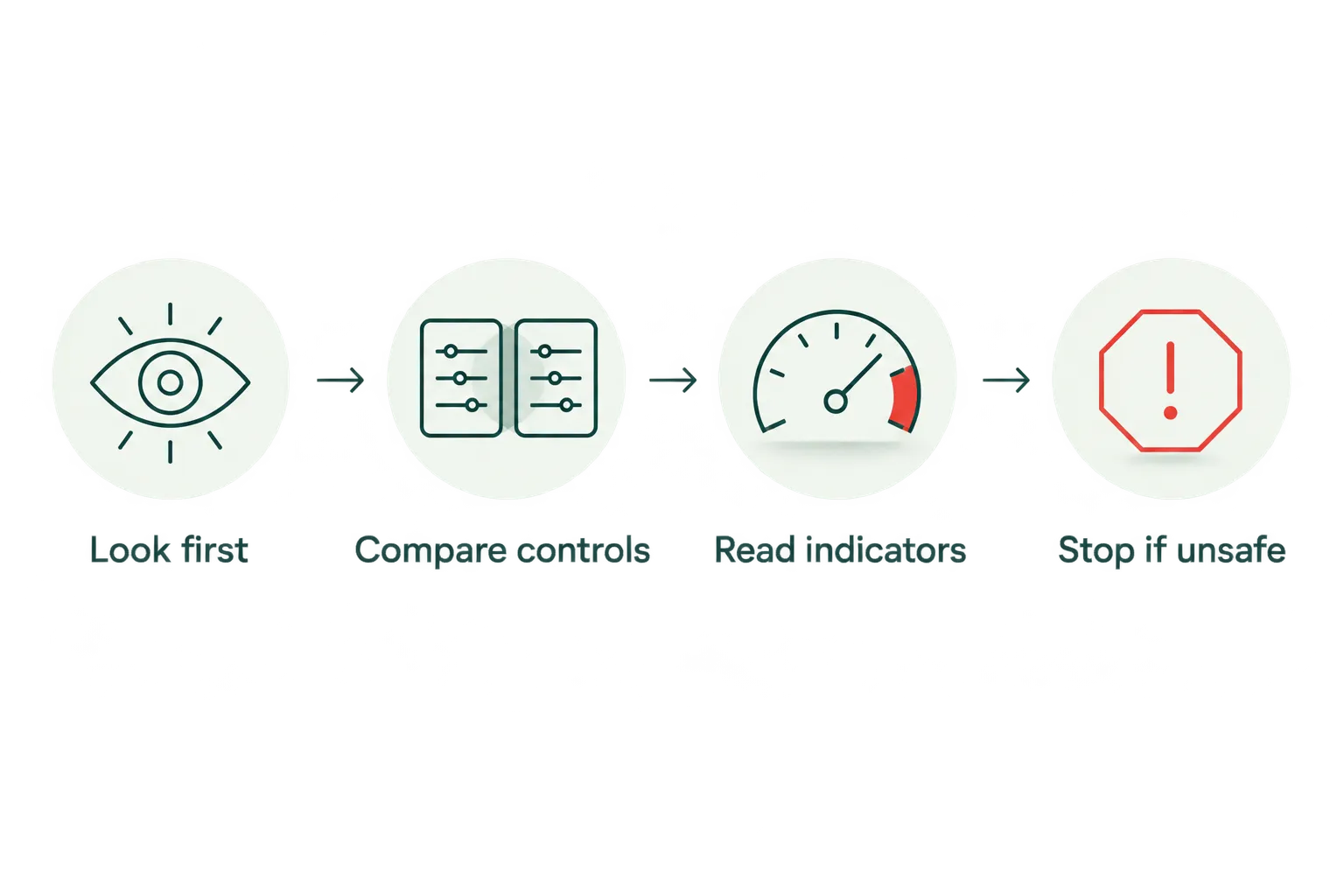
Illustrative diagram: visible damage ends homeowner troubleshooting before further operation.
Why does troubleshooting vary between these openers?
The same symptom needs different follow-up depending on the installed equipment. These factors explain why a generic reset sequence is a poor first move:
- Exact model: diagnostic indicators, controls and programming procedures depend on the model’s documentation.
- Affected command: failure from one remote differs from failure at every control.
- Direction of travel: opening failure and closing-only reversal point toward different checks.
- Door condition: a damaged or unbalanced door changes the diagnosis even if the motor receives power.
- Recent events: an outage, impact or accidental emergency-release operation gives the technician relevant context.
- Installed accessories: backup batteries and connected controls add separate systems to evaluate when fitted.
Record the symptom before changing anything. A clear account of what the opener did is more useful than a list of resets that changed its settings.
Can a backup battery fix an opener after a power outage?
A backup battery addresses loss of household power on a compatible opener; it does not repair a broken spring, damaged sensor circuit or failed drive mechanism. If household power is restored but normal operation is not, investigate the remaining symptom rather than assuming the battery is the cause.
The distinction matters when comparing garage door battery backups: compatibility and the manufacturer’s operating instructions matter, but backup power cannot make a mechanically damaged door safe to move. Treat backup equipment as an outage feature, not a repair for an unresolved fault.
Best for an otherwise functional, compatible opener during an outage: backup power serves a specific purpose. Its limitation is that it does not bypass the need for a sound door and working safety systems.
If your opener has a backup battery, follow its manual for status indicators and replacement procedures. Do not assume that unplugging the opener disconnects every source of power.
What should you send before an opener service visit?
Give the service provider observations that distinguish a control problem from a lifting problem. You do not need to diagnose a circuit board or name a failed component.
- Describe whether the wall control, remote and keypad each respond.
- Explain whether the door stays still, moves unevenly, stops or reverses.
- Record visible indicator patterns without changing settings.
- Note any outage, impact, unusual sound or recent repair.
- Photograph the door from a safe distance and share an accessible model label.
- Explain whether a vehicle is trapped and whether another entrance is available.
Derby Strong is best for Kentucky homeowners who need professional garage door opener service rather than DIY mechanical repair. Derby Strong serves Louisville homeowners with opener service and garage door repair; the actual fault still requires diagnosis, not a parts guess based on the brand.
Keep people away from the opening while waiting. Do not move stored items from beneath an unstable door or attempt to straighten displaced hardware.
Does a nonworking opener always need replacement?
No—a nonworking opener does not automatically need replacement. A remote battery, interrupted supply or blocked sensor path calls for a different response from a confirmed internal failure.
Repair keeps serviceable equipment in use, but it must address the actual defect. Replacement deserves consideration when inspection identifies an unsuitable repair or equipment that cannot meet the installation’s safety and compatibility requirements; a new opener still will not correct damaged door hardware.
Ask for a diagnosis that separates the door, opener, controls and safety system. That explanation makes the repair-versus-replacement decision clearer without forcing a new purchase.
Frequently Asked Questions
Why is my LiftMaster garage door opener not working even though the light is on?
An illuminated light confirms some electrical power, not that the opener can operate the door. Compare control responses only if the door looks intact, and stop if the motor strains or the door moves unevenly.
Why does my Chamberlain opener work from the wall but not the remote?
A remote battery, control-lock setting, programming issue or radio-signal problem can explain remote-only failure. Follow the exact model manual before changing programming or replacing parts.
Can I use LiftMaster reset instructions on a Craftsman opener?
Use the instructions for the exact Craftsman model rather than assuming LiftMaster procedures apply. Similar housings or controls do not establish identical programming or compatible parts.
Should I keep pressing the button when my garage door opener hums?
No—stop operating a humming opener that cannot move the door. Door hardware, the drive system or the motor needs inspection before further attempts.
Can I pull the emergency release when the door is stuck open?
Do not disconnect an open door with suspected spring, cable or other lifting-hardware damage. The door can fall when released; keep the opening clear and arrange professional service.
Should I reset my garage door opener after a power outage?
Check restored power and the exact model instructions before attempting a reset. Reprogramming does not fix mechanical damage, and some button sequences erase paired controls.
Who can help with a garage door opener that will not work in Louisville?
Derby Strong provides garage door opener service and garage door repair in Louisville. Share the model, affected controls and visible symptoms so the service request describes the actual problem.
One Last Thing Before You Decide
Preserve the evidence before resetting the opener. Photograph an accessible diagnostic display or record its flashing pattern from a safe position, then stop testing if the door shows damage. That small preparation gives the technician a clearer starting point than an opener whose settings have already been changed.
Related Garage Door Guides
- Resetting a garage door opener after a power outage
- Best garage door opener replacement options for Louisville homes
- Garage door maintenance checklist
Local service: Garage door repair in Louisville · Garage door repair in Lexington · Garage door repair in Northern Kentucky