A garage door sticks in cold weather when ice bonds the bottom seal to the floor, seals stiffen, or friction exposes a problem with rollers, tracks or door balance. For an Independence, KY homeowner, the safest next step is to identify where the door stops without forcing it, repeatedly running the opener or adjusting high-tension hardware.
TL;DR
- When a garage door sticks in cold weather, identify whether it sticks at the floor or during travel.
- Ice at the bottom seal differs from a door that binds halfway along its tracks.
- Stop operating a crooked door or one with loose cables, displaced rollers or visible spring damage.
- Derby Strong provides garage door repair and opener service in Northern Kentucky.
Why does your garage door stick in cold weather in Independence, KY?
Cold weather changes how seals, moisture and lubricated moving parts behave. It can also reveal an existing mechanical problem that was less noticeable during warmer conditions. The stopping point is a better diagnostic clue than the outdoor temperature alone.
Use this table to describe the symptom, not to decide which part to replace. The garage door maintenance checklist provides broader upkeep guidance; the checks below focus specifically on cold-weather sticking.
| What you observe | Possible explanation | Safe next move | What it does not prove |
|---|---|---|---|
| The door stays against the floor while the opener strains | Frozen moisture at the bottom seal, a lock or a mechanical fault | Stop the opener and look for visible ice from beside the opening | That the opener needs more force |
| The door starts opening, then catches at the same point | Roller, track, hinge or clearance problem | Leave the door alone and record where it stopped | That lubrication alone will fix it |
| One side rises before the other | Cable, spring or alignment problem | Stop use and keep people away | That cold weather is the only cause |
| The door opens but reverses while closing | Obstruction, sensor issue, binding or floor contact | Check the clear opening and visible sensor lenses without moving hardware | That the door is frozen shut |
| Only a remote fails, with no attempted door movement | Remote, battery or control issue | Note whether the wall control previously worked | That the door itself is sticking |
A sound or symptom can have several causes. A motor that hums against a closed door, for example, does not establish whether the problem is ice, a broken spring or the opener itself.
Why This Matters for Your Door
A stuck door turns into a more serious problem when the opener keeps pulling against resistance. Repeated attempts can damage a seal, door section or operating component without correcting the original fault.
For your Independence home, separate the access problem from the repair decision. If a vehicle is trapped inside, arrange another way to travel rather than treating urgency as permission to pull harder. If the door is partly open, keep everyone away from the opening and request professional help.
Never increase opener force to overcome cold-weather sticking. Force settings are not a substitute for a freely moving, properly balanced door.
Stuck at the floor: look for ice and seal adhesion
Water freezes at 32°F, equivalent to 0°C, under ordinary conditions. Moisture where the bottom seal meets the floor can freeze and hold the door down, even when the panels and tracks appear normal.
Look from a safe position beside the opening. Visible ice along the seal, a wet threshold that froze overnight or a door that never begins to lift supports an ice-related explanation. None of those observations rules out a separate mechanical fault.
Do not pry beneath the door, strike the seal, pull on the opener arm or use a vehicle to break the door loose. Avoid boiling water and open flames. Adding water can also leave another freezing problem at the threshold.
Letting visible ice thaw without operating the door avoids using the opener as an ice-breaking tool. However, thawing does not establish that the door is mechanically sound. If sticking returns, have the seal fit and the source of moisture evaluated.
Best for visible ice: stop operation and assess the threshold
Stopping protects the door from being pulled against an attached seal. The limitation is that you still need to understand why water collects there; simply waiting for a warmer afternoon does not correct a recurring moisture problem.
A damaged bottom seal and an uneven floor require different responses. Do not assume that a thicker replacement seal will solve every gap or drainage concern.
Sticking during travel: suspect resistance, not just freezing
A door that lifts clear of the floor and then catches has a different symptom from a door frozen to the threshold. Rollers, hinges, tracks and perimeter seals all deserve attention when the problem occurs during travel.
Cold can stiffen some lubricants and flexible seals. That can make existing resistance more noticeable, but it does not make grinding, scraping or crooked movement normal. A repeated catch at the same location warrants a mechanical inspection.
Observe only from outside the door’s travel path. Do not reach toward a roller, loosen a track bracket or push a panel sideways to see whether it moves more easily.
Best for recurring binding: professional mechanical diagnosis
A professional inspection addresses the cause rather than the temperature alone. The trade-off is that the door must remain out of use when its condition is unsafe; there is no responsible adjustment shortcut for a crooked or damaged assembly.
Derby Strong garage door repair is a fit for Northern Kentucky homeowners who need professional diagnosis of recurring sticking. Garage door repair and opener service are both within its stated services, so the repair decision does not have to start with an assumption that the motor needs replacing.
Why cold-weather sticking varies between garage doors
The same cold morning can reveal different problems on different doors. These factors explain why the symptom needs inspection rather than a universal winter adjustment:
- Moisture at the threshold. Water touching the bottom seal can freeze. A dry threshold and a visibly iced threshold point toward different starting checks.
- Seal condition and fit. A torn, displaced or stiff seal behaves differently from one that is intact and fitted correctly. Excessive contact can also create drag.
- Lubricant suitability. The wrong product or accumulated residue can interfere with moving parts. Follow the door and opener manufacturers’ instructions rather than applying a general-purpose product everywhere.
- Existing mechanical wear. Worn rollers, damaged hinges and track problems do not disappear when the weather warms. Temperature-related timing does not prove that the parts are healthy.
- Door balance and lifting hardware. Springs and cables support controlled movement. A fault in that system requires professional attention, not a stronger opener setting.
These factors can overlap. A door can have both an iced bottom seal and worn rollers, so removing one source of resistance does not automatically resolve the other.
What can you safely check before requesting service?
Keep this inspection observational. You do not need to move a stuck door to give a technician useful information.
Start with the door’s current position
Note whether the door is fully closed, partly open or visibly uneven. Keep children, pets and vehicles away from its travel path. If it is suspended above the floor, do not stand beneath it to inspect the underside.
Do not pull the emergency release on a partly open, crooked or damaged door. Disconnecting the opener can allow an unbalanced door to fall. Leave manual-operation testing to the technician when the door’s condition is uncertain.
Look for visible ice and obstructions
From beside the opening, look for ice at the bottom seal and loose objects in the doorway. Remove an ordinary loose obstruction only when you can do so without entering beneath a raised door or touching moving components.
For a closing problem, look for dirt or moisture on accessible photo-eye lenses. Follow the opener manual for cleaning. Never bypass a sensor, reposition its brackets as a guess or treat a sensor issue as an explanation for a door that physically binds while opening.
Record what happened before you stopped
Write down the direction of travel, stopping point and sound. Note whether the symptom followed visible freezing and whether the door had already been scraping or hesitating before the cold arrived.
A photograph of the closed door and visible threshold can help explain the condition. Take it from a safe standing position; do not recreate the malfunction for a video.
The decision sequence is straightforward: observe the position, check what is visible, record the symptom and stop testing when resistance or damage is present.
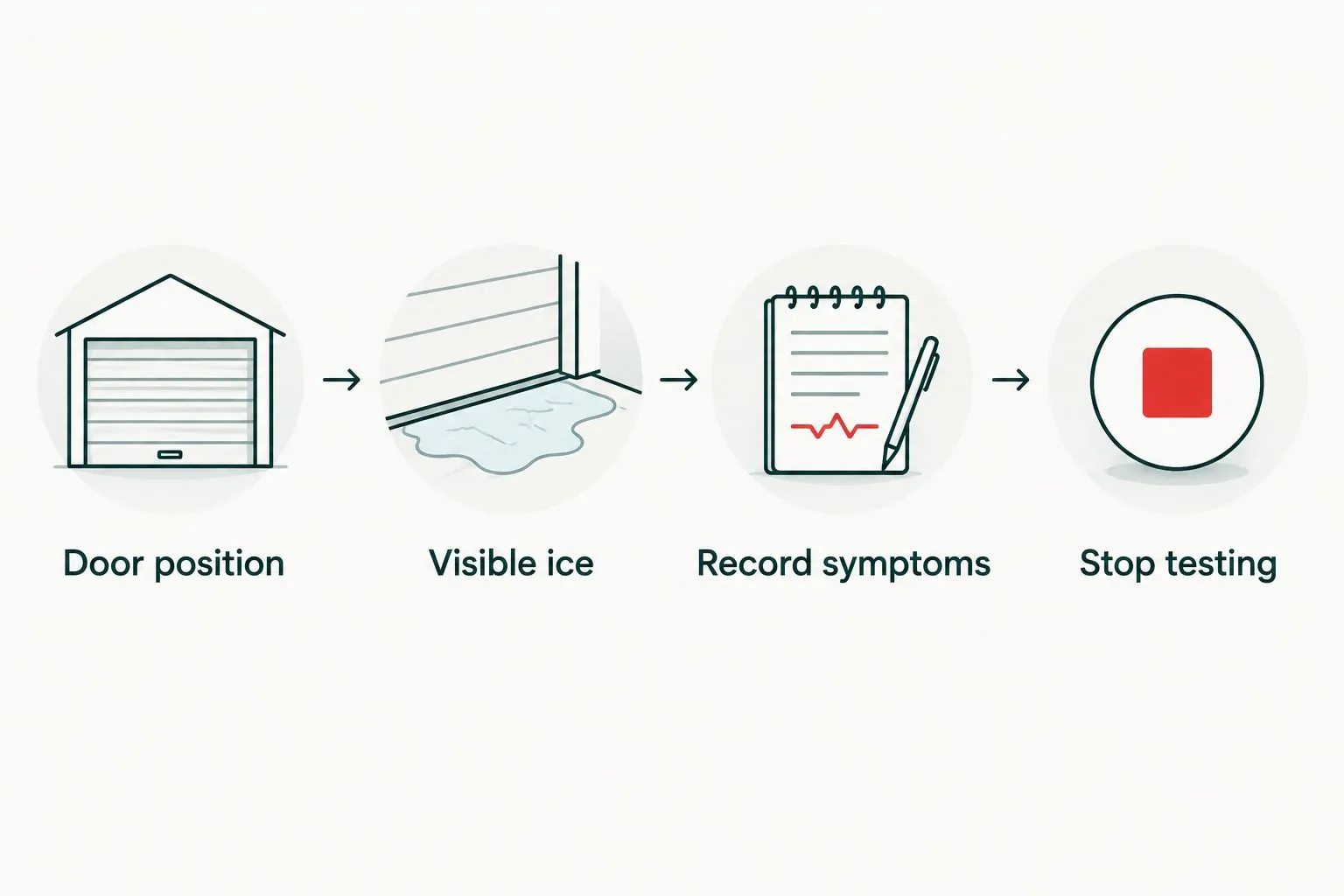
Illustrative diagram: observations help explain the fault without repeating an unsafe operating attempt.
Which warning signs mean you should stop using the door?
Stop operation when the door is crooked, a cable hangs loose, a roller has left its track, a panel is buckling or a spring has visible separation. Keep away from the assembly and arrange professional repair.
A loud bang followed by a door that will not lift also deserves professional assessment. Do not assume the sound came from ice breaking free, and do not try to lift the door with another person to test its weight.
Spring, cable, track and bottom-bracket work is professional-only. These components can hold or transfer substantial force even when the door appears stationary.
For an Independence service inquiry, contact Derby Strong with the door’s position, visible condition and symptom history. Confirm the address and appointment details directly rather than assuming a response time.
Should you lubricate a garage door that sticks in cold weather?
Lubrication is appropriate only where the manufacturer specifies it and after damage has been ruled out. It does not repair a bent track, failed bearing, broken spring or frozen bottom seal.
Check the instructions for the actual door and opener before selecting a product or application point. Do not coat tracks with grease as a general cure, spray sensor lenses or apply petroleum products to seals without manufacturer approval.
Best for routine maintenance: manufacturer-directed lubrication of specified components. Its benefit is reducing friction where lubrication belongs; its limitation is that it cannot correct alignment or structural damage. Leave uncertain components to the technician.
Does cold-weather sticking mean you need a new opener?
Cold-weather sticking does not, by itself, justify replacing the opener. The door’s condition and balance need assessment before the motor is blamed for struggling against resistance.
Best for a mechanically sound door with a confirmed opener fault: opener repair or replacement based on the diagnosis. The limitation is that a new opener will not correct a binding door, and selecting a stronger unit can leave the original problem unresolved.
Ask the technician to distinguish door repairs from opener repairs on the proposed scope. That gives you a clearer decision than replacing equipment solely because the failure happened during cold weather.
Frequently Asked Questions
Why does my garage door stick only when it is cold outside?
Cold can freeze moisture at the bottom seal, stiffen seals or change how lubricated parts move. It can also reveal existing wear, so the temperature alone does not identify the failed component.
Can I keep pressing the opener button until the door breaks free?
No. Repeated opener attempts against resistance can damage the door or operating components. Stop and identify visible ice, obstructions or warning signs without forcing movement.
Should I pull the emergency release when my garage door is stuck halfway?
No. A partly open door can fall if it is unbalanced or its lifting hardware is damaged. Keep clear and have a professional assess it before disconnecting the opener.
Is my garage door frozen if it opens a little and then stops?
Opening a little and then stopping does not prove the door is frozen. Binding rollers, track problems, lifting-system faults and opener faults can produce overlapping symptoms.
Will adding insulation stop my garage door from sticking in winter?
Insulation does not repair binding hardware or remove ice bonding the bottom seal to the floor. Diagnose the sticking separately before deciding whether an insulation upgrade serves another need.
What should I tell a garage door technician about cold-weather sticking?
Tell the technician where the door stopped, which direction it was moving and whether you saw ice, crooked movement or loose hardware. For a Derby Strong service inquiry, provide your Independence address and confirm appointment details directly.
One Last Thing Before You Decide
A door that works after the temperature rises has supplied a clue, not proof of a repair. Record whether the problem was at the threshold or during travel while the details are fresh.
If the same cold-weather sticking returns, request an inspection before the next operating attempt becomes urgent. Ask for the cause to be identified before approving a replacement door or opener.
Related Garage Door Guides
- Garage door frozen shut in Northern Kentucky
- Loose garage door cable in Northern Kentucky
- Repair or replace a garage door opener in Northern Kentucky
Local service: Garage door repair in Northern Kentucky