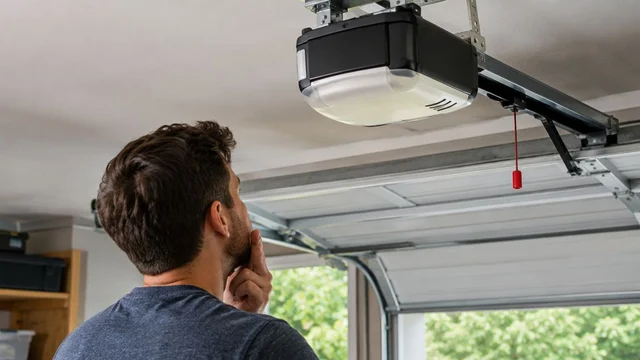
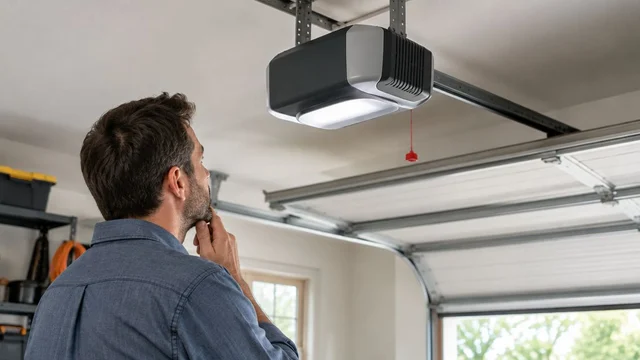
A direct drive garage door opener moves the door using a motor that travels along an overhead rail, rather than a stationary motor pulling a moving belt or chain. This design reduces drive-system noise, but it still needs overhead clearance, a compatible door and properly working springs—it is not the same as a wall-mounted jackshaft opener.
TL;DR
- A direct drive garage door opener uses a traveling motor in its common overhead-rail design.
- Direct drive suits noise-conscious homeowners, but it does not eliminate roller, hinge or door noise.
- Direct drive and wall-mounted jackshaft openers are different mechanisms; check the installation drawing before choosing.
- Derby Strong provides garage door opener service; door condition and installation fit should guide your choice.
What is a direct drive garage door opener?
In the common residential direct-drive design, the motor travels along a fixed chain inside an overhead rail. A connecting arm transfers that movement to the garage door. The chain stays stationary instead of circulating through the rail as it does on a conventional chain-drive opener.
The key distinction is what moves: the motor travels, rather than a belt or chain pulling a trolley. That difference explains the design, but it does not establish whether a particular opener fits your garage.
For a broader look at the alternatives, use this garage door opener comparison alongside the exact model’s installation manual.
| Opener type | How it moves the door | Best for | Main advantage | Main limitation |
|---|---|---|---|---|
| Rail-mounted direct drive | A traveling motor follows a fixed chain and moves the door through an arm | Homeowners prioritizing reduced drive-system noise | Avoids a circulating drive belt or chain | Still occupies overhead rail space |
| Belt drive | A stationary motor moves a belt attached to a trolley | Homeowners seeking quiet operation with a conventional ceiling-mounted layout | Reduces chain-related operating noise | Still uses a moving belt and overhead rail |
| Chain drive | A stationary motor moves a chain attached to a trolley | Garages where chain noise is not the deciding concern | Uses a familiar rail-and-trolley mechanism | Chain movement adds operating noise |
| Wall-mounted jackshaft | A motor beside the door turns a compatible torsion shaft | Garages where removing the central opener rail matters | Leaves the central ceiling area clear of an opener rail | Requires compatible door hardware and side clearance |
Why this matters before you replace an opener
The wrong terminology leads to the wrong expectations. If you want an open ceiling for storage, a rail-mounted direct-drive opener does not solve that problem simply because its motor works differently.
If you want less noise in an attached garage, direct drive deserves consideration. But a scraping track, damaged roller or poorly balanced door still needs repair. A quieter opener cannot make a damaged door safe.
For a Louisville homeowner choosing an opener, the useful question is not just which drive sounds quietest. It is whether the proposed unit fits the existing door, ceiling layout and household’s daily use.
How does a direct-drive mechanism work?
Think of the system as a rail, a traveling motor and a connecting arm. These parts move the door together; the springs remain responsible for counterbalancing its weight.
The operating sequence is straightforward:
- Motor travels. When you activate the opener, the motor assembly moves along the stationary chain within the rail.
- Arm transfers movement. The connecting arm transfers the motor assembly’s travel to the door’s reinforced attachment point.
- Door follows tracks. The garage door moves through its tracks while the counterbalance system supports its weight.
The motor reverses direction to move the door the other way. Travel limits and the opener’s safety systems govern operation according to the model’s design and setup.
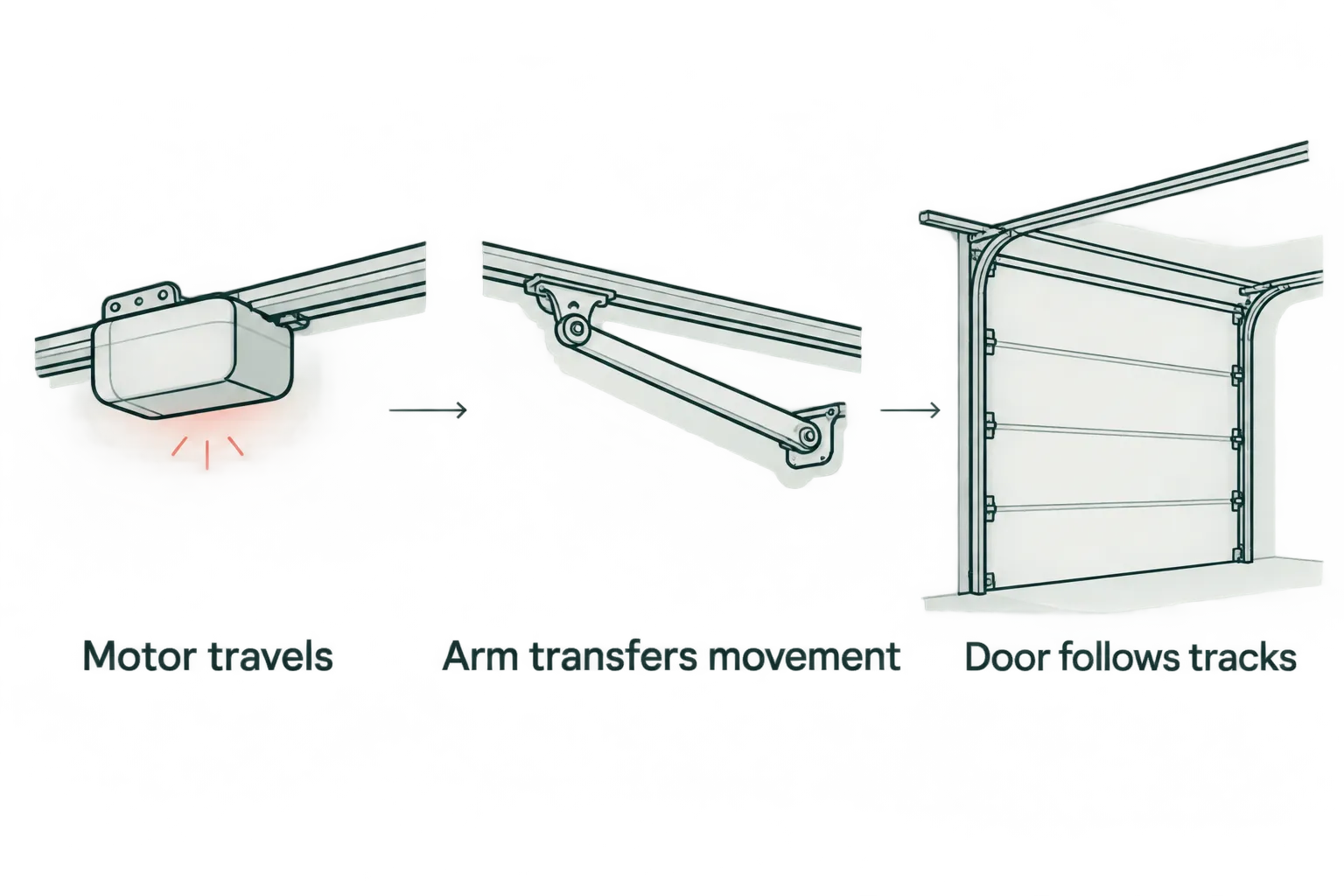
The opener moves the door; the spring system counterbalances its weight.
A direct-drive opener does not replace springs, cables or tracks. It depends on those components working correctly. An installer should evaluate the complete door system before attaching a replacement opener.
Is direct drive the same as a wall-mounted opener?
No. A traveling-motor direct-drive opener and a wall-mounted jackshaft opener use different layouts. The rail-mounted design sits overhead; the jackshaft design mounts beside a compatible door and turns its torsion shaft.
Terminology in product listings is not always consistent. Check the installation drawing rather than relying on the words “direct drive” alone. Look for the motor’s location, whether a central rail is shown and how the opener connects to the door.
Rail-mounted direct drive: best for reducing drive-system noise
A rail-mounted direct-drive opener is worth considering when operating noise matters and the garage can accommodate an overhead rail. Its mechanism avoids a moving belt or circulating drive chain.
The trade-off is space. The rail still runs back into the garage, so ceiling storage, lighting and other obstructions need attention during planning. Quiet operation also depends on the door’s condition and the installation.
Wall-mounted jackshaft: best for clearing the central ceiling
A wall-mounted jackshaft opener addresses a different problem: removing the central opener rail. That makes the layout relevant when overhead space is the priority.
Compatibility is the constraint. A professional must confirm the door, torsion shaft, available side space and manufacturer requirements before recommending this arrangement. A wall-mounted unit is not a universal substitute for a ceiling-mounted opener.
Why direct-drive performance varies
Drive type explains the mechanism, not the finished result. These factors determine whether a direct-drive installation meets your expectations:
- Door balance and mechanical condition. Damaged rollers, binding tracks and counterbalance faults affect operation regardless of the opener type.
- Door dimensions and construction. The exact model must support the door’s size, construction and specified operating requirements.
- Rail fit and mounting. The installation needs the clearances, rail arrangement and structural attachment required by the manufacturer.
- Vibration paths. Mounting and surrounding building materials affect how operating vibration reaches occupied rooms.
- Controls and accessories. Battery backup, vehicle controls, wireless features and other functions depend on the exact model—not the drive label.
- Maintenance requirements. The opener manual and door-hardware instructions determine the required care. Direct drive does not mean maintenance-free.
Ask for these points to be checked before choosing a unit. Comparing mechanisms without checking the garage leaves the most important installation questions unanswered.
Is a direct drive garage door opener quieter than belt drive?
A direct drive garage door opener can reduce drive-system noise, but the mechanism alone does not prove that it is quieter than every belt-drive opener. Model design, mounting, door hardware and the building all affect what you hear.
Separate opener noise from door noise. Motor or drive noise comes from the operator system; squeaks, scraping and rattling also come from hinges, rollers, tracks or panels. Changing the opener leaves those mechanical sources in place unless they receive attention too.
For a bedroom near the garage, ask the installer to evaluate vibration as well as sound. A product’s quiet-operation claim does not describe how every door and building combination will behave.
Can you keep your existing garage door with direct drive?
You can keep an existing garage door if it is sound, compatible with the selected opener and correctly balanced. An opener upgrade does not automatically require a new door.
The inspection should cover the door’s attachment reinforcement, travel, hardware condition and the proposed opener’s requirements. A door that binds, sits crooked or has damaged sections needs that problem addressed before powered operation resumes.
Do not choose a stronger opener to overcome a heavy or sticking door. Spring, cable, track, bracket and other high-tension repairs belong to a trained garage door professional. Do not increase opener force to push through a fault.
How do you know whether direct drive fits your garage?
Start with observations you can make safely from the floor. You do not need to loosen hardware, disconnect a raised door or climb beside the spring assembly to prepare for an assessment.
Record these details for the installer:
- Existing equipment: Photograph the opener’s model label if you can do so without climbing or reaching near moving parts.
- Ceiling layout: Note storage racks, beams, lights or other items around the existing opener rail.
- Door behavior: Describe scraping, shaking, reversing or uneven movement you have already observed. Do not repeatedly cycle a faulty door.
- Control needs: Identify the remotes, wall controls and vehicle controls you want checked for compatibility.
- Noise concern: Explain where the sound is disruptive and whether it occurs throughout travel or at a particular point.
Derby Strong provides garage door opener service in Louisville. An assessment should establish whether the existing door needs repair, whether the proposed rail fits and whether the replacement provides the controls you actually need.
Discuss your opener replacement
Ask about door condition, installation fit and controls before choosing a drive type.
What should you confirm before approving installation?
Ask for the exact manufacturer and model designation, not just a drive-type description. Use the current installation manual and product documentation to confirm the proposed configuration.
A useful written scope identifies the opener and rail, installation work, included controls and any separate door repairs. It should distinguish features included with the selected unit from accessories that require additional equipment.
Also establish how the installer will demonstrate normal operation, emergency release use and the manufacturer’s safety checks. Keep the operating manual where you can find it after installation. An unfamiliar safety procedure is a reason to ask for a demonstration, not to improvise.
Frequently Asked Questions
Does a direct drive garage door opener have a chain?
The common traveling-motor direct-drive design uses a stationary chain inside its overhead rail. Unlike a conventional chain-drive opener, the chain does not circulate to pull a trolley.
Is a direct drive garage door opener better than belt drive?
Direct drive is not automatically better than belt drive. Compare the exact models, installation fit, documented features and door condition rather than choosing by drive name alone.
Will a direct-drive opener get rid of garage door rattling?
A direct-drive opener does not eliminate rattling caused by door hardware or damaged components. Have the noise source identified before replacing an otherwise working opener.
Does a direct-drive opener need an overhead rail?
The common traveling-motor direct-drive design needs an overhead rail. If your goal is to remove that rail, ask about a compatible wall-mounted jackshaft arrangement instead.
Can I install direct drive on a door with a broken spring?
A broken spring needs professional repair before powered door operation resumes. Do not use a replacement opener to lift through the fault or attempt spring adjustments yourself.
Does direct drive automatically include battery backup and phone control?
Direct drive does not automatically include battery backup or phone control. Those features depend on the exact model and its documented accessory requirements.
Can a residential direct-drive opener operate a commercial overhead door?
A residential direct-drive opener is not automatically suitable for a commercial overhead door. A commercial installation needs an operator selected for the door and its operating requirements.
Can Derby Strong help assess an existing garage door opener?
Derby Strong provides garage door opener service. Explain the current symptoms and whether your priority is quieter operation, replacement of a failed unit or a different installation layout.
One Last Thing Before You Decide
Check the installation drawing before deciding what “direct drive” means for your garage. The simplest test is visual: does the drawing show a traveling motor on an overhead rail, or a motor beside the torsion shaft?
That distinction prevents a common mismatch between the product and the problem. For less drive-system noise, evaluate the rail-mounted mechanism. For central ceiling clearance, investigate a compatible wall-mounted layout. For a noisy or struggling door, diagnose the door before buying either.
Related Garage Door Guides
- Garage door opener drive types ranked by noise level
- Best quiet garage door openers for attached garages in Louisville
- Garage door parts names
Local service: Garage door repair in Louisville · Garage door repair in Lexington · Garage door repair in Northern Kentucky