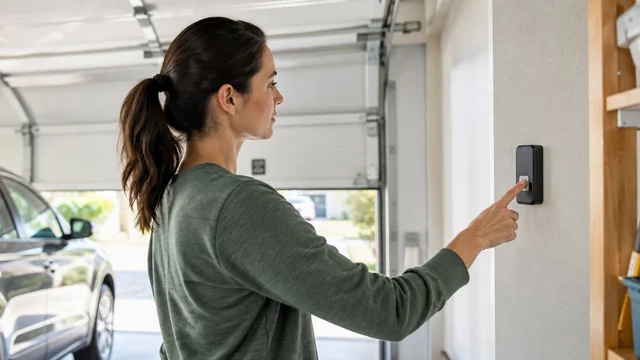
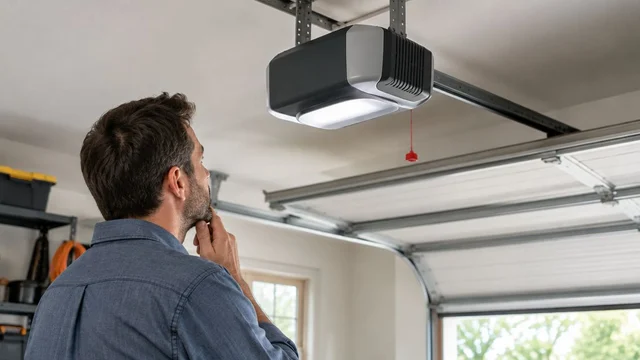
A Genie garage door opener that is not working needs a symptom-based check: compare the wall button with the remote, confirm accessible power, and observe whether the door refuses to open, refuses to close, or starts and stops. A blocked safety sensor or remote problem needs a different response from a damaged spring, loose cable, or stalled drive; stop operating the door if it is crooked, damaged, or struggling to lift.
TL;DR
- Genie garage door opener not working? Compare wall-button and remote responses before resetting or replacing anything.
- A door that opens but refuses to close needs different checks from an opener with no power.
- Genie sensor-light meanings and programming instructions depend on the exact opener model.
- Stop testing when a door hangs crooked, cables look loose, or the motor hums without lifting.
Why This Matters for Your Door
An opener symptom does not prove the opener itself has failed. The door, its lifting hardware, the electrical supply, and the controls all affect what happens when you press the button.
For Louisville homeowners, the practical first question is whether the failure affects every control or only one. If the wall button operates the door normally but the handheld transmitter does nothing, start with the garage door remote troubleshooting guide rather than assuming you need another motor.
Observe first. Change one thing at a time. Repeated programming attempts, force adjustments, and test cycles make diagnosis harder and can put a damaged door back into motion.
Why is your Genie garage door opener not working?
Separate the symptom into a power problem, a control problem, a closing-safety problem, or a mechanical problem. These observations narrow the investigation; they do not establish which replacement part you need.
| What you observe | What to investigate | Safe next move |
|---|---|---|
| Neither control produces a response | Power supply, control wiring, or opener electronics | Check accessible power and record any lights |
| Wall button works; remote does not | Remote battery, programming, or wireless lock setting | Check the remote and model-specific manual |
| Remote works; wall button does not | Wall control or its wiring | Report the difference; leave wiring tests to a professional |
| Door opens but refuses to close | Obstructed safety beam, sensor fault, or door resistance | Remove loose objects and inspect from outside the opening |
| Motor runs but door stays still | Disconnected carriage or drive-system fault | Observe without pulling the release or touching moving parts |
| Motor hums and the door barely moves | Mechanical resistance, lifting-hardware damage, or motor fault | Stop cycling the opener |
| Door closes, then immediately reopens | Floor obstruction, travel setting, or mechanical resistance | Clear loose objects; do not increase closing force |
A working light on the motor housing does not establish that the motor or door mechanism is healthy. Likewise, a lit remote indicator does not establish that its signal reaches the opener.
What can you safely check before scheduling repair?
Work from outside the door’s path. If the door is partly open, hanging unevenly, or visibly damaged, skip these checks and keep people away from the opening.
Compare the controls
With a clear view of an undamaged door, note whether the wall button and remote produce the same response. Record silence, clicking, humming, light activity, and any movement.
Do not keep pressing buttons to reproduce a grinding sound. One clear description is more useful than repeated attempts that strain the mechanism.
Check accessible power
Look for an unplugged power cord without climbing onto the door, tracks, or unstable storage. If the receptacle is safely reachable, dry, and undamaged, a working lamp can help establish whether it supplies power.
A nearby GFCI receptacle can affect a garage circuit. Reset it only if you can do so safely and there is no sign of moisture or damage; if it trips again, stop and have the electrical fault assessed. Never remove outlet covers or probe wiring.
Check the remote battery and lock setting
Use the battery type and installation method specified for your remote. Keep small batteries away from children, and inspect the battery compartment for visible corrosion without scraping or modifying its contacts.
Some wall consoles have a lock feature that restricts remote operation. Check your exact Genie manual before changing settings; console designs and button sequences differ. Do not erase all stored transmitters just to investigate one unresponsive remote.
Record the result
Write down which control works, whether the door moves, and which lights change. A symptom that occurs only during closing belongs in a different diagnostic path from complete silence.
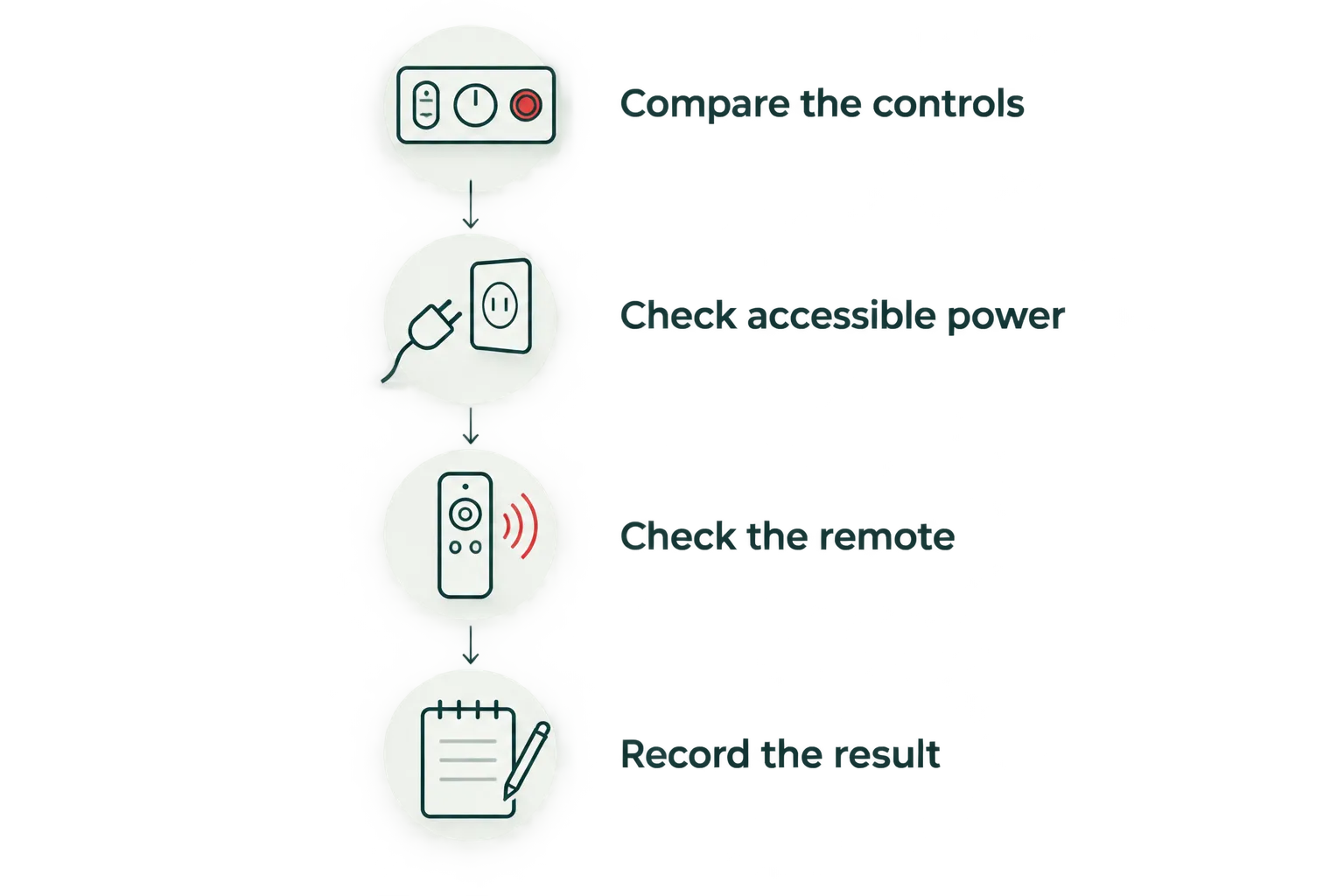
Compare responses before changing programming or settings.
Why does the Genie opener open the door but not close it?
A closing-only failure directs attention toward the safety sensors, their wiring, an obstruction, or resistance during downward travel. It does not automatically mean the motor has failed.
From a safe position, look for a storage bin, broom, debris, or another object interrupting the beam near the floor. Gently clean exposed sensor lenses with a soft cloth, without loosening mounts or handling damaged wires.
Do not bypass the sensors or treat holding a control button as a repair. If the door closes only under an override procedure, the underlying fault still needs attention.
Sensor-light colors and flashing patterns must be interpreted using the manual for the exact opener and sensor system. A generic online chart can send you toward the wrong repair when it describes different equipment.
Why does the motor hum without lifting the door?
Humming without normal lifting is a stop signal, not a reason to press the button again. The opener can be trying to move a door that has a mechanical fault, or the fault can be inside the opener’s drive or motor assembly.
From the floor, look for a crooked bottom edge, a visibly separated spring, loose cable, displaced roller, or bent track. Do not touch these components or attempt to put them back into position.
A moving carriage with a stationary door is a different observation from a motor that hums while nothing moves. Report that distinction, but leave carriage reconnection and drive inspection to the technician when the door’s condition is uncertain.
Never pull the emergency release on a raised or suspect door. A door with damaged lifting hardware can fall when disconnected from the opener.
Why the same Genie symptom can have different causes
The exact equipment and the point where operation stops determine the next diagnostic step:
- Control involved: A remote-only failure points toward a different investigation from failure at every control.
- Direction of travel: Closing-only problems bring safety protection and downward resistance into focus.
- Door condition: Damaged springs, cables, rollers, or tracks can make a functioning opener appear defective.
- Model and console: Programming sequences, indicators, and lock controls differ between systems.
- Recent changes: A power interruption, new remote, moved storage, or impact provides context without proving the cause.
- Repeatability: An intermittent fault needs a record of when it happens, not a guessed replacement part.
Avoid changing several settings together. If operation changes afterward, you need to know which action produced the change.
Should you reset a Genie garage door opener that stopped working?
Do not use a factory reset as the first troubleshooting step. Identify the model and read its instructions before using any reset or programming procedure.
A reset cannot repair a broken spring, damaged cable, obstructed beam, or failed electrical component. Depending on the procedure, clearing memory can also require you to program controls again.
Photograph the model label and indicators from a safe position before changing anything. Distinguish restoring power from erasing transmitter memory or relearning travel; those are separate actions, not interchangeable meanings of reset.
Should you repair or replace a Genie opener that is not working?
Diagnose the door and opener before choosing replacement. A control fault does not establish that the motor needs replacement, and a new motor does not correct damaged door hardware.
| Approach | Best for | Benefit | Limitation |
|---|---|---|---|
| Correct a battery, obstruction, or documented setting issue | A confirmed, homeowner-safe cause | Addresses the identified problem without replacing the opener | Does not resolve damaged wiring or mechanical faults |
| Professional opener repair | A diagnosed fault with a suitable repair path | Keeps a serviceable opener in use | Depends on component condition and compatible parts |
| Opener replacement | A professionally assessed system without a suitable repair path | Replaces the defective opener assembly | Does not repair the door’s springs, cables, or tracks |
Comparing replacement garage door openers makes sense after diagnosis establishes that replacement is appropriate; compatibility with your door and installation space matters more than a general product ranking.
Ask the technician to explain the failed component, the door’s condition, and what each proposed option actually fixes. If replacement is recommended, request the reason a repair is unsuitable rather than accepting age alone as the explanation.
How do you check safety after the problem is corrected?
Restored movement is not the same as confirmed safe operation. Once the fault is corrected and the door is mechanically sound, follow the exact manufacturer instructions for testing obstruction protection and reversal.
For residential photoelectric protection, U.S. Consumer Product Safety Commission guidance places the beam no higher than 6 inches above the floor. Do not move a sensor upward to avoid an obstruction.
The familiar contact-reversal test uses an object 1.5 inches high, commonly a 2-by-4-inch board laid flat. The board’s nominal size and actual thickness are different, which explains those measurements. Follow the opener manual’s procedure rather than improvising a test.
Do not conduct movement tests on a damaged, crooked, or binding door. If safety protection does not perform as specified, stop automatic operation and arrange service; increasing force is not a substitute for correcting the fault.
What should you prepare for a Louisville opener service visit?
Derby Strong is a garage door service option for Louisville homeowners who need professional opener diagnosis. Professional service is the right next step for suspect lifting hardware, damaged wiring, repeated stalling, or a fault that remains after safe checks; an accessible remote-battery change does not need to become a motor-replacement decision.
Before requesting garage door service, gather these details without dismantling anything:
- The Genie opener model and the remote or wall-console model, if accessible.
- Which controls respond and which do not.
- Whether the failure occurs during opening, closing, or both.
- A description of indicator lights, sounds, and the stopping position.
- Any recent power interruption, impact, or programming change.
Clear movable storage from the approach, but do not stand beneath a partly open door to do it. Keep children and pets away, leave damaged components untouched, and tell the service provider if a vehicle is trapped rather than forcing the door open.
Frequently Asked Questions
Why is my Genie garage door opener not working even though the light comes on?
A working opener light does not prove that the motor, controls, or door mechanism is functioning. Compare control responses and stop testing if the motor hums, the door strains, or lifting hardware looks damaged.
Why does my Genie wall button work but my remote does not?
A working wall button with an unresponsive remote directs the check toward the remote battery, programming, wireless lock setting, or signal path. Follow the instructions for your exact remote and console before clearing memory.
Why does my Genie opener click but the door does not move?
Clicking without movement does not identify a single failed component. Record whether it happens with every control and have the opener and door inspected if accessible power checks do not explain the problem.
Can I bypass Genie garage door safety sensors?
Do not bypass garage door safety sensors. Remove loose obstructions, gently clean accessible lenses, and arrange repair if the system still prevents normal closing.
Does unplugging a Genie opener erase the remotes?
Unplugging the opener and deliberately clearing transmitter memory are different actions. Consult your model’s manual before attempting a reset or repeating programming procedures.
Can I pull the emergency release if my Genie opener will not lift the door?
Do not pull the emergency release when the door is raised, damaged, crooked, or suspected of having a broken spring or cable. A door with failed lifting hardware can fall when disconnected.
Does a Genie opener that stopped working need to be replaced?
An opener that stops working does not automatically need replacement. Confirm whether the fault is in the controls, electrical supply, safety system, door hardware, or opener before choosing repair or replacement.
One Last Thing Before You Decide
Record the indicator pattern before touching the programming buttons. A short video taken from a safe position can preserve a flashing sequence or unusual sound that disappears later. Do not trigger another cycle just to capture it if the door is damaged or struggling.
The best service description is specific: which control you used, what the opener did, and where the door stopped. That gives the technician a clearer starting point than “the motor is broken.”
Related Garage Door Guides
- How do you reset a garage door opener after a power outage?
- Why is the garage door wall button not working?
- Garage door maintenance checklist
Local service: Garage door repair in Louisville · Garage door repair in Lexington · Garage door repair in Northern Kentucky