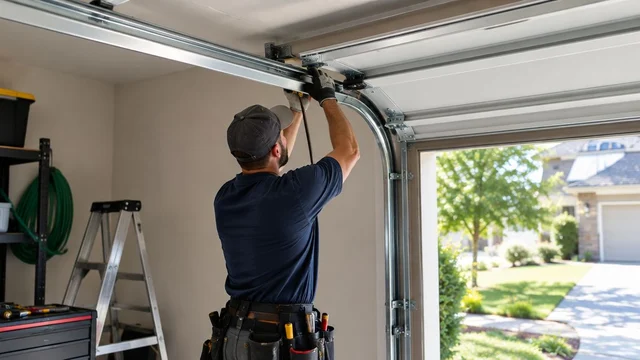
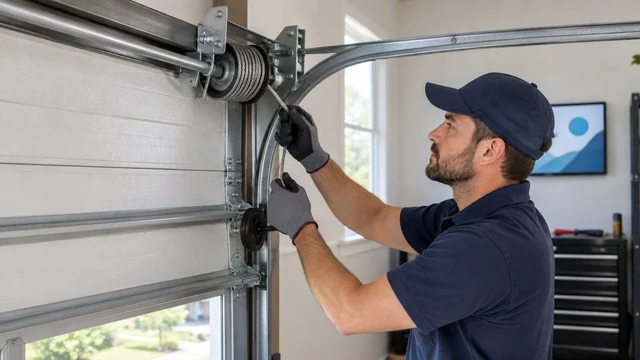
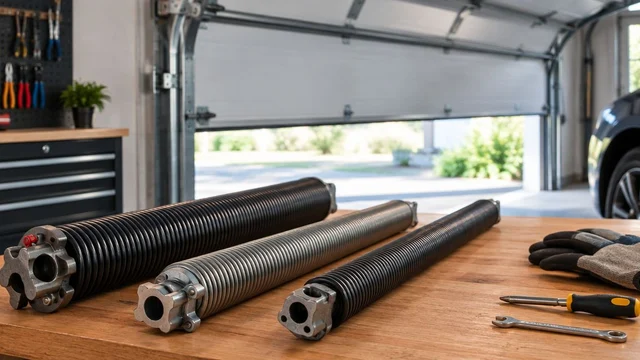
A visible break in the spring coil is the clearest sign of a broken garage door spring in Nicholasville, KY; a sudden bang followed by a door that will not lift is another strong warning. A crooked door, loose cable or straining opener can also indicate a lifting-system fault, so stop operating the door and arrange professional inspection rather than testing it repeatedly.
TL;DR
- Signs of a broken garage door spring in Nicholasville, KY include a separated coil and sudden lifting failure.
- A loud bang alone does not confirm spring failure; visible damage and door behavior help identify the problem.
- Keep a damaged door out of use, and never adjust springs, cables or bottom brackets yourself.
- Derby Strong provides garage door repair in Lexington; confirm appointment coverage for your Nicholasville address.
How do you know if a garage door spring is broken in Nicholasville, KY?
Look for an actual separation in the spring, without touching the hardware or moving the door. Other symptoms help explain the failure, but they do not establish which component broke. When contacting Derby Strong about garage door repair, describe what happened and confirm appointment coverage for your Nicholasville address.
| What you notice | What it tells you | What to do |
|---|---|---|
| A clear break across a torsion spring coil | The spring has fractured | Leave the door out of use |
| A hanging or visibly separated extension spring | Spring damage is present | Stay away from the spring and cable assembly |
| A bang followed by sudden failure to open | A spring failure is possible | Report the sequence without repeating it |
| The opener strains or stops lifting | The lifting system or opener needs diagnosis | Stop pressing the control |
| The door hangs crooked or a cable is loose | The door has a potentially unstable lifting fault | Keep people clear and request professional assessment |
| The door only refuses to close | This symptom alone does not establish spring failure | Report any sensor lights or obstructions you already noticed |
A door can have more than one fault. A broken spring does not rule out damaged cables, and an opener problem does not prove the springs are sound.
Why This Matters for Your Door
Garage door springs counterbalance the door’s weight. The opener moves a properly balanced door; it is not a substitute for the counterbalance system.
When a spring breaks, continuing to run the opener can place extra strain on the opener and door hardware. Treat sudden lifting failure as a mechanical problem until a professional identifies the cause. Buying a remote, resetting the opener or increasing its force does not repair a broken spring.
For a Nicholasville homeowner, the immediate decision is whether the door can remain safely out of use while service is arranged. A closed door and a partially open, crooked door require different precautions.
What does a broken spring look like?
On a common torsion-spring system, a coiled spring sits on a shaft above the door opening. A broken spring often has an obvious separation between the fractured ends. You can sometimes see that separation from the garage floor with the door closed.
Do not confuse a break across the spring with ordinary spaces between coils. If the spring is enclosed, obscured or difficult to see, leave the diagnosis to a technician. Not seeing a gap does not establish that the spring is intact.
Extension springs typically run beside the horizontal tracks. A broken spring can look separated, stretched out of position or hanging, but do not approach it to improve your view. Stay away from loose cables and displaced hardware.
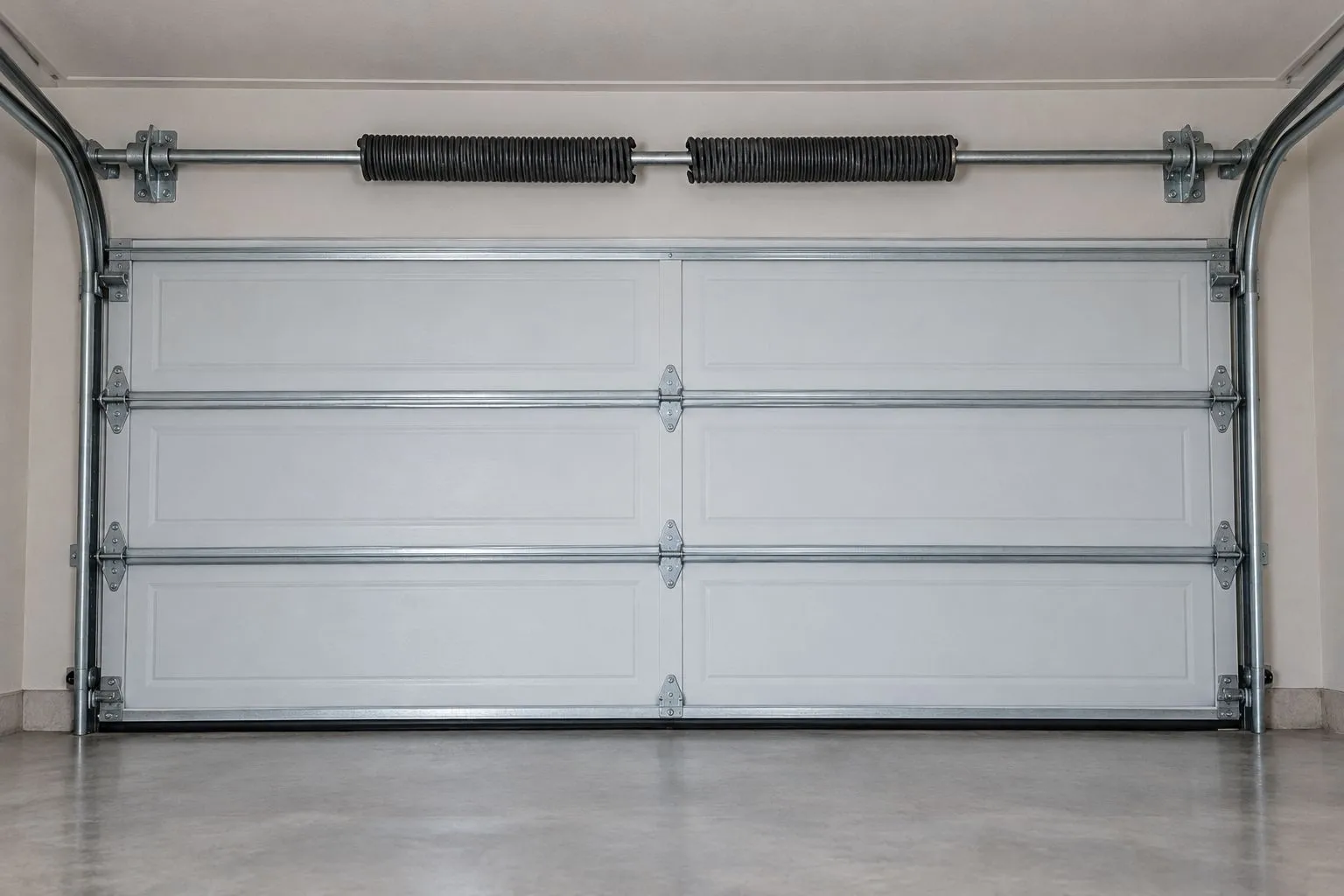
Illustrative image, not a Derby Strong project: a visible spring separation is a reason to stop using the door.
Photograph visible damage only from a safe standing position. Do not use a ladder, reach over the door or move stored items beneath an unstable door to get a better picture.
What other symptoms support a broken-spring diagnosis?
A sharp bang from the garage, followed immediately by lifting failure, is useful information for a technician. The sequence matters more than the sound alone. An impact or another component failure can also produce a loud noise.
An opener that hums, strains or starts moving the door before stopping also needs attention. Those symptoms are not permission to keep testing. Report what happened during the original failure rather than creating another cycle for a recording.
A door that suddenly feels much heavier during ordinary manual use is another warning. Do not deliberately disconnect and lift a suspect door to check its weight. A professional can assess its balance under controlled conditions.
Scraping, jerking and uneven travel can involve tracks, rollers, cables or several components together. Keep those observations separate when describing the problem instead of labeling every lifting fault a broken spring.
Does your door have torsion springs or extension springs?
Spring layout changes where you look, not whether a damaged system is safe to handle. Identify the arrangement from the floor if it is plainly visible; you do not need to identify a spring type before requesting service.
| Spring arrangement | Typical visible location | Useful observation | Limit of a visual check |
|---|---|---|---|
| Torsion springs | On a shaft above the opening | A break across the coil | Enclosed or obscured springs can hide damage |
| Extension springs | Beside the horizontal tracks | A separated or displaced spring | Cables and other hardware can complicate the failure |
Both arrangements store mechanical energy. Neither is a homeowner repair simply because the damaged part is easy to see.
Avoid ordering a replacement from appearance alone. The correct spring depends on the door and its counterbalance requirements, not just the general location of the old spring. Spring selection, installation and tension adjustment belong with the repair professional.
Why do broken-spring symptoms vary?
A failed spring does not make every garage door behave identically. These factors change what you notice:
- Spring arrangement: Torsion and extension systems place the damaged component in different locations.
- Remaining spring support: A system with another intact spring can behave differently from one with no remaining spring support. It is still unsafe to operate.
- Door position: A failure while the door is raised creates a different immediate hazard from a failure with the door fully closed.
- Cable condition: A displaced or damaged cable can add crooked movement or slack to the symptoms.
- Opener response: The opener can stop, strain or display a fault without identifying the failed mechanical component.
- Other damage: Track, roller or panel damage can accompany the spring problem and affect movement.
The absence of a dramatic bang or an obvious gap does not clear the door for use. Sudden changes in lifting behavior still require inspection.
What should you do after noticing a suspected broken spring?
Use this sequence to protect people and preserve useful information. These are observation and preparation steps, not repair instructions.
- Stop operation. Stop using the wall control, remote, keypad and app. Tell everyone who uses the garage that the door is out of service.
- Keep clear. Keep children, pets and vehicles away from the opening. Never walk or drive beneath a raised door with suspected spring or cable damage.
- Observe safely. From a stable floor position outside the door’s travel path, note its position and any visible spring separation, loose cable or crooked section.
- Arrange service. Describe the failure, whether the door is closed or raised, and whether the garage provides your only practical access.
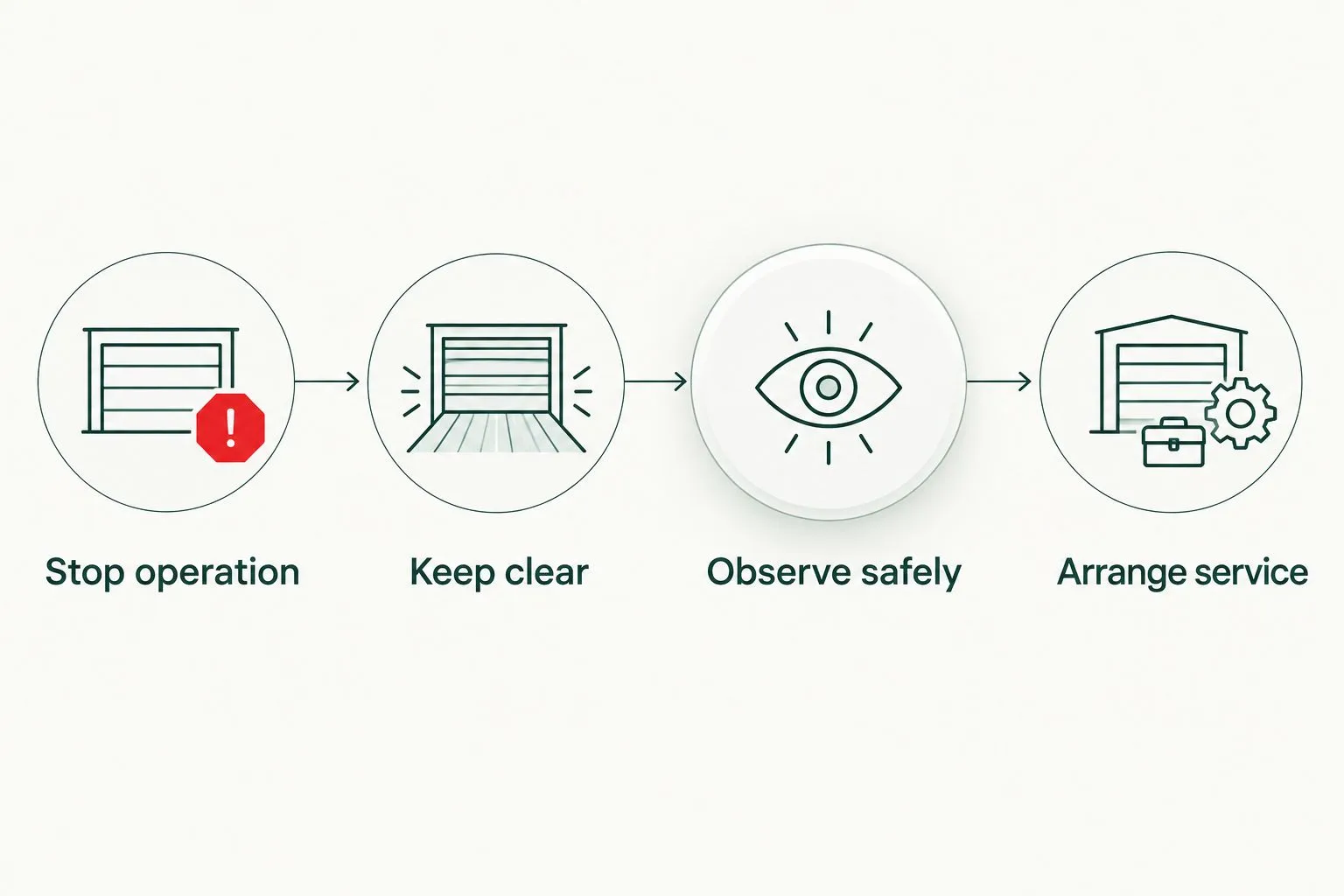
Observe from a safe position; leave lifting-system repairs to a professional.
If the door is fully closed, leave it closed. If it is raised, partly open or crooked, do not attempt to lower it, prop it up or pull the emergency release. Keep the area clear and tell the repair provider about its position before the visit.
What should a Nicholasville homeowner tell the repair provider?
Start with the exact service address and confirm that the provider accepts appointments there. A nearby city listed on a company’s website does not establish coverage for every address. Derby Strong lists Lexington among its service markets; confirm your Nicholasville appointment directly.
Then describe the failure in plain language. Useful details include whether you heard a bang, whether the door stopped while opening or closing, and whether it is level now. Mention a trapped vehicle without attempting to retrieve it through an unstable opening.
Send photos only if you can take them without approaching damaged hardware. A wide view of the closed door and a separate view of visible damage can help explain the situation. Photos support preparation; they do not replace inspection.
Ask the repair provider to assess the spring system, cables and door movement together. Before authorizing additional parts, ask what damage or wear makes each proposed replacement necessary. That keeps a spring-repair visit focused on the actual fault rather than an automatic opener or whole-door replacement.
Does a broken spring mean you need a new garage door?
A broken spring alone does not establish that you need a new garage door. If the door sections and supporting hardware remain serviceable, spring repair can address the failed component. Significant panel damage or other structural problems require a broader assessment.
| Decision | Best for | Benefit | Limitation |
|---|---|---|---|
| Spring-system repair | A serviceable door with a confirmed spring fault | Addresses the failed lifting component | Does not resolve unrelated panel or opener damage |
| Broader hardware repair | A door with additional confirmed cable, roller or track faults | Addresses related mechanical problems | Requires inspection to define the necessary work |
| Door replacement assessment | A door with substantial damage or broader replacement needs | Evaluates the condition of the complete door | A spring failure alone is not sufficient justification |
Ask for the reason behind the recommendation. A clear explanation should distinguish the failed spring from other confirmed defects and identify which work is necessary for safe operation.
Can the opener still lift a door with a broken spring?
An opener can sometimes move a door despite a broken spring, but movement does not establish safety. The remaining spring support, door weight and opener response affect what happens.
Do not use successful movement as a diagnostic test. Stop operating the door when you suspect spring failure, even if it still opens. A stronger opener or a higher force setting does not correct the counterbalance fault.
Should you pull the emergency release if a spring is broken?
Do not pull the emergency release on a raised or partially open door with suspected spring damage. Disconnecting the opener can remove a restraint from a door that lacks proper counterbalance.
A closed door is not an invitation to perform a lifting test either. Leave it closed and let the technician decide how to disconnect, support and inspect the system safely. Use another exit rather than forcing the garage door open.
Frequently Asked Questions
What is the clearest sign that my garage door spring is broken?
A visible fracture separating the spring coil is the clearest sign of a broken spring. Observe it from the floor without touching the hardware or moving the door.
Can a garage door spring break without making a loud bang?
You do not have to hear a bang for a spring to be broken. A visible fracture or sudden lifting failure still requires professional inspection.
Does a loose garage door cable mean the spring is broken?
A loose cable does not prove that the spring is broken. Cable displacement, spring failure and other lifting-system faults require professional diagnosis, and the door should remain out of use.
Can I open my garage door manually after a spring breaks?
Do not attempt to lift a door with a suspected broken spring. The door lacks proper counterbalance and can be difficult to control, especially if cables or other hardware are also damaged.
Should I replace my opener if the door stopped lifting?
Do not replace the opener solely because the door stopped lifting. A technician should check the spring system and other mechanical components before identifying the opener as the cause.
What should I do if my car is trapped behind the garage door?
Leave the damaged door out of use and tell the repair provider that a vehicle is trapped. Do not force the door, pull the release on a raised door or work on springs and cables to retrieve the vehicle.
Can I book Derby Strong for a spring problem in Nicholasville?
Confirm appointment coverage for your Nicholasville address directly with Derby Strong. The company lists garage door repair and Lexington service among its offerings, but you should verify the specific address before arranging a visit.
One Last Thing Before You Decide
The opener can be the messenger rather than the failed part. A motor that strains immediately after a bang deserves a mechanical inspection, not an automatic opener replacement.
Tell the technician what happened first, what happened next and where the door stopped. That sequence is more useful than repeatedly pressing the control to demonstrate the problem.