Check your garage door manufacturer’s maintenance schedule; every 6 months is a common lubrication interval, but your door’s instructions take priority. Use the specified garage-door lubricant only on approved moving parts—not the tracks, belt, sensors, or sealed bearings. Lubrication reduces friction; it does not repair a broken spring, loose cable, bent track, or worn roller.
TL;DR
- How to lubricate garage door hardware: follow the manufacturer’s lubrication points, product instructions, and maintenance schedule.
- Keep roller tracks clean, not greasy; sealed bearings and nylon roller surfaces need different treatment.
- Derby Strong provides garage door repair when noise comes with sticking, uneven movement, or damaged hardware.
- Stop operating a crooked or damaged door; lubricant is not a substitute for mechanical repair.
How often should you lubricate a garage door, and with what?
A 6-month reminder is a useful starting point, not permission to spray every moving component. Your door and opener have separate maintenance instructions. Read both before choosing a product or touching the hardware.
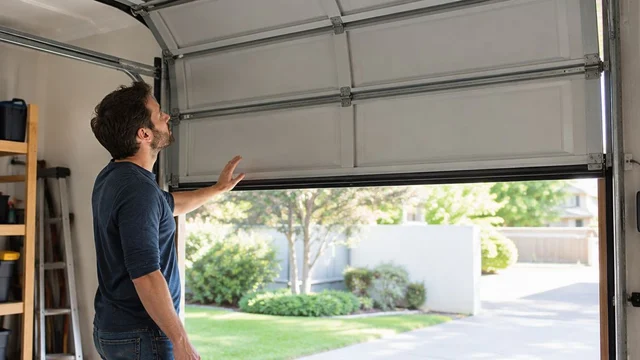
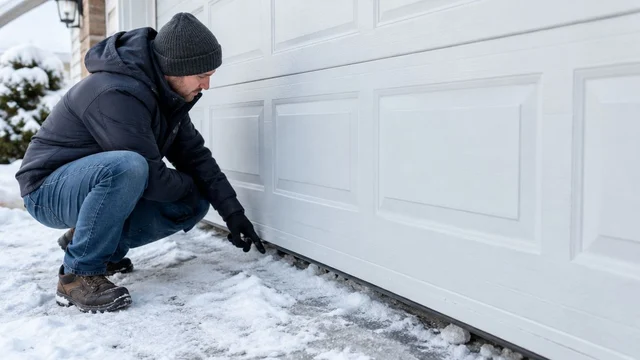
Use lubrication as one part of your garage door maintenance checklist. First inspect the closed door from a safe position. If the door sits crooked, a cable hangs loose, or a roller has left its track, stop there and arrange professional repair.
For an intact door that operates normally, follow this sequence:
- Identify the door and opener. Find their model information and maintenance instructions. The opener manual does not replace the door manual.
- Confirm the approved lubricant. Check both the required formulation and the surfaces where it belongs.
- Prepare safely. Close the door only if it operates normally, keep people clear, and isolate opener power as its manual directs, including battery backup where fitted.
- Clean accessible surfaces. Remove loose dirt with a cloth. Do not loosen hardware, reach into tight spaces, or move damaged parts.
- Apply a small amount. Treat only manufacturer-approved, safely accessible lubrication points. Wipe away excess.
- Check operation. Restore power and operate the door from its control only after tools and people are clear. Stop if it binds, jerks, or makes a new sound.
Do not release the opener to test a door that looks damaged or has a suspected spring or cable fault. A compromised door can move unexpectedly.
Why This Matters for Your Door
A squeak and a grinding noise are not the same maintenance problem. Dry contact surfaces sometimes need lubrication; a cracked roller, loose attachment, or misaligned track needs diagnosis.
The goal is smooth operation, not silence at any cost. Adding more lubricant can hide the sound temporarily without correcting its cause. A door that becomes quieter but still catches or tilts remains a repair concern.
For a Louisville homeowner, recording where the sound occurs is more useful than repeatedly spraying the whole assembly. Note whether it happens near the floor, through the curved track, or at the opener. Keep that observation for the service appointment.
What lubricant should you use on a garage door?
Choose by the door manufacturer’s specification, not by a can’s general promise to stop squeaks. A garage-door-specific silicone-based lubricant or white lithium lubricant can be appropriate where the relevant instructions permit it. Neither belongs everywhere.
| Option | Best for | Benefit | Limitation |
|---|---|---|---|
| Manufacturer-specified lubricant | A door or opener with a stated product requirement | Matches the equipment’s maintenance instructions | Still requires correct application points |
| Garage-door-specific silicone-based lubricant | Approved moving joints and compatible materials | Allows targeted application where permitted | The label must confirm suitability for the surface |
| White lithium lubricant | Exposed metal contact points where specified | Leaves a lubricating film on approved metal parts | Excess leaves residue; it is not a universal treatment |
| Penetrating or water-displacing spray | A specific task expressly allowed by the manufacturer | Serves the task identified on its label | It is not automatically a lasting garage door lubricant |
Best choice: the lubricant your equipment instructions approve for the exact component. Do not assume products with similar packaging have interchangeable formulas.
Read the application and ventilation directions, too. Keep spray away from ignition sources as the label requires, protect nearby surfaces, and avoid breathing aerosol mist. A narrow applicator helps control placement, but it does not make an unsafe location safe to reach.
Do not mix products simply because an earlier application failed to stop a noise. Identify the remaining symptom instead.
Which garage door parts should you lubricate?
The important distinction is between exposed friction points, sealed components, and surfaces that should stay clean. Identify the part before applying anything.
| Component | Normal maintenance approach | What to avoid |
|---|---|---|
| Accessible hinge pivots | Lubricate only where the door manual directs | Removing hinges or loosening fasteners |
| Exposed roller bearings | Treat only if the roller design and instructions allow it | Assuming every roller has serviceable bearings |
| Nylon roller wheels | Follow the roller manufacturer’s instructions | Coating the nylon rolling surface by default |
| Roller tracks | Wipe accessible dirt away without altering alignment | Filling the track channel with grease |
| Springs, cables, drums, and bottom brackets | Leave assessment and work to a garage door professional | Handling, adjusting, loosening, or repairing these parts |
| Opener rail or drive assembly | Follow the separate opener manual | Applying door lubricant to every drive type |
| Photo-eye sensors | Keep lenses clear using the manual’s cleaning method | Spraying lubricant on lenses or wiring |
An enclosed bearing is not an invitation to force lubricant past its seals. Likewise, a roller that wobbles or has a damaged wheel needs inspection rather than another coating.
If you cannot identify a component confidently, leave it alone. Safe maintenance does not require reaching every part of the door.
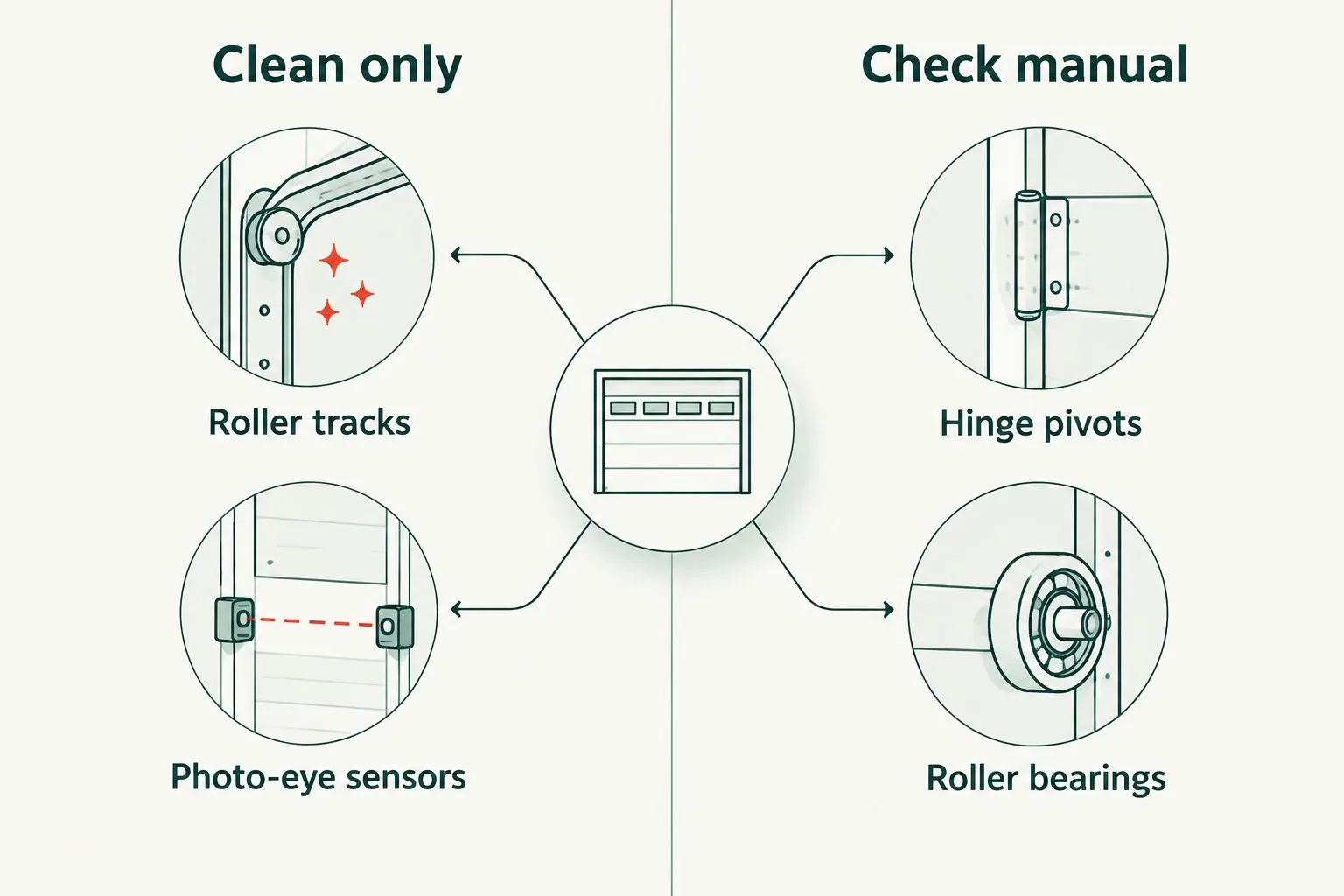
Clean tracks and sensor lenses; check the manual before lubricating hinges or bearings.
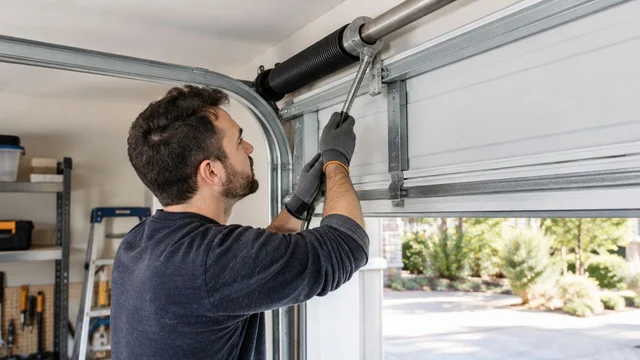
The same restraint applies overhead. Do not stretch from an unstable position to reach a lubrication point. If access requires working close to springs, cables, or an unsupported door, have a professional handle it.
Should you grease garage door tracks?
No—do not grease the channels where the rollers travel. Keep those channels free of dirt and buildup. Lubrication, when specified, belongs at the relevant moving joint or bearing rather than along the roller’s entire path.
Wipe only safely accessible track surfaces with the door stationary and opener power isolated as directed. Keep fingers away from roller contact points and panel joints. Do not bend the track or loosen its mounting hardware to improve access.
If the track already contains heavy grease or packed debris that you cannot remove safely, request service. A visibly bent track is also a repair issue, not a cleaning task.
Why lubrication needs vary
A calendar reminder helps you remember maintenance. These factors determine what the work actually involves:
- Manufacturer instructions. Door, roller, and opener designs have different lubrication points and exclusions.
- Operating frequency. A frequently used door deserves closer observation between scheduled maintenance checks.
- Component construction. Exposed bearings, sealed bearings, metal rollers, and nylon rollers do not share one treatment.
- Dust and residue. Dirty hardware needs appropriate cleaning before another product is applied.
- Exposure and condition. Moisture, visible corrosion, and deteriorated components call for inspection, not an automatic extra spray.
- Changes in movement. New scraping, uneven travel, or repeated stopping changes the next step from routine upkeep to diagnosis.
For a commercial overhead door, use its own maintenance requirements rather than copying a residential schedule. Keep a record of inspections, reported faults, and completed service so different operators do not repeatedly treat the same unresolved problem.
Why is your garage door still noisy after lubrication?
Persistent noise means you need to identify its source—not keep adding lubricant. Watch from a safe distance without touching the moving door, and stop operation when movement becomes abnormal.
| What you notice | What it tells you | Next move |
|---|---|---|
| A squeak at an approved pivot, with otherwise smooth travel | A lubrication point deserves attention | Follow the manual, then reassess |
| Clicking or rumbling near a roller | The roller or its attachment needs inspection | Arrange professional assessment |
| Scraping at one section of track | Contact or alignment needs checking | Stop repeated testing |
| Grinding from the opener housing | Door lubricant does not address the internal fault | Request opener diagnosis |
| A crooked door or loose cable | The lifting system has a mechanical problem | Stop using the door and keep people clear |
If the sound seems concentrated at the rollers, the guide to garage door rollers making noise in Louisville explains that distinct problem.
Never increase opener force to push through resistance. Do not loosen track brackets, adjust spring tension, or remove bottom brackets. Those actions go beyond homeowner lubrication and can expose stored tension or an unstable door.
Derby Strong garage door repair is for homeowners who need a mechanical fault assessed, not covered up with lubricant. The company provides garage door repair and opener service; routine lubrication does not establish whether a damaged component needs repair or replacement.
Arrange a garage door assessment
Describe the noise, where it occurs, and any change in door movement.
Can you lubricate a garage door opener too?
Only where the opener manufacturer directs. The door hardware and opener drive are separate systems, even though you hear them during the same opening cycle.
Do not spray a belt, electrical housing, circuit board, or motor through its vents. Chain and screw-drive maintenance also depends on the model; the presence of an exposed drive does not establish which lubricant it needs.
If the noise starts inside the opener housing, note whether the door moves normally or the motor runs without lifting it. Report that distinction rather than opening the housing or repeatedly running the motor.
When should you stop maintenance and call for repair?
Stop when you see a broken spring, slack cable, displaced roller, damaged bracket, crooked door, or bent track. Also stop when the door binds, drops, or changes direction unexpectedly.
Keep children, pets, and vehicles away from the opening. Do not pull the emergency release on an open or damaged door, stand beneath it, or try to support it yourself.
When contacting Derby Strong, describe what you observed without recreating the fault. A photo taken from a safe position and the door or opener model information help communicate the problem. Do not climb near damaged hardware to obtain either.
Frequently Asked Questions
How often should I lubricate my garage door?
Every 6 months is a common reminder interval, but your garage door manufacturer’s schedule takes priority. Inspect first, and treat new binding or uneven movement as a repair concern rather than a reason to apply more lubricant.
What is the best lubricant for garage door hinges?
The best lubricant is the formulation your door manufacturer approves for the hinge pivot. Garage-door-specific silicone-based or white lithium products are options only where the instructions allow them.
Should I spray lubricant inside garage door tracks?
No—keep roller tracks clean rather than coating their channels with lubricant. Wipe accessible dirt away without moving the track or loosening its brackets.
Can I lubricate nylon garage door rollers?
Do not coat nylon roller wheels by default. Some roller assemblies have exposed bearings that permit lubrication, while sealed bearings require a different maintenance approach; check the roller instructions.
Can lubricant fix a garage door that will not open?
Lubricant does not repair a broken spring, loose cable, displaced roller, or failed opener. Stop repeated attempts to operate the door and arrange diagnosis if it binds or shows damage.
Is it safe to lubricate garage door springs myself?
Leave spring-related maintenance and assessment to a garage door professional. Never loosen spring hardware, winding components, cable drums, or bottom brackets.
Can Derby Strong help if lubrication does not stop the noise?
Derby Strong provides garage door repair and opener service. Describe the sound and any uneven movement so the service request addresses the fault rather than just the noise.
One Last Thing Before You Decide
Write down what changed, not just when you sprayed. Record the product, approved application points, and whether the sound or movement changed afterward. If lubrication quieted a squeak but the door still catches, that remaining symptom is the useful information—not a reason to apply another coat.
Related Garage Door Guides
- Can a garage door be adjusted without professional service?
- Repair or replace a garage door opener in Northern Kentucky
- Commercial overhead door maintenance in Lexington
Local service: Garage door repair in Louisville · Garage door repair in Lexington · Garage door repair in Northern Kentucky