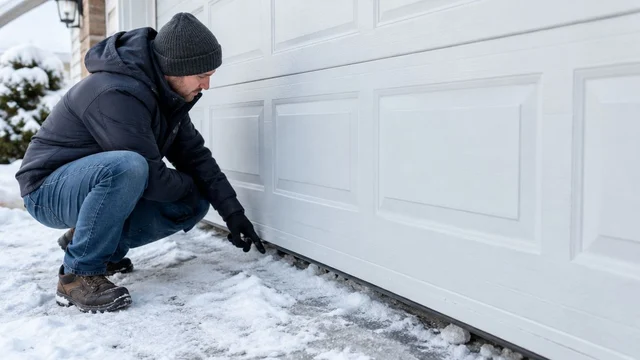
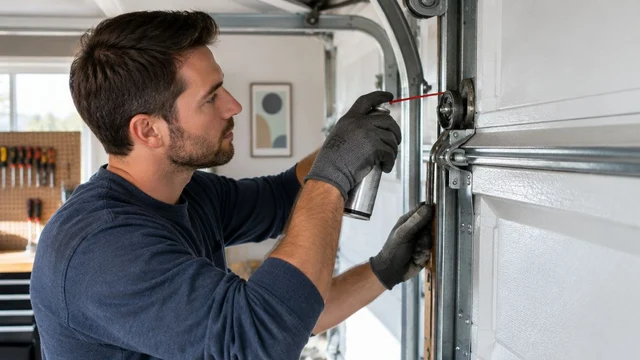
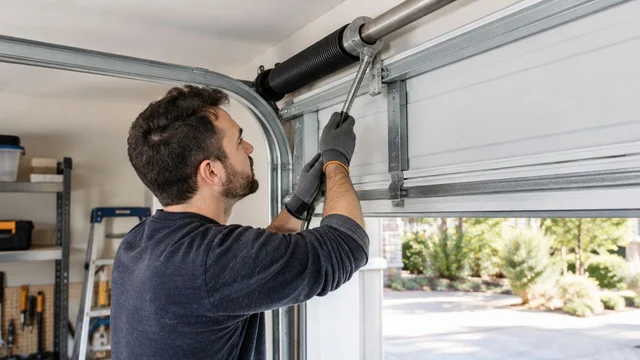
Fix a garage door closing too fast by stopping use and having a garage door technician check the springs, lift cables, door balance and opener before adjusting anything. A sudden drop or slam is not a normal speed-setting issue, and changing opener force does not repair a failed counterbalance system. For Louisville homeowners, the safe first move is to keep everyone clear and leave the door in its current position until professional help is arranged.
TL;DR
- A garage door closing too fast needs mechanical inspection before opener adjustments.
- Broken springs, loose lift cables and damaged hardware are professional-only repairs.
- Never pull the emergency release on an open door that is dropping or appears damaged.
- Derby Strong provides garage door repair for Louisville homeowners who need spring, cable or opener service.
How do you fix a garage door that closes too fast?
The repair must address what stopped controlling the door’s weight—not simply slow the motor. Garage door springs counterbalance the door, while lift cables transfer that support on common sectional-door systems. The opener moves a properly balanced door; it should not compensate for failed springs or damaged lifting hardware.
If the door is already closed, leave it closed. If it is partly or fully open, keep people away from the opening and do not attempt to lower it manually. You can request garage door service and describe the movement without operating the door again.
Use what you already observed to explain the problem:
| What you noticed | What needs inspection | Safe next move |
|---|---|---|
| The door dropped suddenly or slammed after a bang | Springs and the counterbalance system | Stop use; report the sound and sudden change |
| One side hangs lower or a cable looks loose | Lift cables, drums, tracks and supporting hardware | Keep clear; do not straighten or lift the door |
| The door moves normally, then strikes the floor hard | Door balance, opener travel and mechanical condition | Avoid further cycles until the cause is checked |
| The door became unusually heavy before the fast closing began | Springs and balance | Do not disconnect the opener to test the weight |
| Closing changed after opener programming or replacement | Model-specific settings and installation, after mechanical checks | Report the recent work; do not copy another model’s settings |
These symptoms guide an inspection. None identifies a failed part with certainty from the floor.
Why this matters: the opener is not the counterbalance
An opener and a spring system do different jobs. Springs offset the door’s weight so the door can move in a controlled way; the opener supplies movement and control during powered operation.
When that balance is lost, the opener connection can mask part of the problem until a component fails or the door is disconnected. That is why an emergency-release test is the wrong starting point for a door that already drops.
Do not stand beneath the door, try to catch it or use a vehicle to hold it up. Keep children, pets and anyone arriving home away from the opening. A door that remains open creates a security problem, but approaching an unstable door creates an immediate injury risk.
What can you safely check without moving the door?
Your role is to observe from a safe position—not reproduce the fault. Stay outside the door’s travel path and away from springs, cables, bottom brackets and tracks.
Record what happened before you stopped using it
Write down whether the door accelerated through its whole descent, dropped on one side or struck the floor only at the end. Include any bang, scraping sound, jerking or recent impact you noticed.
Also record whether the problem occurred during powered operation or during manual movement that had already taken place. Do not disconnect the door now to create that comparison. Existing observations are enough to start the service conversation.
Look for visible damage from a distance
A visibly separated torsion spring, hanging cable, crooked door or roller outside its track is a reason to keep the door out of service. Do not climb a ladder or reach around hardware for a better view.
A spring can be faulty without an obvious break visible from the floor. Likewise, a straight-looking door does not prove that the cables, spring tension or opener connection are sound.
Identify the opener only if the label is accessible
A model number helps a technician find the correct operating instructions. Photograph the label only if you can do so without standing under the door or climbing near moving equipment.
Do not remove covers or search through settings while troubleshooting an unstable door. A model-specific manual matters later, after the mechanical condition is established.
Why does a garage door start closing too fast?
Several faults can produce similar movement. The useful distinction is whether the door has lost support, is moving unevenly or is being driven incorrectly.
- Broken or weakened springs: Reduced counterbalance leaves more door weight unsupported. A sudden bang followed by changed operation is an important symptom to report.
- Incorrect spring balance: Springs that do not match the door or are incorrectly adjusted can leave the door poorly balanced. Recent spring work or changes to door weight belong in the service history.
- Lift-cable or drum problems: A cable that comes loose, frays or leaves its intended position can disrupt support and make the door uneven. Cable and drum work involves stored tension.
- Track, roller or supporting-hardware damage: Binding or displaced components can produce irregular movement. A crooked door requires professional inspection rather than forced operation.
- Opener travel, control or installation faults: Incorrect travel or an opener fault can change powered closing behavior. Mechanical problems must be ruled out before settings become the repair target.
The symptom alone does not justify ordering springs or replacing the opener. Diagnosis comes before parts.
What should a technician check before adjusting closing speed?
A professional inspection should separate door support from opener operation. The technician needs to establish that the door and its lifting hardware are safe before performing any controlled movement or balance testing.
The inspection follows this basic order:
- Secure the door. Establish a safe working condition before disconnecting equipment or handling loaded components.
- Inspect support hardware. Check springs, cables, drums, brackets, rollers and tracks for failure, displacement or damage.
- Check door balance. Evaluate whether the counterbalance matches the door and supports controlled movement under safe conditions.
- Inspect opener operation. Review the connection, travel and applicable settings using the exact manufacturer’s instructions.
- Verify safe operation. Confirm controlled movement and perform the safety checks specified for the installed equipment.
The sequence matters. Adjusting an opener first can leave the original mechanical fault unresolved.
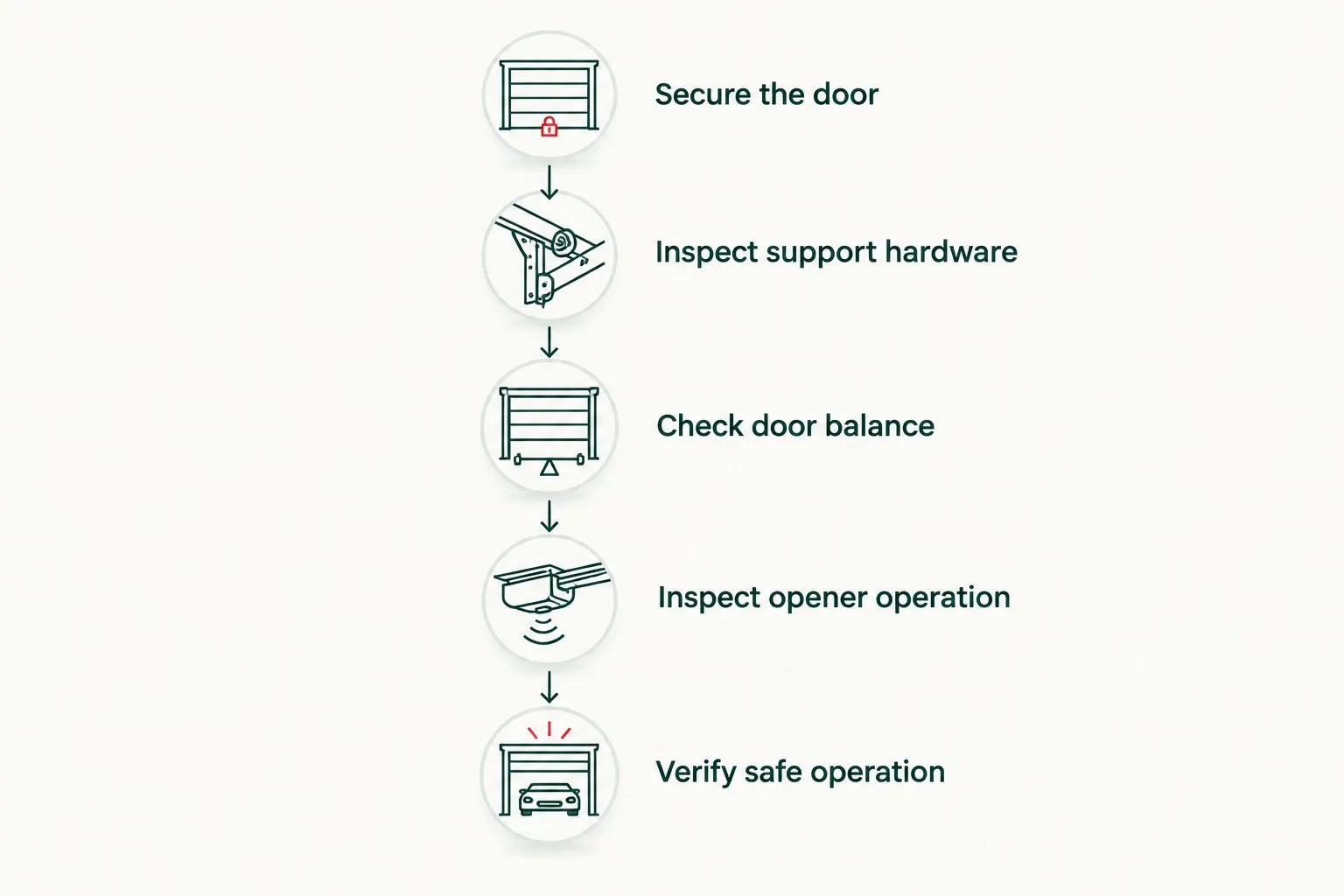
Door support and balance come before opener adjustments.
Ask the technician to explain what failed and how that finding accounts for the fast closing. A repair recommendation should connect the observed symptom to a specific mechanical or control problem.
Should you adjust the opener’s speed or force?
Do not increase opener force to overcome a fault. Force settings concern how the opener responds to resistance; they do not restore spring support or put a displaced cable back where it belongs.
Closing-speed adjustment is also model-dependent. Do not assume your opener offers it, or that instructions for a similar-looking unit apply. If the change began after programming, tell the technician exactly what was changed rather than continuing to experiment.
Travel settings deserve the same caution. A door striking the floor hard needs an assessment of balance, condition and travel—not a guessed adjustment followed by repeated test cycles.
If the motor appears to be struggling as well, that does not automatically mean the opener needs replacement. An opener working against a poorly balanced door and an opener with an internal fault require different repairs.
Does fast closing mean you need new springs or a new door?
Not automatically. An otherwise serviceable door with a confirmed spring failure needs a spring-system repair assessment, not an automatic full-door replacement recommendation.
The repair scope also determines how you should interpret estimates. Comparisons of garage door spring repair costs cannot establish a Louisville quote: the failed components, required spring specification and related damage must be identified on your door. A spring-only estimate and a repair that also addresses damaged lifting hardware describe different work.
Use these distinctions when discussing the recommendation:
| Repair path | Best for | Benefit | Limitation |
|---|---|---|---|
| Spring-system repair | A serviceable door with confirmed counterbalance failure | Addresses lost support without replacing sound door sections | Does not repair damaged panels, tracks or an unrelated opener fault |
| Cable or hardware repair | A door with a confirmed lifting or guidance fault | Targets the damaged components | Requires inspection of connected parts and door alignment |
| Opener repair or adjustment | A mechanically sound door with a confirmed opener problem | Addresses powered movement without unnecessary door replacement | Cannot compensate for failed springs or structural damage |
| Door replacement | A door whose condition makes repair inappropriate | Replaces the damaged door assembly | Is not justified by fast closing alone |
For the broader decision, the guide to repairing or replacing a Louisville garage door addresses a separate question: whether the door itself remains a sensible repair candidate.
How should you prepare for garage door service in Louisville?
Derby Strong is for Louisville homeowners who need professional garage door repair rather than DIY spring adjustment. Describe the unsafe movement when arranging service so the conversation starts with the door’s condition, not a request to change its speed.
Keep the area clear without walking beneath or disturbing an open door. Move loose items only when you can reach them safely, and keep remotes away from anyone who might operate the door without knowing about the problem.
Prepare a short service history:
- When the fast closing first happened and whether it began suddenly.
- Whether a bang, impact, power interruption or recent repair preceded it.
- Whether the door appeared crooked or a cable looked loose.
- Whether someone changed opener settings before the symptom began.
- Whether the door is currently open, partly open or fully closed.
Tell Derby Strong if a vehicle is trapped inside, but do not attempt another opening cycle to free it. Explain any access limitation when arranging the visit; do not assume the damaged door can serve as the entry route.
Can you keep using the door if it only slams occasionally?
No. Intermittent slamming still needs inspection before further use. A problem that appears only on some cycles is not proof that the spring system, cables or opener are safe.
Do not keep cycling the door to capture a better video. If you already have footage, preserve it; otherwise, a clear written description is safer than deliberately repeating uncontrolled movement.
Is it safe to pull the emergency release?
Not on an open or partly open door that is dropping, crooked or suspected of having spring or cable damage. Disconnecting the opener can remove a restraint and allow an unsupported door to fall.
Even with the door closed, disconnecting it does not repair the cause. Leave manual-operation testing to the technician when fast closing has already signaled a possible support problem.
Frequently Asked Questions
Why is my garage door suddenly closing too fast?
Sudden fast closing can indicate lost spring support, a lift-cable problem, damaged hardware or an opener fault. Stop using the door and have its mechanical condition checked before anyone changes settings.
Can I slow my garage door down by adjusting the opener?
An opener adjustment is not the first repair for a garage door closing too fast. A technician should first confirm that the springs, cables and door balance are sound, then follow the installed opener’s instructions.
Does a broken spring make a garage door slam shut?
A broken spring can leave the door without its intended counterbalance and contribute to uncontrolled closing. Do not disconnect an open door or attempt to lift it to confirm the diagnosis.
Should I lubricate a garage door that is dropping?
Lubrication does not repair lost spring support, a displaced cable or damaged lifting hardware. Stop operation rather than cycling the door after applying lubricant.
Do safety sensors stop a garage door from falling?
Photoelectric safety sensors do not support the door’s weight. Their presence does not make a door with a suspected spring or cable failure safe to operate.
Does Derby Strong repair fast-closing garage doors in Louisville?
Derby Strong provides garage door repair and opener service in Louisville. Describe the fast closing, any visible damage and the door’s current position when arranging service.
One Last Thing Before You Decide
A door reaching the floor is not proof that the repair is complete. Ask what failed, what was corrected and how controlled movement and safety operation were verified. The goal is a properly supported door—not simply a quieter landing.
Related Garage Door Guides
- Loose garage door cables in Northern Kentucky
- Off-track garage door safety in Northern Kentucky
- Garage door maintenance checklist
Local service: Garage door repair in Louisville · Garage door repair in Lexington · Garage door repair in Northern Kentucky