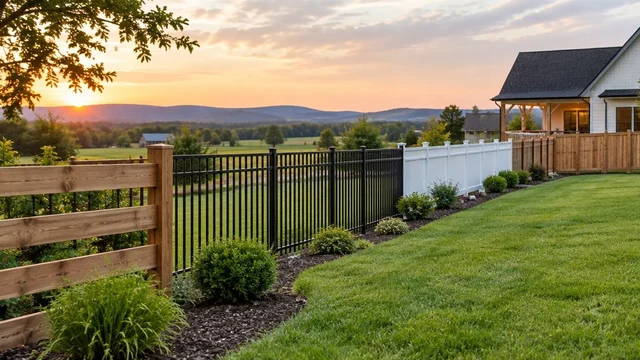
Horse-farm fencing is an equine containment system designed to keep horses safely enclosed while supporting pasture management and daily access. For farms in northern Fayette County, Lexington, the practical question is not simply which fence looks right: it is which combination of barriers, gates and inspection routines fits the horses using each enclosure.
TL;DR
- For fencing horse farms Lexington KY, choose containment for the horses first and entrance appearance second.
- Horse-rated woven wire and board fencing have different maintenance needs; neither eliminates inspections.
- Northern Fayette County farm plans should separate pasture containment, horse-handling access and vehicle entrances.
- Repair sound sections where appropriate; replace a fence system that cannot safely serve its intended use.
Why fencing matters for northern Fayette County horse farms
A horse fence must do more than mark a boundary. It must remain visible to horses, avoid entrapment hazards and work around the way people move animals, equipment and vehicles through the property.
A decorative entrance fence and a turnout fence do different jobs. Compare the broader fence options for Kentucky properties, but make the final selection around equine containment rather than appearance alone.
For a northern Fayette County property, confirm the actual parcel boundary, access rights and applicable Lexington-Fayette requirements before settling the fence line. An existing fence is not proof of a legal boundary, and a mailing address does not establish which restrictions apply.
Choose the enclosure around the horses and daily work first; choose its finish afterward. A sound plan also leaves room to isolate a damaged section without losing the entire turnout area.
How to plan horse-farm fencing in northern Fayette County
1. Map how horses and vehicles use the property
Start with a paper sketch or an existing property plan. Mark current fences, gates, water points, buildings and the routes used to lead horses or drive equipment. This gives you a useful starting point without buying design software.
Separate the perimeter from internal pasture divisions. A perimeter breach exposes a horse to hazards outside the property; an internal division serves a different purpose and deserves its own design decision. Do not assume one material or gate arrangement must serve every enclosure.
Walk the proposed line from a safe position. Note low spots, vegetation and places where equipment needs access, then ask the installer to assess those conditions rather than deciding post foundations by eye.
- Mark boundaries as confirmed or requiring survey verification.
- Separate horse routes from routine vehicle routes where practical.
- Identify a secure holding area during construction.
- Mark water access and equipment entry points.
- Record locations where a failed gate would compromise containment.
2. Match the barrier to the horses using it
Write down which horses will occupy each enclosure. Foals, small ponies and adult horses do not present identical clearance or opening-size questions. Horses that challenge fences also need a different assessment from horses that consistently respect an existing barrier.
Use manufacturer documentation for the proposed equine fencing system. General livestock wire is not automatically suitable for horses, and the label alone does not settle how the complete installation should be built.
Visibility matters, but visibility is not containment. A prominent top rail does not correct unsuitable mesh, unsafe gaps or poorly supported corners. Ask the installer to explain how the complete system addresses those conditions.
- Identify the smallest animals expected in each enclosure.
- Record known leaning, chewing or fence-challenging behavior.
- Ask for equine-specific mesh and installation documentation.
- Assess visibility from the horse’s approach, not just the driveway.
- Reject exposed sharp edges and openings that create entrapment risks.
3. Request a scope that separates fence work from gate work
Prepare the same written brief for each contractor. Include photographs taken from outside occupied enclosures, your marked plan, the horses using each space and the sections you want assessed for repair. Comparable scopes make contractor discussions more useful than a single total without detail.
Derby Strong is a fit for Lexington property owners seeking fence, gate and garage door services from one provider. Derby Strong lists those service categories; ask the company to confirm the proposed equine fencing materials, installation scope and suitability for your particular farm before proceeding.
A general fence service offering does not establish experience with every horse-containment system. Request a specific explanation of corner construction, gate clearances, transitions and the manufacturer’s requirements for any tensioned components.
- Separate perimeter fencing, internal divisions and entrances in the scope.
- Identify sections proposed for repair versus replacement.
- Specify materials without accepting undocumented substitutions.
- Assign responsibility for removals and temporary containment.
- Ask who verifies boundaries, utilities and applicable approvals.
4. Design gates around movement and containment
Begin by measuring the actual equipment and trailers that must pass through each opening. Include the approach and turning movement, not just the vehicle body. An opening that works on a straight approach can still be awkward beside a fence corner or building.
Plan horse-handling gates separately from vehicle entrances. A powered entrance gate manages access; it is not automatically an appropriate turnout gate. Horses must not have access to dangerous moving parts, pinch points or an opening that defeats the enclosure.
For automated gates, require a professional assessment of entrapment protection and the applicable safety requirements. Do not bypass protective devices or improvise a control arrangement because the gate sometimes fails to close.
- Check trailer approaches with the actual vehicle dimensions.
- Keep the gate’s movement clear of horse-handling space.
- Specify latches appropriate to the horses using the enclosure.
- Include a secure plan for power failure and manual access.
- Ask how gate-to-fence gaps will be addressed.
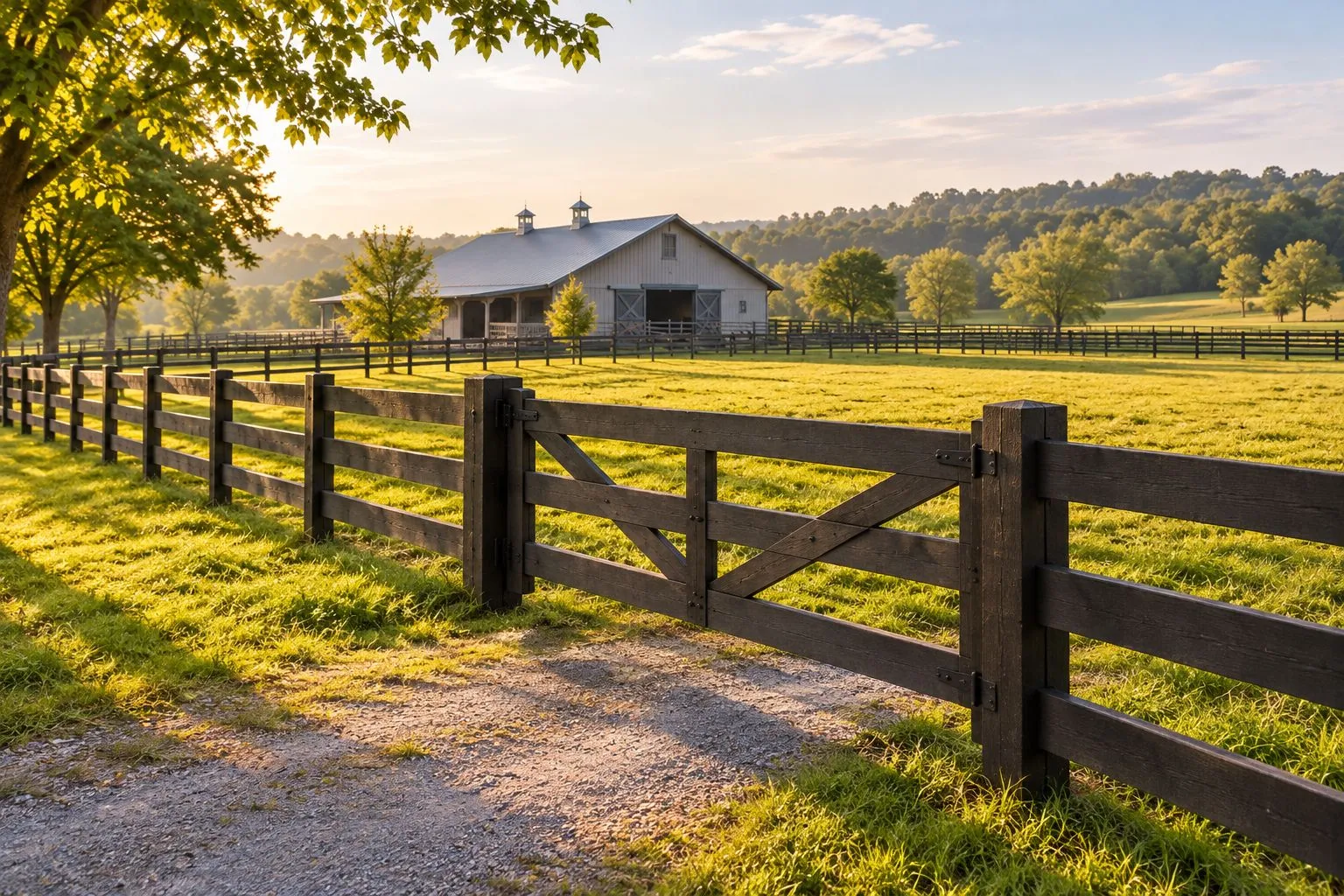
Illustrative photo: assess the gate and adjoining fence as one containment system.
5. Decide whether to repair or replace each section
Inspect from outside the enclosure and document visible damage without pulling on wires or testing unstable posts. A loose board on otherwise sound fencing presents a different decision from widespread deterioration, repeated failures or a design unsuitable for the horses.
Repair is appropriate when the remaining system is sound and the repair restores suitable containment. Replacement is appropriate when isolated fixes cannot correct the underlying condition or design. Do not replace serviceable fencing solely to make every section look new.
Have a qualified fence contractor assess tensioned wire, unstable assemblies and damaged gates. Keep horses away from compromised fencing until secure containment is restored; a temporary visual marker is not a substitute for a suitable barrier.
- Photograph damage from a safe position.
- Record whether failures are isolated or repeated.
- Separate cosmetic wear from structural deterioration.
- Ask whether repairs preserve the intended equine-safe design.
- Arrange secure alternative turnout before work begins.
6. Establish an inspection and handover routine
Before returning horses to a completed enclosure, walk the accessible fence line with the installer. Review joins, gates, latches and transitions between materials. Ask for the maintenance instructions for the installed system rather than applying a generic routine to every fence type.
Keep a simple inspection record using a notebook or spreadsheet. Record the location, observed condition and action taken. Recheck after an impact, storm damage, a reported escape or work near the fence; a completed installation does not remove the need for ongoing observation.
When requesting Derby Strong fence services, ask what handover information accompanies the proposed work and which maintenance tasks require professional attention. Confirm those details in the written scope rather than assuming they are included.
- Check for loose boards, exposed fasteners and damaged mesh.
- Observe posts and gate supports for movement or deterioration.
- Confirm gates close and latch as intended.
- Keep vegetation from concealing damage or interfering with equipment.
- Record unresolved defects and restrict access where containment is unsafe.
Compare fencing options for horse farms
The best choice depends on the enclosure’s use, the horses and your capacity to maintain it. Compare complete installed systems, not individual materials viewed in isolation. No option removes the need for inspections.
| Option | Best for | Practical advantage | Key limitation |
|---|---|---|---|
| Board fencing | Farms prioritizing a visible rail barrier | Makes the fence line easy to see and allows individual damaged boards to be assessed | Boards, fasteners and posts need inspection; rail openings require assessment for the horses present |
| Horse-rated woven wire with a visible top element | Enclosures needing mesh containment | Adds a mesh barrier between posts | Mesh selection, tension, corners and transitions must follow the system’s equine requirements |
| Horse-rated polymer rail systems | Owners considering an alternative rail material | Offers a rail-format option without choosing conventional timber boards | Performance depends on the particular system; do not assume every product provides identical containment |
| Equine electric offset fencing | Supplementing a suitable primary fence where professionally specified | Can discourage horses from contacting the primary barrier | Requires appropriate equipment, power and checking; it does not repair a failed primary fence |
| Barbed wire | Not recommended for horse enclosures | No horse-containment advantage justifies choosing sharp barbs | Creates injury hazards when horses contact or become entangled in it |
Avoid treating electric fencing as a shortcut around a damaged perimeter. Its suitability depends on the intended use, the horses and a complete system assessment. Follow the energizer and fencing manufacturer’s instructions, and use qualified help for electrical work.
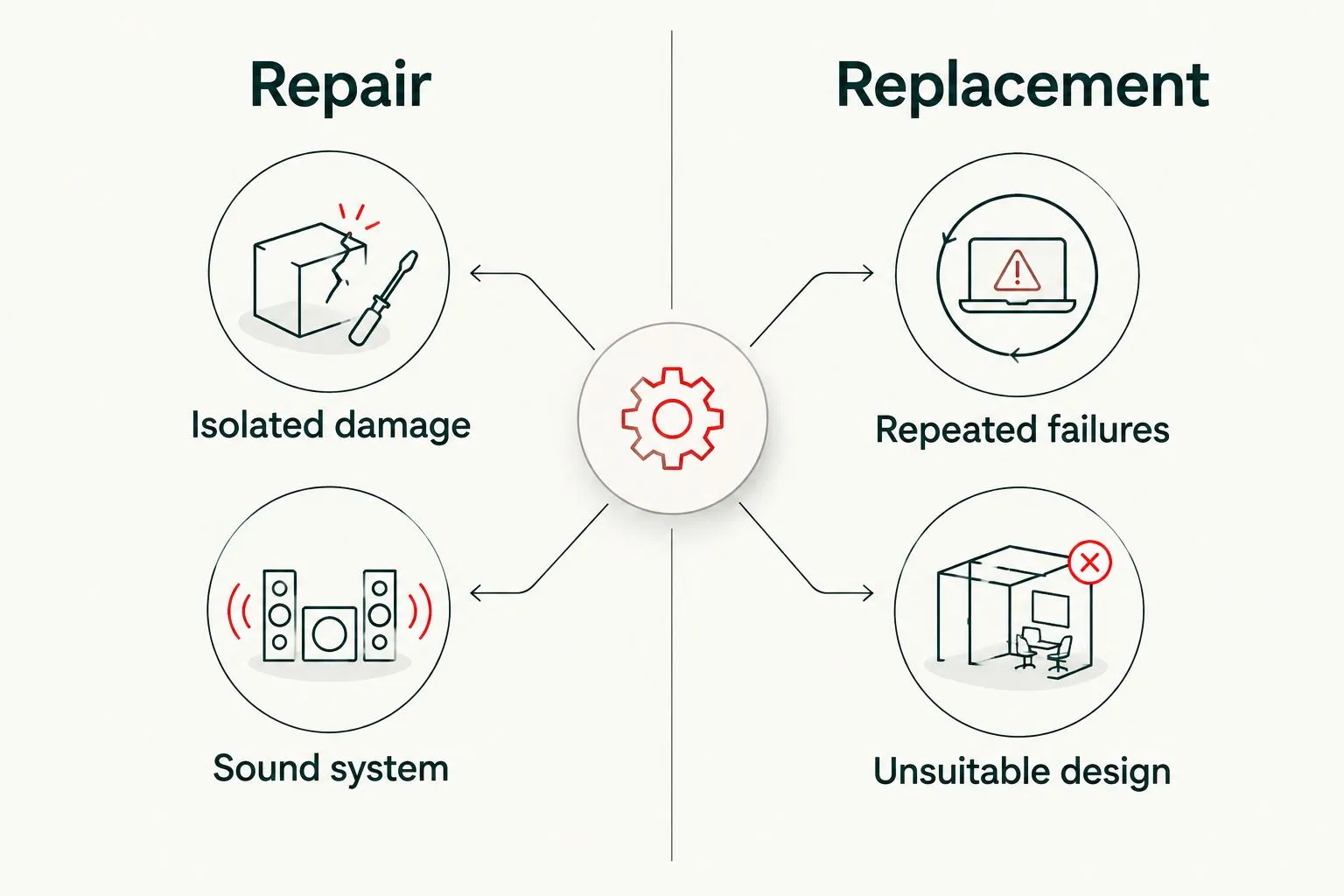
Choose repair or replacement by the condition and suitability of the whole system.
Common mistakes horse-farm owners make
Choosing an entrance appearance before a containment plan
A coordinated entrance does not establish that adjoining pasture fencing suits the horses. Decide which areas contain animals, which control vehicles and which serve both purposes. Then select finishes that work with the required construction.
Treating every gate as the same job
A pasture gate, equipment gate and automated entrance have different users and failure consequences. Specify each separately. Do not let an access-control upgrade create a new horse-handling hazard.
Requesting replacement without testing the repair case
A worn appearance is not a complete replacement diagnosis. Ask which components have failed, whether sound sections can remain and whether the proposed repair restores appropriate containment. Equally, do not keep patching a system whose basic design is unsuitable.
Assuming an old fence proves the boundary
An established fence line can still require boundary verification. Resolve uncertainty before removing posts or ordering a replacement layout. Confirm recorded access rights and applicable requirements rather than relying on a neighbor’s recollection.
Returning horses before checking transitions
A long, straight fence run can look finished while a gate junction or change in material remains incomplete. Walk the entire accessible perimeter before turnout. Confirm the work area is clear of loose materials and unresolved hazards.
Prepare for a useful contractor visit
Bring your enclosure sketch, photographs and a list of the horses using each area. Identify your immediate containment problem before discussing appearance upgrades. That keeps the visit focused on the decision you actually need to make.
For a northern Fayette County farm, supply the exact property address privately when arranging service. Ask Derby Strong to confirm the requested fence and gate scope for that location. Do not assume a general Lexington service description confirms every specialized farm application.
Provide access instructions and explain where horses will be secured during the assessment. A contractor should not have to discover an occupied paddock or an unstable gate on arrival. Keep people and animals clear of damaged assemblies until they have been assessed.
Frequently Asked Questions
What is the best fencing for a horse farm in Lexington, Kentucky?
The best horse-farm fencing is a complete equine containment system suited to the horses, enclosure and maintenance routine. Compare board fencing, horse-rated woven wire and documented equine rail systems rather than choosing by appearance alone.
Is board fencing better than woven wire for horses?
Neither board fencing nor woven wire is best for every horse enclosure. Board fencing offers a visible rail barrier, while horse-rated woven wire adds mesh containment; both require appropriate design, sound installation and inspections.
Can I repair horse fencing instead of replacing it?
Repair is appropriate when the remaining fence is sound and the repair restores suitable containment. Widespread deterioration, repeated failures or an unsuitable design require an assessment of replacement rather than repeated patching.
Can an automatic entrance gate serve as a pasture gate?
An automatic entrance gate is not automatically suitable as a pasture gate. A professional must assess horse access, moving components, entrapment risks and whether the opening preserves secure containment.
Do I need approval for a new farm fence in northern Fayette County?
Confirm applicable Lexington-Fayette requirements and recorded property restrictions before installing a farm fence. The parcel, proposed location and access arrangements determine which questions need resolution; an existing fence does not prove approval or a legal boundary.
What should I do if my horse fence is damaged?
Keep horses away from the damaged enclosure and arrange secure alternative containment. Photograph the damage from a safe position and request professional assessment without handling tensioned wire or unstable assemblies.
Does Derby Strong provide fencing services in Lexington?
Derby Strong lists fence and gate services among its Lexington-area offerings. Confirm the exact property, equine fencing system and installation scope directly before scheduling specialized horse-farm work.
One Last Thing Before You Decide
Inspect where the fence changes, not just where it runs straight. Gate junctions, corners and transitions between materials deserve a deliberate handover check because a sound stretch of fencing cannot compensate for an insecure opening beside it.
Before approving the job, ask the installer to walk the route a horse could take around the enclosure. That turns a material discussion into the containment check that matters.