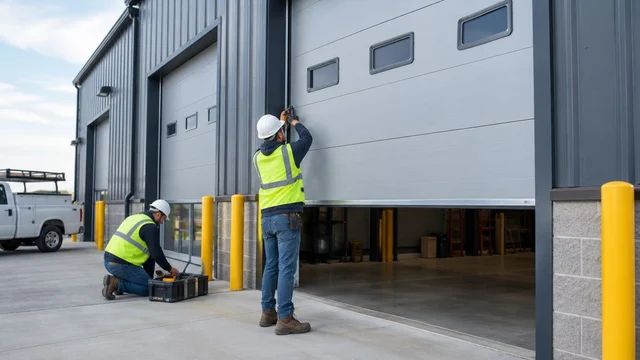
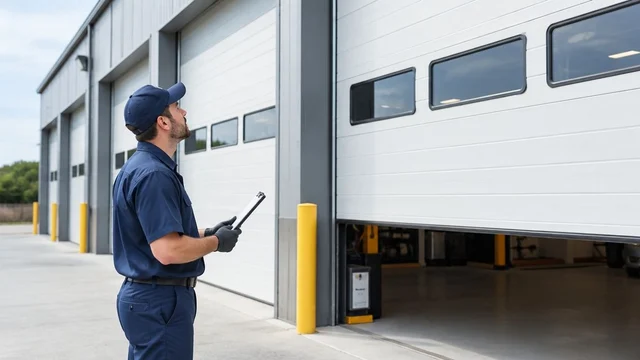
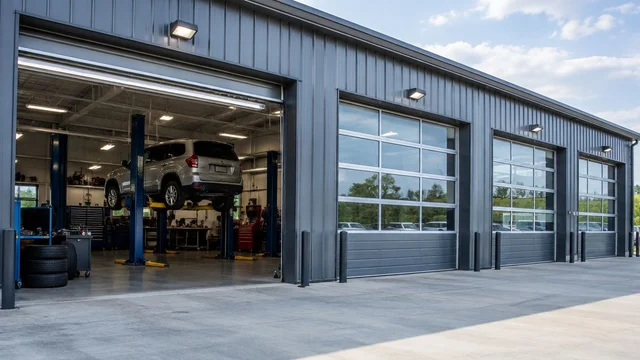
Best overall for a conditioned Lexington work bay: an insulated sectional steel door. Best for keeping ceiling tracks out of the bay: rolling steel; best for frequent traffic: a purpose-rated high-speed door; best for daylight: full-view aluminum; best for a required fire-rated opening: a listed fire-rated assembly. This guide compares the types of commercial overhead doors by the job each opening needs to do.
TL;DR
- Among types of commercial overhead doors, insulated sectional steel is the default shortlist choice for conditioned Lexington work bays.
- Rolling steel coils above the opening; sectional doors need a planned track path inside the building.
- High-speed doors suit frequent traffic, but the selected model must match interior or exterior exposure.
- Derby Strong provides commercial overhead door service in Lexington; bring opening details before choosing a replacement.
Why this matters for Lexington businesses
Choose the door around the opening, traffic and indoor conditions—not the building’s business category alone. A Lexington repair bay and a storage bay can need different doors even when their openings look alike. A door serving customers also has a different visibility requirement from a back-of-building loading opening.
Derby Strong provides commercial overhead door service in Lexington. Before requesting a replacement, identify what the existing door fails to do: close reliably, clear equipment, retain conditioned air or withstand the actual operating schedule. A repair remains the right question when the current assembly still fits the job.
What makes the best commercial overhead door?
Use these criteria before comparing appearances or selecting an operator:
- Opening fit: Verify clear width, clear height, headroom, side room, mounting structure and the proposed travel path.
- Traffic demand: Record opening frequency and busy periods. Match the complete door and operator system to that demand.
- Indoor conditions: Distinguish conditioned space from unconditioned storage, and identify moisture or washdown exposure.
- Visibility: Decide whether daylight and a view through the opening help operations or expose stored equipment unnecessarily.
- Protection requirements: Separate ordinary closure needs from documented wind, fire or other project requirements.
- Service needs: Consider inspection access, replaceable components and the consequences of taking the bay out of use.
Commercial overhead door types at a glance
These categories overlap. Insulation, glazing, fire ratings and operating speed are specifications to verify—not features every door in a category automatically includes.
| Rank and door type | Best for | Standout feature | Key limitation |
|---|---|---|---|
| 1. Insulated sectional steel | Conditioned work bays | Insulated sections travel along a planned track path | Tracks and the open door occupy interior space |
| 2. Rolling steel | Keeping the overhead bay area clear of sectional tracks | Interlocking slats coil above the opening | Coil and guide clearances still need verification |
| 3. High-speed door | Frequently used traffic openings | Designed around faster opening and closing | Speed alone does not establish insulation or security |
| 4. Full-view aluminum | Customer-facing bays needing daylight | Framed glazed sections provide visibility | Glazing complicates privacy and thermal decisions |
| 5. Listed fire-rated assembly | Openings requiring fire protection | Documented fire-protection function | Requires the correct assembly and ongoing inspection |
1. Insulated sectional steel: best for conditioned work bays
An insulated sectional steel door uses connected sections that travel on tracks. For a Lexington business heating or cooling an occupied service bay, this is the default starting point because insulation and perimeter sealing belong in the initial specification.
Best for: A conditioned work bay where staff spend time near the opening and the building can accommodate the track layout.
Insulated sectional steel pros:
- Insulated construction addresses heat transfer through the closed door.
- Sectional layouts offer different track configurations when the building supports them.
- Window placement can be considered without making the entire door glazed.
Insulated sectional steel cons:
- Tracks, supports and the raised door need space inside the building.
- Insulation does not prevent air exchange while the opening remains open.
Compare whole-door thermal information where provided, not just the insulation value of a panel sample. Ask how joints, windows and perimeter seals affect the proposed assembly. Existing tracks are not automatically suitable for a replacement door.
Verdict: Buy insulated sectional steel for a conditioned bay once the track layout and operating requirements are confirmed.
2. Rolling steel: best for keeping sectional tracks out of the bay
A rolling steel door uses a curtain of interlocking slats that coils above the opening. Unlike a conventional sectional layout, it does not carry a broad door assembly back across the ceiling on horizontal tracks.
Best for: A storage or service opening where the planned interior layout conflicts with sectional tracks.
Rolling steel pros:
- Coiling operation keeps the curtain near the opening when raised.
- It avoids the conventional horizontal track arrangement of a sectional door.
- Solid slats provide an opaque closure for storage and service areas.
Rolling steel cons:
- The coil, guides and supporting structure require their own clearances.
- Insulation, sealing and operating frequency vary by assembly.
Do not translate “rolls up” into “fits anywhere.” A low beam above the opening or limited mounting room can rule out a proposed arrangement. Provide the installer with information about overhead piping, lighting and equipment before choosing the door.
A rolling steel door is also not automatically fire rated. That requires a specifically listed assembly suited to the opening.
Verdict: Buy rolling steel when verified coil clearances solve an interior-space problem.
3. High-speed door: best for frequent traffic openings
A high-speed door is selected around repeated movement through an opening. The category includes different constructions and applications, so “high-speed” describes an operating characteristic rather than a single material or protection level.
Best for: An opening with frequent vehicle or material movement where time spent open is an operational concern.
High-speed door pros:
- Faster operation can reduce how long an opening stays exposed during each passage.
- Traffic controls can be specified around the intended movement pattern.
- Different constructions address different interior and exterior applications.
High-speed door cons:
- Not every design provides the same physical barrier as a steel closure.
- Controls and protective devices require application-specific planning and maintenance.
Start with a traffic record rather than a speed claim. Note forklifts, delivery vehicles and pedestrians separately, including whether people cross the vehicle route. The selected model’s current documentation must establish operating limits, exposure suitability and required protective devices.
If the opening also needs an overnight closure, ask how the proposed system addresses that requirement. Do not assume faster operation answers every security or environmental question.
Verdict: Buy a high-speed door for documented traffic demand; hold if frequency is only a guess.
4. Full-view aluminum: best for customer-facing bays needing daylight
Full-view aluminum doors use framed sections with glazing. Their main distinction is visibility through the closed opening, making them a candidate when daylight or a view into the bay serves a clear purpose.
Best for: A customer-facing Lexington service bay where visibility matters more than an opaque exterior.
Full-view aluminum pros:
- Glazing admits daylight while the door remains closed.
- Clear glazing allows a view through the opening.
- Glazing choices let the specification address visibility and privacy separately.
Full-view aluminum cons:
- Transparent glazing exposes the bay’s contents to outside view.
- Thermal performance depends on the complete frame and glazing assembly.
Choose glazing deliberately. Ask about safety glazing, cleaning requirements, privacy and the thermal information for the exact proposed construction. A photograph cannot establish those properties.
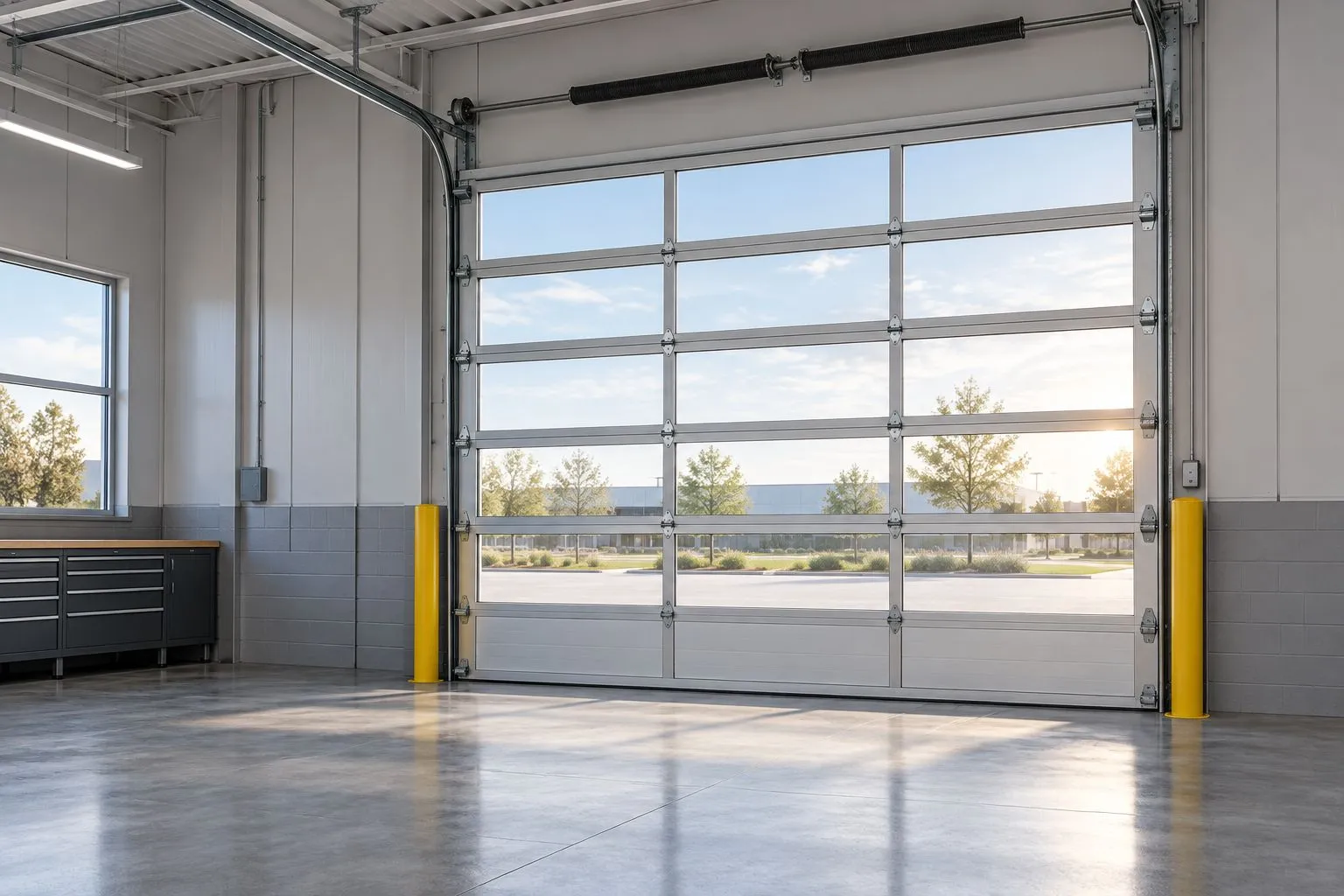
Illustrative photo: full-view construction adds daylight but still needs an interior track path.
An attractive glazed door still needs the same opening survey as an opaque sectional door. Confirm the raised-door position before committing to lighting, storage or equipment nearby.
Verdict: Buy full-view aluminum when daylight and visibility serve the business; skip it when privacy is the priority.
5. Listed fire-rated assembly: best for required fire protection
A fire-rated overhead door is a specialized assembly for an opening with a documented fire-protection requirement. It is not a general upgrade to select simply because the curtain is metal.
Best for: An opening identified by the project documents or responsible authority as requiring a fire-rated closure.
Listed fire-rated assembly pros:
- Addresses a defined fire-protection requirement when correctly specified.
- Provides documented assembly requirements rather than assumptions about materials.
- Establishes inspection and testing obligations for ongoing operation.
Listed fire-rated assembly cons:
- Components and controls must remain consistent with the listed assembly.
- Inspection, testing and maintenance add responsibilities for the building operator.
Have the required rating and opening conditions established before requesting a specific assembly. Confirm how closing and release functions interact with the building’s systems. Do not modify or defeat those functions to make daily use easier.
Treat this as a project requirement, not a preference ranking beneath glass or steel. If the opening requires fire protection, that requirement controls the shortlist.
Verdict: Buy the correctly specified listed assembly when required; skip an unrated substitute.
How to turn the shortlist into a usable specification
For your Lexington site, give Derby Strong commercial overhead door requirements tied to the actual opening—not just a request for “a stronger door.” Use this preparation sequence without touching loaded hardware.
Record the traffic
Log activity over 5 representative workdays, including busy periods. Count 1 complete opening-and-closing movement as 1 cycle, and distinguish normal use from unusual delivery days. This is a planning record, not a substitute for the manufacturer’s duty requirements.
Document the space
Have the installer verify 3 clearance dimensions: headroom, side room and backroom, alongside opening width and height. From floor level, take 2 overview photos, one showing the opening and one showing the interior overhead space. Do not climb near the mechanism to obtain a measurement.
Describe the operating conditions
State whether the bay is conditioned, washed down, exposed to moisture or used for customer interaction. Explain what must remain clear when the door is raised. These details determine whether a seemingly suitable door conflicts with the building’s work.
Separate repair from replacement
Report damaged sections, uneven movement, loose cables, failed controls or an opening that no longer suits equipment. Ask whether the fault is repairable before treating replacement as the answer. A failed operator does not by itself establish that the entire door needs replacement.
Stop using a door that hangs crooked, has displaced hardware or moves unpredictably. Keep people and vehicles clear. Spring, cable, track and bracket repairs belong to a trained professional; never force the door or increase operator force to overcome a fault.
Schedule a commercial door assessment
Discuss your Lexington opening, operating needs and repair-versus-replacement questions.
How the door types are ranked
This ranking prioritizes opening fit, operating demand, indoor conditions, visibility, protection requirements and service needs. It is a use-case guide, not a product test or a comparison of specific manufacturers. Verify every shortlisted model against its current documentation before approval.
Which commercial overhead door should you choose?
Start with insulated sectional steel for a conditioned Lexington work bay. Switch to rolling steel when the interior track path is the deciding constraint, high-speed construction when documented traffic drives the decision, or full-view aluminum when daylight and visibility are essential.
A required fire rating takes precedence over that sequence. Derby Strong is a fit for Lexington businesses seeking commercial overhead door service. Bring the operating problem and opening details to the discussion before selecting a door style.
Frequently Asked Questions
What are the main types of commercial overhead doors?
Common categories include sectional steel, rolling steel, high-speed and full-view aluminum doors, plus specialized fire-rated assemblies. These categories overlap: insulation, glazing and ratings must be checked on the specific assembly.
What is the best commercial overhead door for a heated Lexington work bay?
Insulated sectional steel is the default shortlist choice for a conditioned Lexington work bay when the track layout fits. Compare the complete door’s thermal information, perimeter sealing and operating requirements before choosing.
Is a rolling steel door better than a sectional door?
Rolling steel is better when avoiding a conventional sectional track layout solves a space problem. A sectional door remains a strong candidate for a conditioned bay, but both designs require a verified opening survey.
Does a high-speed door provide insulation and overnight security?
The high-speed label alone does not establish insulation or overnight security. Verify the specific model’s construction, exposure suitability, operating limits and closure requirements.
Are full-view commercial doors practical for customer-facing bays?
Full-view doors are practical when daylight and visibility serve the business. Check privacy, safety glazing, thermal performance and the raised-door position before specifying the assembly.
Can I keep my existing operator when replacing a commercial overhead door?
Keep an existing operator only after compatibility and condition are verified for the replacement assembly. Door weight, balance, operating demand, controls and protective devices all belong in that review.
Should I replace a commercial overhead door that stops opening?
A door that stops opening needs diagnosis before a replacement decision. Keep the opening clear and arrange professional service rather than forcing movement or adjusting spring tension.
One Last Thing Before You Decide
The raised door occupies space too. Before approving a Lexington installation, ask for the open-door position, track or coil layout, and service access to be shown alongside lights, pipes and equipment. Checking only the clear opening leaves an important part of the decision unfinished.
Related Garage Door Guides
- How to measure a garage door opening in Lexington
- Commercial overhead door installation cost in Lexington
- Commercial overhead door maintenance in Lexington
Local service: Commercial garage door repair in Lexington