Wood garage doors are worth it in Kentucky when you want real wood grain and accept the finishing, inspection and moisture management that come with it. They are a poor fit if your priority is minimal exterior upkeep. Humidity alone does not rule wood out, but exposed edges, failing finishes and repeated wetting make the door’s construction and maintenance especially important.
TL;DR
- Are wood garage doors worth it? Yes, when real wood matters more to you than low-maintenance ownership.
- Compare real wood with wood-look steel before choosing a garage door material.
- Moisture protection depends on finish condition, exposed edges and water exposure—not appearance alone.
- Derby Strong Garage Doors provides garage door installation and repair for Kentucky homeowners weighing replacement options.
Is a wood garage door worth it in Kentucky’s humid climate?
Choose wood for the material itself, not because you expect maintenance-free performance. Wood exchanges moisture with surrounding air, expanding and shrinking as its moisture content changes. A suitable finish slows that exchange but does not make the door waterproof.
Compare the complete door assembly, not just the face. Wood overlays, wood panels and wood-look finishes describe different constructions; a wood appearance does not tell you what supports the door or how to maintain it. The broader garage door materials guide for Kentucky homes helps frame that decision.
| Door option | Best for | Main advantage | Main drawback | Decision |
|---|---|---|---|---|
| Real-wood garage door | Homeowners who specifically want natural grain and accept finish upkeep | Natural variation and a genuine wood surface | Moisture-sensitive material requiring finish care | Choose when you want wood itself |
| Wood-look steel garage door | Homeowners who want a wood appearance without maintaining a natural-wood face | Wood appearance on a steel surface | Does not reproduce every characteristic of real wood; damaged coatings need attention | Compare when appearance is the main goal |
| Painted steel garage door | Homeowners prioritizing a painted finish over natural grain | Avoids natural-wood refinishing requirements | Steel can dent, and exposed metal needs protection from corrosion | Compare when upkeep matters more than grain |
These are material-level comparisons, not promises about a particular model. Insulation, panel construction, finish requirements and hardware must be checked against the documentation for the door you select.
Why this matters before you order
A garage door is a moving assembly, not exterior siding. A finish problem affects the surface, while swelling, damaged joints or deteriorated panels can also affect fit and operation. Those problems require different responses.
Separate the decision into appearance, exposure and maintenance. You can like a wood door and still decide it is wrong for the opening—or keep an existing wood door when professional inspection shows that repair and refinishing are appropriate.
Do not replace a serviceable door simply because it is wood. First establish whether the problem is cosmetic, related to water exposure or part of the lifting system.
Real wood: best for homeowners committed to finish care
Real wood makes sense when its natural character is the reason you want the door. Grain, joints and surface variation are part of that choice. A printed or embossed wood-look surface is a different material, even when it looks convincing from the driveway.
The trade-off is responsibility for the finish. You need to notice peeling, cracking, open joints and exposed wood before treating them as ordinary cosmetic wear. Follow the door manufacturer’s instructions for cleaning, coating compatibility and maintenance.
Ask whether the proposed door uses solid wood components, wood panels, a wood overlay or another combination. The answer affects which surfaces need protection and which repair methods are appropriate. Do not assume every door sold as “wood” has the same construction.
Verdict: choose real wood when you want the material enough to maintain it. If refinishing already sounds like an unwanted chore, compare alternatives before ordering.
Wood-look steel: best for appearance with less wood-specific upkeep
Wood-look steel deserves consideration when your main goal is a warmer-looking exterior. It avoids maintaining a natural-wood face, but it does not eliminate garage door maintenance. Rollers, seals, hardware and the lifting system still need appropriate attention.
Inspect a physical finish sample rather than relying only on a screen image. Look at the grain pattern, sheen and how the finish changes under different lighting. The right comparison is the actual proposed finish against the appearance you want.
Its limitation is straightforward: it is not real wood. Steel also has its own damage risks, including dents and coating damage that can expose metal. Ask how the selected finish should be cleaned and how damage should be addressed.
Verdict: compare wood-look steel when you want the look more than the material. Do not treat “wood-look” as a specification for insulation, strength or finish durability.
Why wood garage door performance varies
Kentucky humidity is only part of the decision. The conditions at your particular opening and the construction of the selected door determine what needs attention.
- Water exposure: Rain, splashback and runoff create different demands from humid air alone. Identify where liquid water reaches the door.
- Finish condition: Peeling, cracks and bare areas interrupt the protective coating. A good-looking center panel does not establish that the edges are protected.
- Door construction: Panels, overlays, joints and backing materials differ. Read the care instructions for the complete assembly.
- Sun exposure: Sunlight affects exterior coatings. Consider the opening’s actual exposure when discussing finish selection and maintenance.
- Drainage and drying: Water collecting near the threshold or repeatedly wetting the bottom section needs investigation. A new door does not correct the source automatically.
- Maintenance follow-through: A finish system only helps when you maintain it as directed. Do not buy on the assumption that someone else will notice deterioration.
Avoid applying a universal refinishing interval to every wood door. The manufacturer’s instructions, coating condition and actual exposure are more useful than an unsupported calendar promise.
What can you safely check on an existing wood door?
Observe the door without adjusting its lifting hardware. If the door is crooked, partially open, visibly damaged or unstable, keep people clear and arrange professional service instead of operating it for inspection.
For a door already fully closed and stable, make observations from the floor. Keep fingers away from section joints and do not loosen hardware to inspect behind it.
| Safe observation | What it helps identify | Appropriate next move |
|---|---|---|
| Peeling finish or exposed grain | A coating problem requiring attention | Document it and check the approved refinishing process |
| Staining concentrated near the bottom | A possible pattern of repeated wetting | Investigate runoff, splashback and threshold conditions |
| Cracks, separated joints or distorted sections | Possible damage beyond the finish | Request a professional door assessment |
| Uneven gaps or a crooked resting position | A possible door or lifting-system fault | Stop operation and arrange service |
| New scraping, binding or reversal | A change in operation, not proof of swelling | Stop repeated cycling and have the cause diagnosed |
Photographs help document visible conditions without touching the mechanism. Capture the whole closed door and the affected surface from a safe position; do not climb, remove covers or move a damaged door to obtain a better picture.
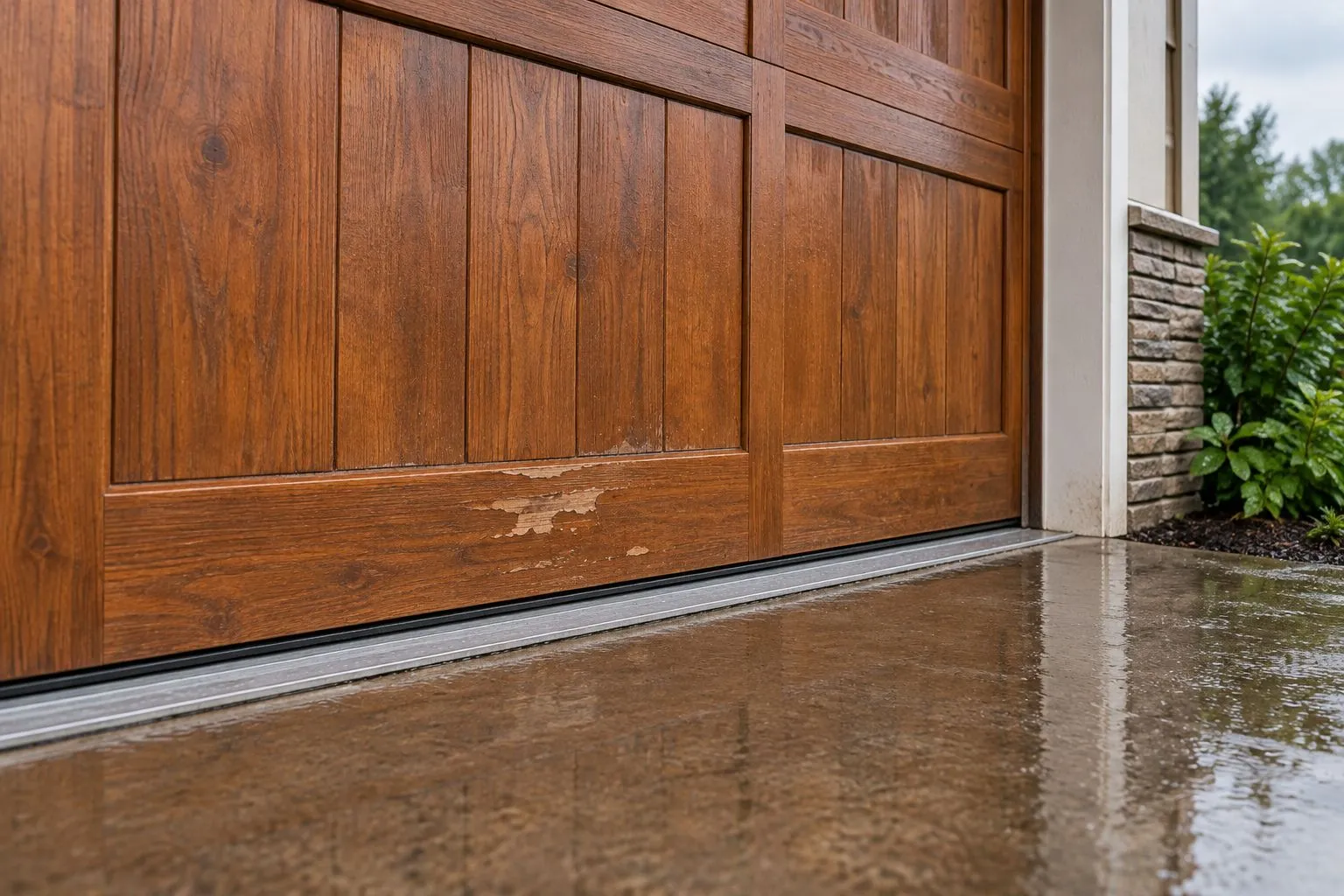
Illustrative photo, not a customer project: finish damage needs assessment before it is treated as cosmetic wear.
Do not increase opener force to push through binding. Springs, cables, tracks, brackets and door balance are professional-only work; a moisture-related concern does not make those components safe to adjust.
Can a wood garage door be refinished in humid weather?
Humid weather affects the drying conditions for exterior coatings, but the product instructions determine whether a particular application is suitable. Air conditions alone are not enough: the wood’s condition and moisture content also matter.
The concern with staining wood in high humidity is whether the surface and drying conditions meet the coating’s requirements—not simply whether rain is falling. For a garage door, follow the door manufacturer’s finish requirements as well as the coating label; do not transfer an unrelated exterior-wood process directly to moving sections.
Ask the refinisher how exposed edges, joints and other specified surfaces will be handled. Preparation must account for the existing finish and any deterioration beneath it. Applying a fresh coat over an unresolved moisture problem does not correct the underlying cause.
Keep finishing work separate from mechanical repairs. If sections must be removed or hardware disturbed, arrange the appropriate professional work rather than treating disassembly as ordinary paint preparation.
What should a professional check before installing a wood door?
A replacement decision must cover the complete door system. Do not assume the existing opener, springs or tracks are suitable just because the new door fits the opening. Weight, configuration and manufacturer requirements determine compatibility.
Use this sequence when discussing installation:
- Confirm construction. Identify the door’s materials, finish requirements and intended configuration.
- Inspect the opening. Check dimensions, mounting conditions, clearance and visible water-entry concerns.
- Match the hardware. Have the installer determine the appropriate springs, tracks and related components.
- Review the opener. Establish whether the existing unit and installation meet the new door’s requirements.
- Document upkeep. Obtain the applicable care instructions before committing to the door.
An opener is not a substitute for correct door balance. Repeated strain, hesitation or unusual movement deserves diagnosis, not a stronger operating setting.
Derby Strong Garage Doors is a fit for Kentucky homeowners seeking garage door repair or installation. When requesting an assessment, describe both the material question and any operating symptoms; use the scheduling page to arrange the next step.
Should you repair an existing wood garage door or replace it?
Repair is appropriate when the underlying door remains serviceable and the identified damage can be corrected. Worn finish alone does not establish that the entire door needs replacement. Conversely, refinishing does not restore deteriorated structural components.
Ask the technician to distinguish finish failure from panel damage, joint deterioration and lifting-system problems. Then ask what each proposed repair addresses. A clear diagnosis prevents a cosmetic solution from being presented as a mechanical repair—or a replacement from being presented as the only option without explanation.
Replacement becomes a separate decision when the door’s condition, repair feasibility or your maintenance preferences justify it. If you no longer want natural-wood upkeep, that preference belongs in the discussion even when repair remains possible.
Will a wood garage door solve a cold or damp garage?
Wood alone does not establish the thermal performance of a complete garage door. Compare the selected assembly’s documented insulation and air-leakage information, along with its seals and installation details.
A damp garage also needs a cause-based assessment. Water under the door, condensation and moisture passing through an unprotected wood surface are not interchangeable problems. Buying a different material without identifying the moisture source leaves the decision incomplete.
Frequently Asked Questions
Are wood garage doors worth it in Kentucky?
Wood garage doors are worth it when you specifically want real wood and accept its finish-care requirements. Compare the selected door’s construction, exposure and maintenance instructions before deciding.
Will a wood garage door swell in humid weather?
Wood changes dimensions as its moisture content changes, but binding does not prove humidity is the cause. Stop repeated operation and have a professional distinguish material movement from track, roller or balance problems.
Is a wood-look steel garage door better than real wood?
Wood-look steel is the better fit when you want a wood appearance without maintaining a natural-wood face. Real wood is the better fit when the material itself matters enough to justify its upkeep.
How often should I refinish a wood garage door?
Follow the door and coating manufacturers’ instructions rather than a universal refinishing schedule. Exposure, finish condition and the selected coating affect when attention is needed.
Can I keep my opener when installing a wood garage door?
Keep the existing opener only after its suitability for the selected door and installation has been confirmed. The door also needs correctly specified lifting hardware and professional balancing.
Does peeling finish mean I need a new garage door?
Peeling finish alone does not mean the door needs replacement. Have the underlying wood, joints and sections assessed before choosing refinishing, repair or replacement.
Can Derby Strong Garage Doors assess an existing wood garage door?
Derby Strong Garage Doors provides garage door repair and installation for Kentucky homeowners. Describe visible wood damage and operating symptoms when requesting an assessment so the discussion covers both condition and function.
One Last Thing Before You Decide
Judge a wood garage door by its least-protected surfaces, not just its best-looking panel. Ask how the selected door’s edges and joints must be finished and maintained. That question tells you more about ownership than choosing a stain color first.
Related Garage Door Guides
- Wood versus steel garage doors for Louisville homes
- Wood-look garage doors for Lexington homes
- Garage door maintenance checklist
Local service: Garage door repair in Louisville · Garage door repair in Lexington · Garage door repair in Northern Kentucky