Best overall: insulated wood-grain steel. Best for raised wood-like detail: composite-overlay steel. Best for a non-steel exterior skin: wood-grain fiberglass. For Lexington homeowners, the right wood-look garage door starts with the finish you like, then passes checks for construction, maintenance and fit—not the other way around.
TL;DR
- Wood look garage doors Lexington KY: insulated wood-grain steel is the default shortlist choice.
- Composite-overlay steel suits homeowners who want raised trim rather than a printed wood pattern alone.
- Compare physical finish samples, complete-door specifications and maintenance instructions before selecting a garage door.
- Derby Strong provides garage door installation in Lexington; confirm the proposed door’s fit before ordering.
Why this matters in Lexington
Wood-look describes an appearance, not a construction standard. Two doors with similar brown grain patterns can have different exterior materials, insulation, trim, care requirements and installation needs.
Derby Strong is a fit for Lexington homeowners who need wood-look garage door installation. If you already have a shortlist, schedule an assessment to establish what fits your opening before committing to a finish.
For a Lexington property governed by an association, check the actual rules before ordering. A wood-look surface does not automatically satisfy requirements for material, color, windows or panel design; the guide to HOA approval for a new garage door in Lexington explains that separate decision.
What makes the best wood-look garage door?
Use these criteria to narrow the field. A convincing sample matters, but it cannot compensate for an unsuitable door assembly.
- Finish realism: Inspect the grain, sheen, repeated pattern and panel edges on a physical sample.
- Construction: Identify the exterior skin, backing, insulation and any applied overlays separately.
- Care requirements: Read the manufacturer’s cleaning, coating and touch-up instructions for the exact finish.
- Garage fit: Confirm opening dimensions, headroom, side clearance, track arrangement and opener compatibility.
- Documented performance: Compare ratings for the same scope; a section insulation value is not a complete-door rating.
- Repair planning: Ask how damage to the selected finish or overlay is repaired and what a replacement section would involve.
Wood-look garage doors at a glance
These are construction categories, not manufacturer rankings. The distinctions help you choose what to request in a proposal; the exact model’s documentation controls the final decision.
| Ranked option | Best for | Standout feature | Key limitation |
|---|---|---|---|
| Insulated wood-grain steel | A practical starting point for an attached garage | Wood appearance on an insulated steel assembly | Steel can dent; damaged coatings need attention |
| Composite-overlay steel | Raised trim and carriage-style detail | Applied components create physical depth | Added trim introduces more edges and care details |
| Wood-grain fiberglass | Buyers seeking a non-steel exterior skin | Molded grain on a fiberglass exterior | The skin can crack; repair methods are product-specific |
| Wood-grain aluminum | A coordinated contemporary exterior | Wood appearance on aluminum construction | Dent resistance and thermal construction need scrutiny |
1. Wood-grain steel: best overall starting point
Insulated wood-grain steel combines a steel door assembly with a finish intended to resemble wood. Depending on the product, the appearance comes from surface texture, a decorative finish or both. Start here if you want the wood look without choosing a door that requires a real-wood refinishing routine.
For an attached Lexington garage, compare the insulation and backing as carefully as the exterior. A wood pattern tells you nothing about air leakage, perimeter seals or the installed door’s thermal performance.
Wood-grain steel pros:
- Gives you a wood appearance without a solid-wood exterior.
- Allows insulation and interior backing to be evaluated separately from style.
- Offers a clear baseline for comparing more decorative constructions.
Wood-grain steel cons:
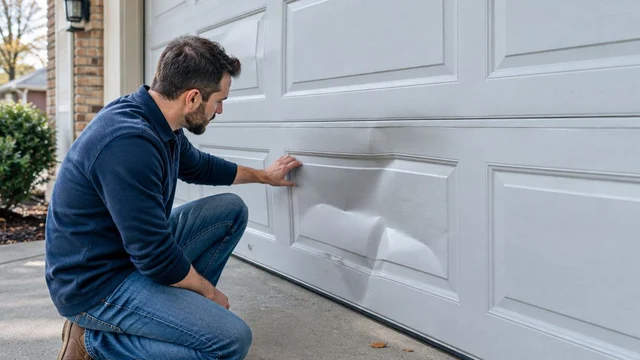
- Steel sections can dent after an impact.
- Scratches that expose steel require care under the manufacturer’s instructions.
- Repeated grain patterns and sheen can look different across a full-width door.
Best for: Homeowners seeking a practical default rather than the deepest decorative texture.
Ask to see the finish across an entire panel, not just a small color chip. Check whether raised details are stamped into the section or applied separately; those are different constructions even when photographs look similar.
Verdict: Buy if the finish sample, complete-door specifications and installation plan meet your needs.
2. Composite-overlay steel: best for raised wood-like detail
Composite-overlay doors use applied trim over a door base to create physical depth. The term composite does not identify one universal material, so request the exact overlay composition and maintenance instructions. Judge the underlying steel assembly and the decorative surface as separate parts.
This option deserves a closer look when flat printed grain leaves you unconvinced. Raised rails and stiles create shadows that a flat pattern cannot reproduce in the same way.
Composite-overlay steel pros:
- Creates dimensional detail rather than relying on grain alone.
- Supports a carriage-style appearance on an overhead sectional door.
- Lets you evaluate decorative trim separately from the base construction.
Composite-overlay steel cons:
- Overlay joints and edges add inspection and cleaning details.
- Repairing a damaged section involves matching both the base and trim.
- Added components affect door weight and require a correctly specified lifting system.
Best for: Homeowners who prioritize raised trim and a more dimensional exterior.
Do not assume decorative handles mean the door swings outward. Confirm how the proposed door operates, where the hardware sits and whether its projection affects clearance.
Verdict: Buy for physical depth; skip if a simpler panel already gives you the appearance you want.
3. Wood-grain fiberglass: best for a non-steel exterior skin
Wood-grain fiberglass doors use a fiberglass exterior to reproduce wood texture. The supporting frame, backing and insulation depend on the specific assembly. A fiberglass face does not mean every component in the door is fiberglass.
Consider this category when you specifically want to compare alternatives to a steel exterior. Do not treat the material name alone as proof of impact resistance, insulation or reduced maintenance.
Wood-grain fiberglass pros:
- Provides molded wood-like surface texture.
- The fiberglass skin itself does not rust.
- Gives you another material to compare against wood-grain steel.
Wood-grain fiberglass cons:
- Fiberglass can crack after an impact.
- Finish repairs and approved cleaning products depend on the manufacturer.
- The exterior material does not establish complete-door insulation performance.
Best for: Buyers who want a non-steel exterior and accept its specific repair requirements.
Ask how the manufacturer addresses damaged skins, finish changes and replacement sections. Keep the answers tied to the proposed model rather than accepting general claims about fiberglass.
Verdict: Hold until you have reviewed the exact construction and damage-repair instructions.
4. Wood-grain aluminum: best for contemporary coordination
Wood-grain aluminum pairs an aluminum exterior with a wood-effect finish. Consider it when clean panel lines and coordination with other exterior finishes matter more than traditional raised trim. The finish process and door assembly still need individual review.
Aluminum construction does not automatically mean the finished door is suitable for your existing opener. Glass, insulation, reinforcement and overall dimensions also affect the assembly.
Wood-grain aluminum pros:
- Provides a wood appearance without a real-wood exterior.
- Aluminum does not develop the red rust associated with steel.
- Supports a distinct material comparison when evaluating contemporary designs.
Wood-grain aluminum cons:
- Aluminum can dent, and construction affects resistance to damage.
- Finish touch-up requires product-specific guidance.
- Insulation and thermal breaks must be checked rather than assumed.
Best for: Homeowners deliberately selecting a contemporary door design.
Compare an actual sample beside your trim. A finish that works on a small accent can look too orange, too glossy or too patterned across a garage opening.
Verdict: Buy for a specific design match, not because aluminum alone promises better performance.
How to judge the wood finish before ordering
Bring at least 2 finish samples to the property rather than selecting from a phone screen. Compare them against the materials that will remain: brick, siding, trim and the entry door. Matching every brown surface exactly is not necessary; avoiding an unintended clash is.
Take 3 photographs of each sample: a close view of the grain, a view beside the trim and a wider view showing the garage opening. Photographs help you compare later, but the physical sample remains the better reference for color and sheen.
Check these details in daylight:
- Grain pattern: Does repetition become distracting across adjacent sections?
- Sheen: Does the surface look more reflective than you expected?
- Panel edges: Does the finish remain convincing around profiles and joints?
- Trim contrast: Do overlays and decorative hardware compete with the house?
A small sample cannot show the full pattern repeat. Request a full-door rendering as a layout aid, while recognizing that a rendering is not a reliable color standard.
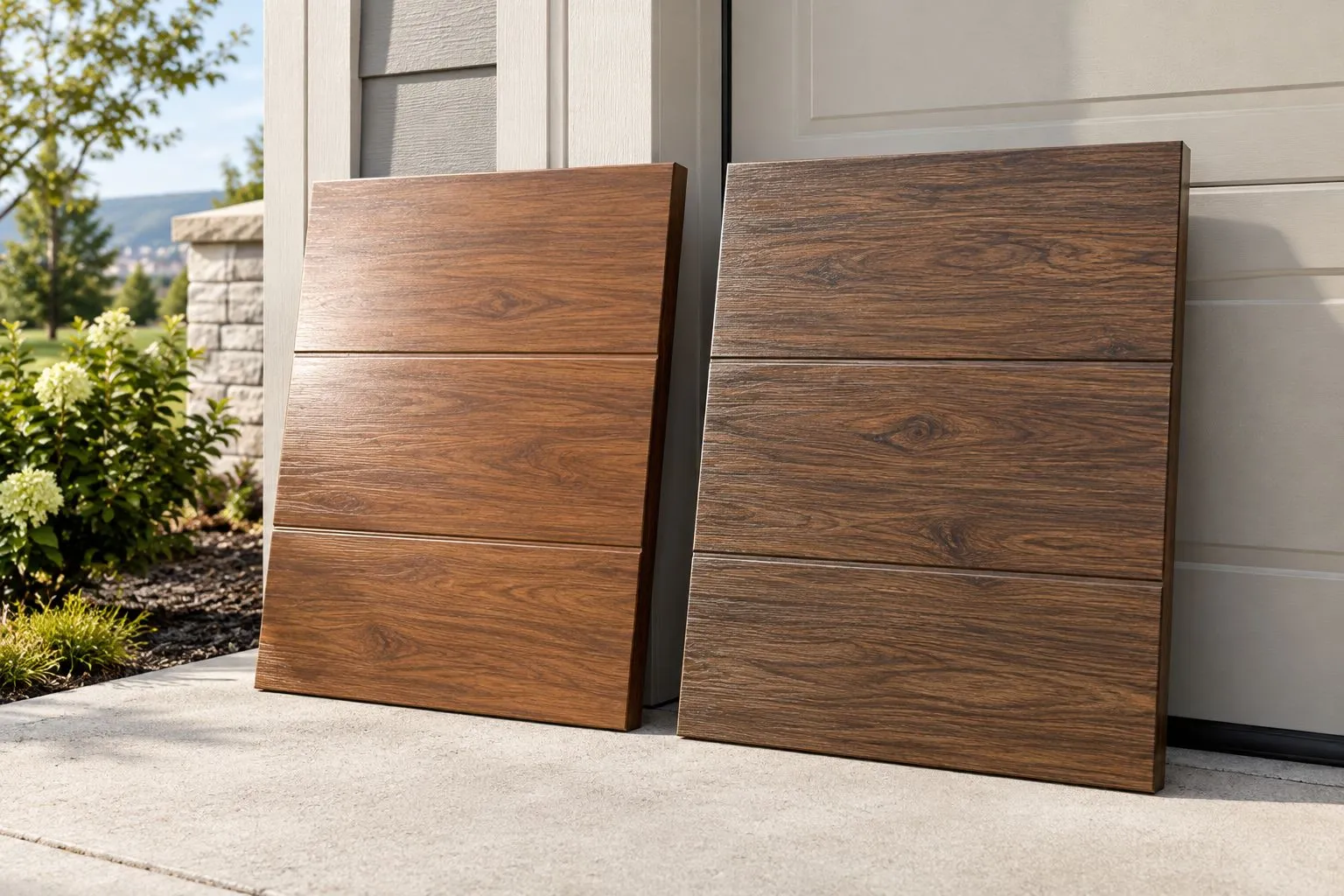
Illustrative photo: compare physical finish samples beside the exterior materials that will remain.
Separate appearance from installation requirements
A replacement door is a moving assembly, not a decorative panel hung over the old opening. Track, springs, cables, brackets and the opener must suit the selected door. Reusing existing components requires professional evaluation, not an assumption that similar dimensions make them compatible.
Ask Derby Strong to distinguish cosmetic choices from installation requirements in the proposal. Window placement and wood tone are design decisions; correct balance, clearance and compatible hardware are operating requirements.
Before accepting a proposal, confirm:
- The exact door model, construction and finish designation.
- Whether windows, overlays and decorative hardware are included.
- Which tracks, springs, seals and other components are being replaced.
- Whether the existing opener is suitable for the proposed assembly.
- What removal, disposal and opening preparation include.
- Which manufacturer care instructions apply to the selected finish.
Keep springs, cables, tracks and bottom brackets professional-only. Do not add homemade wood cladding to an existing door or adjust spring tension to compensate for added weight. If the current door is crooked, has a loose cable or struggles to move, stop operating it until it is assessed.
Compare proposals without forcing replacement
Request 2 written proposals with the same scope if you want a useful comparison. A basic steel assembly and an insulated overlay assembly are not equivalent simply because both show a similar brown finish.
Separate the reason for the project from the desired appearance. If your current door has an operating fault, a wood-look replacement is not automatically the necessary repair. Ask what is wrong, whether the existing assembly is repairable and what replacement changes beyond its appearance.
For a new door, keep the selection record with your home documents. Save the finish designation, model information, care instructions and any written approvals. Those details are more useful for future service than a photograph labeled only brown garage door.
How these options are ranked
The ranking favors an insulated steel starting point, then separates alternatives by a distinct reason to choose them: raised detail, a non-steel skin or contemporary coordination. It is not a claim that every steel door outperforms every fiberglass or aluminum door.
Finish realism, documented construction, care requirements and installation fit decide the final choice. A category earns a place on your shortlist; the exact door earns your approval.
Which wood-look garage door should you choose?
Choose insulated wood-grain steel unless another construction solves a specific design or material preference. Choose composite-overlay steel when physical trim depth matters, fiberglass when you deliberately want that exterior material, and aluminum when its design fits the project.
For a Lexington installation, Derby Strong can address the door replacement itself. Bring finish samples and a clear list of priorities so the discussion stays focused on appearance, fit and operating requirements.
Frequently Asked Questions
What is the best wood-look garage door for a Lexington home?
Insulated wood-grain steel is the default starting point for a Lexington home. Compare the exact finish, insulation, maintenance instructions and installation requirements before choosing a model.
Do wood-look garage doors contain real wood?
Not necessarily; wood-look describes appearance rather than material. Steel, fiberglass, aluminum and composite-overlay constructions can all create a wood-like exterior.
Is composite-overlay steel better than printed wood-grain steel?
Composite-overlay steel is better for raised physical detail, not automatically for every performance measure. Compare the base construction and care requirements separately from the decorative trim.
Are wood-look garage doors maintenance-free?
No; wood-look garage doors still require care. Follow the exact manufacturer’s cleaning and finish instructions, and arrange professional attention for damaged operating components.
Can I keep my opener when installing a wood-look garage door?
Keep the opener only after a professional confirms compatibility with the new door assembly. Similar opening dimensions do not establish that the opener, tracks or lifting components are suitable.
Does a Lexington HOA have to approve a wood-look garage door?
Approval depends on the rules governing your specific property. Confirm requirements for material, finish, windows and panel design before placing an order.
How should I compare quotes for wood-look garage doors?
Compare written proposals with matching construction and installation scope. Identify the exact model, finish, insulation, included hardware, opener work and removal requirements before judging the difference.
One Last Thing Before You Decide
Ask what happens if one visible section is damaged later. A convincing wood-look finish is only part of the decision; understanding section identification, finish matching and the repair process helps you choose with fewer unanswered questions.
Related Garage Door Guides
- How much does garage door installation cost in Lexington?
- Best garage door styles for Lexington homes
- How do you measure a garage door opening in Lexington?
Local service: Garage door repair in Lexington